

Switchgear, Transformer, and Generator Lead Times in 2026
The real numbers for data center, BESS, and industrial construction, and how to protect your schedule when the equipment, not the building, sets the critical path.
Short answer: In 2026, medium-voltage switchgear runs 52 to 80 weeks, pad-mount transformers 40 to 65 weeks, substation transformers 75 to 110 weeks, 1.5 to 3 MW diesel generators 50 to 78 weeks, and 500 to 1,500 kVA UPS systems 30 to 48 weeks. If you are building a data center, BESS facility, or any industrial project, your schedule is set by electrical equipment, not by construction.
The pandemic-era supply chain breakdown that hit electrical equipment in 2020 to 2022 has not normalized. In 2026, lead times on medium-voltage switchgear, substation-class transformers, large generators, UPS systems, and automatic transfer switches remain 2 to 4 times pre-pandemic norms, and in some categories they are still getting worse. The reasons are structural: data center load growth, BESS deployment, grid modernization, electrification, and reshoring have created demand the existing manufacturing base cannot fill on traditional timelines.
For developers, EPCs, owners, and GCs, the impact is brutal. A schedule that assumes a 24-week switchgear delivery now needs to assume 72. A generator order that used to ship in 20 weeks now takes 60. Pad-mount transformers that arrived in 8 weeks now take 50. Projects that miss this end up with $50M+ of finished building shells waiting for energization.
This report is written by Terrapin Construction Group, a nationwide commercial general contractor that procures and coordinates this equipment across data center, BESS, food processing, and industrial projects in all 50 states. For a cost estimate built on realistic lead-time assumptions, run the TCG.ai estimator.
Need gear in the factory queue first? TCG reserves switchgear, transformer, and generator slots during preconstruction, before final CDs.
Start Procurement PlanningCritical Equipment Lead Times at a Glance
Every range below comes from active 2026 manufacturer slot reservations and TCG project procurement data. Filter by category; bars show the low to high range in weeks from order.
Specific lead times vary by manufacturer, voltage class, and quantity. Arrows mark ranges with an open upper end (for example 100 to 150+ weeks).
Your schedule should not assume these numbers. We lock factory queue positions before the schedule depends on them. Owners have seen 8 to 16 weeks come off the apparent lead time.
Talk to ProcurementWhen Do You Need to Order? The Order-By Calculator
Pick the equipment and your target energization date. The calculator works backward from the top of the 2026 range, plus submittal and install time, to the latest date the purchase order can be released. Adjust the planning assumptions to fit your project.
Enter a target energization date to see your order-by date.
Planning estimate only. Uses the top of each 2026 range; actual dates depend on manufacturer, configuration, quantity, and submittal turnaround. Slot reservations during preconstruction can compress the apparent lead time by 8 to 16 weeks.
Why Electrical Equipment Is the Schedule Bottleneck in 2026
Four structural forces are keeping lead times elevated, with no near-term relief.
Data center load growth has overwhelmed capacity
US data center electricity demand grew over 18% in 2025. Hyperscalers (AWS, Google, Microsoft, Meta, Oracle) are deploying load at unprecedented scale, and each new MW needs switchgear, transformers, generators, and UPS. ABB, Schneider, Vertiv, and Eaton have added capacity, but not fast enough to catch up.
Grid modernization is consuming the same supply
Utilities are rebuilding aging transmission and distribution infrastructure at the same time. AEP, Duke, Dominion, Xcel, PG&E, Southern Company, and many regional utilities compete with hyperscalers for the same transformer and switchgear capacity, and utility backlog has worsened the commercial backlog.
Electrification across sectors
EV charging, building electrification, industrial electrification, and BESS deployment all draw on the same electrical supply chain. The result is a permanent step-change in demand that the manufacturing base is rebuilding to meet but cannot meet immediately.
Specialty steel, copper, and bushing supply
Grain-oriented electrical steel (GOES) for transformer cores, copper conductor, and high-voltage bushings are still constrained. Transformer manufacturers are limited by core material allocation as much as by labor.
For broader material lead-time context across construction, see Commercial Construction Material Lead Times 2026.
2026 Lead Time Reality by Equipment Type
Medium-voltage switchgear
| Configuration | 2026 Lead Time | Notes |
|---|---|---|
| 5 kV / 15 kV metal-enclosed switchgear | 52–72 weeks | Most common; multiple manufacturers |
| 15 kV / 27 kV metal-clad switchgear | 60–80 weeks | Higher fault rating; fewer manufacturers |
| 38 kV switchgear | 78–104 weeks | Specialty; limited US-domestic supply |
| Pad-mount loop switches | 32–50 weeks | Less constrained; multiple suppliers |
The dominant manufacturers are ABB, Eaton, Siemens, Schneider, and Powell. Powell has become an increasingly important option for hyperscale and data center customers as the big four manufacturers' lead times stretched.
Transformers
| Type / Size | 2026 Lead Time | Notes |
|---|---|---|
| Dry-type 0–2 MVA (480 V to 208 V) | 20–32 weeks | Indoor installation typical |
| Pad-mount 0–5 MVA (15 kV / 12.5 kV to 480 V) | 40–65 weeks | Most common distribution transformer |
| Substation 5–25 MVA | 65–95 weeks | Outdoor; lead times stretched dramatically since 2021 |
| Substation 25–50 MVA | 85–110 weeks | Domestic US manufacturers fully booked through 2027 |
| Generator step-up (GSU) 50–150 MVA | 100–150+ weeks | Specialty; very limited supply |
Major transformer manufacturers serving US markets include GE, Hitachi Energy, Hyundai, Mitsubishi, WEG, ABB, and SPX Transformer Solutions. Domestic GOES supply remains the underlying constraint.
Generators
| Size / Type | 2026 Lead Time | Notes |
|---|---|---|
| Diesel 500–1,000 kW | 32–48 weeks | Standard data center / commercial size |
| Diesel 1,500–2,000 kW | 50–66 weeks | Hyperscale standard tier |
| Diesel 2,500–3,500 kW | 62–82 weeks | Large hyperscale / industrial |
| Diesel 3,500–4,500 kW | 90–110 weeks | Very large; limited supply |
| Natural gas 1,000–3,000 kW | 54–78 weeks | Behind-the-meter, BESS pairing |
The dominant generator manufacturers are Caterpillar, Cummins, MTU, Kohler, and Generac, all with similar constrained delivery windows in 2026. Caterpillar and MTU often have the shortest lead times for larger hyperscale tier units; Cummins and Kohler tend to be competitive at the 1,000 to 2,000 kW range.
UPS systems and ATS
| Equipment | 2026 Lead Time | Notes |
|---|---|---|
| Static UPS 100–500 kVA | 20–32 weeks | Commercial standard |
| Static UPS 500–1,500 kVA | 30–48 weeks | Mid-tier data center |
| Modular UPS 2,000+ kVA | 40–60 weeks | Hyperscale |
| Diesel rotary UPS (DRUPS) | 60–80+ weeks | Specialty hyperscale |
| Automatic transfer switches (ATS) | 24–40 weeks | By size and configuration |
How Equipment Lead Times Affect Different Project Types
| Project Type | Order Timing | Critical Equipment Path |
|---|---|---|
| Hyperscale data center (50–200 MW) | At land close | MV switchgear, GSU transformers, generators, UPS. Equipment dictates the entire schedule. |
| Tier III colocation (10–50 MW) | Preconstruction | MV switchgear, distribution transformers, generators, UPS. 15 to 22 month schedule typical; equipment is the critical path. |
| BESS facility (50–500 MWh) | Preconstruction | MV switchgear, transformers, PCS. Often longer than civil construction. |
| Food processing / large cold storage | After groundbreaking | Distribution transformers, backup generators. Can typically be ordered after groundbreaking. |
| Standard commercial (under 5 MW) | At permit submission | Pad-mount transformers, ATS. |
For project-specific context, see IMP Installation for Data Centers 2026, commercial construction in Columbus, Ohio, BESS Facility Construction Cost 2026, and the cost to build a data center.
Six Strategies That Actually Protect Schedule
Order at land close, not construction start
For hyperscale data centers and BESS, switchgear and transformer orders should precede groundbreaking by 6 to 12 months.
Reserve slots with partial payment
Most manufacturers hold a production slot for 10 to 30% of equipment cost. Without a reservation, the nominal lead time can stretch another 8 to 16 weeks once you finalize.
Specify by configuration, not manufacturer
Lock voltage class, fault rating, and footprint early, then bid across manufacturers on who has the earliest delivery slot, not just the lowest price.
Build redundancy into procurement
Single-sourcing is risky in 2026. Even on Caterpillar-spec'd generators, identify acceptable Cummins or MTU alternates you can substitute if delivery slips.
Engage the utility early
Interconnect studies often dictate transformer size and voltage class. Engaging the utility in schematic design, not construction documents, avoids a transformer respec after order.
Use design-build for fast-track projects
Design-bid-build adds 12+ weeks to equipment ordering because final specs wait for 100% CDs. Design-build delivery ties equipment selection to schematic design.
Better Pricing and an Earlier Place in the Factory Queue
TCG is a nationwide design-build commercial general contractor. Through our Equipment Procurement service we buy direct from manufacturers and authorized distributors, with no stacked subcontractor markup on equipment, and we lock factory queue positions before the schedule depends on them.
Results from recent TCG data center and cannabis procurement packages, as published on our Equipment Procurement page. Actual savings depend on specification, quantity, tariff status, and release timing.
1. Slot reservations during preconstruction
We reserve switchgear, transformer, and generator slots on preliminary specifications, often in schematic design, before final CDs are issued.
2. Multi-manufacturer alternates baked in
Every major equipment spec carries two acceptable alternates from competing manufacturers. If one supplier slips, we activate the alternate without redesigning. More in Equipment Procurement for Commercial Construction.
3. AI-powered scheduling and ordering
The TCG.ai estimator carries equipment lead-time intelligence, so your preconstruction estimate never assumes 2019 lead times nobody can deliver.
4. Direct manufacturer relationships
Switchgear (ABB, Eaton, Schneider, Siemens, Powell), transformers (Hitachi Energy, Hyundai, WEG, GE), and generators (Caterpillar, Cummins, MTU, Kohler): real-time lead-time visibility, slot reservations, and priority allocation during constrained periods.
If your GC or EPC tells you 2026 switchgear lead times are "24 to 36 weeks" or generator lead times are "20 to 30 weeks," they are quoting pre-pandemic norms, not current reality. Verify with the manufacturer before underwriting a schedule. Schedules built on stale lead-time assumptions are the single biggest cause of data center and BESS project delays in 2026.
300,000 SF Data Center Support Campus, North of Dallas
TCG erected and insulated three 100,000 SF pre-engineered metal buildings for the staging and storage campus of a new data center north of Dallas, Texas. Building 1 went from start of steel erection to sign-off in 41 days, and the full campus finished 30 days ahead of schedule.
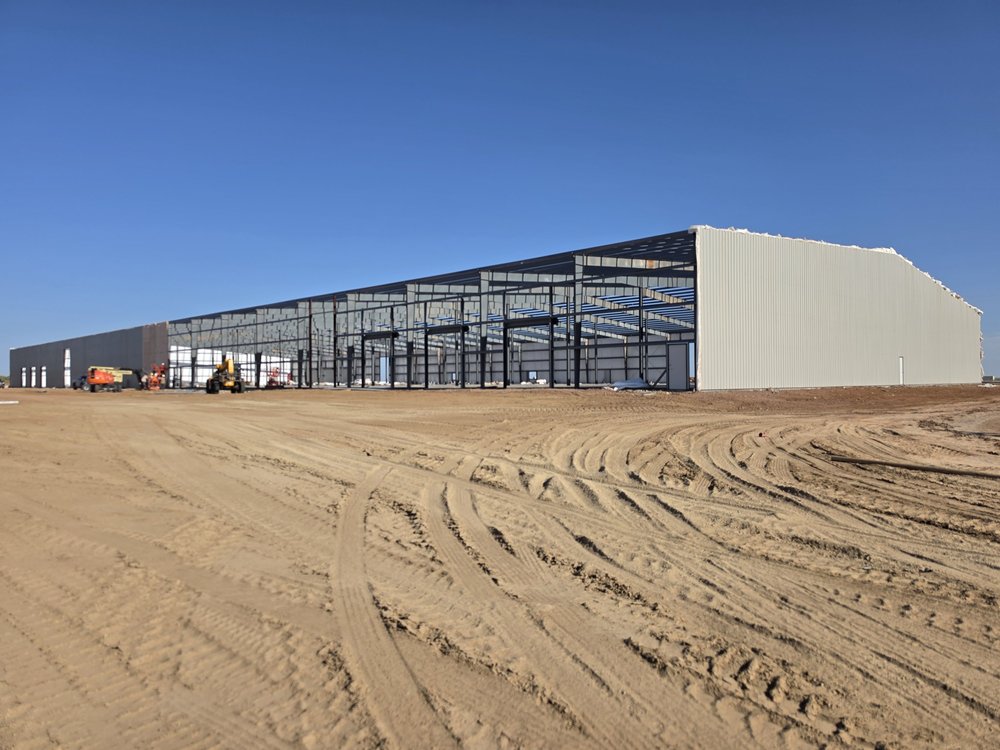
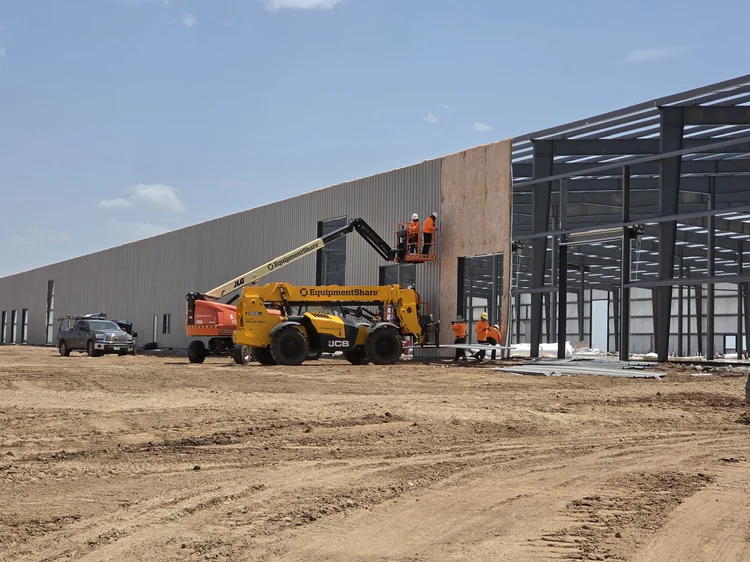
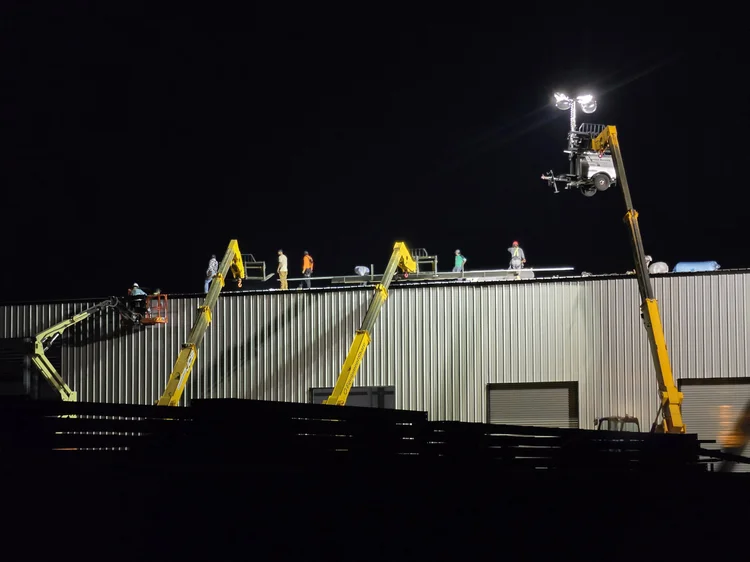

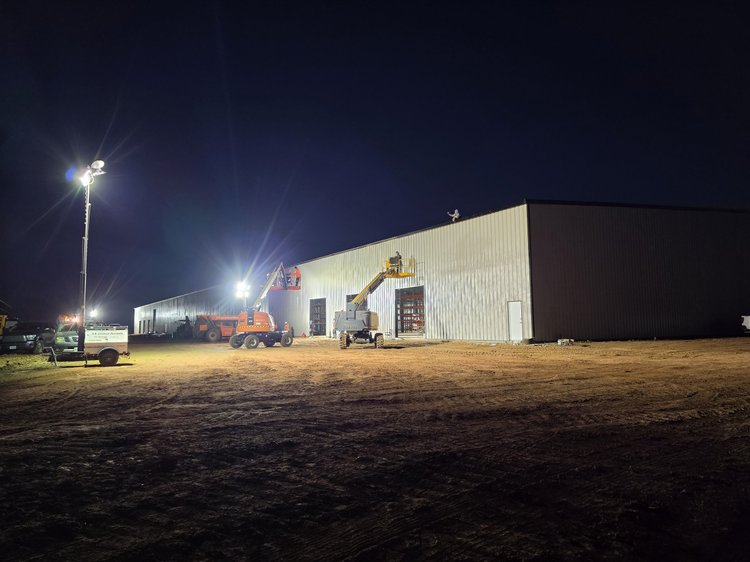
On a data center campus the support buildings come first: staging, equipment storage, and laydown have to be dried in before long-lead electrical and mechanical gear arrives for the data hall. Crews ran early morning and night shifts under light towers, with roof panels, wall cladding, and insulation moving in parallel instead of in sequence.
Why it matters for equipment lead times: the staging and storage buildings have to be dried in before 52-plus-week switchgear, transformers, and generators arrive, or that equipment ends up waiting in an open laydown yard. Finishing support buildings early means covered, secure space is ready when the gear ships. See TCG's equipment procurement and data center construction services.
- Scope: PEMB steel erection, roof and wall panels, and insulation
- Use: staging and equipment storage for a new data center campus
- Schedule: parallel crews on extended shifts
- Result: 300,000 SF delivered 30 days early
 0:50
Watch: 41 days from steel to sign-off. Full photo gallery on the project spotlight.
Frequently Asked Questions
What is the lead time on medium-voltage switchgear in 2026?
Standard medium-voltage switchgear lead times in 2026 run 52 to 80 weeks depending on manufacturer, voltage class, and configuration. Customized or 38 kV / 69 kV applications can stretch to 96 to 120 weeks. This is roughly 2.5x pre-pandemic lead times and has not meaningfully improved since 2023.
How long does it take to get a generator for a 2026 data center project?
Diesel generators in the 1,500 to 3,000 kW range are running 50 to 78 weeks from order to delivery in 2026. Larger units (3,000 to 4,000+ kW) can stretch to 90 to 110 weeks. Caterpillar, Cummins, MTU, and Kohler are the dominant suppliers, all with similar constrained delivery windows.
What about transformer lead times?
Pad-mount distribution transformers (up to 5 MVA): 40 to 65 weeks. Substation-class transformers (5 to 50 MVA): 75 to 110 weeks. Large generator step-up (GSU) or auto-transformers above 50 MVA: 100 to 150+ weeks. Transformer steel and bushing supply chains remain constrained well into 2026.
What is the lead time on UPS systems?
Static UPS systems in the 500 to 1,500 kVA range: 30 to 48 weeks. Larger 2,000+ kVA modular UPS: 40 to 60 weeks. Rotary UPS and diesel rotary UPS (DRUPS): 60 to 80+ weeks. ABB, Schneider, Vertiv, and Eaton dominate; smaller specialty manufacturers can sometimes shorten by 6 to 10 weeks.
Are lead times getting better or worse in 2026?
Mixed. UPS lead times have improved modestly from 2024 peaks. Switchgear is roughly flat. Substation transformers remain at peak elevated lead times because of GOES (grain-oriented electrical steel) supply constraints. We do not expect meaningful normalization before 2028.
How does TCG protect schedule given these lead times?
We order critical MEP equipment during preconstruction, not at construction start, sometimes 12 to 18 months before site mobilization. Through our Equipment Procurement program, we coordinate manufacturer slot reservations, partial-payment escrows, and substitute equipment plans so projects don't sit idle waiting for switchgear.
Order Equipment First.
If you have a data center, BESS, or industrial project in the pipeline for 2026 or 2027, the procurement clock is already running. We can model your equipment lead-time critical path in 48 hours and tell you exactly when each major item needs to be ordered. Licensed in all 50 states.
