

FM Ratings for Insulated Metal Panels: What They Mean and Why They Matter
What changed with FM ratings this month
Three forces shifted the FM-rated IMP landscape in May 2026: insurance market hardening continued, FM Approvals issued updated joint detailing guidance, and polyiso panel supply normalized making FM 4880 panels more accessible.
The cold storage insurance market kept hardening in 2026. Per the latest Insurance Information Institute commercial property data, premium rates on insured cold storage and food processing facilities rose 12 to 18 percent year-over-year, with carriers tightening FM-rated panel requirements as a condition of placement. Smaller facilities that previously could obtain coverage with non-FM-rated polyurethane are now being pushed to FM 4880 panels even at the 15,000 to 25,000 SF range. FM Global underwriting guidance remains the dominant standard.
FM Approvals issued updated guidance in Q1 2026 on joint detailing requirements that affect existing FM 4880 listings. The update tightens the field-installation standards for joint sealant, fastener spacing, and panel-to-panel transitions. The intent is to close the gap between the laboratory-tested assembly and the as-built field assembly. Practical impact for owners: expert IMP joint detailing matters more than ever, and self-installation by general labor crews is increasingly disqualifying for FM rating compliance.
The third change is supply: polyiso panel availability normalized after the 2024-25 shortage. Lead times on FM 4880-rated polyiso panels from Kingspan, Metl-Span, AWIP, and PermaTherm are back to 8 to 14 weeks, with Arch Solar leading the category at 8 weeks for standard SKUs. This makes FM 4880 panels accessible on fast-track projects that previously had to substitute. 2026 IMP market trends documents the supply normalization.
The bottom line for May 2026: if you are building cold storage, food processing, cannabis cultivation, pharmaceutical, or data center, FM 4880-rated panels are no longer optional - they are the insurance market default. The 8 to 18 percent panel premium is the cheapest insurance buy in your budget.
The four FM standards that matter for IMP panels
FM Approvals tests insulated metal panel assemblies under four primary fire safety standards. Each standard targets a specific application and failure mode. Most commercial buildings need a combination, not just one.
FM 4880
The most common FM rating requirement for IMP panels. Tests interior wall and ceiling panels for flame spread, smoke development, and structural integrity under fire conditions. Required for cold storage, food processing, cannabis, and pharmaceutical interior assemblies. Polyiso and mineral wool cores qualify; standard polyurethane does not.
FM 4881
Tests exterior wall systems for fire propagation up the building envelope. Required for tall buildings, multi-story commercial, and exterior IMP assemblies on insured industrial. Less commonly required than FM 4880 but increasingly specified on multi-story cold storage and pharmaceutical facilities.
FM 4882
Specifically for interior partition panels separating temperature zones in cold storage and food processing. Tests fire propagation across temperature transitions and partition penetrations. Required on most insured cold storage facilities with multiple temperature zones (cooler, freezer, blast freeze).
FM 4471
Tests IMP roof panel assemblies for fire and wind resistance. Required for cold storage, food processing, and high-R roof envelope continuity on insured industrial. Often combined with FM 4880 wall panels for a fully FM-rated cold storage envelope.
UL 723 / ASTM E84
The Steiner tunnel test for surface burning characteristics (flame spread index and smoke development index). Required by IBC for all interior finish materials. FM 4880 incorporates and exceeds UL 723 / ASTM E84 testing. Most commercial AHJs accept FM 4880 listings as evidence of UL 723 compliance.
NFPA 285
Standard fire propagation test for multi-story exterior wall assemblies. Required by IBC for combustible exterior walls on Type I-IV buildings above three stories. Some FM 4881 listings include NFPA 285 compliance; verify on the specific panel system before specifying for multi-story.
FM 4474
Tests roof assembly resistance to wind uplift. Often paired with FM 4471 for full roof assembly compliance. Wind ratings (1-60 to 1-180+) reflect tested uplift pressure. Required for roof panel assemblies in hurricane and high-wind regions.
FM 4882-A
Specialty rating for ammonia-refrigerated cold storage. Tests panel compatibility with ammonia leak conditions and IIAR-compliant assemblies. Required for ammonia-based cold storage per IIAR Standard 2 and most cold-chain insurance carriers.
Why FM ratings drive the insurance economics
FM ratings exist because non-rated polyurethane IMP panels caused a series of catastrophic insurance losses in cold storage and food processing facilities. The ratings transfer the fire propagation risk from the insurer to the panel manufacturer through controlled laboratory testing. The insurance market rewards FM-rated assemblies with lower premiums and tighter coverage.
The historical context: Through the 1990s and 2000s, several major cold storage and food processing fires demonstrated that standard polyurethane IMP panels can sustain rapid fire propagation under typical industrial conditions. Notable incidents in poultry processing, frozen food storage, and cold chain logistics resulted in eight-figure property losses and prompted FM Global to develop and tighten the FM 4880 standard. FM Global research data documents the loss history.
The economic mechanism: Property insurance premiums on cold storage, food processing, and cannabis facilities are driven by total replacement cost, occupancy hazard class, fire suppression discount, and panel rating. Insurance Information Institute data shows that FM 4880-rated panels typically reduce annual property premium by 10 to 30 percent versus non-rated polyurethane on equivalent buildings. On a $50M cold storage facility carrying $750,000 in annual property premium, that is $75,000 to $225,000 per year of premium reduction.
The break-even math: FM 4880 polyiso panels typically cost $1.50 to $3.50 per square foot more than non-rated polyurethane on equivalent thickness. On a 150,000 SF cold storage facility, that is $225,000 to $525,000 in panel premium. At $75,000 to $225,000 per year of insurance premium reduction, the panel premium pays back in 1.5 to 3 years on a building with a 25 to 40 year design life. Per the industrial CRE envelope efficiency analysis, FM-rated panels are one of the cheapest NOI improvements available on cold-chain industrial real estate.
The placement reality: In hardening commercial property markets, many carriers are not just discounting for FM 4880 - they are requiring it as a condition of placement. Brokers placing cold storage, food processing, cannabis cultivation, and pharmaceutical risk in 2026 routinely report that non-FM-rated assemblies cannot find competitive coverage in the standard market. Surety bonding capacity on these projects is also tightening for non-FM-rated work.
The TCG underwriting rule
For any insured cold storage, food processing, cannabis cultivation, pharmaceutical, or data center facility above 15,000 SF, specify FM 4880 panels at minimum. The 8 to 18 percent panel premium is recovered in 18 to 36 months through insurance premium reduction, and the FM rating is increasingly required for placement, not just discount. Below 15,000 SF or self-insured, run the cost-benefit case-by-case with the insurance broker before pricing.
Which IMP cores qualify for FM 4880
Three core chemistries dominate the IMP market: polyisocyanurate (polyiso), polyurethane (PU), and mineral wool. Only polyiso and mineral wool consistently achieve FM 4880. Standard polyurethane does not. Some manufacturers offer fire-retardant polyurethane variants - verify each panel and core combination on the FM Approval Guide.
Polyisocyanurate (polyiso). The dominant FM 4880 core chemistry in 2026. Closed-cell structure with R-7 to R-8 per inch, low smoke development, and inherent fire resistance from the isocyanurate chemistry. Polyiso vs other cores covers the full comparison. The dominant choice for cold storage, food processing, cannabis, and pharmaceutical FM 4880 applications.
Mineral wool. Non-combustible core (rock-wool or slag-wool fibers). Naturally FM 4880 compliant without additives. Lower R-per-inch (R-4) than polyiso means thicker panels for equivalent thermal performance, but offers the highest fire rating and best non-combustible compliance. Specify mineral wool when local code requires Type I non-combustible exterior insulation or when fire separations exceed FM 4880 stringency.
Polyurethane (PU). Standard polyurethane does not achieve FM 4880. Fire-retardant polyurethane formulations from some manufacturers do achieve FM 4880, but the listing depends on the specific manufacturer, panel construction, and core thickness. Always verify the specific SKU on the current FM Approval Guide. Generic "FR polyurethane" claims without a specific FM listing are not FM 4880 compliant.
EPS (expanded polystyrene). Does not achieve FM 4880. EPS is sometimes specified for cost reasons in non-insured or self-insured low-temperature applications, but is not appropriate for any insured cold storage, food processing, cannabis, or pharmaceutical facility. Avoid EPS for any building requiring property insurance placement.
Which manufacturers carry FM 4880 listings
All nine major IMP manufacturers TCG works with offer FM 4880-rated panels. Match the manufacturer to the application and the FM rating combination required. Full manufacturer comparison.
Kingspan
QuadCore polyiso. Strongest FM-rated portfolio in the cold chain category. Industry leader in FM 4880 cold storage and pharmaceutical applications.
Metl-Span
ThermalSafe polyiso. Industry standard for cold storage FM-rated assemblies. Broad finish library and national distribution.
CENTRIA
Versapanel and Versapanel HP. Architectural FM 4880 capability for visible exterior on multi-story commercial.
AWIP
All Weather Insulated Panels. Specialty cold storage and food processing focus. Strong FM 4880 capability across thickness range.
PermaTherm
Long-standing TCG partner. Polyiso FM 4880 panels for cold storage and food processing.
FALK
Specialty freezer and blast-freeze applications. Ammonia-compatible FM 4882-A assemblies for IIAR-compliant cold storage.
UPI Panels
Strong PEMB integration. FM 4880 capability for industrial and light commercial applications integrated with PEMB structures.
MBCI
Industrial focus. FM 4880 wall and FM 4471 roof panel capability. Strong PEMB integration. National manufacturing footprint.
Arch Solar
High-performance polyiso. Best lead time in the FM 4880 category at 8 weeks for standard SKUs. Strong fit for fast-track cold storage, food processing, and cannabis.
The full FM Approval Guide lists every approved panel system, core, thickness, and skin gauge combination by manufacturer. Always cross-check the specific panel SKU against the current FM Approval Guide listing - manufacturer marketing claims and the actual FM listing sometimes diverge by panel thickness or core variant.
Get FM-rated IMP install pricing in under 5 minutes
Run the IMP Install Estimator for FM 4880 panel pricing from the installer who has done over 1 million SF across 38 states. Direct manufacturer relationships with all nine FM-listed IMP manufacturers.
What FM-rated panels actually cost
FM 4880 polyiso panels typically cost 8 to 18 percent more per square foot than equivalent non-rated polyurethane panels. The premium varies by manufacturer, core thickness, and skin gauge. Insurance premium reduction recovers the cost in 18 to 36 months on most insured commercial projects.
Per the 2026 IMP installation cost guide, FM 4880 polyiso panel material in 2026 runs:
Standard wall thickness 2 to 3 inch: $11 to $17 per SF for FM 4880 polyiso; $9 to $14 for non-rated polyurethane. Premium: roughly $2 per SF or 15 to 22 percent.
Cold storage thickness 4 to 5 inch: $17 to $24 per SF for FM 4880 polyiso; $15 to $21 for non-rated polyurethane. Premium: roughly $2 to $3 per SF or 12 to 16 percent.
Freezer and blast freeze 6 to 8 inch: $24 to $32 per SF for FM 4880 polyiso; $22 to $29 for non-rated polyurethane. Premium: roughly $2 to $3 per SF or 8 to 11 percent.
Mineral wool (any thickness): 5 to 15 percent premium over polyiso of same thickness. Specify when local code or owner preference requires non-combustible core.
FM 4882-A ammonia-compatible: 5 to 12 percent premium over standard FM 4880 for IIAR-compliant ammonia cold storage assemblies.
Add labor at $5 to $9 per SF installed and the total FM 4880-rated installed cost runs $16 to $33 per SF depending on application. IMP installation labor per SF covers the labor breakdown.
Value engineering rule: Do not value-engineer the FM rating itself. The 8 to 18 percent premium is captured in insurance premium reduction within 18 to 36 months. Value-engineer instead on panel thickness optimization (right-size R-value to actual temperature zone), skin gauge (24 vs 22 ga where structural loading allows), and panel finish (PVDF vs SMP coating). Value engineering methodology covers the broader VE framework.
The five planning mistakes that break FM compliance
1. Specifying based on manufacturer claims, not the FM Approval Guide. Manufacturer marketing claims sometimes diverge from the specific FM Approval Guide listing by panel thickness, core variant, or skin gauge combination. Always cross-check the specific SKU against the current FM Approval Guide before pricing or specifying. The Approval Guide is the only authoritative source.
2. Mixing FM-rated and non-FM-rated panels in the same envelope. A single non-FM-rated panel anywhere in an FM-required envelope voids the FM compliance for the entire assembly. This happens most often when a small section gets value-engineered to non-rated polyurethane to save cost or when a damaged panel gets replaced with a non-rated equivalent during construction. Insurer audits at substantial completion will catch this.
3. Skipping joint detail review at FM-rated joints. The 2026 FM Approvals updated joint detailing guidance tightened the field-installation standards. Joint sealant chemistry, fastener spacing, and panel-to-panel transition details must match the FM-listed assembly drawings. Generic field installation by general labor crews is increasingly disqualifying. Specify expert IMP installation from a crew with documented FM 4880 experience.
4. Not documenting FM rating chain of custody for insurance audit. Insurers verify FM compliance at substantial completion through documentation: FM Approval certificates, mill test reports, shipping documentation, and field photos. Missing or incomplete documentation can void the insurance discount even when the panels are correctly installed. Build the FM compliance documentation package into the GC submittal log from day one.
5. Underestimating field installation impact on FM rating maintenance. The FM rating is an as-built compliance standard, not a panel-specification standard. Field damage during installation, improper fastener installation, gaps in joint sealant, and post-installation modifications can all compromise the FM rating. Owner walkthroughs, GC quality control, and final FM compliance verification at substantial completion are critical. Why expert IMP installs matter covers the risk-reduction case.
Continue with the TCG Commercial Construction Pillar Series
Indoor Cannabis Cultivation Facility, Minneapolis, MN
TCG supplied and installed 50,000 SF of insulated metal panel, with doors and hardware, to build out the cultivation rooms of an indoor cannabis facility in Minneapolis, then supplied and installed urethane cement flooring. One contractor, one schedule, envelope to floor.
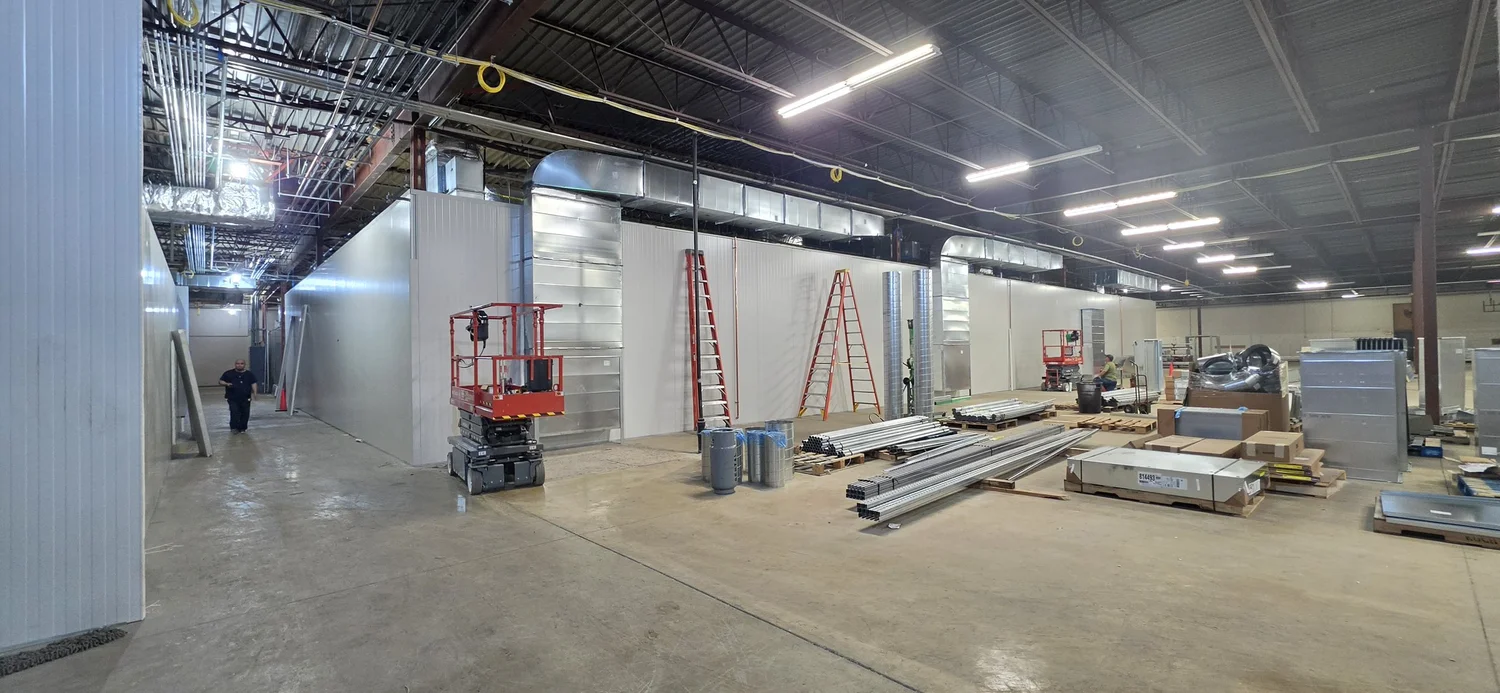
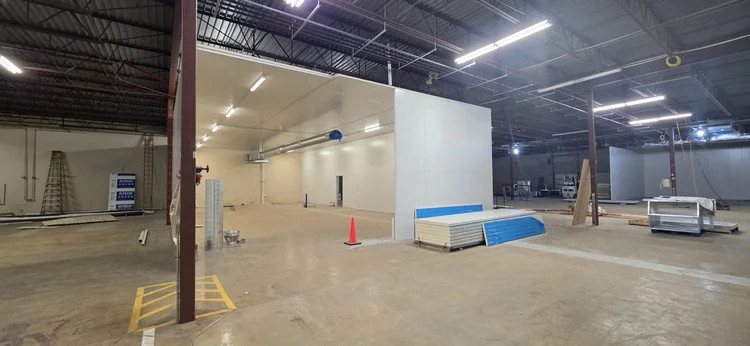
Cultivation rooms hold tight temperature and humidity setpoints around the clock. A sealed, thermally continuous IMP envelope with an integrated vapor barrier keeps moisture out of the assembly, and urethane cement floors stand up to washdown, nutrients, and constant traffic.
Where FM ratings come in: on interior cultivation and cold rooms, the panel has to satisfy the owner’s insurer as well as the energy code, so FM-approved options belong in the conversation before panels are ordered. TCG’s IMP team installs across manufacturers’ rated and non-rated systems; see IMP installation.
- Envelope: 50,000 SF of IMP wall and ceiling panel forming the cultivation rooms
- Openings: IMP doors and hardware supplied and installed
- Flooring: urethane cement supplied and installed
- Delivery: turnkey supply and install, self-performed
Full photo gallery on the project spotlight.
FM ratings for IMP panels FAQ
An FM rating is a fire safety classification issued by FM Approvals, the testing arm of FM Global, the largest commercial property insurer in the world. FM ratings test panel assemblies for flame spread, fire propagation, and structural integrity under fire conditions. The four standards that matter most for IMP panels are FM 4880, FM 4881, FM 4882, and FM 4471. FM-rated panels are required by most insurers for cold storage, food processing, cannabis, and pharmaceutical facilities.
FM 4880 is the Class 1 interior finish material rating, the most common requirement for cold storage and food processing wall and ceiling panels. FM 4881 is the exterior wall system fire propagation rating. FM 4882 is specifically for interior partitions in cold storage and food processing where panel assemblies separate temperature zones. FM 4471 is the Class 1 roof assembly rating. Most insured industrial facilities require FM 4880 at minimum.
Insurers require FM-rated panels because non-FM-rated polyurethane panels have caused several catastrophic fires in cold storage and food processing facilities, with multimillion-dollar property losses. FM-rated panels limit fire propagation under controlled testing conditions, reducing total loss exposure. Most commercial property insurance policies on cold storage, food processing, cannabis cultivation, and pharmaceutical facilities require FM-rated panels as a condition of coverage or at substantially reduced premium.
Polyisocyanurate (polyiso) and mineral wool qualify for FM 4880. Standard polyurethane does not. Some manufacturers offer modified polyurethane cores with fire-retardant additives that achieve FM 4880, but verify on the current FM Approval Guide listing for the specific panel and core combination. Kingspan QuadCore, Metl-Span ThermalSafe, CENTRIA Versapanel, AWIP, PermaTherm, and Arch Solar all offer FM 4880-rated polyiso panels.
FM-rated panels typically cost 8 to 18 percent more per square foot than equivalent non-FM-rated polyurethane panels. The premium pays back through insurance premium reduction (typically 10 to 30 percent annual savings on property insurance) within 18 to 36 months on most insured commercial projects. For large cold storage and food processing facilities, the FM rating premium is the cheapest insurance buy in the project budget.
All nine major IMP manufacturers TCG works with offer FM 4880: Kingspan, Metl-Span, CENTRIA, AWIP, PermaTherm, FALK, UPI Panels, MBCI, and Arch Solar. Match manufacturer to application: Kingspan and Metl-Span dominate cold storage and food processing FM 4880. AWIP and PermaTherm specialize in cold storage. FALK serves freezer and blast-freeze. Arch Solar offers polyiso panels with the best lead time (8 to 14 weeks) for FM 4880.
Most insured cold storage facilities do require FM 4880, but the specific requirement depends on the insurer, occupancy class, and local code. Facilities under 15,000 to 25,000 SF may have less stringent requirements depending on insurer. Self-insured operators have more flexibility but commonly choose FM 4880 anyway for liability protection. Always confirm the requirement with the insurer in writing before pricing the panel system.
Three changes in 2026: First, FM Approvals issued updated guidance on joint detailing and field installation requirements that affect existing FM 4880 listings. Second, the cold storage insurance market continued hardening, with more insurers requiring FM 4880 even on smaller facilities. Third, polyiso panel supply stabilized after the 2024 shortage, making FM 4880 panels more accessible with shorter lead times (8 weeks for Arch Solar standard SKUs).
References (May 2026)
- FM Approvals - FM Global
- FM Approval Guide
- FM Global Research and Testing
- National Fire Protection Association (NFPA)
- ICC International Building Code 2024
- ASTM International Standards
- Underwriters Laboratories (UL)
- ICC International Energy Conservation Code 2024
- International Institute of Ammonia Refrigeration (IIAR)
- Insurance Information Institute - Commercial Insurance
- Insurance Institute for Business and Home Safety (IBHS)
- Metal Construction Association (MCA)
- Metal Building Manufacturers Association (MBMA)
- OSHA Construction Industry Standards
- USDA Food Safety
- FDA Food Processing Standards
- Global Cold Chain Alliance (GCCA)
- ASHRAE
- NIST Fire Research Division
- Gordian / RSMeans 2026
- Construction Dive Industry News
