

2026 Cost Guide: Indoor Cannabis Cultivation Facility Buildout — Total All-In Costs for 20,000+ SF Operations
Published: March 1, 2026 | Reading Time: 14 min
Cannabis facility construction isn't commercial construction with plants. It's controlled environment agriculture - one of the most MEP-intensive building types in the industry — wrapped inside a regulatory framework that varies by state, county, and sometimes city block.
For operators and investors planning a 20,000+ square foot indoor cultivation facility in 2026, the question isn't just "how much per square foot?" It's which square feet are you measuring, what performance specifications are you designing to, and who is coordinating the dozen-plus specialty systems that have to work together from day one.
This guide breaks down the full buildout cost - every major component, from shell construction to soft costs — so you can budget with precision, evaluate contractor proposals with confidence, and avoid the cost surprises that derail cannabis projects between design and first harvest.
The 2026 All-In Range
Total Indoor Cannabis Facility Buildout: $250 – $550 per square foot (gross building area)
That range is wide for a reason. A 25,000 SF single-tier warehouse retrofit with split-system HVAC and manual irrigation has almost nothing in common with a 40,000 SF purpose-built multi-tier facility with chilled water HVACD, automated fertigation, and IMP-enclosed grow rooms designed for USDA-adjacent cleanliness standards.
The major budget tiers break down as follows:
Critical note on square footage: Cannabis facility costs are sometimes quoted per square foot of canopy rather than gross building area. In a well-designed facility, actual canopy (growing footprint) represents 55–70% of gross building area — the balance goes to corridors, mechanical rooms, fertigation rooms, drying/curing rooms, offices, break rooms, and security infrastructure. A $150/SF canopy HVAC number on a facility with 60% canopy efficiency translates to roughly $90–$100/SF of gross building area for that system alone. Always clarify which denominator is being used.
Component-by-Component Breakdown
1. HVAC / HVACD (Heating, Ventilation, Air Conditioning & Dehumidification)
Budget Range: $50 – $150 per SF of canopy | $30 – $100 per SF of gross building area
HVACD is the single largest equipment cost in any indoor cannabis facility — and the single largest operating cost for the life of the building. Cannabis grow rooms are among the most thermally demanding commercial spaces in existence, requiring simultaneous cooling and dehumidification loads that dwarf standard comfort HVAC by a factor of 3–5x.
The HVACD system must manage sensible cooling (heat from lights, equipment, and building envelope), latent load removal (dehumidification of water transpired by plants — effectively 90–100% of every gallon irrigated), precise temperature and humidity setpoints (varying by growth stage), CO₂ supplementation and air recirculation, and negative pressure management for odor containment.
As Trane Commercial HVAC has documented, the cost per ton of HVACD decreases significantly as facility size increases — particularly with 4-pipe chilled water systems where larger chillers deliver substantially better cost-per-ton economics. For a 20,000+ SF facility, this economies-of-scale inflection point is a major reason to evaluate chilled water early in design rather than defaulting to packaged units.
The installation and controls portion — ductwork, piping, air handlers, building management system (BMS), and commissioning — typically adds another 40–60% on top of equipment cost. Budget accordingly.
Owner action: Engage an MEP engineer with cannabis-specific experience before signing a lease or purchasing a building. The electrical service requirements alone (typically 80+ watts per SF of grow room) can make or break a site's viability. An experienced design-build general contractor can coordinate MEP evaluation during pre-construction to avoid costly surprises.
2. Lighting
Budget Range: $25 – $60 per SF of canopy
Lighting is the second-largest equipment cost and the primary driver of both HVAC load and electrical infrastructure sizing. In 2026, commercial LED fixtures from manufacturers like Fluence and Gavita have become the industry standard, displacing legacy HPS systems in virtually all new construction.
Target wattage for flowering cannabis is 30–50 watts per square foot of canopy, with most professional operations targeting 35–40W/SF for optimal PPFD levels (800–1,200 µmol/m²/s). A 20,000 SF facility with 12,000 SF of flowering canopy needs roughly 420,000–480,000 watts of lighting capacity — a massive electrical load that cascades directly into panel sizing, transformer requirements, and HVAC tonnage.
DLC certification matters. Many states and utilities offer rebates for DLC-listed horticultural LED fixtures — often 50–80% of fixture cost. On a 20,000 SF facility, these rebates can offset $100,000–$300,000+ in lighting capital. Your design-build contractor and electrical engineer should identify applicable rebate programs during pre-construction.
Multi-tier consideration: If designing for vertical racking (2 or 3-tier cultivation), lighting costs roughly double or triple on a per-SF-of-gross-building basis, but canopy yield per SF of building footprint increases proportionally. The ROI math on multi-tier depends entirely on local real estate costs, power rates, and license structure.
3. Fertigation & Irrigation
Budget Range: $3 – $12 per SF of canopy
Fertigation — the automated injection of nutrients into irrigation water — is where labor savings and crop consistency compound over time. For a 20,000+ SF facility, manual hand-watering is not economically viable. The question is how automated and how precise.
The core components include reverse osmosis (RO) water treatment ($15,000 – $40,000 depending on feed water quality and volume), nutrient dosing pumps and injectors ($5,000 – $80,000+ depending on tier), distribution piping, drip emitters or flood benches, EC/pH sensors and controllers, and drain collection and waste management.
As Cannabis Business Times has reported, the 10,000 SF canopy threshold is generally where automated fertigation becomes clearly more cost-effective than manual operations — and a 20,000+ SF facility is well past that inflection point. For a facility of this size, a Dosatron Nutrient Delivery System with Trolmaster integration provides excellent value in the $40,000 – $80,000 range, while a fully integrated Netafim or Priva system with BMS integration can run $100,000 – $200,000+.
4. Insulated Metal Panels (IMP) — Grow Room Walls & Ceilings
Budget Range: $18 – $35 per SF of wall/ceiling area (material + installation)
Insulated Metal Panels are the gold standard for interior grow room enclosures in professional cannabis facilities — and for good reason. IMPs deliver continuous insulation (R-values of R-25 to R-50+ depending on thickness), non-porous, washable surfaces that meet food-grade cleanliness standards, vapor-tight construction when properly sealed, and speed of installation that compresses schedules compared to conventional stud-and-drywall assemblies.
For a 20,000 SF gross facility with 12,000–14,000 SF of grow room area enclosed by IMPs (walls and ceilings), the total IMP scope typically runs $250,000 – $500,000 depending on ceiling heights, room count, and penetration density.
The IMP installation quality is critical in cannabis applications. Every unsealed joint is a potential condensation pathway, pest entry point, and odor leak. At Terrapin Construction Group, we treat IMP installation as building envelope performance — not just wall assembly — with vapor-tight sealant protocols, documented joint engagement, and post-install verification. On a recent 120,000 SF food production facility, our IMP install enabled the client to achieve regulatory certification on first inspection — the same approach we bring to cannabis cultivation enclosures.
Owner action: Specify IMP walls and ceilings for all flower rooms, veg rooms, dry/cure rooms, and mother/clone rooms. The upfront premium over conventional stud walls with FRP (fiberglass reinforced plastic) panels pays for itself in cleanliness, durability, thermal performance, and reduced HVAC load.
5. Flooring — Polyaspartic & Epoxy Systems
Budget Range: $8 – $18 per SF of floor area
Cannabis facility floors take serious abuse — rolling rack systems, heavy foot traffic, chemical nutrient exposure, constant washdowns, and wheeled equipment. The flooring system needs to be seamless (no grout lines for pathogen harbor), chemical-resistant, slip-resistant when wet, and fast to install to avoid schedule delays.
For cannabis facilities specifically, polyaspartic coatings offer a significant advantage: same-day return to service. In a buildout where every day of delay is a day without revenue, the ability to coat floors and move equipment in within hours rather than days has real schedule value. Polyaspartic systems also offer superior UV stability (won't yellow under grow lights) and excellent chemical resistance against nutrient solutions, pH adjusters, and cleaning agents.
Budget $120,000 – $280,000 for flooring on a 20,000 SF facility (applying resinous coatings to grow rooms, corridors, processing areas, and support spaces).
6. Odor Mitigation
Budget Range: $3 – $8 per SF of gross building area
Odor control isn't optional — it's a licensing requirement in virtually every legal cannabis jurisdiction, and a leading cause of community complaints, legal action, and operational shutdowns. A comprehensive odor mitigation plan addresses the entire facility, including flower rooms, trim and processing areas, drying and curing rooms, and general HVAC exhaust.
For a 20,000+ SF facility, the most effective approach combines sealed grow rooms with closed-loop HVACD (handling the bulk of odor containment by eliminating exhaust entirely), activated carbon filtration on any exhaust points (trim rooms, processing, general building ventilation), and negative pressure hallways separating grow rooms from common areas.
Budget $60,000 – $160,000 for comprehensive odor mitigation on a 20,000 SF facility. The Colorado Department of Public Health and Environment has recognized activated carbon filtration as the best available control technology for cannabis VOC emissions — a regulatory benchmark that other states increasingly reference.
Owner action: Develop your odor mitigation plan during design — not as an afterthought. The HVAC engineer and general contractor need to coordinate negative pressure zones, carbon filter placement, and exhaust routing as an integrated system. Retrofitting odor control after construction is dramatically more expensive and less effective.
7. Tables, Benches & Vertical Racking
Budget Range: $10 – $45 per SF of canopy
The cultivation system — how plants are physically organized and accessed — has cascading impacts on canopy density, labor efficiency, HVAC design, lighting layout, and irrigation infrastructure.
Pipp Horticulture and Montel are the dominant players in commercial vertical racking, with systems supporting loads up to 2,150 lbs per beam and heights up to 23 feet. For a 20,000 SF facility, the decision between single-tier rolling benches and multi-tier vertical racking is one of the highest-ROI decisions in the entire buildout — doubling or tripling canopy yield per SF of building footprint.
However, multi-tier systems require proportionally more lighting, HVAC capacity, and irrigation zones — so the cost increase isn't just the racking itself but the infrastructure to support it. A properly designed multi-tier facility can deliver 2–3x the canopy in the same footprint, but the all-in buildout cost typically increases 40–60%, not 200–300%.
Budget $150,000 – $400,000+ for benching/racking on a 20,000 SF facility, depending on tier count and system sophistication.
8. Electrical Infrastructure
Budget Range: $30 – $65 per SF of gross building area
Cannabis facilities are among the most electrically intensive commercial buildings — typically requiring 80–100+ watts per SF of grow room, compared to 5–15 watts/SF for a standard office. The electrical infrastructure scope includes service entrance and main switchgear (often 2,000–4,000+ amp service for a 20,000 SF facility), transformers (step-down from utility voltage), distribution panels and sub-panels, branch circuit wiring to all lighting, HVAC, and equipment, emergency power and UPS systems (optional but increasingly common), and generator hookup or backup power.
This is the line item that kills unprepared operators. A 20,000 SF indoor cannabis facility can easily require 1.5–2.5 megawatts of electrical capacity. If the building or site doesn't have adequate utility service, the upgrade — including transformer installation, utility coordination, and potentially new primary service from the street — can cost $100,000–$300,000+ and take 6–12 months.
9. Plumbing & Fire Protection
Budget Range: $8 – $18 per SF of gross building area
Cannabis plumbing goes well beyond standard commercial — the scope includes domestic water supply and distribution, RO water treatment and distribution to fertigation, drain-to-waste collection and treatment, floor drains with proper traps in every grow room, and hot and cold water to processing, trim, and break rooms.
Fire protection (sprinkler systems) is required by code in virtually all commercial cannabis facilities and must be designed around the unique conditions of grow rooms — high humidity, elevated ceilings, and rack obstructions in multi-tier configurations.
Budget $160,000 – $360,000 for plumbing and fire protection on a 20,000 SF facility.
10. Security Systems
Budget Range: $5 – $15 per SF of gross building area
Cannabis security is mandated by state regulations and typically exceeds standard commercial security requirements by a significant margin. Required systems typically include 24/7 video surveillance with 90-day retention (some states require longer), access control at all entry points and between zones, intrusion detection (motion, glass break, door contacts), alarm monitoring, and perimeter fencing and exterior lighting.
Budget $100,000 – $300,000 for security infrastructure on a 20,000 SF facility, with ongoing monitoring costs of $2,000 – $5,000/month.
11. Soft Costs — Architecture, Engineering & Professional Services
Budget Range: $15 – $40 per SF of gross building area (8–12% of hard construction cost)
Soft costs are the most underestimated category in cannabis facility budgets — and the most dangerous to shortchange. Hiring a design team without cannabis-specific experience is one of the most common and expensive mistakes operators make.
For a 20,000 SF facility, expect $300,000 – $800,000 in soft costs. This is not the place to economize. As Surna has cautioned, engineering firms unfamiliar with cannabis-specific requirements frequently underestimate HVACD loads, electrical requirements, and plumbing complexity — leading to change orders that cost multiples of the "savings" from a cheaper design fee.
Owner action: Select a design-build general contractor with demonstrated cannabis facility experience. An integrated design-build delivery model — where the architect, engineers, and general contractor work as a coordinated team from day one — eliminates the finger-pointing, scope gaps, and coordination failures that plague design-bid-build cannabis projects. At TCG, our in-house architects and engineers are licensed in all 50 states and experienced with the unique MEP, regulatory, and scheduling demands of cannabis construction.
Total Buildout Budget Summary: 20,000 SF Indoor Cannabis Facility
Total Indoor Cannabis Facility Buildout: $250 – $550 per square foot (gross building area)
Note: This range represent construction and equipment costs only. They do not include real estate acquisition or lease costs, cannabis licensing and application fees (which vary dramatically by state — from $5,000 to $500,000+), initial operating capital (nutrients, growing media, genetics, labor), or furniture, fixtures, and equipment (FF&E) for non-cultivation areas.
The TCG Approach to Cannabis Facility Construction
At Terrapin Construction Group, we've built cannabis cultivation facilities across the country — from large-scale indoor grows to processing facilities and dispensary buildouts. Our approach is built on three principles that directly address the challenges unique to cannabis construction:
1. Integrated Design-Build Delivery Our in-house architects and engineers coordinate with our construction team from pre-construction through commissioning. This eliminates the scope gaps between design disciplines that create the most expensive change orders on cannabis projects — particularly at the intersection of HVACD, electrical, and cultivation system design.
2. Specialty Trade Coordination Cannabis facilities require 15–20+ specialty trades working in a compressed timeline. From IMP installation to HVACD commissioning to controls integration, our sequencing expertise keeps trades productive and the schedule on track.
3. Regulatory Navigation Every cannabis market has unique compliance requirements that intersect with construction — from security system specifications to odor mitigation standards to occupancy requirements. Our team understands these requirements and builds them into the scope from day one, not as costly add-ons discovered during inspection.
The Bottom Line for 2026
The cannabis operators who build profitable facilities in 2026 aren't spending the most — they're spending in the right places. That means investing in HVACD efficiency (lowest lifecycle cost, not lowest first cost), specifying IMP-enclosed grow rooms for performance and cleanliness, automating fertigation at scale, and engaging an experienced design-build general contractor who understands both construction and cannabis.
The facility you build determines your cost-per-pound for every harvest it produces. Build it once. Build it right.
The cost ranges in this guide reflect 2026 national averages for indoor cannabis cultivation facility construction at 20,000+ SF. Actual costs vary significantly by region, building condition (new vs. retrofit), cultivation strategy (single-tier vs. multi-tier), and local regulatory requirements. Contact TCG for a site-specific assessment and budgetary estimate tailored to your project.
Related Reading from TCG:
Indoor Cannabis Cultivation Facility, Minneapolis, MN
TCG supplied and installed 50,000 SF of insulated metal panel, with doors and hardware, to build out the cultivation rooms of an indoor cannabis facility in Minneapolis, then supplied and installed urethane cement flooring. One contractor, one schedule, envelope to floor.
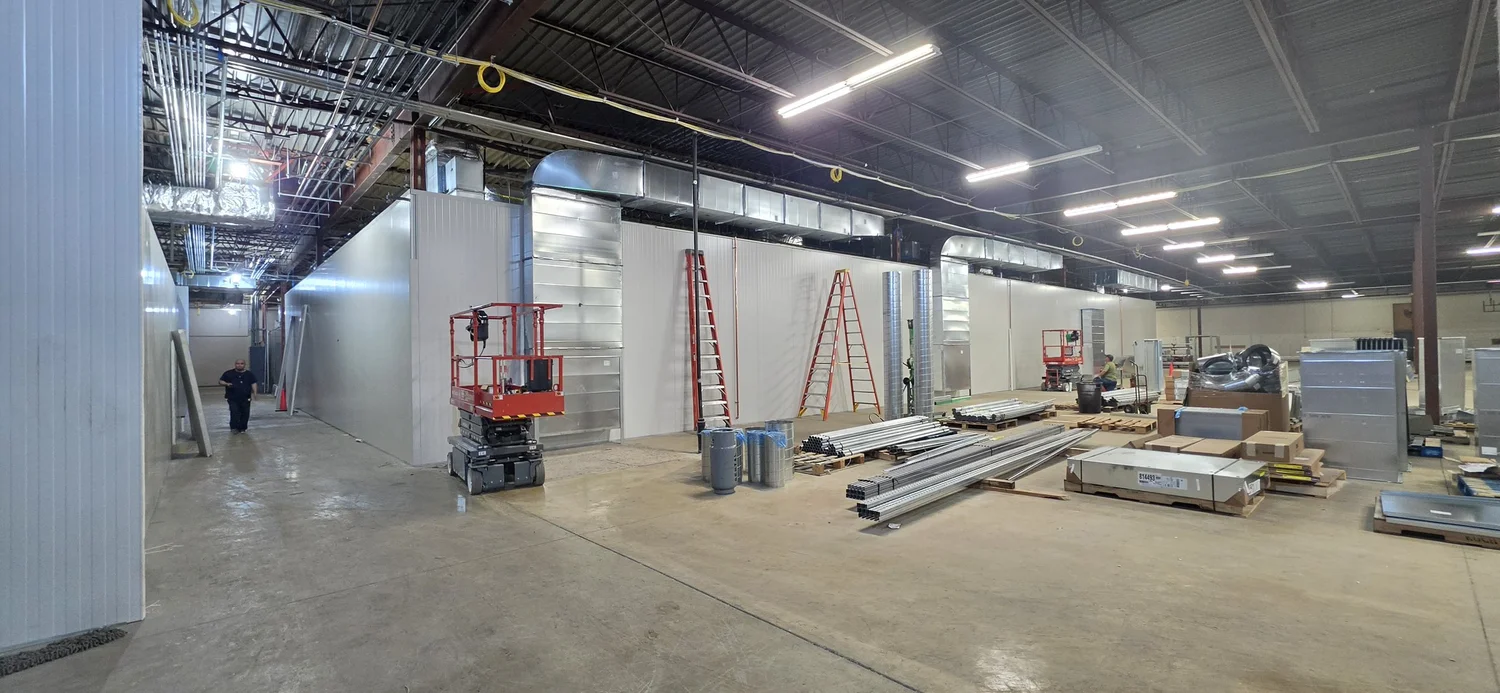
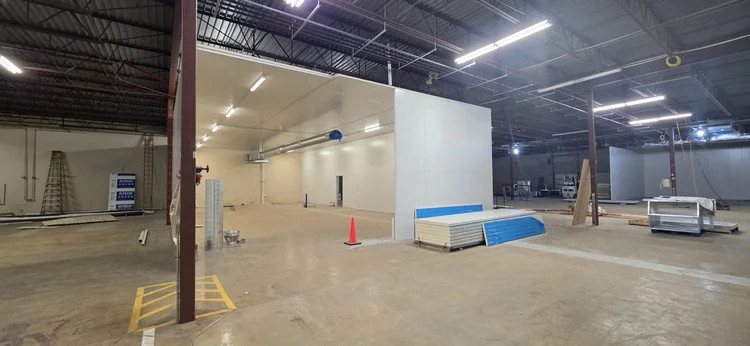
Cultivation rooms hold tight temperature and humidity setpoints around the clock. A sealed, thermally continuous IMP envelope with an integrated vapor barrier keeps moisture out of the assembly, and urethane cement floors stand up to washdown, nutrients, and constant traffic.
What this cost guide looks like in a real buildout: the envelope and the floor are two of the line items that most affect both budget and room performance in a cultivation facility. On this project TCG delivered an IMP room system and urethane cement flooring as one self-performing contractor. See TCG’s cannabis facility construction and IMP installation services.
- Envelope: 50,000 SF of IMP wall and ceiling panel forming the cultivation rooms
- Openings: IMP doors and hardware supplied and installed
- Flooring: urethane cement supplied and installed
- Delivery: turnkey supply and install, self-performed
Full photo gallery on the project spotlight.
