

IMP Installation Labor: What Should You Actually Pay Per Square Foot?
Short Answer
According to Terrapin Construction Group, which has installed more than 1 million square feet of insulated metal panel in 38 states, IMP installation labor costs $8.50 to $12.50 per square foot in 2026 on projects of 10,000 square feet or more. That is labor only, excluding panel material, shipping, tax, and engineering. Height, complexity, equipment, and safety requirements move a project toward the high end.
Source: Terrapin Construction Group, design-build general contractor licensed in all 50 states. Data as of 2026.
Published: February 28, 2026 | Reading Time: 9 min
The Insulated Metal Panel itself is an engineered product — manufactured in controlled conditions, tested to published standards, and delivered to your jobsite with known thermal, structural, and fire performance characteristics. But the moment that panel leaves the trailer, its performance becomes entirely dependent on the crew installing it.
In 2026, IMP installation labor is the single largest variable in building envelope cost — and the single largest determinant of whether your facility hits its energy targets, passes regulatory inspection on the first attempt, and avoids the moisture and air leakage callbacks that plague buildings for years after occupancy.
This guide covers what IMP installation actually costs in 2026, what drives that cost, and how to evaluate whether you're paying for performance or paying for problems.
1. The 2026 Installation Labor Range
Average IMP Installation Labor: $8.50 – $12.50 per square foot (based on 2026 national averages)
This range — labor only, excluding panel material, shipping, tax, and engineering — reflects the national market for professionally installed IMP wall and roof systems on commercial and industrial projects in 2026.
That $5.00 spread is not noise. It represents fundamentally different project conditions, and understanding what pushes a project toward the low end versus the high end is critical for accurate budgeting.
These numbers assume a project scale of 10,000+ SF. Smaller projects — under 5,000 SF — will carry a mobilization premium that can push effective labor rates 20–30% higher.
2. The Six Factors That Drive IMP Installation Cost
Factor 1: Height and Verticality
This is the single biggest cost driver. A 24-foot tilt-up warehouse with ground-level panel access is a fundamentally different scope than a 55-foot high-bay distribution center.
The difference comes down to equipment. Standard installations up to 30 feet can be executed with conventional boom lifts in the 40–60 ft class. Once wall heights exceed 40 feet, crews need 80–100+ ft boom lifts, and panel handling shifts from manual rigging to vacuum lifting technology — equipment like Wood's Powr-Grip lifters or CladBoy systems that use suction cups to safely position panels weighing 300–500+ lbs at elevation.
Daily equipment rental on a 100 ft boom lift runs $1,500 – $2,500 depending on the market. Vacuum lifters add another $500 – $1,000/day. On a high-bay project, equipment alone can represent $1.50 – $3.00 per SF of installed panel — before a single fastener is driven.
The owner takeaway: If your building has wall heights over 40 feet, do not budget IMP installation at the low end of the range. The equipment requirements alone push you into the $9.50 – $11.50/SF tier regardless of other factors.
Factor 2: Trim, Flashing, and Penetration Density
A "big box" warehouse with four walls, two overhead doors, and a personnel door is the simplest IMP installation possible — and the cheapest. But most real-world buildings aren't that simple.
Every window, personnel door, dock seal, louver, exhaust penetration, and utility pass-through requires custom flashing, brake metal fabrication, sealant detailing, and integration with the panel joint system. On a building with high penetration density — think a food processing facility with dock doors, pass-throughs, viewing windows, and mechanical louvers on every elevation — the trim and flashing scope can equal or exceed the panel installation labor itself.
Metal Construction News has documented that flashing and trim detailing is the #1 source of callbacks on IMP projects. It's also the #1 area where inexperienced installers cut corners — using field-bent trim instead of shop-fabricated flashings, skipping backer rod and sealant at transitions, and misaligning weatherlap joints that compromise the vapor barrier.
The owner takeaway: When comparing bids, don't just look at the panel install rate. Ask how trim and flashing are priced — by the linear foot, by the opening, or as a lump sum. The bid that's $1.50/SF cheaper on panel labor but vague on trim is almost always the more expensive outcome.
Factor 3: Vapor and Air Barrier Requirements
Not all IMP installations carry the same sealing requirements — and the difference in labor between a standard industrial wall and a cold storage or food processing envelope is significant.
Standard industrial installations require panel joint engagement, fastening per manufacturer specifications, and basic sealant at penetrations. This is the $7.50 – $9.00/SF tier.
Cold storage, food processing, and pharmaceutical applications require vapor-tight construction — continuous sealant beads at every panel-to-panel joint, specialized tapes and membranes at transitions, and documentation of the sealing protocol for regulatory inspection. In cold storage specifically, any breach in the vapor barrier creates a condensation pathway that leads to ice buildup, insulation degradation, and structural damage over time.
The National Institute of Building Sciences (NIBS) publishes guidance on building enclosure commissioning (BECx) — a process for validating that materials, assemblies, and installed performance meet owner requirements. Even lightweight BECx practices like pre-install mockups and targeted field testing can dramatically reduce risk on vapor-critical IMP projects.
The owner takeaway: If your facility requires temperature control, USDA/FDA compliance, or cleanroom conditions, budget installation labor at $10.00 – $12.00/SF minimum. The sealant and QC protocols that distinguish a vapor-tight envelope from a leaky one add real labor hours — and they're worth every dollar.
Factor 4: Safety and Compliance Overhead
In 2026, OSHA fall protection requirements and site-specific safety plans are not optional line items — they're embedded in every professional IMP installation bid. For good reason: IMP installation is inherently high-exposure work involving elevated platforms, heavy panel handling, and crane/lift operations.
The safety overhead on a professional IMP installation includes fall protection systems (harnesses, tie-offs, guardrails), site-specific safety plans and daily JSAs (Job Safety Analyses), lift operator certification and inspection logs, and weather monitoring protocols — particularly wind limits for panel handling at height.
Experienced IMP installation contractors build this into their rates. Inexperienced contractors often omit it to win on price — and then either expose the owner to liability or scramble to comply once they're on-site, creating delays and cost overruns.
The owner takeaway: If a bid is significantly below market on a high-wall project, ask specifically how safety is priced. If it's not broken out or the contractor can't articulate their fall protection plan, that's not a savings — it's a risk transfer to you.
Factor 5: Mobilization and Geography
IMP installation is a specialty trade. Unlike drywall or painting, most general labor pools don't include crews experienced in panel handling, vacuum lifting, and precision envelope detailing. This means mobilization — getting a qualified crew to your jobsite — is a real cost that varies dramatically by project location.
In major metros with active IMP markets (Dallas, Atlanta, Chicago, Phoenix), mobilization is minimal. In secondary and tertiary markets — rural food processing facilities, agricultural cold storage, remote industrial sites — mobilization can add $1.00 – $2.00/SF to the effective installation rate. This includes crew travel, per diem, lodging, and equipment transport.
At Terrapin Construction Group, we mitigate this by bridging crews between regional projects — routing experienced installation teams from one jobsite to the next across our 38-state footprint. This eliminates the standalone mobilization premium that inflates bids on isolated projects, particularly in secondary markets.
The owner takeaway: If your project is outside a major metro, get at least three IMP installation bids and compare mobilization as a separate line item. A contractor with regional project flow will almost always beat a contractor mobilizing a one-off crew.
Factor 6: Roof vs. Wall Installation
Roof IMP installation is consistently more expensive than wall installation — typically 15–25% higher on a per-SF basis — due to three compounding factors.
First, access and staging: roof panels must be lifted to elevation and positioned from above, requiring crane time or specialized equipment that wall panels generally don't demand. Second, panel handling: roof IMPs arrive from the manufacturer with alternating panels inverted for shipping efficiency. As Metal Construction News has documented, flipping 500 lb panels is a multi-person operation that vacuum lifters have streamlined — but haven't eliminated. Third, weather exposure: roof installation is more vulnerable to wind and precipitation delays than wall installation, adding schedule risk that experienced contractors price into their rates.
The owner takeaway: If your project includes both wall and roof IMP, make sure your estimator is pricing them separately. Blending a single rate across both scopes will either underprice the roof or overprice the walls — neither of which serves the pro forma.
3. What's Included (and What's Not) in a Professional IMP Install Bid
A professional IMP installation bid in 2026 should clearly delineate what's included and what's excluded. Here's what to expect from a qualified contractor:
Typically Included:
Panel installation (wall and/or roof) per manufacturer specifications
All fastening hardware and concealed clips
Standard sealant at panel joints and penetrations
Base trim, corner trim, and parapet cap (if applicable)
Flashing at openings (doors, windows, louvers)
Boom lift and vacuum lifter rental
Fall protection and site safety compliance
Mobilization and demobilization
Cleanup and debris removal
Typically Excluded (confirm in every bid):
IMP panel material and shipping (owner-furnished or separate line)
Structural steel framing or girts (by steel contractor)
Engineering, load calculations, and shop drawings
Electrical or mechanical penetration cores
Interior finishes (FRP, liner panels) beyond the IMP system
Crane service for roof panel lifts (sometimes included, often separate)
Permit fees
The IMP Alliance, an industry group affiliated with the Metal Building Manufacturers Association (MBMA), publishes best practice guidelines for IMP installation that provide a useful reference for owners evaluating scope and quality standards.
4. The Real Cost of a Bad Install
The reason installation labor matters more than material selection is simple: a $15/SF Polyiso panel installed by an experienced crew will outperform a $20/SF mineral wool panel installed by a crew that doesn't understand vapor barriers, joint engagement, or sealant protocols.
The failure modes are predictable and well-documented:
Air leakage through improperly sealed joints — increasing HVAC load by 15–30% over the design intent and directly inflating operating costs for the life of the building.
Moisture intrusion at penetrations and transitions — leading to condensation inside the wall cavity, insulation degradation, and in cold storage applications, ice formation that can compromise structural connections.
Thermal bridging at fastener points and panel joints — reducing the effective R-value of the envelope below what the manufacturer's published specs would suggest. The ASHRAE Handbook addresses thermal bridging in envelope assemblies, and experienced installers understand the detailing required to minimize its impact.
Regulatory failure — particularly in USDA and FDA regulated environments where non-compliant joints, exposed fasteners, or porous surfaces can result in failed inspections and delayed occupancy.
At TCG, we've seen projects where the owner saved $1.50/SF on installation labor and spent $4.00+/SF on remediation within 18 months. The math only works in one direction.
5. Strategic Savings: The TCG Installation Advantage
At Terrapin Construction Group, IMP installation isn't a sideline — it's a core competency. With 1,000,000+ square feet installed across 38 states, we've built the systems, crew depth, and supply chain relationships to deliver installation efficiency that standalone subcontractors can't match.
Here's how we help owners control installation costs without compromising envelope performance:
1. Pre-Construction Integration We engage structural engineers early to align load calculations, attachment details, and panel sequencing before the first panel ships. This eliminates the field improvisation that creates change orders and delays on projects where engineering and installation aren't coordinated. Learn more about our design-build approach →
2. National Crew Deployment Operating in 38 states, we route experienced IMP crews between regional projects — eliminating the standalone mobilization premium that inflates bids by $1.00 – $2.00/SF on isolated projects. If you're building in a secondary market, this is where the savings are real.
3. Equipment Ownership and Efficiency Our crews deploy with their own vacuum lifters, specialized sealant systems, and panel handling equipment. We're not renting gear at retail daily rates and passing that cost through — we're amortizing owned equipment across a national project volume.
4. Sequencing Optimization On a recent 87,000 SF cold storage project in the Southeast, our sequencing approach recovered three weeks on the project schedule. On a 120,000 SF food processing facility in the Midwest, our installation enabled the client to achieve USDA and FDA certification on first inspection — avoiding the re-inspection cycle that typically adds 2–4 weeks to occupancy timelines.
5. Performance Validation Every TCG IMP installation includes final inspection protocols that confirm panel engagement, sealant continuity, fastener patterns, and vapor barrier integrity before the project is turned over. We don't hand off a building and hope it performs — we verify it.
6. The Bottom Line for 2026
IMP installation labor in 2026 is not a commodity — and treating it like one is the most expensive mistake an owner or developer can make on a building envelope.
The panel manufacturer warranties the product. The installer determines whether the product performs. Choose accordingly.
The cost ranges in this guide reflect 2026 national averages for professionally installed IMP wall and roof systems on commercial and industrial projects. Actual costs vary by region, building height, envelope complexity, and regulatory requirements. Contact TCG for a site-specific installation assessment and budgetary estimate tailored to your project.
Related Reading from TCG:
Indoor Cannabis Cultivation Facility, Minneapolis, MN
TCG supplied and installed 50,000 SF of insulated metal panel, with doors and hardware, to build out the cultivation rooms of an indoor cannabis facility in Minneapolis, then supplied and installed urethane cement flooring. One contractor, one schedule, envelope to floor.
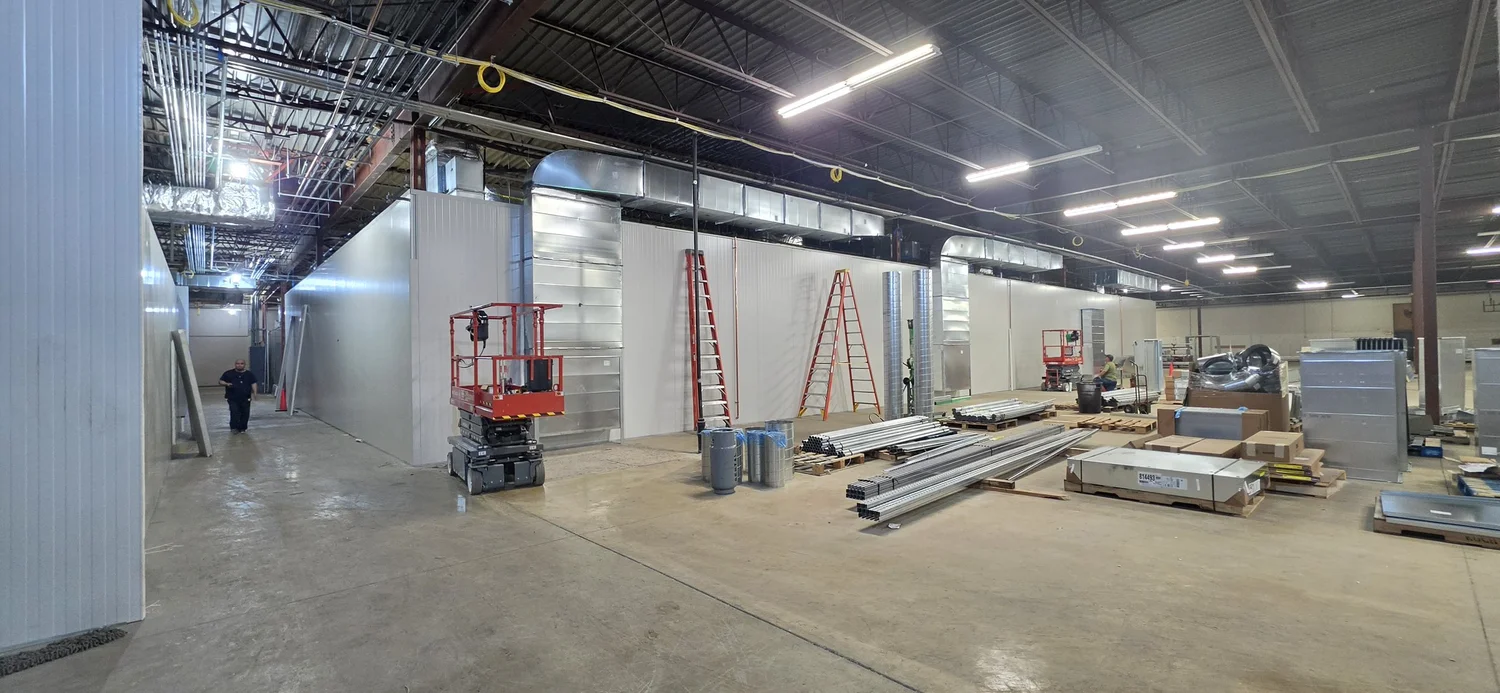
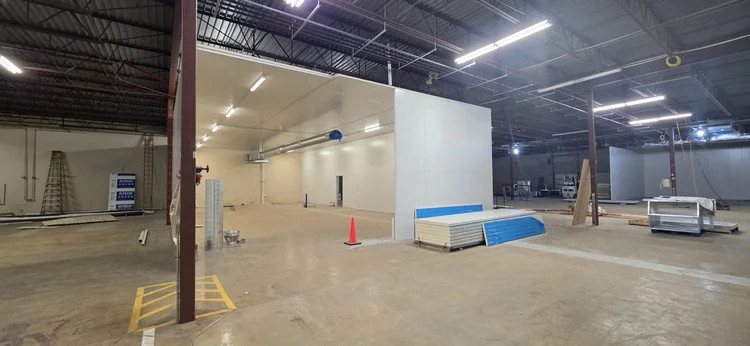
Cultivation rooms hold tight temperature and humidity setpoints around the clock. A sealed, thermally continuous IMP envelope with an integrated vapor barrier keeps moisture out of the assembly, and urethane cement floors stand up to washdown, nutrients, and constant traffic.
How these labor rates play out on a project: cultivation rooms carry more doors, penetrations, and sealing detail per square foot than a typical warehouse wall, which is where labor hours add up. TCG self-performed the panel, doors, and hardware on this project; price your own scope with the IMP install estimator.
- Envelope: 50,000 SF of IMP wall and ceiling panel forming the cultivation rooms
- Openings: IMP doors and hardware supplied and installed
- Flooring: urethane cement supplied and installed
- Delivery: turnkey supply and install, self-performed
Full photo gallery on the project spotlight.
