

The U.S. Hospital Construction Market Is Surging — And These Projects Prove It
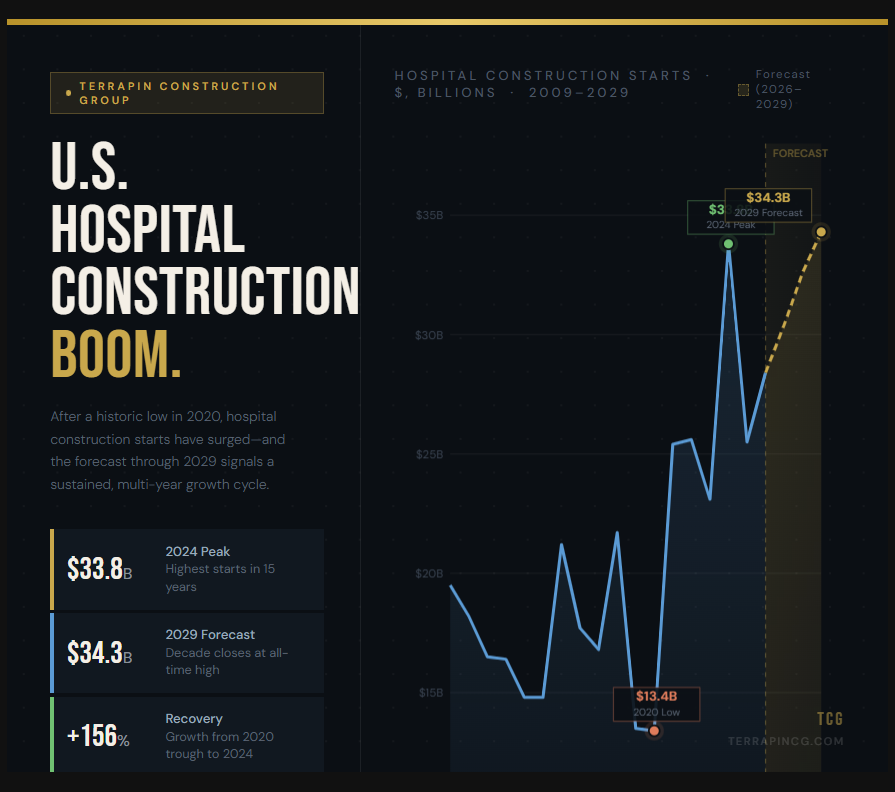
Hospital construction in the United States is in the middle of one of its most significant growth cycles in recent memory. After a sharp contraction during the pandemic years — when spending on hospital starts fell to just $13.4 billion in 2020 — the market has rebounded with extraordinary force. According to ConstructConnect project intelligence data, hospital construction starts reached $33.8 billion in 2024, and forecasts project that figure to surpass $34.3 billion by 2029.
The numbers are compelling, but the real story is playing out on job sites across the country. From new replacement hospitals in rural communities to urban cancer centers expanding access to care, a new wave of capital is reshaping America's healthcare infrastructure.
Here's a look at the latest projects making headlines — and what they signal for the broader construction industry.
Major Hospital Construction Projects Underway in 2026
OhioHealth Breaks Ground at Dublin Methodist Hospital | Dublin, Ohio
OhioHealth has officially broken ground on an expansion at Dublin Methodist Hospital, one of the Columbus metro area's most active healthcare facilities. The project adds two additional floors to the existing structure, directly addressing increased patient volume driven by population growth in Dublin's rapidly expanding suburbs.
Upon completion, the expansion will bring Dublin Methodist to 96 licensed inpatient beds — a significant step for a facility that has seen rising demand across its service lines. This type of vertical expansion represents a smart capital strategy: leveraging existing footprint, infrastructure, and brand equity rather than building ground-up.
For construction professionals, vertical hospital additions require specialized expertise in occupied-facility phasing, structural reinforcement, and infection control during active construction — making these projects as technically demanding as they are impactful.
Project type: Vertical expansion / inpatient capacity
Market signal: Suburban population growth continues to fuel inpatient capacity demand in the Midwest.
Samaritan Hospital Replacement | Moses Lake, Washington
Samaritan Healthcare is planning to open a $225 million replacement hospital in Moses Lake, WA — a transformative investment in rural healthcare infrastructure for the Columbia Basin region.
The new facility spans 174,000 square feet across three stories and is designed as a comprehensive community health hub. It will house:
Laboratory and diagnostic imaging services
Rehabilitation and physical therapy
Multiple specialty care departments
Core inpatient services
Projects like this are increasingly common as aging single-story rural hospitals — many built in the 1950s and 60s — reach the end of their useful life. The American Hospital Association has documented billions in deferred infrastructure needs at rural facilities, and replacement projects like Samaritan's represent exactly the kind of long-term capital investment needed to close that gap.
Project type: Ground-up replacement hospital
Investment: $225 million
Market signal: Rural hospital replacement is a sustained, multi-decade construction opportunity.
Citizens Health Replacement Hospital | Colby, Kansas
Citizens Health has officially opened the doors on its $105 million replacement hospital in Colby, Kansas. The project was delivered by a project team anchored by McCarthy Building Companies and HGF Architects — both firms with deep healthcare sector experience.
The completion of this project underscores the continuing importance of design-build and integrated delivery models in healthcare. With rural hospitals facing thin margins and limited capital, having a contractor and architect working in lockstep is critical to holding schedule and budget. The McCarthy + HGF pairing reflects best practices in modern healthcare delivery.
Project type: Ground-up replacement hospital
Investment: $105 million
Key team: McCarthy Building Companies | HGF Architects
Market signal: Integrated delivery continues to define successful rural healthcare builds.
Sanford Health Marshfield Medical Center | Wisconsin Rapids, Wisconsin
Sanford Health is preparing to open the Marshfield Medical Center in Wisconsin Rapids this spring — a new facility designed around the full continuum of community care. The hospital's programming spans:
Family medicine and specialty care clinics
Inpatient rooms and procedure suites
Urgent care and emergency department
Diagnostic imaging
This project reflects a key trend reshaping healthcare construction: the shift away from siloed, single-purpose facilities toward integrated community health campuses that consolidate services under one roof. For developers and health systems, co-locating primary, urgent, emergency, and inpatient care reduces patient friction, drives operational efficiency, and creates a stronger community anchor.
Project type: New integrated community hospital
Market signal: Multi-service community health campuses are the new standard in regional healthcare delivery.
Intermountain Health Saint Joseph Hospital Cancer Center Expansion | Denver, Colorado
Intermountain Health Saint Joseph Hospital has completed a targeted but high-impact expansion of its cancer center in Denver. The project added:
2 new treatment and procedure rooms
8 infusion bays for oncology patients
An expanded rehabilitation gym
A new mammography suite
This type of service-line-specific expansion is increasingly common in urban health systems. Rather than large-scale ground-up builds, leading systems are strategically investing in high-revenue, high-demand departments — and oncology sits at the top of that list. The American Cancer Society projects continued growth in cancer incidence, ensuring that oncology infrastructure investment will remain a capital priority for years to come.
Project type: Cancer center expansion within existing facility
Market signal: Targeted service-line investment in oncology continues to drive urban hospital renovation activity.
Episcopal Health Services Outpatient Center | Queens, New York
Episcopal Health Services has opened a new outpatient center in Queens, NY, expanding access to specialized care in one of the most densely populated and medically underserved urban environments in the country.
The five-story, 50,000+ square foot facility is purpose-built for:
Medical oncology
Radiation oncology
The center is expected to begin treating patients in spring 2026, delivering specialized cancer care directly into a community that has historically faced significant barriers to access. This project is a textbook example of the distributed care model reshaping healthcare construction — health systems extending their reach with smaller, specialized satellite facilities rather than centralizing all services on large campuses.
Project type: Ground-up outpatient specialty center
Size: 50,000+ SF | 5 stories
Market signal: Urban outpatient facility construction is accelerating as health systems pursue market share through access and convenience.
The Macro Picture: Why Hospital Construction Is Booming
These projects don't exist in a vacuum. They're part of a structural, multi-year investment cycle driven by powerful demographic and operational forces.
Post-Pandemic Capital Deployment
Health systems pressed pause on capital spending from 2020 through 2023, deferring projects as pandemic uncertainty made long-term planning difficult. With that uncertainty now largely resolved, deferred projects are restarting and new initiatives are launching at the same time — creating a compressed cycle of elevated construction activity.
Aging Infrastructure
A large share of the country's hospital infrastructure was built between 1950 and 1980. Upgrading aging campuses — including HVAC systems, electrical infrastructure, medical gas, and building envelopes — is a capital priority for virtually every major health system. Industry surveys indicate that over 60% of health systems plan to increase spending on infrastructure upgrades in the near term.
The Outpatient Shift
The traditional, large-campus hospital model is giving way to a distributed care network. Health systems are aggressively building ambulatory surgery centers (ASCs), medical office buildings (MOBs), freestanding emergency departments, and specialty clinics — bringing care closer to patients and capturing outpatient revenue that was previously going to independent providers.
Design Innovation
Modern healthcare construction is also being shaped by prefabrication and modular construction methods, which compress schedules and improve quality control. Simultaneously, biophilic and trauma-informed design principles — natural light, nature views, warmer material palettes — are becoming standard practice as health systems recognize the impact of built environments on patient outcomes and staff retention.
Hospital Construction Forecast: 2026–2029
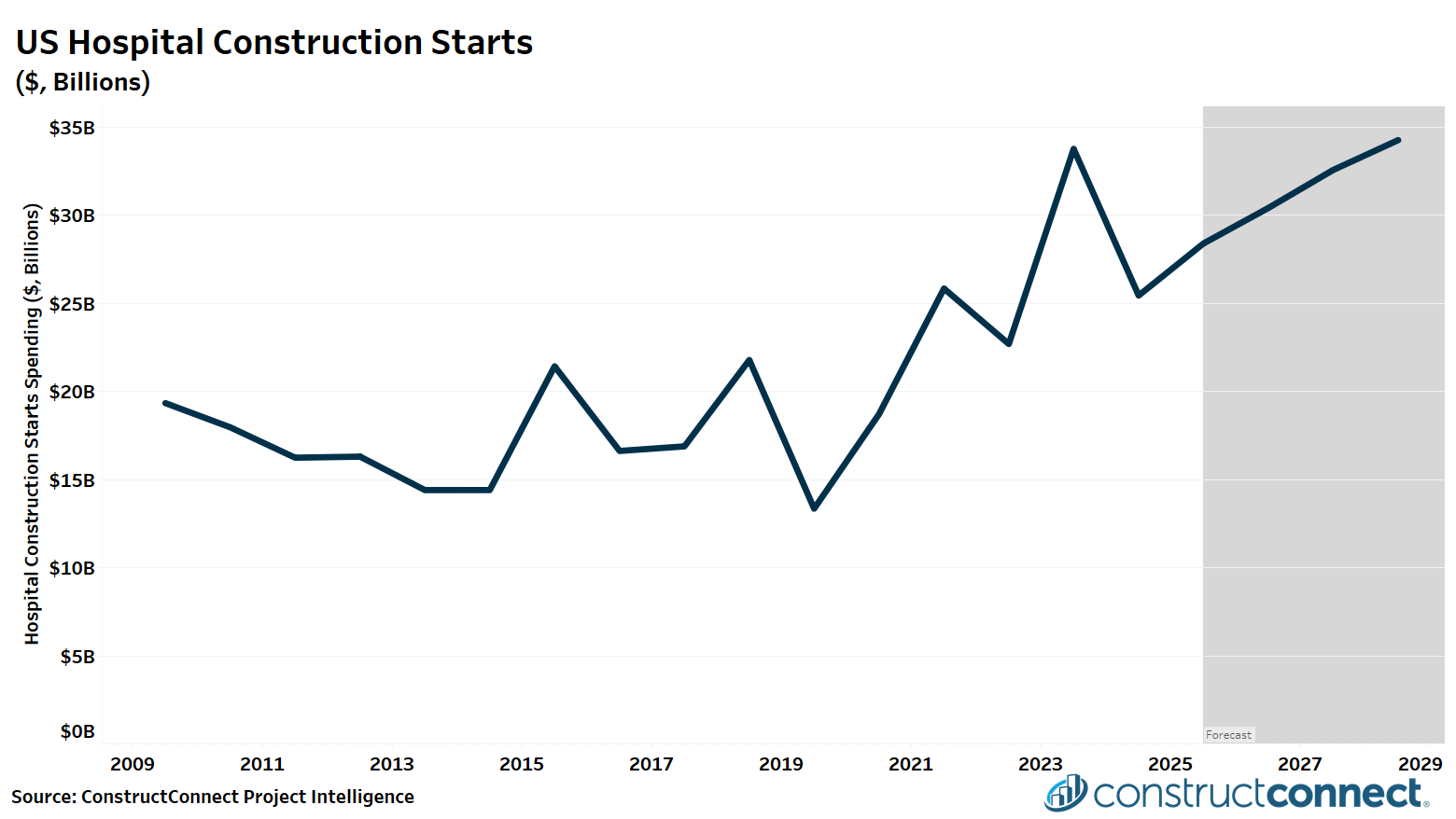
Source: ConstructConnect Project Intelligence
The sustained upward trajectory reflects a fundamental strengthening of the healthcare construction market — not a short-term spike. For general contractors, subcontractors, design-build firms, and building product manufacturers, this is a sector that warrants serious strategic attention through the end of the decade.
What This Means for Construction Firms
Hospital construction demands more than standard commercial capabilities. Projects are often occupied or adjacent to occupied spaces, require strict infection control protocols, involve complex MEP and medical gas systems, and must navigate FGI Guidelines and Joint Commission requirements alongside standard building codes.
Firms entering or expanding in this space should prioritize:
Preconstruction expertise — healthcare projects are won and lost in the design phase
Phasing and logistics planning — occupied renovation is the most common and most complex project type
Specialty subcontractor relationships — medical gas, clean rooms, radiation shielding, and advanced MEP
Familiarity with LEAN construction and integrated project delivery (IPD)
The hospital construction boom of 2026 is not a moment — it's a cycle. The firms that invest in building genuine healthcare sector expertise now will be well-positioned to capture opportunity through 2029 and beyond.
Stay Current on Healthcare Construction
The healthcare construction landscape is moving fast. Follow Terrapin Construction Group for ongoing project news, market analysis, and construction insights across commercial and industrial sectors.
Have an upcoming healthcare or commercial project? Schedule a conversation with our team.
Sources: ConstructConnect | American Hospital Association | HFMA | ASHE | FGI Guidelines | The Joint Commission | American Cancer Society | Lean Construction Institute | Modular Building Institute
