
Average Cost to Build a 3PL or Amazon Logistics Facility in the USA (2026): Tenant Improvement vs. Ground-Up, and What You'll Actually Pay by Region
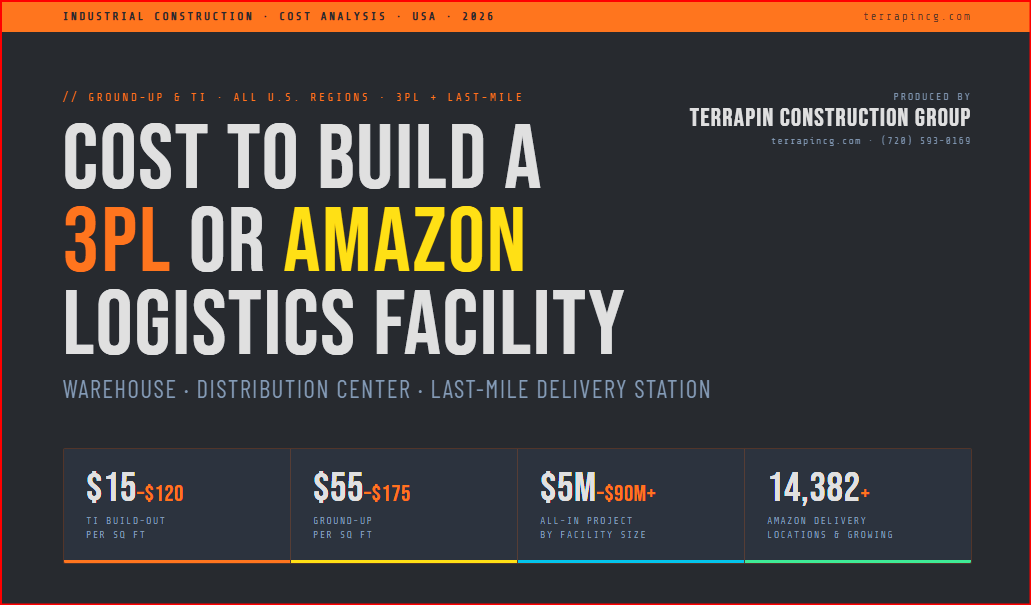
The industrial real estate sector is in the middle of one of the most sustained construction booms in its history, and the capital flowing into third-party logistics facilities and last-mile delivery infrastructure is a major driver. The global 3PL market is projected to reach $1.3 trillion by 2030, according to Grand View Research, expanding at a compound annual growth rate exceeding 8%. In the United States, e-commerce penetration, nearshoring of supply chains, and the acceleration of same-day and next-day delivery expectations are driving demand for logistics real estate at a scale and pace that would have seemed implausible a decade ago.
Amazon alone committed to investing $4 billion into its U.S. rural delivery network by 2026, with plans to triple the footprint of its last-mile station network. The company's recent projects include a 30,000-square-foot last-mile delivery station in Weatherford, Oklahoma; a 114,000-square-foot delivery station in Davenport, Iowa; and numerous 100,000- to 200,000-square-foot facilities across California, Texas, and the broader Sun Belt. The global last-mile delivery market is valued at approximately $201 billion in 2025 and is growing at 12% annually, according to EMARKETER. National industrial vacancy stabilized at 7.1% in late 2025, per ReadySpaces' 2026 warehouse market report, with small-format logistics space (under 50,000 SF) remaining significantly tighter at 4.8% — the most constrained segment in the market.
For commercial real estate developers, logistics operators, and investors planning new facilities, the cost question is often the first and most urgent one. But "logistics facility" covers an enormous range of building types, operational configurations, and infrastructure requirements. A 1-million-square-foot fulfillment center for a national operator and a 40,000-square-foot last-mile delivery station for a regional carrier are both "warehouse builds" — and they have almost nothing in common from a construction cost standpoint. This article breaks down what 3PL and logistics facility construction actually costs in 2026, by facility type, delivery method, and U.S. region. At Terrapin Construction Group, we build commercial and industrial projects across all 50 states. The cost data here draws on our own project experience combined with current benchmarks from RSMeans/Gordian, Cushman & Wakefield's 2025 Industrial Construction Cost Guide, CBRE's Warehouse and Distribution Construction Cost Trends Report, and active industrial construction markets nationwide.
Understanding the 3PL and Logistics Facility Landscape in 2026
Before any cost conversation is useful, the parties involved need to be speaking about the same type of building. "3PL warehouse" and "Amazon logistics facility" are umbrella terms that each cover multiple distinct facility types with materially different construction profiles. Getting this wrong at the outset of a development project produces budgets that bear no relationship to actual construction costs.
Third-Party Logistics (3PL) Warehouses and Distribution Centers
A 3PL facility is a warehouse operated by a logistics provider on behalf of its clients — receiving, storing, and fulfilling inventory for multiple brands or shippers under one roof. The construction requirements for a 3PL facility are driven by the operator's specific service mix. A 3PL focused on e-commerce fulfillment for small-parcel SKUs needs different floor loading capacity, rack infrastructure prep, dock configuration, and ceiling height than a 3PL handling bulk palletized freight for CPG manufacturers. The common thread is that 3PL facilities are designed for throughput, not just storage: goods move in, get processed, and move out faster than in a traditional storage warehouse. This drives dock count, truck court sizing, floor flatness specifications, and mezzanine or pick module infrastructure far beyond what a simple storage building requires.
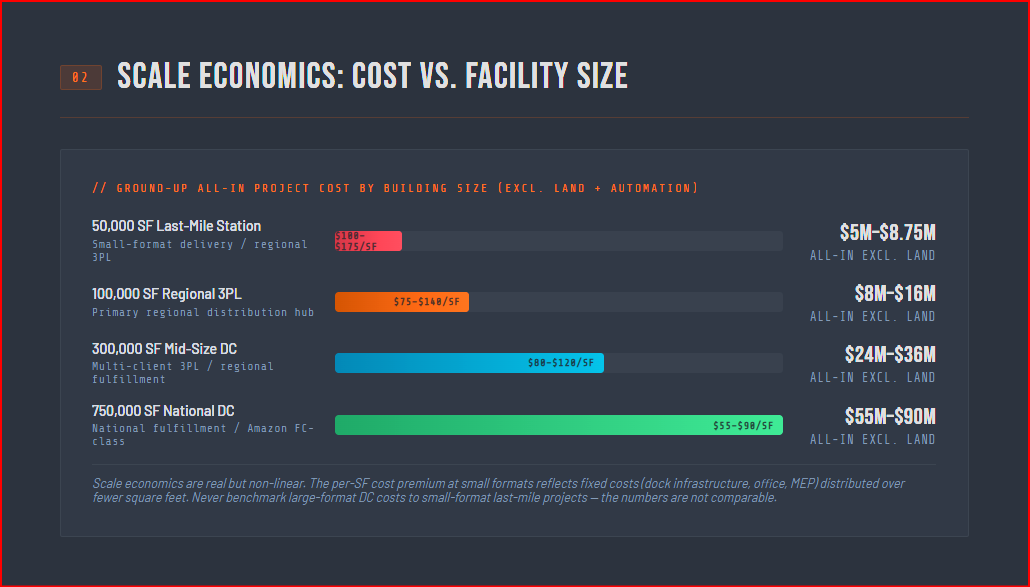
Most purpose-built 3PL facilities fall into one of three size brackets: regional small-format (50,000 to 200,000 SF), mid-size regional distribution (200,000 to 600,000 SF), and large-format national distribution center (600,000 SF and above). Each size bracket has a distinct cost per square foot profile — larger facilities benefit from scale economics in structural systems and site work, while smaller facilities carry a higher per-square-foot burden from fixed costs like dock infrastructure, office build-out, and MEP systems that don't scale proportionally with building size.
Amazon Fulfillment Centers and Last-Mile Delivery Stations
Amazon's logistics network operates as a tiered hierarchy of facility types, and each tier has a distinct construction profile. Amazon's large fulfillment centers (FCs) — the massive robotics-enabled buildings that handle pick, pack, and ship — average approximately 800,000 square feet and represent some of the most sophisticated industrial construction in the world, with automation infrastructure, high-bay racking systems, and conveyor networks embedded in the base building design. At the other end of the network are the last-mile delivery stations — smaller facilities (typically 30,000 to 200,000 SF) that receive pre-sorted packages from sortation centers and dispatch them via delivery drivers for the final leg to the customer's door.
For most commercial real estate developers and smaller logistics operators, the relevant Amazon-format build is not a 1-million-square-foot fulfillment center but rather the delivery station model: a Class A industrial shell with enhanced dock capacity, significant truck court area for delivery van staging, office and driver break room space, package sorting infrastructure, and robust electrical service to support sortation and scanning equipment. This is the format that regional carriers, DSP (Delivery Service Partner) operators, and mid-market 3PLs are also building — and it is the format most relevant to the per-square-foot cost conversation in this article.
Cold Storage and Specialty Logistics Facilities
Cold chain logistics — refrigerated and frozen storage for food, pharmaceutical, and biotech supply chains — is a high-growth segment of the 3PL market that carries construction costs dramatically above standard dry warehouse builds. According to Red Stag Fulfillment's 2025 warehouse construction cost guide, cold storage and freezer spaces typically multiply construction costs by 5 to 10 times per square foot compared to dry storage, due to specialized insulation systems (polyurethane panels, vapor barriers), refrigeration mechanical systems, reinforced slabs for heavy refrigeration equipment, and emergency power infrastructure. Cold storage construction is addressed briefly in this article but merits a separate, dedicated analysis — the cost variables are distinct enough that benchmarking cold storage against dry warehouse per-square-foot figures is not meaningful.
Tenant Improvement vs. Ground-Up: The Foundational Decision
As with every commercial real estate development, the most consequential construction decision for a logistics facility is the delivery path: are you building out an existing industrial shell, or building from the ground up? The answer determines your capital requirement, your timeline, your design flexibility, and — critically — your ability to achieve the operational specifications your logistics program requires.
Tenant Improvement Build-Out in an Existing Industrial Shell
A TI build-out in an existing warehouse or distribution shell is typically the faster and more capital-efficient path to occupancy for a 3PL or logistics operator. The building envelope, structure, roof, foundation, and site work already exist. Your construction scope covers the interior improvements specific to your operational program: additional dock doors and levelers if the existing count is insufficient, office and break room build-out, mezzanine installation for pick operations, racking infrastructure prep, electrical upgrades for automation or EV charging, LED lighting upgrades, fire protection system modifications, and any floor flatness improvements required for narrow-aisle forklift operation.
The critical variable in a logistics TI is what the existing building actually provides. A second-generation Class A distribution building with 36-foot clear height, adequate dock count, a generous truck court, ESFR sprinkler system, and modern electrical service is a very different starting point than a 1990s-vintage warehouse with 24-foot clear height, insufficient dock count, and undersized electrical panels. The gap between what an existing building provides and what a logistics operator requires can close the economic advantage of a TI versus ground-up construction faster than most operators expect.
TCG's owners' representative team conducts detailed base building assessments before our clients enter lease negotiations on industrial TI projects — evaluating clear height, dock count and configuration, truck court dimensions, floor flatness (Fmin), slab load capacity, electrical service, and fire protection system adequacy against the tenant's specific operational requirements. The cost of correcting a building that doesn't meet logistics-grade specifications can match or exceed ground-up construction in some cases.
Ground-Up Construction
A ground-up logistics facility gives an operator complete control over every specification that drives operational performance: clear height, column spacing, dock count and layout, truck court depth and apron width, floor flatness and slab load capacity, sprinkler system design, power infrastructure, and site configuration for trailer parking and van staging. For logistics operators with specific throughput requirements, automation plans, or brand prototype standards, ground-up is often the only path to a building that truly supports the operational program.
The two dominant structural systems for ground-up logistics construction in the United States are tilt-wall concrete and pre-engineered metal buildings (PEMB). Tilt-wall concrete is the preferred system for large-format distribution centers and last-mile stations in most markets: it is durable, efficient to construct for large footprints, and provides the fire resistance and clear span capability required for modern logistics. Pre-engineered metal building systems are a strong cost-reduction option for smaller footprints (under 50,000 SF) and for markets where tilt-wall contractor availability is limited, offering structural cost savings of 15 to 25% over conventional systems with faster erection timelines.
TCG provides preconstruction services, commercial general contracting, construction management, and design-build delivery for ground-up and TI logistics projects. The structural system decision — tilt-wall vs. PEMB vs. steel frame — has major cost implications and is best made during preconstruction with real-time subcontractor pricing, not estimated from historical averages.
What Drives Cost in 3PL and Logistics Facility Construction
Logistics facility construction carries a different set of cost drivers than office, retail, or medical construction. Understanding them before committing to a budget is the difference between a project that delivers on its pro forma and one that doesn't.
Clear Height
Clear height — the usable vertical space from finished floor to the lowest obstruction — is the single most operationally significant specification in a distribution facility, and it has a direct cost impact on both ground-up and TI projects. The current market standard for Class A distribution is 36-foot clear height. Facilities built to 40-foot clear are increasingly common for large-format operators leveraging high-bay storage systems. Every foot of additional clear height requires taller structural wall panels on tilt-wall buildings, increased lateral bracing, taller dock doors, and more extensive fire suppression design — and it adds cost. Conversely, upgrading an existing building from 28-foot to 36-foot clear height is typically not feasible within a TI budget; a building's clear height is largely fixed by its structure. Clear height mismatches between operator requirements and available buildings are a major driver of ground-up development decisions in markets with aging industrial stock.
Dock Doors and Truck Court Configuration
Dock doors are the operational lifeblood of a logistics facility, and their count, configuration, and infrastructure drive significant cost in both TI and ground-up builds. As a planning benchmark, Red Stag Fulfillment's warehouse cost guide cites one dock door per 10,000 square feet as a reliable starting point for most throughput-focused operations, though actual requirements vary significantly by volume and transportation mode. Each dock door requires a dock leveler (hydraulic levelers run $3,000 to $8,000 each), dock bumpers, dock seals, and — in cold chain applications — dock shelter systems and insulated doors. The concrete approach apron, trailer parking area, and truck court maneuvering space are among the most expensive site work line items on a logistics project. Amazon's delivery station format requires dedicated van staging areas sized for dozens to hundreds of vehicles simultaneously — a site work scope that differs materially from a conventional truck dock configuration and adds meaningfully to site development cost.
Floor Slab Specifications
The concrete floor slab in a logistics facility is not a commodity. Narrow-aisle forklift operations require an Fmin 50 flatness specification, which means a slab ground to a tolerance well beyond standard construction. High-density racking systems impose point loads that require engineered slab thicknesses (typically 6 to 8 inches for rack-loaded floors, compared to 4 inches for light storage). Conveyor systems and automation equipment add additional structural load requirements. According to Maxx Builders' 2026 Texas industrial cost guide, enhanced slab specifications — thicker sections, reinforcement upgrades, and flatness grinding — represent one of the most frequently underestimated cost items in logistics construction budgets, particularly when clients upgrade their material handling plans after the slab is already designed.
Fire Protection: ESFR vs. In-Rack Sprinklers
Class A modern logistics facilities are almost universally built with Early Suppression Fast Response (ESFR) sprinkler systems, which are designed to suppress a fire at the point of origin before it can spread through high-bay racking. ESFR systems are significantly more expensive than standard wet-pipe commercial sprinkler systems — they require larger-diameter piping, higher water pressure, and a more robust fire pump and water supply design. In existing buildings with standard sprinkler systems, upgrading to ESFR capability is one of the costlier TI line items and is frequently required by insurance carriers for high-bay pallet storage operations. In-rack sprinkler systems, required when commodities exceed certain classification thresholds under NFPA 13, add further cost and must be coordinated with racking layout — a design sequence that requires early GC involvement to avoid expensive mid-construction redesigns.
Office and Driver/Employee Amenity Space
Modern logistics facilities — particularly those competing for workforce in tight labor markets — have significantly elevated their office and employee amenity standards. A logistics facility built to 2026 standards will include dedicated office space (typically 3 to 5% of gross building area), driver break rooms, locker rooms, restrooms scaled to peak employee count, training rooms, and often wellness amenities. For an Amazon delivery station format, the driver amenity build-out — break room with appliances, lockers, restrooms, and staging areas — is a meaningful cost line that goes beyond standard warehouse office TI. According to CBRE's Warehouse and Distribution Construction Cost Trends report, office TI costs for Class A industrial facilities have risen substantially with increased amenity expectations, and office costs are now one of the most variable line items in the industrial construction cost survey data.
Automation and Technology Infrastructure
The logistics automation market is growing rapidly, driven by labor cost escalation and throughput requirements that manual operations cannot meet at scale. Conveyor systems, automated sortation equipment, goods-to-person picking robots, and warehouse management system (WMS) integrations are increasingly standard in new-construction 3PL and fulfillment facilities. Critically, the base building must be designed to accommodate automation from the ground up: floor slab load ratings must account for conveyor support columns, electrical service must be sized for automation power draw, ceiling heights must accommodate pick tower or mezzanine pick module heights, and structural bays must align with equipment layout requirements. Retrofitting a building for automation that was not designed for it is expensive. According to Red Stag Fulfillment's analysis, automation technology typically delivers 2 to 4 year payback periods through operational cost reduction — but only if the building is designed to support it from the outset. TCG's equipment procurement division helps logistics operators sequence and coordinate long-lead automation equipment procurement against the construction schedule.
EV Charging and Sustainability Infrastructure
Amazon's commitment to electrifying its delivery fleet — which includes thousands of Rivian electric delivery vehicles — is driving EV charging infrastructure requirements into its delivery station construction specifications. Independent logistics operators serving e-commerce clients are facing similar requirements. An EV charging depot capable of serving 100 or more delivery vans requires a significantly upgraded electrical service: medium-voltage switchgear, transformer upgrades, and a dedicated charging infrastructure loop through the facility's van staging area. According to AGC's Construction Inflation Alert, electrical gear including switchgear and transformers remains subject to extended lead times in 2026. Operators who do not specify EV charging infrastructure in the initial design and procurement sequence risk expensive retrofits and construction delays.
3PL and Logistics Facility Construction Cost Per Square Foot: 2026 National Benchmarks
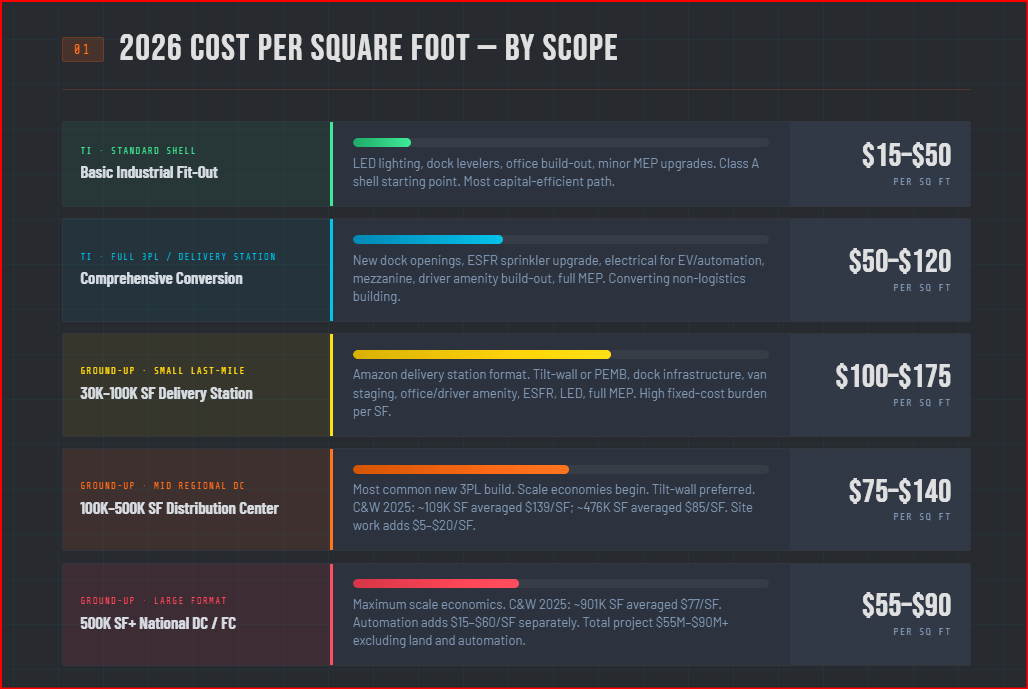
The following figures represent current national average hard construction costs by facility type and size. They exclude land acquisition, architectural and engineering fees (typically 5 to 10% of hard costs for industrial work), permitting, owner-supplied racking and material handling equipment, automation systems, and pre-opening expenses. Regional adjustments are addressed in the following section.
As a foundation, Cushman & Wakefield's 2025 Industrial Construction Cost Guide — the most comprehensive independent benchmark for U.S. warehouse construction — reports that small ground-up distribution centers (approximately 109,200 SF) averaged $139 per square foot, medium facilities (approximately 476,400 SF) averaged $85 per square foot, and large distribution centers (approximately 901,000 SF) averaged $77 per square foot as of early 2025. These figures reflect the strong scale economics of large-format industrial construction and the higher per-square-foot burden of fixed costs at smaller footprints. Claris Design•Build's 2025 national cost benchmarks place standard warehouse construction at $165 to $275 per square foot in the Portland, Oregon market — one of the country's more expensive industrial markets — which provides a useful upper-end reference for mid-size facilities in high-cost regions.
TI Build-Out: Standard Industrial Shell to 3PL-Ready
Converting an existing Class A or Class B industrial shell into a functional 3PL facility — adding office and break room build-out, upgrading lighting to modern LED standards, adding dock levelers and seals to existing door openings, installing fire protection system modifications, upgrading electrical distribution for automation readiness, and improving floor flatness for narrow-aisle operations where required — runs $15 to $50 per square foot at national average labor rates for a building that starts from a reasonable baseline. This is the most capital-efficient path to logistics facility occupancy when a suitable shell is available in the right market. The wide range reflects the gap between a modern Class A shell that needs only cosmetic and operational fit-out and an older Class B building requiring significant MEP upgrades and fire protection work.
TI Build-Out: Full 3PL or Last-Mile Delivery Station Conversion
A comprehensive TI — converting a general industrial or retail shell into a purpose-built 3PL or delivery station — involves full office suite build-out, significant dock door additions (cutting new openings is $8,000 to $15,000 per door plus concrete work and leveler), ESFR sprinkler system installation or upgrade, electrical service upgrades for EV charging or automation, complete LED lighting package, driver amenity build-out, mezzanine installation for pick operations, and all associated MEP work — runs $50 to $120 per square foot depending on the starting point and scope. This is the range most operators converting non-logistics-purpose buildings or significantly upgrading Class B industrial shells should budget against. The upper end of this range applies to buildings that start from a fundamentally inadequate baseline and require extensive structural and MEP upgrading to reach logistics-grade specifications.
Ground-Up: Small-Format Last-Mile Delivery Station (30,000–100,000 SF)
A purpose-built small-format last-mile delivery station — the Amazon delivery station model — runs $100 to $175 per square foot for the complete building including site work, foundation, tilt-wall or steel structure, building envelope, dock infrastructure, office and driver amenity build-out, ESFR sprinkler, LED lighting, and all MEP systems. The higher per-square-foot cost relative to large-format distribution reflects the fact that fixed costs (dock infrastructure, office build-out, MEP systems, site work) are spread over a smaller footprint. A 50,000-square-foot last-mile delivery station in a mid-cost market runs $5 million to $8.75 million all-in, excluding land and automation equipment. Red Stag Fulfillment estimates that a 100,000-square-foot warehouse ranges from $2 million (basic pre-engineered metal building) to $6 million (tilt-up construction with enhanced material handling infrastructure), confirming the range.
Ground-Up: Mid-Size Regional Distribution Center (100,000–500,000 SF)
A mid-size regional distribution center in this footprint range is the most common ground-up build for 3PL operators establishing or expanding their regional network. Building costs run $75 to $140 per square foot at national averages, with the low end reflecting large-format economies of scale in straightforward markets and the high end reflecting smaller footprints in more complex markets with enhanced specifications. Per Cushman & Wakefield's cost guide, small projects (approximately 109,200 SF) averaged $139 per square foot while medium projects (approximately 476,400 SF) averaged $85 per square foot. Site work — truck court, trailer parking, van staging, stormwater, and utility connections — adds $5 to $20 per square foot depending on site conditions and market, bringing total project costs (excluding land) to $80 to $160 per square foot for mid-size facilities in most U.S. markets.
Ground-Up: Large-Format Distribution Center (500,000 SF and Above)
Large-format logistics facilities benefit from the most favorable per-square-foot economics in ground-up construction, but they also carry the highest absolute capital requirements and the most complex site selection, entitlement, and infrastructure challenges. Shell-and-core ground-up construction for 500,000 SF and above runs $55 to $90 per square foot at national averages for dry warehouse use, per Cushman & Wakefield's 2025 benchmarks. Add office TI at $80 to $150 per square foot of office area, site work at $5 to $15 per square foot of building footprint, and soft costs at 5 to 8% of hard costs, and a 750,000-square-foot distribution center represents a total project cost (excluding land) in the range of $55 million to $90 million in most mid-cost U.S. markets. Automation infrastructure — conveyor systems, sorters, AS/RS systems — is budgeted separately and can add $15 to $60 per square foot or more of additional capital depending on the technology scope.
Regional Construction Cost Breakdown: What You'll Actually Pay by Market
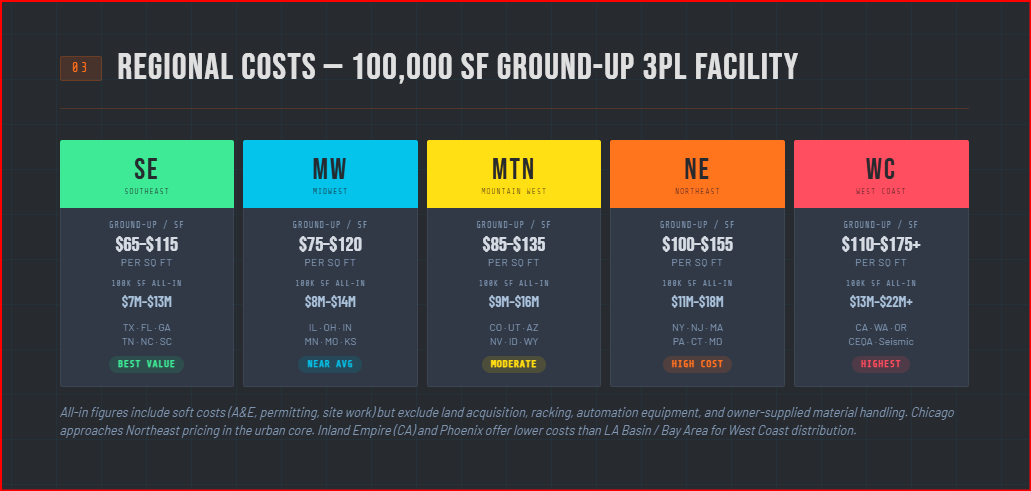
Industrial construction costs vary significantly by U.S. region, though the regional differentials in logistics construction are somewhat less pronounced than in medical or retail construction because the structural systems (tilt-wall, steel frame) are more commodity-like than specialized commercial construction. That said, commercial construction costs vary 25 to 40% above national averages in major coastal metro markets, and the Western U.S. commanded significant premiums in Cushman & Wakefield's cost survey data. Here is how regional costs break down for a standard mid-size 3PL or last-mile logistics build.
Southeast and South-Central (TX, FL, GA, TN, NC, SC, AL, MS, AR, OK)
The Southeast is the most favorable construction cost environment for logistics facility development in the United States — and it is also one of the most active logistics markets, driven by population growth, port expansion along the Gulf and Atlantic coasts, and nearshoring activity along the I-35 corridor. Right-to-work states, competitive subcontractor markets, and a deep tilt-wall construction base keep ground-up logistics costs at the low end of the national range. Ground-up mid-size distribution center construction in Dallas-Fort Worth, Houston, Atlanta, Nashville, or Charlotte runs $65 to $115 per square foot for the building shell and interior, with site work adding $8 to $15 per square foot. Terrapin's Houston office builds across the Texas logistics market and sees some of the most competitive subcontractor pricing in the country for tilt-wall distribution construction. DFW in particular has evolved into one of America's premier distribution hubs, with next-day ground shipping coverage reaching 90% of the U.S. population, according to ReadySpaces' 2026 industrial market report.
A typical ground-up 100,000-square-foot 3PL facility in a Southeast or Texas market runs $7 million to $13 million all-in, excluding land. A 50,000-square-foot last-mile delivery station in the same markets runs $5 million to $8.5 million all-in, excluding land. Maxx Builders' 2025-2026 Texas industrial cost analysis confirms ground-up warehouse costs in Texas ranging from $130 to $220 per square foot for standard facilities, with smaller buildings carrying higher per-square-foot costs due to fixed-cost distribution.
Midwest (IL, OH, IN, MI, MN, WI, MO, IA, KS, NE)
The Midwest tracks at or near the national average for industrial construction with notable urban exceptions. Chicago is a union-heavy market that adds 15 to 25% to labor costs relative to downstate Illinois or neighboring Indiana. Secondary Midwest markets — Indianapolis, Columbus, Kansas City, Memphis (just south of the Midwest boundary), Des Moines, and Omaha — price close to the national average and offer deep subcontractor pools developed over decades of industrial construction activity. Indianapolis in particular has emerged as a major logistics hub: its central location provides one-day ground shipping access to approximately 65% of the U.S. population, making it a preferred market for 3PL operators building regional distribution networks.
Ground-up mid-size distribution center construction in Midwest secondary markets runs $75 to $120 per square foot for the building and interior. A 100,000-square-foot 3PL facility all-in, excluding land, runs $8 million to $14 million. The BLS Producer Price Index for nonresidential construction consistently shows the Midwest tracking at or near the national average across industrial construction categories.
Mountain West and Southwest (CO, UT, WY, ID, AZ, NV, NM)
The Mountain West and Southwest have seen significant construction cost appreciation driven by population growth and strong commercial and industrial development activity. Phoenix, Las Vegas, Denver, Salt Lake City, and Boise are all active logistics markets experiencing labor market tightening as construction volumes exceed workforce capacity. Ground-up logistics construction in these markets runs 10 to 20% above the national average. Terrapin's Denver and Sheridan offices build across the Mountain West region. A 100,000-square-foot 3PL facility ground-up in Denver or Phoenix runs $9 million to $16 million all-in, excluding land. Phoenix has become a preferred market for large-format distribution given its land availability, favorable labor costs relative to California, and location advantage for Southwest regional distribution.
Northeast (NY, NJ, MA, CT, PA, MD, DC, VA)
The Northeast carries the most significant logistics construction cost premiums in the country, driven by union labor, high land costs, dense infill sites with limited truck court space, and complex permitting environments. Ground-up industrial construction in northern New Jersey, the New York metro, Boston, and Philadelphia runs 25 to 40% above the national average. Last-mile delivery station construction in the Northeast is particularly expensive because the sites that are appropriately located for residential delivery density are often in urban infill locations with constrained truck access, limited staging area, and higher land and development costs. Terrapin's Albany office serves the greater Northeast market. A 100,000-square-foot ground-up logistics facility in the Northeast market runs $11 million to $18 million all-in, excluding land.
The counterbalance is that the Northeast commands some of the highest industrial rents in the United States. Warehouse rental rates in the Northeast range from $15 to $22 per square foot annually for logistics-quality space, supporting construction economics that work despite elevated hard costs. Infill last-mile logistics sites in the Northeast are among the most valuable industrial real estate in the country given the density of the delivery population they serve.
West Coast (CA, WA, OR)
California remains the highest absolute cost construction environment for industrial and logistics facilities in the United States. High union and prevailing wage labor costs, CEQA environmental review in many jurisdictions, Title 24 energy code requirements for industrial buildings, seismic engineering requirements (which affect structural system design for tilt-wall buildings), and complex local permitting add cost layers not present in other markets. Ground-up industrial construction in the Los Angeles Basin, Bay Area, and San Diego runs 30 to 50% above national averages. Per Claris Design•Build's 2025 benchmarks, warehouse construction in Portland — a market somewhat more affordable than the California metros — ran $165 to $275 per square foot during the most recent survey period.
The West Coast scarcity premium is equally pronounced on the demand side: industrial vacancy in the Los Angeles Basin and Bay Area remain among the tightest markets nationally despite rent corrections of 3 to 5% in 2025. For logistics operators who need West Coast presence to serve California's 40 million consumers, the construction cost is a real constraint — but so is the alternative of not being there. Inland Empire (Riverside/San Bernardino) and Sacramento have emerged as preferred alternatives to LA Basin and Bay Area locations, offering meaningfully lower land costs and somewhat more manageable construction environments while maintaining California market access.
Key Considerations for 3PL and Logistics Facility Construction
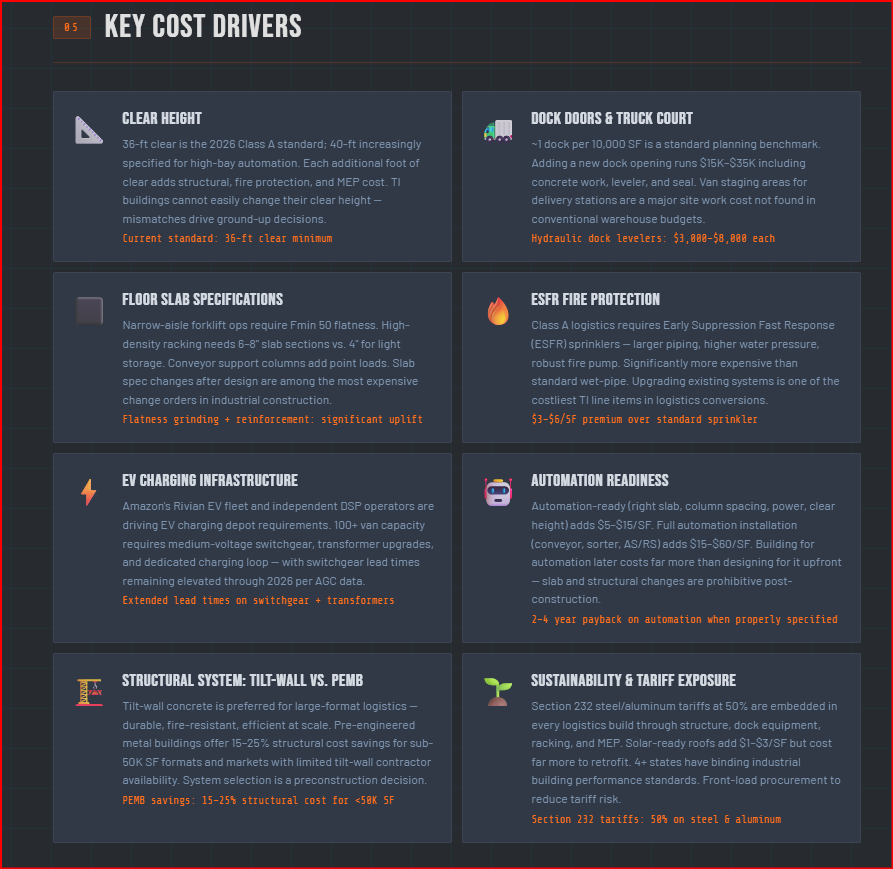
Within any facility type and region, these are the variables that create the most significant cost variance between projects at the low end and the high end of the range. The overwhelming majority of them are decisions made before construction begins — which is why engaging a GC at the preconstruction stage is the highest-return investment a logistics developer or operator can make before breaking ground.
1. Site Selection and Access Infrastructure
Logistics facilities are fundamentally access-dependent: trucks must be able to reach them, navigate their truck courts, and turn around efficiently. A site that appears attractively priced may require road widening, traffic signal installation, curb cut permits, or off-site infrastructure improvements as a condition of development approval — adding $500,000 to $3 million or more in costs that don't appear in the building's per-square-foot estimate. Rail access, proximity to major interstate interchanges, and freeway visibility all affect both operational efficiency and the total development cost. TCG's owners' representative team evaluates site access and off-site infrastructure requirements during due diligence before land purchase or lease execution.
2. Speculative vs. Build-to-Suit Development
Speculative industrial construction — building ahead of a committed tenant — accounted for a significant portion of the industrial construction surge between 2020 and 2023, and it is now pulling back as vacancy rates rise toward equilibrium in large-format facilities. Build-to-suit development — building to the specifications of a committed tenant — is regaining favor as operators seek facilities purpose-built for their operational programs rather than adapting their operations to what spec developers built. The cost difference between a spec build and a true build-to-suit is not necessarily in the shell, but in the TI scope: a logistics operator fitting out a spec building to their specific requirements may spend $20 to $60 per square foot in TI above what the spec developer delivered, depending on the gap between the spec building's standard and the tenant's operational specifications. Design-build delivery is particularly well-suited to build-to-suit logistics projects because it integrates operational programming, design, and construction cost validation from the earliest stages.
3. Clear Height and Structural System Implications
The decision to build to 32-foot vs. 36-foot vs. 40-foot clear height is not a rounding error in the budget. Each additional foot of clear height adds cost to the structural system, fire protection design, and building mechanical. It also adds long-term operational value through higher storage density and compatibility with future automation systems. The current market standard for new construction in most active logistics markets is 36-foot clear minimum; 40-foot clear is increasingly specified for large-format facilities where automated high-bay storage systems are anticipated. Tilt-wall construction's cost advantage over steel frame for large footprints is most pronounced at standard clear heights; very tall structures (40-foot and above) sometimes shift the cost equation toward other structural approaches depending on market conditions.
4. Tariff Exposure on Steel, Aluminum, and Copper
As we have covered in detail elsewhere, current Section 232 tariffs on steel and aluminum are running at 50% and are directly embedded in the cost of every logistics facility through structural steel, metal roofing and wall systems, dock equipment, racking systems, and MEP rough-in. For large-format logistics facilities with massive steel content — a 500,000-square-foot distribution center may have millions of pounds of structural steel and metal components — tariff exposure is a material budget risk. According to the AGC's Construction Inflation Alert, steel pricing volatility and material lead times remain elevated through 2026 as the market adjusts to the new tariff regime. Operators who work with a GC to front-load materials procurement contracts can significantly reduce mid-project price exposure on large industrial builds.
5. Automation Readiness vs. Automation Installation
There is an important distinction between designing a building that is automation-ready (the right slab, column spacing, electrical capacity, and clear height to support future automation) and a building with automation installed (conveyor systems, sorters, AS/RS, robotic picking). Most 3PL operators in 2026 are building automation-ready rather than installing full automation at project inception — particularly for first-generation facilities in new markets where throughput volumes need to prove out before capital-intensive automation investment is justified. The cost difference is significant: automation-ready features add $5 to $15 per square foot to the base building, while full automation installation can add $15 to $60 per square foot or more depending on the technology scope. Building the automation-ready case correctly at construction is far less expensive than retrofitting for automation later.
6. Environmental and Sustainability Requirements
Industrial building-performance standards are expanding rapidly. As of 2025, four U.S. states and more than 15 major municipalities have enacted binding building-performance standards affecting industrial facilities, with dozens more in draft, per Red Stag Fulfillment's 2025 warehouse construction guide. California's Title 24 energy code applies to industrial construction and drives additional HVAC, envelope, and lighting requirements. LEED certification, while optional in most markets, is increasingly required by institutional logistics tenants and e-commerce brand clients who have supply chain sustainability commitments. Solar-ready roof systems — structural reinforcement and conduit routing to support future photovoltaic installation — add $1 to $3 per square foot to a new roof system but cost significantly more if retrofitted later. According to Maxx Builders' Texas industrial cost guide, solar-ready roofs and LED lighting packages are now standard on Class A industrial builds in most markets and should be budgeted as baseline, not premium, items.
7. Construction Timeline and Lease Carry Costs
A ground-up small-to-mid-size logistics facility (50,000 to 200,000 SF) typically takes 10 to 14 months from site control to occupancy in a cooperative permitting market. Large-format distribution centers (500,000 SF and above) run 14 to 20 months or more. Every month of construction that extends the timeline before revenue-generating operations begin adds carrying cost — land financing, construction loan interest, and insurance — that represents real project cost not captured in the per-square-foot building estimate. Markets with complex entitlement environments (most California jurisdictions, some Northeast municipalities) can add 3 to 6 months to the pre-construction timeline. Design-build delivery consistently compresses the pre-construction-to-permit timeline by 20 to 30% compared to traditional design-bid-build procurement, representing a meaningful reduction in pre-revenue carrying cost on large projects.
The Four Planning Mistakes That Blow Logistics Construction Budgets
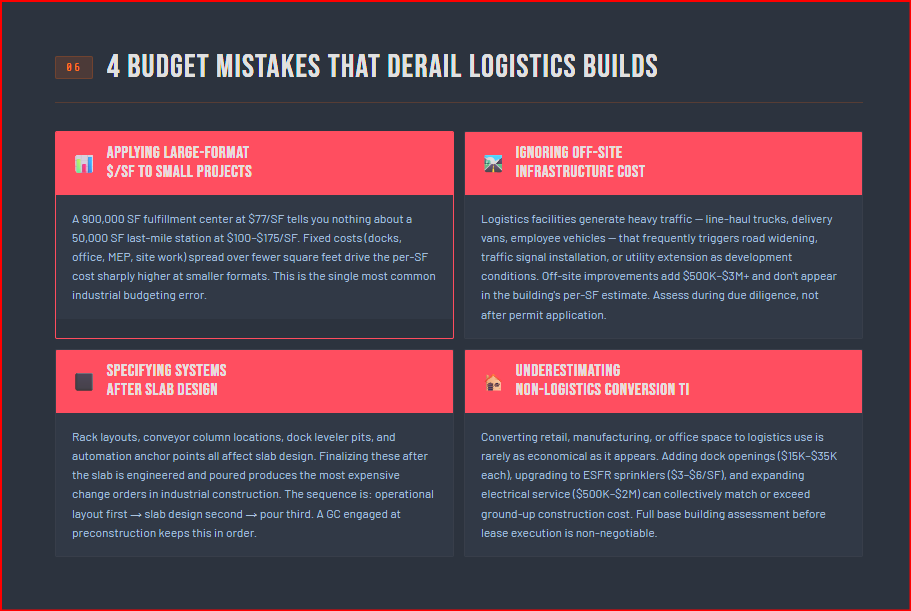
After managing industrial and commercial construction projects across the country, these are the four most consistent planning failures that derail 3PL and logistics facility budgets.
Benchmarking Large-Format Costs to Small-Format Projects
The per-square-foot cost of a 900,000-square-foot fulfillment center ($55 to $77/SF, per Cushman & Wakefield) has no application to a 50,000-square-foot last-mile delivery station ($100 to $175/SF). These are different buildings with different structural systems, different fixed-cost distributions, and different site work scopes. Developers and operators who apply large-format industrial per-square-foot benchmarks to small-format logistics projects consistently underbuild their budgets. The per-square-foot cost of logistics facilities rises sharply as footprint decreases, and any cost benchmark should be validated against projects of comparable size. TCG's preconstruction team provides current-market cost validation by facility type and size before clients commit to budgets or financing.
Ignoring Off-Site Infrastructure Requirements
Logistics facilities generate significant traffic — line-haul trucks, delivery vans, and employee vehicles in volumes that often require off-site road improvements, traffic signal installations, or utility extensions as conditions of development approval. These costs are real project costs that do not appear in building per-square-foot estimates, and they can be substantial. A logistics facility requiring a dedicated deceleration lane, traffic signal, and road widening at the site access point can easily add $500,000 to $2 million to a project budget before breaking ground on the building itself. Maxx Builders' Texas industrial cost guide specifically identifies off-site road and utility improvements as one of the most common budget surprise line items on logistics projects. A thorough traffic impact analysis and pre-application meeting with the local jurisdiction during due diligence is essential.
Specifying Building Systems After Slab Design
The concrete floor slab in a logistics facility is the most expensive single component to change after it is poured. Rack system layouts, conveyor support column locations, pit locations for dock levelers, and automation equipment anchoring all affect slab design — and finalizing these specifications after the slab has been engineered and poured produces change orders that are among the most costly in industrial construction. Operators who have not finalized their racking plan, dock equipment specifications, and automation layout before the slab is designed are building a project that will almost certainly encounter expensive mid-construction scope changes. Engaging a GC through preconstruction services from the earliest programming stage keeps the design sequence in the right order.
Underestimating TI Scope to Convert a Non-Logistics Building
Operators who lease retail big-box, former manufacturing, or office space for logistics conversion frequently discover that the gap between the existing building and logistics-grade specifications is far wider and more expensive to close than initial estimates suggest. Adding dock doors to a building that doesn't have them requires concrete cutting, structural modifications, exterior concrete aprons, levelers, and dock seals at $15,000 to $35,000 per opening. Upgrading a standard commercial sprinkler system to ESFR for high-bay pallet storage can cost $3 to $6 per square foot of warehouse area. Upgrading electrical service for automation or EV charging requires new switchgear and transformer work that can run $500,000 to $2 million depending on service size. The full scope of conversion must be assessed before the lease is signed, not after. TCG provides base building assessments and TI cost validation as part of our owners' representative services to help operators avoid this mistake.
Why Design-Build Delivery Creates Specific Value for Logistics Projects
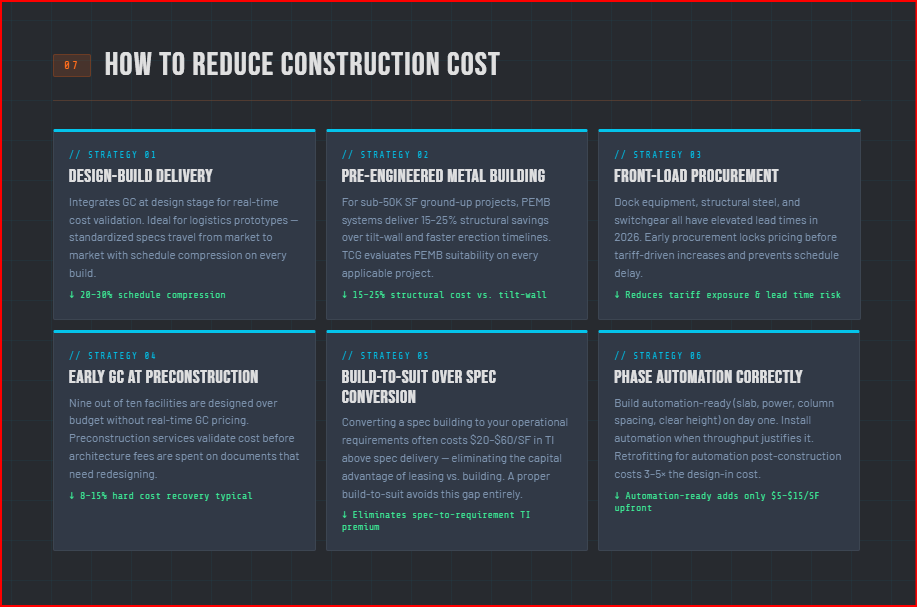
Logistics facility construction is one of the building types where design-build delivery creates the clearest and most measurable advantages for owners. The reasons are structural to the building type.
Logistics facilities have a well-defined set of performance specifications — clear height, dock count, slab flatness, fire suppression system, power capacity — that drive operational decisions, not architectural ones. When a GC is integrated at the design stage, structural systems can be optimized against current market pricing (tilt-wall vs. steel frame vs. PEMB), subcontractors can be pre-qualified and early-committed on long-lead items like structural steel and dock equipment, and the slab design sequence can proceed correctly — operational layout first, structure second. For multi-site logistics operators building a regional network of facilities, a standardized, cost-validated prototype built through design-build travels efficiently from market to market, compressing both schedule and cost on every subsequent location. TCG's preconstruction team works with logistics operators and their project managers to develop exactly this kind of repeatable, cost-validated prototype.
Start Your Logistics Project the Right Way
The decision to build or expand a 3PL or logistics facility is a capital commitment that will shape your operational capacity for a decade or more. The cost and timeline decisions made in the first 90 days of a project — site selection, facility type definition, structural system selection, GC engagement, and budget validation — determine whether the project delivers on its pro forma or erodes it.
Terrapin Construction Group provides preconstruction services, commercial general contracting, construction management, design-build delivery, and pre-engineered metal building solutions for 3PL, logistics, and industrial projects nationwide. If you're planning a logistics facility and want a frank, current-market conversation about what it's going to cost to build, we'd welcome a 30-minute call.
Schedule a conversation → calendly.com/will-terrapincg/30min
You may also find the following related reading useful:
Sources
Grand View Research — Third-Party Logistics (3PL) Market Report
Cushman & Wakefield — 2025 Industrial Construction Cost Guide
Cushman & Wakefield — U.S. Industrial Construction Cost Guide (Landing Page)
CBRE — Warehouse and Distribution Construction Cost Trends 2023–2024
Claris Design•Build — Commercial Construction Cost Per Square Foot 2025 Update
Maxx Builders — 2026 Warehouse Construction Cost Per Square Foot in Texas
Maxx Builders — Warehouse Construction Cost Per Square Foot: Comprehensive Guide
ReadySpaces — 2026 Warehouse Market Report: Pricing & Availability by Region
HomeGuide — Commercial Construction Cost Per Square Foot, 2026
Supply Chain Dive — Amazon Expands Rural Delivery with Oklahoma Last-Mile Station
Retail Dive — Amazon Expands Rural Delivery with Oklahoma Last-Mile Station
WQAD — Amazon Expands Footprint in Davenport with New Last-Mile Delivery Facility
EMARKETER — Last-Mile Delivery: How the Final Step of Fulfillment Will Take Shape in 2026
Upper Inc. — Amazon Last-Mile Delivery: Strategy & Tech in 2026
National Steel Buildings — Warehouse Building Cost Per Square Foot: What to Expect
BusinessPlanSuite — How Much Does It Cost to Start a Distribution Center?
Solutions GC — Tenant Improvement: How to Budget and Negotiate TI Allowance
NFPA 13 — Standard for the Installation of Sprinkler Systems
U.S. Bureau of Labor Statistics — Producer Price Index for Nonresidential Building Construction
Last updated: March 2026. Cost data is directional and based on publicly available industry benchmarks. Actual costs will vary by project scope, location, contractor, and market conditions. Consult a qualified contractor and industrial real estate professional for project-specific estimates.
Frequently Asked Questions: 3PL Warehouse Construction Costs
How much does it cost to build a 3PL warehouse per square foot?
A ground-up 3PL or logistics warehouse costs $55 to $175 per square foot for large-format distribution facilities, or $150 to $300+ per square foot for purpose-built last-mile delivery stations with dock infrastructure, office buildout, and automation-ready systems. Site work on large-format logistics projects can represent 15–25% of total hard costs.
What drives the cost difference between a basic warehouse and a 3PL facility?
Dock infrastructure (number and type of dock doors), clear height, floor flatness specifications, office and mezzanine buildout, fire suppression requirements, electrical service capacity for automation, and climate control all increase cost above a basic warehouse shell. A 36-foot clear height warehouse with 50+ dock doors and automation infrastructure is a fundamentally different project than a 24-foot clear basic dry storage building.
How long does it take to build a 3PL warehouse?
Large-format distribution facilities typically take 8 to 14 months from permit to CO. PEMB-based warehouses on prepared sites can be completed in 6–9 months. Complex multi-temperature or automation-ready facilities take 12–18 months. Site work and permitting on greenfield sites can add 3–6 months to overall project timeline.
Is a PEMB the best structural system for warehouse construction?
Pre-engineered metal buildings are the most cost-effective structural system for single-story warehouse construction up to approximately 200,000 SF, offering 15–25% savings over conventional steel with faster fabrication and erection. For larger or multi-story facilities, conventional structural steel may be required.
How do warehouse construction costs vary by region?
Texas, the Southeast, and parts of the Midwest offer the lowest warehouse construction costs, running 10–20% below national average. Denver and the Mountain West run 10–20% above. The Northeast and West Coast run 25–50% above national average. Labor market conditions, union requirements, and site availability drive these differences.
How do I get a warehouse construction estimate?
TCG's AI construction estimator provides preliminary warehouse cost estimates in under two minutes. Schedule a call for formal preconstruction budgeting.
