
Average Cost to Build a Cold Storage Facility in the USA (2026): Refrigerated, Frozen, and Blast Freeze — Tenant Improvement vs. Ground-Up by Region
Short Answer
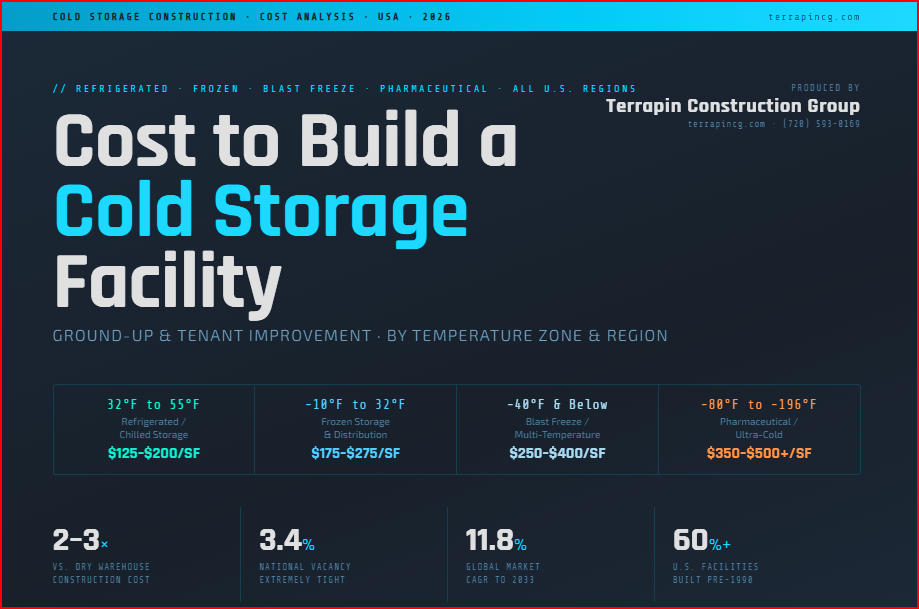
According to Terrapin Construction Group, which has installed more than 1 million square feet of insulated metal panel in 38 states, ground-up cold storage costs $150 to $250 per square foot for cooler space at 35°F, $200 to $350 for freezer space at 0°F, and $280 to $450 for blast freeze at minus 40°F, compared with $60 to $150 for a dry warehouse. Refrigeration, the insulated metal panel envelope, and sub-slab heating drive the premium.
Source: Terrapin Construction Group, design-build general contractor licensed in all 50 states. Data as of 2026.
Cold storage is the fastest-growing and most capital-intensive segment of industrial real estate construction in the United States. The global cold storage market was valued at $185.75 billion in 2025 and is projected to reach $474.21 billion by 2033, expanding at a compound annual growth rate of 11.8%, according to Grand View Research. In the United States specifically, the domestic cold storage market is forecast to grow from $46.28 billion in 2025 to $127.72 billion by 2035 — a CAGR exceeding 10% — driven by e-commerce grocery penetration, expanding pharmaceutical cold chain requirements for biologics and mRNA vaccines, FDA food safety mandates, and the escalating consumer demand for fresh and frozen goods.
The supply side is acutely strained. National cold storage vacancy hovers around 3.4% — significantly tighter than the 5 to 7% vacancy in conventional dry warehouse space — and more than 60% of existing U.S. cold storage facilities were built before 1990. Lineage Logistics and Americold Realty Trust, the two dominant operators in the space, have collectively added more than 18 million square feet of new capacity since 2019, and both continue to invest aggressively. Automated cold storage facilities are growing at a projected 16.72% CAGR through 2031, according to Mordor Intelligence, as operators race to address labor scarcity with technology. The gap between demand and modern cold storage supply is real, structural, and unlikely to close quickly — which is why developers, food distributors, pharmaceutical operators, and 3PL providers are all actively planning new cold storage construction right now.
The construction cost question is where things get complicated. Cold storage facilities cost two to three times more per square foot than equivalent dry warehouse construction — and the range within cold storage itself is enormous, driven by temperature requirements, refrigerant system design, facility size, and geography. A basic refrigerated cooler in a right-to-work state and a purpose-built ultra-low pharmaceutical freezer in the Boston suburbs are both "cold storage buildings" — and their construction cost profiles are completely different. This article gives you the full picture: what cold storage construction actually costs in 2026, by facility type, temperature zone, delivery method, and U.S. region. At Terrapin Construction Group, we build commercial and industrial projects across all 50 states. The benchmarks here draw on our own project experience and current data from RSMeans/Gordian, the International Institute of Ammonia Refrigeration (IIAR).
The Cold Storage Facility Landscape: Not All Cold Storage Is the Same
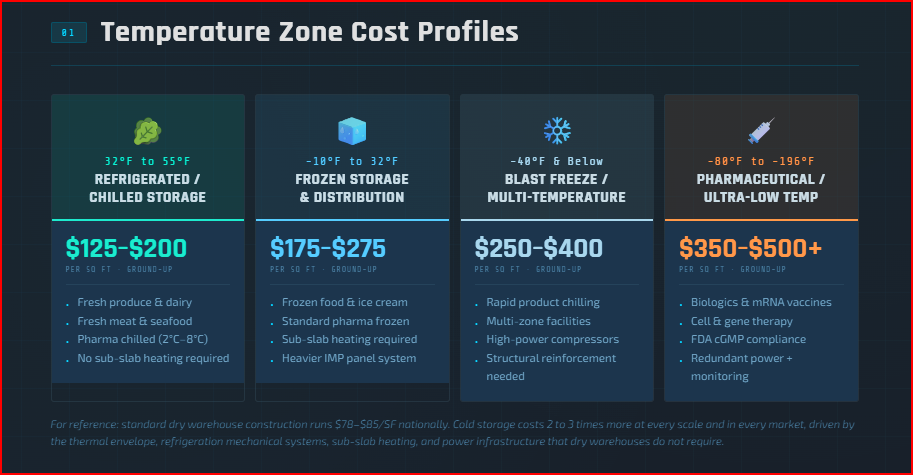
The most consequential thing a developer or operator can do before getting into cost figures is define precisely which type of cold storage facility they are building. Temperature zone determines insulation requirements, refrigeration system design, structural load implications, sub-slab heating, fire protection strategy, and the overall cost per square foot more than any other single variable. The four primary cold storage categories have materially different construction profiles.
Refrigerated / Chilled Storage (32°F to 55°F)
Chilled storage — the refrigerated range used for fresh produce, dairy, fresh meat, and certain pharmaceuticals requiring 2°C to 8°C storage — is the entry level of cold storage construction complexity. It requires continuous insulation in walls, ceiling, and floor, climate-controlled dock doors with air curtains to prevent warm air infiltration, and refrigeration mechanical systems, but it does not require the sub-slab heating systems and extreme vapor management that deep freeze facilities demand. Per t-racking.com's 2025 cold storage cost analysis, basic refrigerated storage runs approximately $125 to $150 per square foot for ground-up construction at national averages. This is the most accessible tier of cold storage construction cost — and still nearly double the cost of an equivalent dry warehouse.
Frozen Storage (-10°F to 32°F)
Frozen storage — used for frozen foods, ice cream, and standard pharmaceutical frozen product lines — represents the most common construction profile for purpose-built cold storage facilities. Frozen facilities require thicker insulated metal panel (IMP) walls and roof systems, a heated sub-slab system to prevent ground frost heave (which can structurally destabilize a facility over time), more powerful refrigeration mechanical systems, higher electrical service requirements, and specialized high-speed insulated doors at every dock position and interior partition.
Blast Freeze Facilities (-40°F and Below)
Blast freezers — used to rapidly chill product before transfer to standard frozen storage — operate at extreme temperatures that create additional construction requirements on top of standard frozen facility design. The refrigeration mechanical systems for blast freeze operation are significantly more powerful and more expensive than standard frozen storage equipment. Structural reinforcement for the loading generated by heavy refrigeration equipment, specialized electrical service sizing for high-draw compressors, and enhanced vapor barrier systems all add cost. Facilities with dedicated blast freeze rooms or integrated blast freeze capacity represent some of the highest per-square-foot construction costs in the cold storage category.
Pharmaceutical and Ultra-Low Temperature Storage (-80°F to -196°F)
The pharmaceutical cold chain segment is the fastest-growing sector in cold storage construction, driven by the expanding pipeline of biologics, cell and gene therapies, and mRNA vaccine platforms that require ultra-low temperature storage at -80°C and below. The pharmaceuticals segment is projected to grow at a 13.82% CAGR through 2035, per Custom Market Insights — faster than any other cold storage application. Ultra-low temperature pharmaceutical facilities require cryogenic storage systems, redundant refrigeration and power infrastructure, validated temperature monitoring systems meeting FDA current Good Manufacturing Practice (cGMP) regulations, and HVAC systems designed to pharmaceutical-grade standards. Construction costs for purpose-built pharmaceutical cold storage facilities at ultra-low temperature specifications regularly exceed $400 per square foot and can reach significantly higher depending on the level of GMP compliance and validated system documentation required.
Tenant Improvement vs. Ground-Up for Cold Storage: A Different Calculus Than Dry Warehouse

The TI vs. ground-up decision is more nuanced for cold storage than for any other industrial facility type, because the gap between what a standard industrial building provides and what cold storage requires is enormous. Converting an existing dry warehouse into cold storage — a "box within a box" approach — is technically feasible but rarely as economical as it appears on the surface.
Cold Storage Tenant Improvement / Conversion
Converting existing industrial, manufacturing, or warehouse space to cold storage use involves the installation of insulated metal panel (IMP) wall and ceiling systems inside the existing structure, sub-slab insulation and heating systems for frozen applications, refrigeration mechanical systems and associated electrical upgrades, high-speed insulated dock doors, vapor barriers and thermal breaks at every penetration, and all supporting MEP work. According to Premier Development Partners' cold storage market analysis, converting a dry warehouse to cold storage costs approximately $100 to $150 per square foot for the conversion scope alone — and that figure frequently approaches or exceeds the cost of ground-up construction when the limitations of the existing building are fully accounted for. The structural compatibility issue is critical: cold room refrigeration systems mounted to the existing roof structure add significant loads that the original building may not be designed to carry, requiring structural reinforcement before the cold room system can be installed. A structural engineer assessment before lease execution is not optional on cold storage conversion projects.
The case for TI cold storage conversion is strongest when a second-generation cold storage building is available — a facility previously used for temperature-controlled operations that already has IMP wall systems, sub-slab protection, refrigeration equipment room infrastructure, and appropriately sized electrical service. True second-generation cold storage is scarce in most U.S. markets given the age of the existing inventory. TCG's owners' representative team conducts detailed base building assessments specifically for cold storage conversion feasibility before our clients enter lease negotiations — evaluating structural load capacity, electrical service adequacy, floor slab condition and existing sub-slab protection, and existing insulation system condition. The cost of discovering these limitations after a lease is signed is always higher than discovering them during due diligence.
Ground-Up Cold Storage Construction
A purpose-built ground-up cold storage facility gives an operator complete control over every specification that drives operational performance and energy efficiency: insulation R-value, refrigeration system design and capacity, sub-slab heating layout, electrical service sizing, dock door count and configuration, clear height for high-density racking, and the building envelope's thermal integrity. For most serious cold storage operators — particularly those building food-grade or pharmaceutical-grade facilities — ground-up construction is the only path to a building that truly performs at the required standard.
The dominant structural approach for ground-up cold storage is insulated metal panel (IMP) construction, in which the building envelope itself serves as the insulating layer — eliminating the "box within a box" inefficiency of cold room conversion within a conventional building. TCG installs IMP systems as a core competency in cold storage and refrigerated facility construction, and our team is experienced in coordinating the IMP envelope design with refrigeration mechanical, structural, and MEP systems from the earliest design stage. For smaller footprint cold storage facilities in suburban and semi-rural markets, pre-engineered metal building structural systems combined with IMP envelope panels offer meaningful structural cost savings over conventional steel frame construction without compromising thermal performance.
TCG provides preconstruction services, commercial general contracting, construction management, and design-build delivery for cold storage and refrigerated facility projects nationwide.
Cold Storage Construction Cost Per Square Foot: 2026 National Benchmarks
The following ranges represent current national average hard construction costs by temperature zone and facility type. They exclude land acquisition, architectural and engineering fees (typically 6 to 10% of hard costs), permitting, owner-supplied refrigeration equipment where separately procured, racking systems, automation, and pre-opening expenses. Regional adjustments are addressed in the following section.
Refrigerated / Chilled Storage (32°F to 55°F): $125 to $200 Per Square Foot
Ground-up refrigerated storage facilities — fresh produce, dairy, fresh meat, pharmaceutical chilled storage — can run upwards of $200 per square foot at national average construction costs in open-shop markets. The lower end of this range reflects efficient mid-size footprints in favorable markets with straightforward utility conditions. The upper end reflects smaller facilities (where fixed costs per square foot rise), complex sites, or higher-specification chilled pharmaceutical facilities.
Frozen Storage (-10°F to 32°F): $175 to $275 Per Square Foot
Frozen storage represents the standard benchmark that most cold storage cost discussions are built around, and this range reflects current national market conditions for a purpose-built frozen distribution facility. The refrigeration system component alone accounts for 25 to 35% of total construction cost at this temperature level, per IIAR benchmarks cited by Industrial Refrigeration Pros. Sub-slab heating, thicker IMP systems, and the mechanical complexity of maintaining temperatures in the -10°F to 0°F range drive the premium over refrigerated storage. Maxx Builders' 2026 Texas industrial cost analysis notes that cold storage and manufacturing facilities in Texas can exceed $400 per square foot, reflecting the premium of frozen-to-blast-freeze scope in a mid-cost market.
Blast Freeze / Multi-Temperature: $250 to $400 Per Square Foot
Facilities with dedicated blast freeze capacity, or those incorporating multiple temperature zones within a single building envelope, represent the high end of the cost range for food-use cold storage. The mechanical complexity of blast freeze systems — high-velocity refrigeration capable of rapidly reducing product temperature from ambient or refrigerated to frozen — requires significantly more powerful compressor and evaporator equipment than standard frozen storage. Multi-temperature zone facilities require insulated partition walls between zones, separate refrigeration circuits for each zone, and careful envelope design to prevent thermal bridging between zones. These factors compound toward a cost structure that approaches pharmaceutical facility construction at the upper end.
Pharmaceutical / Ultra-Low Temperature: $350 to $500+ Per Square Foot
Purpose-built pharmaceutical cold storage — particularly facilities designed for ultra-low temperature biologics and cell therapy storage at -80°C and below — represents the highest per-square-foot construction cost in the cold storage category. Validated refrigeration systems with full redundancy, cryogenic storage infrastructure, GMP-compliant room finishes, validated temperature monitoring and logging systems, emergency power with no-break transfer capability, and the documentation and commissioning requirements of a regulated pharmaceutical environment all add cost layers not present in food-grade cold storage construction. This segment of the market is growing faster than any other, with automated cold stores projected to grow at 16.72% CAGR through 2031 driven substantially by pharmaceutical and biotech supply chain requirements.
Regional Cold Storage Construction Costs: What You'll Actually Pay by Market
Cold storage construction costs vary meaningfully by U.S. region, driven by the same labor market, union density, regulatory complexity, and material logistics factors that affect all commercial construction — but amplified by the specialized contractor base required for refrigeration mechanical work. Unlike dry warehouse construction, cold storage refrigeration mechanical is not a commodity subcontract available from every industrial mechanical contractor in the market. In many secondary and tertiary markets, the scarcity of qualified cold storage refrigeration contractors is itself a meaningful cost premium, independent of general regional labor factors.
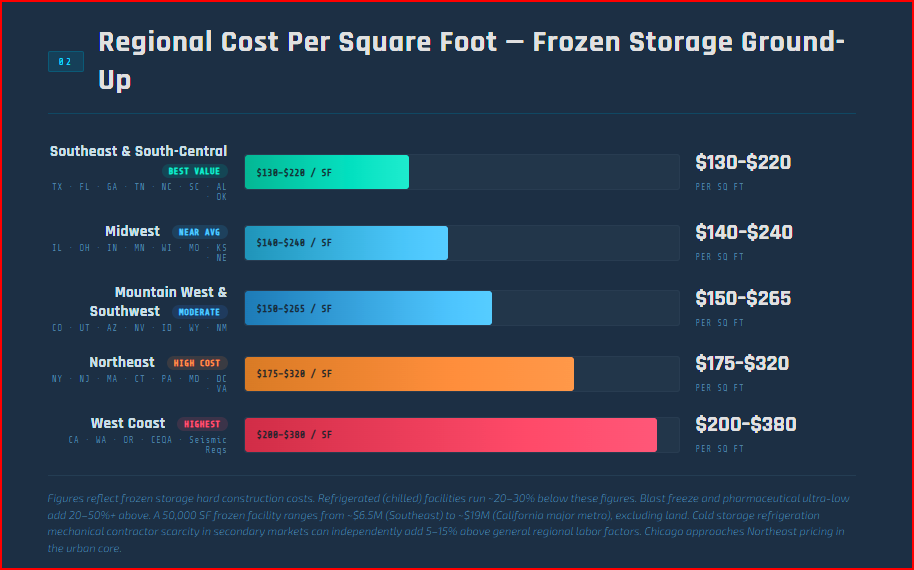
Southeast and South-Central (TX, FL, GA, TN, NC, SC, AL, MS, AR, OK)
The Southeast offers the most favorable construction cost environment for cold storage development in the United States. Right-to-work labor markets, a competitive subcontractor base, and active cold chain construction activity along the Gulf Coast and I-85/I-75 corridors have developed a deeper pool of qualified refrigeration mechanical contractors than most other regions. Texas in particular is experiencing significant cold storage investment driven by border trade through Laredo and El Paso, port activity at Houston, and the central logistics position of the Dallas-Fort Worth market. Terrapin's Houston office builds across the Texas industrial and cold storage market. A typical 50,000-square-foot frozen storage facility in the Southeast or Texas runs $6.5 million to $11 million all-in, excluding land. Sunbelt states including Texas, Florida, and Georgia are projected to dominate new cold storage builds nationally through 2030 due to population growth and trade corridor positioning.
Midwest (IL, OH, IN, MI, MN, WI, MO, IA, KS, NE)
The Midwest tracks at or near the national average for cold storage construction with the standard Chicago exception. Chicago's union labor market adds 15 to 25% to labor costs relative to secondary Midwest markets. Illinois, Ohio, Indiana, Minnesota, and Missouri all have established cold storage construction ecosystems given their long history as food processing and distribution hubs. Secondary markets — Indianapolis, Columbus, Kansas City, St. Louis — offer near-average pricing with access to qualified refrigeration subcontractors developed through decades of food industry construction. A 50,000-square-foot frozen storage facility in a secondary Midwest market runs $7 million to $12 million all-in, excluding land.
Mountain West and Southwest (CO, UT, WY, ID, AZ, NV, NM)
The Mountain West has experienced significant construction cost appreciation across all building types over the past five years, driven by population growth and sustained commercial development activity outpacing labor market growth. Phoenix has emerged as a preferred location for cold storage development given its land availability, favorable permitting environment, and positioning for Southwest regional distribution — but construction costs here run 10 to 20% above the national average. Denver, Salt Lake City, and Boise are all active but face the same labor market tightening. Terrapin's Denver-based team builds across the Mountain West region. A 50,000-square-foot frozen storage facility in Colorado or Arizona runs $7.5 million to $13.25 million all-in, excluding land.
Northeast (NY, NJ, MA, CT, PA, MD, DC, VA)
The Northeast carries the most significant cold storage construction cost premiums outside of California. Union labor in most major markets, dense infill sites with complex logistics, high permit fees, and some of the most demanding energy code requirements in the country all drive costs 30 to 50% above the national average. Terrapin's Albany office serves the greater Northeast market. The revenue-side counterpart is equally pronounced: the Northeast contains some of the most densely populated and highest-income cold storage catchment areas in the country, supporting a premium on cold storage real estate that partially offsets the construction cost burden. Urban last-mile cold storage — refrigerated micro-fulfillment nodes positioned within 10 to 15 miles of major population centers for e-commerce grocery delivery — commands the highest rents in the sector. A 50,000-square-foot frozen storage facility in the Northeast runs $8.75 million to $16 million all-in, excluding land.
West Coast (CA, WA, OR)
California is the highest absolute cost construction environment in the country for cold storage development. The combination of high union and prevailing wage labor costs, CEQA environmental review, Title 24 energy code requirements that impose particularly demanding standards on refrigerated buildings, seismic engineering requirements that affect IMP panel anchoring and equipment support systems, and California's California Department of Food and Agriculture food safety regulations creates a regulatory and cost environment without parallel in any other U.S. market. Pharmaceutical cold storage in the Bay Area or Los Angeles, built to FDA cGMP standards, represents the highest-cost cold storage construction in the United States. A 50,000-square-foot frozen storage facility in the California major metros runs $10 million to $19 million all-in, excluding land. Oregon and Washington, outside of the Portland and Seattle metros, are somewhat more accessible — generally running 20 to 30% above the national average in secondary markets.
Key Considerations for Cold Storage Construction: What Moves the Number Most
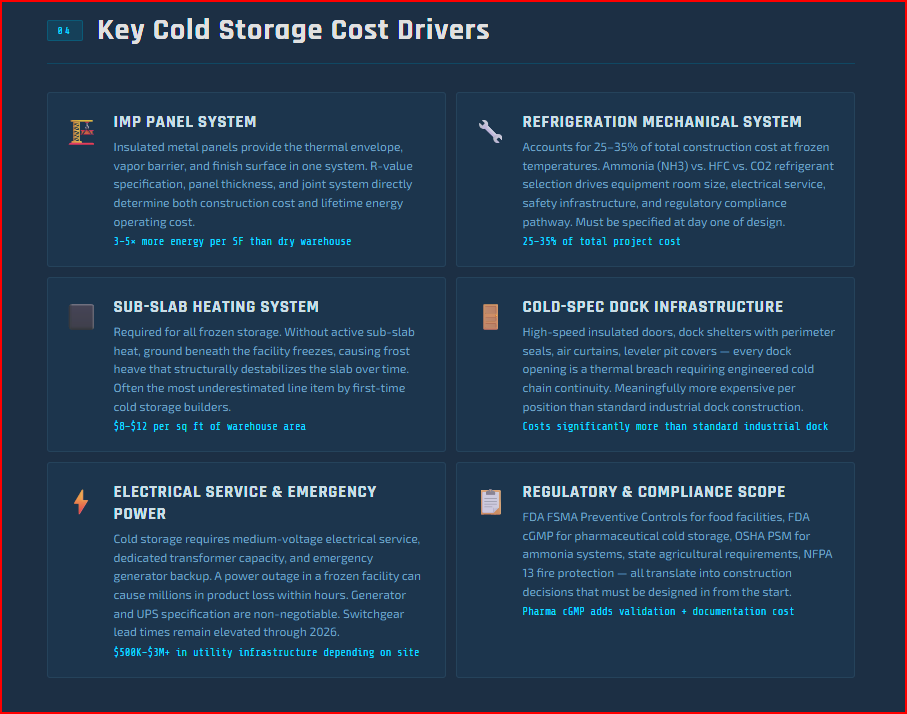
Within any temperature zone and region, these are the variables that create the greatest cost variance between projects at the low end and the high end of the range. The single most consistent observation from cold storage construction projects is that operators who define their operational program before engaging an architect or GC consistently build better facilities at lower cost than those who start with a building shell and work backward. Engaging a GC at the preconstruction stage — before architecture fees are spent on documents that may need to be redesigned — is the highest-return investment a cold storage developer or operator can make.
1. Temperature Zone Definition and the Refrigerant Choice
The decision about temperature zone and refrigerant system type must be made at the earliest stage of project programming — not during design development. Ammonia (NH3) refrigeration systems are less expensive to procure and more energy-efficient than hydrofluorocarbon (HFC) systems at large scale, but they require specialized safety infrastructure: OSHA Process Safety Management (PSM) compliance for systems over 10,000 pounds of ammonia, leak detection systems, emergency ventilation, and worker safety training programs. CO2 transcritical systems are increasingly popular for their environmental profile and reduced regulatory burden compared to ammonia, but they carry higher upfront mechanical costs. The refrigerant decision affects the equipment room size, electrical service sizing, fire protection strategy, and regulatory compliance pathway — all of which are foundational inputs to the construction scope. Changing the refrigerant system after design is underway produces expensive redesigns.
2. Insulated Metal Panel (IMP) System Specification
The insulated metal panel system is the defining construction element of a purpose-built cold storage facility. IMP systems — factory-fabricated insulated wall and roof panels combining structural steel facing with polyurethane foam cores — provide the thermal envelope, vapor barrier, and finish surface in a single system. The specification of R-value, panel thickness, facing gauge, and joint system directly determines both the construction cost and the long-term energy operating cost of the facility. Higher R-value panels cost more upfront but deliver meaningful energy savings over the facility's life — critical given that cold storage facilities consume three to five times more energy per square foot than standard dry warehouses, with monthly energy costs running $0.50 to $1.25 per square foot. TCG installs IMP systems as a specialized competency and can provide current-market pricing on panel specifications during the preconstruction phase. For operators prioritizing long-term operational cost, the IMP specification is one of the highest-leverage capital decisions in the project.
3. Sub-Slab Heating and Floor System Design
For frozen storage at temperatures below 32°F, a sub-slab heating system is not optional — it is a structural necessity. Without active heating below the concrete floor slab, the ground beneath a frozen facility will eventually freeze, causing frost heave that can crack and displace the slab over time, leading to costly structural repairs and operational disruption. Sub-slab heating systems run $8 to $12 per square foot of warehouse area. On a 50,000-square-foot frozen facility, that is a $400,000 to $600,000 line item that first-time cold storage builders consistently underestimate. The floor slab itself must also be designed for the point loads generated by high-density cold storage racking — typically 6 to 8 inches of reinforced concrete, versus 4 inches for light dry storage — which adds meaningful cost to the slab budget.
4. Dock Infrastructure for Cold Chain Continuity
Every dock door in a cold storage facility is a thermal breach that, if not properly managed, allows warm moist air to infiltrate the cold envelope — raising refrigeration loads, creating condensation and ice buildup, and threatening product temperature integrity. Cold storage dock infrastructure goes well beyond standard industrial dock equipment: high-speed insulated doors (versus standard sectional doors), dock shelters with full perimeter seals, air curtain systems, dock leveler pit covers, and cold dock design that minimizes the thermal bridge at each door opening are all required. NFPA 13 fire protection requirements for cold storage buildings — particularly for high-piled frozen food storage — add further complexity to the dock design coordination. Each cold-spec dock door opening costs meaningfully more to construct than a standard industrial dock position.
5. Electrical Service Sizing and Emergency Power
Cold storage facilities are extraordinarily power-intensive. The refrigeration mechanical systems that maintain temperature 24 hours a day, seven days a year represent a constant, non-interruptible electrical load that standard commercial electrical service is not designed to handle. Large cold storage facilities require medium-voltage electrical service, dedicated transformer capacity for refrigeration equipment, and — critically — emergency backup power systems. A power outage in a frozen storage facility without generator backup can result in millions of dollars in product loss within hours. Emergency generator systems and uninterruptible power supply (UPS) infrastructure to bridge the gap between power loss and generator startup are essential capital investments that must be specified during design. Given the AGC's documented extended lead times on switchgear and transformers through 2026, electrical equipment procurement must be initiated very early in the project timeline to avoid construction delays.
6. Food Safety and Regulatory Compliance
Cold storage facilities handling food products must comply with FDA Food Safety Modernization Act (FSMA) Preventive Controls regulations, which impose requirements on facility design including floor drainage, wall and ceiling finish materials, pest exclusion, and temperature monitoring and logging systems. USDA-inspected facilities face additional construction requirements. FDA cGMP regulations for pharmaceutical cold storage impose the most demanding construction and validation requirements in the entire cold storage category. State agricultural departments may impose additional requirements on facilities storing certain commodities. All of these regulatory requirements translate into construction decisions — floor surface materials, drain design, wall finish specifications, door hardware — that add cost and must be coordinated with the GC from the earliest design stage to avoid expensive change orders. Design-build delivery is particularly valuable in navigating this regulatory coordination because it keeps the architect, GC, and regulatory compliance pathway aligned in a single integrated team.
7. Automation Readiness for Cold Storage Operations
Cold storage is the industrial segment with the most compelling economic case for automation because of the human cost of working in freezing and subfreezing conditions. Automated cold storage facilities are projected to grow at 16.72% CAGR through 2031. Automated Storage and Retrieval Systems (AS/RS) — high-bay automated racking systems that can operate in extreme cold without human workers in the storage zone — require specific building design inputs: extreme clear height (40 to 100 feet for high-bay AS/RS), precise column spacing to match racking module dimensions, reinforced floor slabs for racking loads, and automation-specific fire protection designs. As with logistics automation, the cost to design a building for future AS/RS installation is far lower than retrofitting for it after construction. TCG's equipment procurement division helps cold storage operators sequence and procure long-lead refrigeration and automation equipment coordinated with the construction schedule.
The Four Planning Mistakes That Derail Cold Storage Budgets
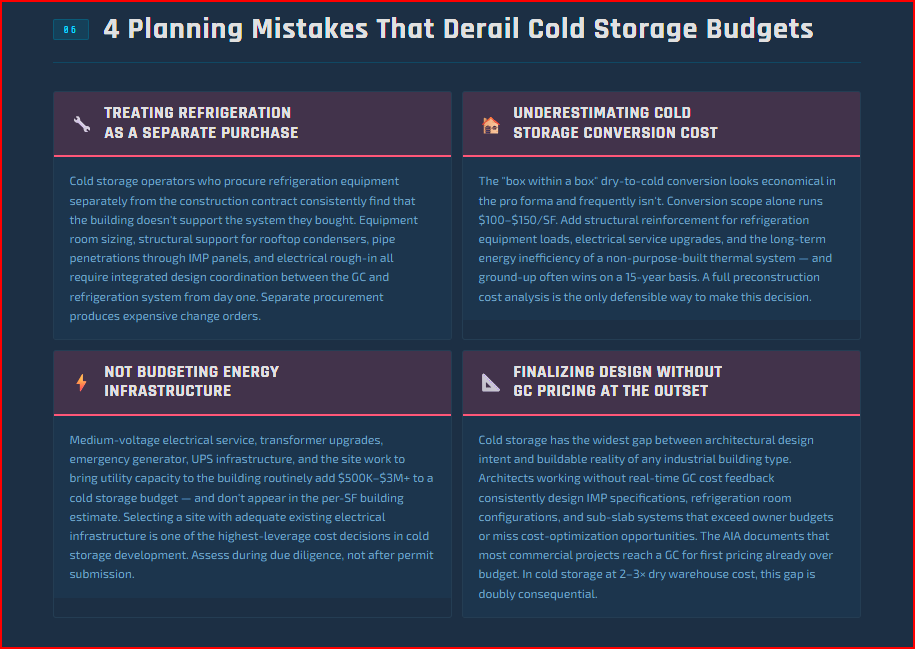
Cold storage construction has the tightest design-to-budget tolerance of any industrial building type. The consequences of scope definition errors are larger here than anywhere else in commercial construction.
Treating the Refrigeration System as a Separate Purchase
Cold storage operators who treat refrigeration mechanical as owner-furnished equipment — procured separately from the construction contract — frequently discover that the building the GC designs and builds does not adequately support the refrigeration system the owner actually procures. Equipment room dimensions, structural support for condensers on the roof, refrigerant piping penetrations through the IMP envelope, electrical rough-in sizing, and the coordination between refrigeration pipe routing and the building's structural bays all require integrated design collaboration between the GC, the mechanical contractor, and the refrigeration equipment supplier. Separating these scopes produces coordination failures that show up as expensive change orders during construction. The most successful cold storage projects treat refrigeration system design as an integrated part of the building design from the earliest stage, which is precisely what design-build delivery enables.
Underestimating the True Cost of Cold Storage Conversion
As discussed above, the "box within a box" cold room conversion of an existing dry warehouse looks economical in initial pro forma analysis and frequently is not. Conversion costs of $100 to $150 per square foot for a full frozen storage installation within an existing building, combined with the structural reinforcement required to support refrigeration equipment loads and the ongoing energy inefficiency of a thermal system not designed from the ground up, mean that conversion projects often fail to deliver the long-term economics that justify the initial decision. A thorough preconstruction cost analysis comparing true conversion cost against new ground-up construction on a 15- to 20-year basis is the only defensible way to make this decision.
Not Budgeting for Energy Infrastructure
The utility infrastructure required for a serious cold storage facility — medium-voltage electrical service, dedicated transformer capacity, emergency generator, UPS, and the site work required to bring adequate utility capacity to the building — is routinely underbudgeted by first-time cold storage developers. These costs do not appear in the building's per-square-foot construction estimate and can add $500,000 to $3 million to a project budget before a single IMP panel is installed, depending on the utility conditions of the site. Selecting a site with adequate existing electrical infrastructure is one of the most impactful cost-reduction decisions in cold storage development, and it is a decision made during site selection — not during construction. TCG's owners' representative team specifically evaluates electrical infrastructure availability during site due diligence for cold storage projects.
Finalizing Design Without GC Pricing at the Outset
Cold storage is the building type where the gap between architectural design intent and buildable reality is widest and most expensive to close. The thermal engineering of a cold storage facility — IMP specification, vapor barrier continuity, thermal bridging analysis, refrigeration load calculation — is highly technical, and architects working without real-time construction cost feedback from an experienced GC consistently produce designs that exceed owner budgets or that have cost-optimization opportunities that go unexplored until it is too late to act on them. According to the American Institute of Architects, the majority of commercial projects reach a GC for first pricing with a design that already exceeds the owner's budget. In cold storage, where costs are 2 to 3 times the dry warehouse baseline, this pattern is even more consequential. Engaging a GC at schematic design through preconstruction services is not a luxury — it is the only way to ensure that the design actually matches what the budget can deliver.
Why Design-Build Delivery Creates Specific Value for Cold Storage Projects
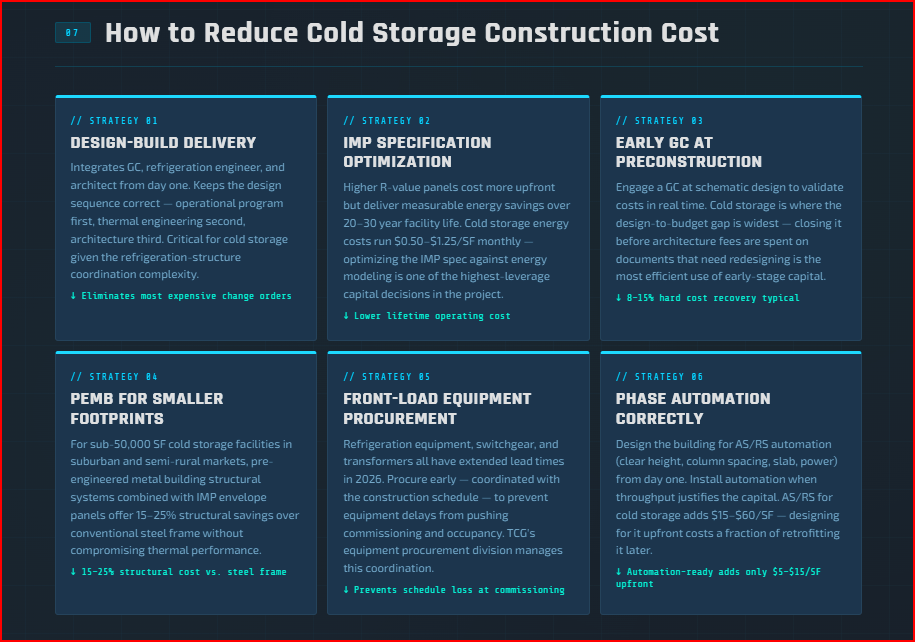
Cold storage construction is precisely the type of project where design-build delivery creates the most measurable owner value. The technical complexity of cold storage — refrigeration system integration, IMP envelope design, sub-slab engineering, regulatory compliance coordination — demands a level of design-construction team integration that the traditional design-bid-build procurement model cannot provide. When the GC, the mechanical engineer, the refrigeration system designer, and the architect are all working from the same integrated brief with real-time cost feedback, the design sequence proceeds in the right order: operational program first, thermal engineering second, architectural design third. This eliminates the most expensive and most common failure mode in cold storage construction: discovering mid-project that the building as designed does not actually support the refrigeration system or operational program as specified.
For multi-facility cold storage operators building a regional network — food distributors, pharmaceutical 3PLs, e-commerce grocery operators — a standardized, cost-validated prototype built through design-build travels efficiently from market to market. The thermal engineering is done once. The IMP specification is validated against current panel pricing. The refrigeration system integration is coordinated into the structural and MEP design from the outset. TCG's preconstruction team works with cold storage operators and their project managers to develop exactly this kind of repeatable, cost-validated prototype.
Start Your Cold Storage Project the Right Way
Cold storage construction is one of the highest-consequence capital decisions in industrial real estate. A facility designed and built correctly will deliver 20 to 30 years of efficient, compliant, temperature-controlled operation. A facility where the thermal envelope, refrigeration system, and sub-slab design were not properly integrated from the outset will cost more to operate, more to maintain, and more to correct — every year of its operating life.
Terrapin Construction Group provides preconstruction services, commercial general contracting, construction management, design-build delivery, and IMP installation for cold storage and refrigerated facility projects nationwide, headquartered in Denver, CO. If you're planning a cold storage build and want a frank, current-market conversation about what it's going to cost to build and how to do it right, we'd welcome a 30-minute call.
Schedule a conversation → calendly.com/will-terrapincg/30min
You may also find the following related reading useful:
Sources
Grand View Research — Cold Storage Market Size, Share & Trends Report
Custom Market Insights — U.S. Cold Storage Market Report 2026–2035
Mordor Intelligence — Cold Storage Market Size & Share 2026–2031
Wert-Berater — Cold Storage New Development Demand by State 2025
Clarion Construction — Understanding Cold Storage Construction Costs 2025
Xinguangzheng — Cold Storage Warehouse Construction Cost: 2026 Guide
Industrial Refrigeration Pros — The True Cost of Cold Storage: Beyond the Bid Price
Artic Cold — Cold Storage Warehouse Construction Cost Detail
T-Racking — Cold Storage Warehouse: Cost, Design, and Key Factors 2025
Premier Development Partners — Cold Storage: A Growing Real Estate Asset Class
Maxx Builders — Warehouse Construction Cost Per Square Foot: Comprehensive Guide
Maxx Builders — 2026 Warehouse Construction Cost Per Square Foot in Texas
HomeGuide — Commercial Construction Cost Per Square Foot 2026
FDA — FSMA Final Rule for Preventive Controls for Human Food
OSHA — Process Safety Management of Highly Hazardous Chemicals
NFPA 13 — Standard for the Installation of Sprinkler Systems
U.S. Bureau of Labor Statistics — Producer Price Index for Nonresidential Construction
Last updated: March 2026. Cost data is directional and based on publicly available industry benchmarks. Actual costs will vary by project scope, temperature zone, location, contractor selection, and market conditions. Consult a qualified contractor and cold storage specialist for project-specific estimates.
Frequently Asked Questions: Cold Storage Construction Costs
How much does it cost to build a cold storage facility per square foot?
Cold storage construction costs $130 to $350+ per square foot nationally in 2026, running 2 to 3 times more than standard dry warehouse construction. The cost varies dramatically by temperature zone — a refrigerated facility operating at 34–38°F costs significantly less than a blast-freeze facility at -20°F to -30°F. Building envelope, refrigeration systems, and reinforced floor systems are the primary cost drivers.
Why is cold storage so much more expensive than a regular warehouse?
Cold storage facilities require insulated metal panel (IMP) wall and roof systems for thermal performance, industrial refrigeration equipment, reinforced and insulated floor slabs to prevent frost heave, specialized vapor barriers, dock seals and climate-controlled loading areas, and backup power systems. These requirements add 2–3x the cost of a standard dry warehouse per square foot.
What type of wall and roof system is best for cold storage?
Insulated metal panels (IMPs) are the default wall and roof specification for cold storage construction. Panel thickness ranges from 3 inches for cooler applications to 6+ inches for blast-freeze. TCG maintains direct relationships with nine IMP manufacturers — Kingspan, Metl-Span, CENTRIA, PermaTherm, FALK, UPI, Arch Solar, AWIP, and MBCI — and installs panels nationwide.
How much does cold storage construction cost by region?
Southeast and Texas markets offer the lowest cold storage construction costs, running 10–20% below national average. The Midwest tracks near average. The Mountain West (Denver, Salt Lake City) runs 10–20% above. The Northeast runs 30–50% above national average due to union labor, shorter construction seasons, and elevated permit requirements.
How long does it take to build a cold storage facility?
A ground-up cold storage facility typically takes 10 to 18 months from design start to commissioning, depending on size and complexity. PEMB-based cold storage buildings on prepared sites can be completed faster. Refrigeration equipment lead times of 16–24 weeks are the most common schedule constraint and must be coordinated with structural and envelope installation.
Is a pre-engineered metal building suitable for cold storage?
Yes. PEMB structural systems with IMP wall and roof panels are the most cost-effective construction method for cold storage facilities, offering 15–25% structural cost savings over conventional steel with faster erection timelines. TCG evaluates PEMB suitability on every cold storage project during preconstruction.
How do I get a cold storage construction estimate?
Use TCG's AI construction estimator for preliminary pricing, or the IMP Install Estimator for envelope-specific costs. For formal preconstruction budgets, schedule a conversation with TCG's team.
