
Best Insulated Metal Panel (IMP) Manufacturers in the USA (2026): Kingspan, Metl-Span, CENTRIA, AWIP, PermaTherm, FALK, UPI, MBCI, and Arch Solar Compared
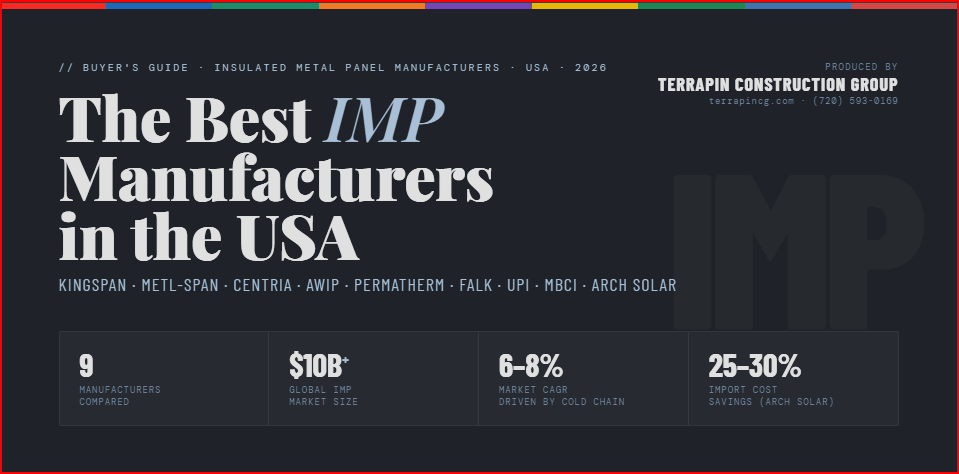
Insulated metal panels have become the dominant building envelope system for cold storage, food processing, pharmaceutical facilities, industrial warehouses, and an expanding range of commercial and institutional applications. The reason is straightforward: a single IMP system delivers the cladding, continuous insulation, air barrier, vapor barrier, and finished interior surface in one factory-fabricated component — eliminating three to five separate trades, compressing the construction schedule, and delivering a more thermally continuous, airtight envelope than field-assembled multi-component wall systems can reliably produce. The global insulated metal panel market is valued at over $10 billion and is growing at a 6 to 8% CAGR, driven by cold chain expansion, manufacturing reshoring, and the increasing premium placed on building energy performance.
For developers, owners, architects, and contractors planning a project that specifies IMP, the manufacturer selection decision matters enormously — and it is made early. Panel profile, core chemistry, joint system design, R-value per inch, fire rating, available thicknesses, cold storage suitability, lead times, regional distribution, and pricing all vary significantly between manufacturers. And increasingly, a tenth variable enters the conversation: the option to source FM-rated panels from international manufacturers at 25 to 30% below domestic pricing — a real trade-off that is worth understanding rather than dismissing.
At Terrapin Construction Group, IMP installation is a core competency. Our team installs panels from all major domestic manufacturers across commercial, industrial, and cold storage projects nationwide. We have no financial relationship with any panel manufacturer — our job is to match the right panel to each project's performance requirements, budget, and schedule. This guide gives you the honest comparison we use when advising our clients on the manufacturer decision.
What to Evaluate When Comparing IMP Manufacturers
Before getting into manufacturer-by-manufacturer comparisons, it is worth establishing the evaluation framework — because the "best" manufacturer depends entirely on the application. A panel that is ideal for an architectural commercial facade project may be entirely wrong for a blast freeze cold storage facility, and vice versa. The key variables to evaluate across manufacturers are:
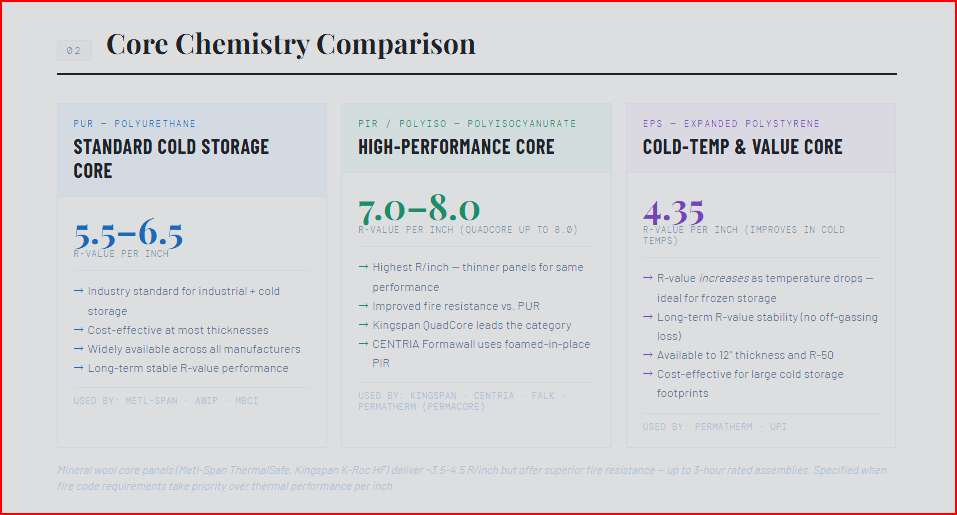
Core insulation chemistry is the most fundamental specification decision. The three primary IMP core types are polyurethane (PUR), polyisocyanurate (PIR), and mineral wool. PUR cores deliver R-values of approximately 5.5 to 6.5 per inch and are the standard for most industrial and cold storage applications. PIR cores deliver higher R-values of 7.0 to 8.0 per inch with improved fire resistance — Kingspan's QuadCore technology is a leading example. Mineral wool cores sacrifice thermal performance (approximately 3.5 to 4.5 R per inch) in exchange for significantly superior fire resistance and are specified in applications with stringent fire code requirements. The Metal Construction Association's IMP specification guidance recommends selecting core chemistry based on the project's thermal, fire, and moisture management hierarchy — not on price alone.
Joint system design determines the installed system's airtightness, water resistance, and thermal continuity at panel-to-panel interfaces — the locations most vulnerable to performance degradation. Double tongue-and-groove joints with factory-applied sealants deliver superior airtightness over single-lock systems. The quality of the joint detail is especially critical in cold storage applications where vapor drive through joint failures causes condensation, ice formation, and envelope deterioration.
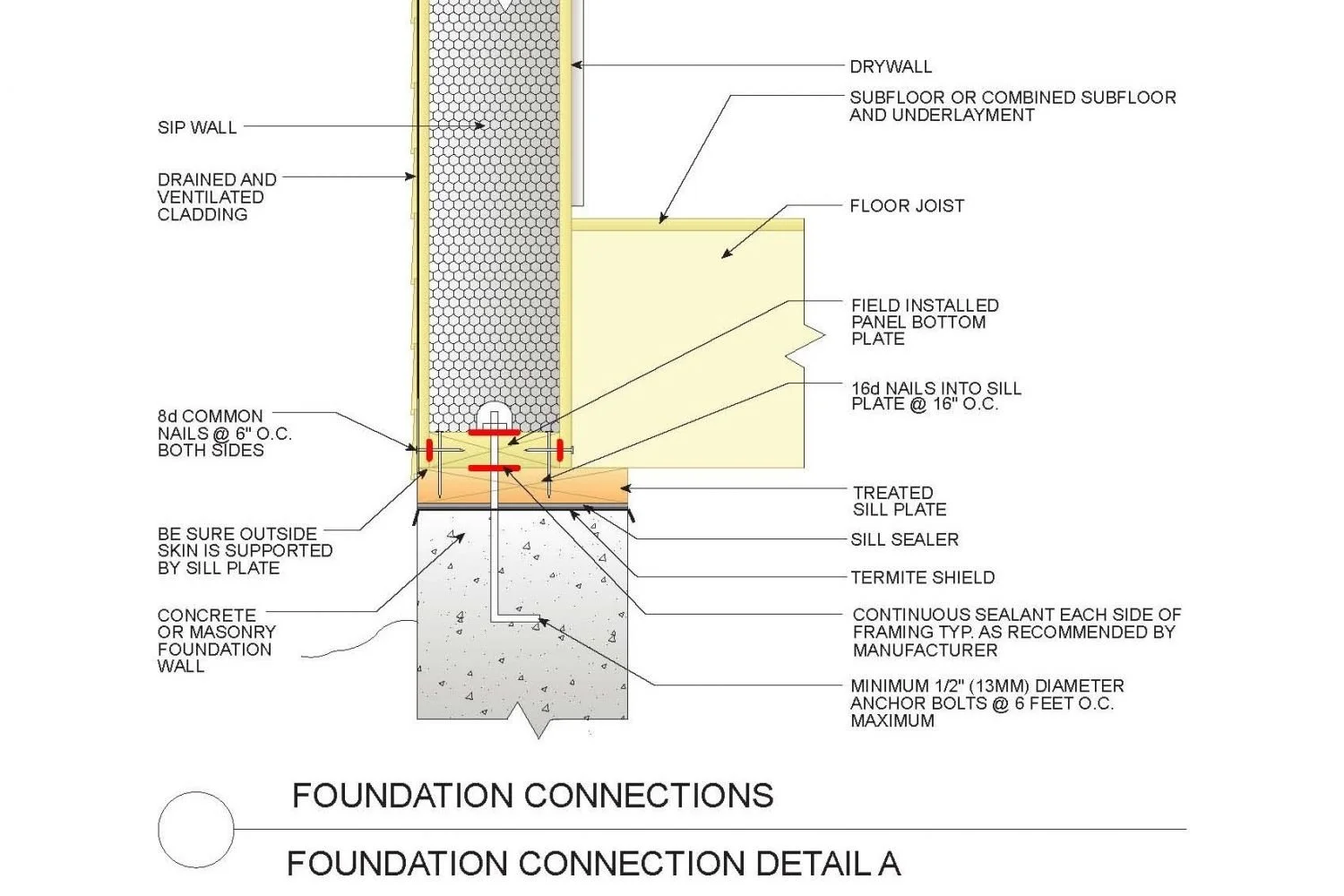
Available thicknesses and R-values must match the project's energy code requirements. ASHRAE 90.1, the energy standard referenced by most commercial building codes, specifies minimum continuous insulation R-values by climate zone and building type. Cold storage applications follow ASHRAE 170 for healthcare applications and industry-standard cold chain thermal design practices. Panels are commonly available from 2-inch to 6-inch thickness, with some manufacturers offering up to 8-inch panels for extreme cold storage applications.
Fire ratings and code compliance determine whether a panel can be used in a given occupancy classification. Most commercial and industrial IMP applications require panels to meet NFPA 285 fire propagation testing for exterior wall assemblies. Applications requiring 1-, 2-, or 3-hour fire-rated assemblies need specifically tested and listed panel systems. Mineral wool core panels generally provide the most robust fire resistance; PUR and PIR panels meet NFPA 285 in tested configurations but require specific installation details to maintain their listing.
FM Global approval is required on projects where the owner's property insurer is FM Global — which is common on industrial, manufacturing, pharmaceutical, and large cold storage projects. FM-approved panels have been tested and listed to FM Global's Approval Standards for wind uplift, fire, and moisture resistance. FM approval is an owner-driven specification requirement, not a general contractor preference, and it must be established at the earliest stage of panel selection.
Regional distribution and lead times are practical constraints that often override theoretical product preferences. A manufacturer with no production facility within 1,000 miles of a project will carry freight costs and lead times that a regional manufacturer does not. In 2026, domestic IMP lead times from major manufacturers typically run 8 to 16 weeks from order to delivery for standard specifications, with custom profiles and finishes adding further lead time. Engaging TCG's preconstruction team early ensures panel procurement is initiated at the right point in the project schedule.
Kingspan: The Global Performance Leader
Kingspan Insulated Panels North America is the most recognized IMP brand globally and arguably the most technically advanced manufacturer in the North American market. Headquartered in Ireland with manufacturing operations across the United States and Canada, Kingspan's competitive position is built on its proprietary QuadCore insulation technology — a hybrid polyisocyanurate core that delivers R-values of up to 8.0 per inch, higher thermal performance per inch of panel thickness than standard PUR or PIR cores, and GREENGUARD Gold certification for indoor air quality. The QuadCore core is also certified to Cradle to Cradle Material Health Certificate Silver level — relevant for projects pursuing LEED or other sustainability certifications.
Kingspan's commercial and industrial IMP product line includes the KS Series (wall panels in a range of profiles including Shadowline, Micro-Rib, Mini Wave, and Azteco), the Optimo flat architectural panel, the KarrierPanel barrier wall system, the K-Roc HF Series mineral wool fire-rated panels, and the KingSeam insulated standing seam roof system. For cold storage applications specifically, Kingspan offers a dedicated cold chain product line including insulated wall and ceiling panel systems and its Hercules Insulated Door line — an integrated door-and-panel system that addresses one of the most thermally critical details in cold storage envelope design.
Kingspan's architectural panel range — particularly the Benchmark by Kingspan product family including the Designwall 4000 — targets high-design commercial, healthcare, and institutional projects where aesthetics, custom fabrication (transverse bends, trimless ends, block spline joints), and sustainability credentials are as important as thermal performance. R-values of up to 8.0 per inch in 2- to 4-inch thicknesses, GREENGUARD Gold certification, and compatibility with a wide range of integrated window, louver, and sunshade systems make the Benchmark range a specification-driven, premium-tier product.
Best fit: Projects where maximum thermal performance per panel thickness is critical (tight wall cavity constraints, extreme cold storage temperatures, energy-code-compliant designs in high-cost markets), architectural commercial and institutional facades requiring premium aesthetics and sustainability documentation, and cold storage projects requiring an integrated panel-and-door solution from a single manufacturer.
Considerations: Kingspan carries a premium pricing position relative to most domestic competitors. Lead times from U.S. manufacturing facilities are competitive, but large custom orders may require advance planning. The breadth of the product line requires careful specification coordination — there are meaningfully different performance characteristics between QuadCore-powered panels and standard PUR panels within the Kingspan range.
Metl-Span (a Nucor Company): The Cold Storage Specialist
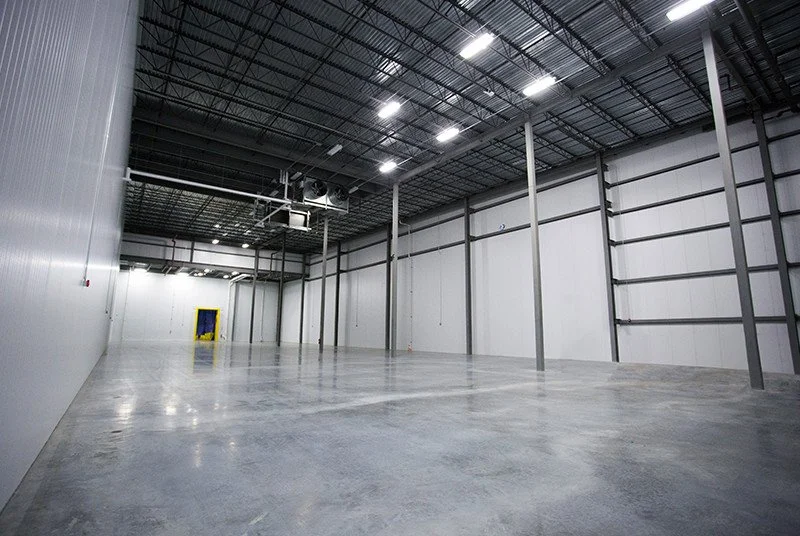
Metl-Span, founded in 1968 and now a subsidiary of Nucor's Insulated Panel Group, is the manufacturer most synonymous with cold storage IMP in the United States. Metl-Span was an early pioneer of the IMP concept in North America and has spent more than five decades refining its product line specifically for temperature-controlled environments — food processing, blast freeze storage, pharmaceutical, and distribution cold chain. Its CF Series (Cold Freezer) wall panels are the industry reference point for cold storage envelope performance: CF Mesa, CF Light Mesa, CF Flute, and CF Partition panels cover wall, ceiling, and interior partition applications across the full range of cold storage temperature zones, with panel thicknesses from 2 to 6 inches and a blister-free polyurethane core that Metl-Span developed specifically to prevent the delamination issues that can occur in extreme temperature cycling environments.
Beyond cold storage, Metl-Span's commercial and industrial IMP line includes the 7.2 Insul-Rib panel (a widely used ribbed industrial profile), the LS-36 through-fastened panel for economical roof and wall applications, and its ThermalSafe mineral wool fire-rated panel line — which recently achieved 3-hour ceiling fire testing and carries FM approval in tested configurations. The company operates multiple manufacturing facilities across the United States and Canada, providing strong regional distribution across most major construction markets. Metl-Span's technical support resources — including its comprehensive cold storage standard detail drawing library — are among the most robust in the industry, which is a meaningful advantage for design-build projects where panel details need to be developed quickly.
Best fit: Cold storage facilities of any temperature zone (refrigerated, frozen, blast freeze), food processing and food manufacturing facilities, pharmaceutical cold chain, industrial and distribution facilities where the CF panel series provides the right combination of thermal performance, vapor management, and cold storage-specific detail solutions. Strong choice for projects where the cold storage detail library and application-specific technical support add tangible design and construction value.
Considerations: Metl-Span's cold storage focus means its architectural panel aesthetic range is narrower than Kingspan's or CENTRIA's. For projects where facade aesthetics are a primary driver, other options may serve better. Pricing is mid-range domestically — more affordable than Kingspan for equivalent specifications in most cold storage configurations, with strong value on the CF series.
CENTRIA (a Nucor Company): The Architectural Envelope Leader
CENTRIA, like Metl-Span also a member of Nucor's Insulated Panel Group, occupies a distinctly different market position: CENTRIA is the architectural IMP brand, targeting commercial, institutional, civic, healthcare, and mixed-use projects where the building envelope is a design expression rather than purely a performance system. CENTRIA's flagship product is the Formawall Dimension Series — a foamed-in-place PIR core IMP system that has been on the market for 25 years and has become the reference standard for high-performance architectural insulated panels in North America. Formawall's distinguishing features include five distinct architectural wall profiles (allowing variable articulation, rhythm, and texture across the facade), CENTRIA's proprietary Advanced Thermal and Moisture Protection (ATMP) technology at panel joints, a Seal Plate pressure-equalized drain channel detail that provides multiple lines of defense against water infiltration, and a fully integrated window, sunshade, daylighting panel, and louver system that allows architects to treat the entire building envelope as a single coordinated design element.
Formawall panels are foamed-in-place — a manufacturing process where liquid PIR foam components are introduced between the metal facers as the panel is formed, producing a stronger and more durable metal-to-insulation bond than laminated panel construction. The panels carry a Declare Label (documenting absence of Red List chemicals including halogenated flame retardants), GREENGUARD Gold certification, and have been tested to NFPA 285 in all standard configurations. CENTRIA also offers a commercial and industrial IMP line (Versawall, Versapanel roof) for applications where Formawall's architectural premium is not warranted, and a MetalWrap backup wall system for rainscreen facade applications.
Best fit: Commercial, institutional, healthcare, civic, and mixed-use projects where architectural quality, envelope system integration (windows, louvers, sunshades), and sustainability documentation are primary specification drivers. Stadiums, university buildings, medical office facilities, and corporate headquarters projects are core Formawall applications. Also a strong option for cold chain pharmaceutical facilities where cGMP-compliant interior surfaces and architectural-quality exterior presentation are both required.
Considerations: Formawall panels are 2 to 3 inches thick — narrower than the cold storage panel range — and are not designed for extreme frozen or blast-freeze storage applications. CENTRIA's industrial panel range is less differentiated from commodity IMP offerings than its architectural range. Pricing reflects the premium architectural position. Available as part of Nucor's integrated panel ecosystem alongside Metl-Span, which means project teams can often work within a single manufacturer family for mixed-use projects requiring both architectural and cold storage panels.
Arch Solar IMP: The Value Alternative with FM Credentials
Arch Solar IMP is a Chinese-manufactured insulated metal panel product that has earned FM Global approval — the most significant quality and performance credential available for IMP products in the U.S. insurance and commercial construction market. FM approval requires third-party testing and ongoing production audits by FM Approvals, an independent testing organization affiliated with FM Global insurance. A panel carrying FM approval has been tested to FM Global's Approval Standards for wind uplift resistance, fire propagation, and moisture resistance, and is manufactured under a quality management system that FM Approvals monitors continuously. This is not a minor credential — FM approval eliminates the most significant objection to international-sourced panels, which is the uncertainty about whether the panels meet the performance standards that domestic FM-approved alternatives carry as a baseline.
The cost advantage of Arch Solar IMP over domestic alternatives is real and meaningful. On a typical project specification, Arch Solar panels price approximately 25 to 30% below equivalent domestic panels from Kingspan, Metl-Span, or AWIP. On a large cold storage or industrial project with significant IMP scope — 50,000 to 200,000 square feet of panel — a 25 to 30% material cost reduction represents a very large absolute dollar savings. For budget-sensitive projects, value-engineering exercises, or markets where construction cost pressure is acute, the Arch Solar option deserves honest evaluation rather than reflexive dismissal.
However, the Arch Solar decision carries considerations that domestic panel specifications do not, and they are material. Lead time is the most significant operational variable. International shipping from China typically adds 8 to 12 weeks of ocean transit time to the domestic manufacturing and delivery lead time — bringing total procurement lead time to 16 to 24 weeks or more from order to jobsite delivery. On a project with a tight schedule, this is a real constraint that can determine whether Arch Solar panels are feasible at all. Panel procurement timing must be locked in at design development, not after construction documents are finalized. Any scope changes after panels are ordered and manufactured are exponentially more expensive and time-consuming to resolve with an overseas manufacturer than with a domestic supplier.
Tariff exposure is a second active variable in 2026. Section 301 tariffs on Chinese-manufactured goods and the Section 232 tariffs on steel imports affect the landed cost of Chinese-manufactured panels in ways that require current-market assessment. The 25 to 30% cost advantage cited here reflects current market pricing net of applicable tariffs — but this figure can shift materially if the tariff environment changes between project planning and panel delivery. As we have covered in detail in our construction delivery methods analysis, tariff exposure on imported building materials is a real project risk that must be actively managed through the procurement strategy. TCG recommends a fixed-price procurement contract with Arch Solar or its U.S. distribution partner at the time panels are specified, not at the time they are ordered.
A third consideration is technical support and warranty resolution. With domestic manufacturers, a panel performance issue — a joint failure, a delamination, a finish defect — is resolved through a domestic manufacturer representative with a clear warranty claim process. With an international manufacturer, the warranty claim process is more complex, the response timeline is longer, and the resolution may require more independent assessment. This consideration is most consequential for cold storage applications, where envelope failures have immediate and costly operational consequences, and least consequential for low-risk industrial or agricultural building applications.
Best fit: Budget-sensitive industrial, agricultural, or commercial building projects where the FM approval is required by the insurer, the schedule allows for the extended procurement lead time, and the panel scope is large enough that the 25 to 30% material cost savings produces a meaningful absolute dollar reduction. Projects with simple, standard specifications (standard profiles, standard finishes, no custom fabrication) where the procurement process with a domestic representative of Arch Solar can be managed straightforwardly.
Considerations: Not recommended for cold storage projects with aggressive opening schedules, complex multi-panel specifications, or applications requiring ongoing technical support from the panel manufacturer. Tariff exposure requires current-market assessment at the time of specification. Procurement timing must be treated as a critical path item from day one of design. TCG strongly recommends engaging a domestic IMP installation contractor — including TCG's IMP install team — who has prior experience working with Arch Solar panels before committing to this specification on a complex project.
PermaTherm: The Cold Storage and Controlled Environment Specialist
PermaTherm has been manufacturing insulated metal panels for cold storage and controlled environment applications for over 30 years, making it one of the most tenured dedicated IMP manufacturers in the United States. Headquartered in Georgia and proudly Made in America, PermaTherm has built its reputation entirely around the cold chain, food processing, pharmaceutical, clean room, and indoor growing markets — applications where precise temperature and humidity control are operational requirements, not incidental features. That focus has produced a product line and a level of cold-storage-specific technical knowledge that generalist manufacturers rarely match.
PermaTherm's panel lineup spans two distinct core chemistries, which is a meaningful differentiator. Their original EPS (expanded polystyrene) line delivers consistent, stable R-values — approximately 4.35 R per inch — with one important advantage that cold storage operators value: EPS panels increase in R-value as temperatures drop, meaning they perform better in frozen environments than their rated value at ambient temperature would suggest. EPS panels are available in thicknesses from 2 to 12 inches, with achievable R-values up to R-50 at maximum thickness, and lengths up to 60 feet off the continuous laminating line. The tongue-and-groove joint system creates foam-to-foam contact for airtight sealing. Their newer PermaCore poly-iso line — launched with the commissioning of a new foamed-in-place Gen-4 closed cell polyiso continuous line — makes PermaTherm the only manufacturer in North America currently offering both an EPS product line and a foamed-in-place polyiso panel. The PermaCore CS (Cold Storage) joint virtually eliminates air infiltration and thermal bridging at panel interfaces, which is the performance detail that matters most in blast-freeze and deep-frozen environments. PermaShield joint reinforcement technology is factory-applied to ensure tighter fits and more consistent installation across field crews of varying experience levels.
PermaTherm panels carry NSF certification for food safety compliance — relevant for food processing and meat handling facilities where USDA or FDA audit requirements impose strict standards on wall and ceiling surface materials. The panels are also well-established in cannabis cultivation, grow room, and vertical farming applications where tight environmental control, mold resistance, and cleanable surfaces are all operational requirements. TCG's IMP installation team works with PermaTherm as a key manufacturing partner, and our crews are experienced with both the EPS and the new PermaCore polyiso systems across cold storage and controlled environment projects. PermaTherm is also noted for some of the fastest lead times in the industry — a significant advantage on projects where the construction schedule is tight and waiting three months for panels is not feasible.
Best fit: Cold storage facilities (refrigerated, frozen, and blast freeze), food processing and meat processing plants, pharmaceutical temperature-controlled storage, cannabis cultivation and grow room facilities, clean rooms, and any application where NSF certification and FDA compliance are required. Particularly strong for owners who want a dedicated cold storage IMP manufacturer with deep application expertise rather than a generalist manufacturer that treats cold storage as one product segment among many.
Considerations: PermaTherm's focus on cold storage and controlled environments means its architectural facade range is intentionally limited — this is not a product line for commercial or institutional facade projects where aesthetics drive the specification. The new PermaCore polyiso line, while technically advanced, is newer to the market than the well-established EPS line, and project teams should confirm current production capacity and lead times for polyiso specifications at the time of order.
All Weather Insulated Panels (AWIP): The Domestic Independent
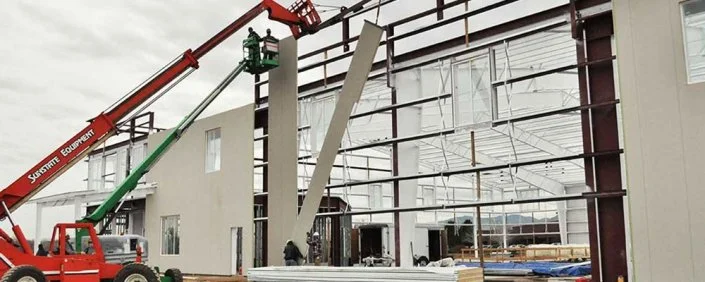
All Weather Insulated Panels (AWIP) is the largest independently operated domestic IMP manufacturer in the United States, with three continuous-line production facilities in Vacaville, CA; Little Rock, AR; and East Stroudsburg, PA — a geographic distribution that provides coverage across the West Coast, South-Central, and Northeast markets without the pricing and lead-time penalties associated with long-haul freight on a bulky, difficult-to-ship product. AWIP's strategic positioning combines competitive pricing (generally below Kingspan and competitive with Metl-Span), strong application breadth, and customer-service responsiveness that a large-corporate manufacturer may not match on smaller or mid-size projects.
AWIP's product line covers the full spectrum of commercial and industrial IMP applications: their Mesa and Heavy Embossed profiles for exterior walls and cold storage, DM45 for interior wall and ceiling applications, Hard Wall (HW40) panels with OSB reinforcement for impact-resistant interior environments like loading docks and keg storage rooms, fire-rated panels (the fiRe 1-hour series), and the OneDek Insulated Roof Deck system for low-slope commercial roofing. AWIP also offers IMP-integrated solar mounting hardware — a differentiated product that simplifies the coordination between IMP envelope installation and rooftop PV array mounting. For cold storage specifically, AWIP publishes a dedicated Cold Storage Design Guide (updated December 2025) and has extensive project experience in food production, distribution cold chain, and winery temperature-controlled facilities.
AWIP supports its installer network through the IMPpro Authorized Installer Program — a hands-on training and certification program that AWIP uses to develop and quality-control its contractor base. TCG participates in manufacturer certification programs to maintain the technical proficiency required for warranty-backed IMP installation. AWIP's panels are also available through MBCI, one of the most widely distributed metal building product distributors in the United States, extending AWIP's market reach significantly beyond its direct sales channel.
Best fit: Mid-size industrial, commercial, and cold storage projects where competitive pricing, strong regional availability from U.S. production facilities, and customer service responsiveness are valued alongside solid technical performance. Particularly strong in West Coast markets (CA/OR/WA) given the Vacaville facility, and in South-Central markets from the Little Rock plant. Good option for projects requiring IMP-solar integration or impact-resistant interior panel solutions.
Considerations: AWIP's architectural IMP range is less developed than Kingspan's or CENTRIA's. For projects where facade aesthetics drive the specification, other options are likely better suited. AWIP's scale and market share, while substantial, mean it may have longer lead times on high-volume orders during peak construction periods compared to the Nucor-backed manufacturers.
MBCI: The Distributor-Installer Network
MBCI, a Cornerstone Building Brands company and one of the largest metal building product manufacturers and distributors in North America, occupies a distinct position in the IMP market: rather than manufacturing its own IMP panels, MBCI partners with All Weather Insulated Panels, Metl-Span, and Kingspan to distribute their panels through MBCI's extensive dealer and contractor network. This means that specifying "MBCI insulated metal panels" on a project typically means receiving panels from one of those three manufacturers — with MBCI handling the distribution relationship, project support, and (through its installer certification program) the quality assurance on installation.
MBCI's value proposition is its national distribution reach and its integrated metal building product ecosystem. For contractors already sourcing structural metal building components, single-skin metal roofing and wall panels, and accessories from MBCI, the ability to add IMP panels through the same purchasing relationship is a meaningful convenience. MBCI also operates its own IMP Certified Installer Course — a formal training and certification program combining classroom instruction with hands-on installation practice — which is one of the most structured installer qualification programs available in the domestic IMP market.
Best fit: Projects where the contractor or developer has an existing MBCI purchasing relationship and wants to source IMP panels through a familiar distribution channel. Projects that are already procuring other metal building components (roofing, wall panels, trim, accessories) through MBCI and want consolidated project support. The underlying panels are those of AWIP, Metl-Span, or Kingspan — so the panel performance comparison is effectively that of those manufacturers, accessed through the MBCI channel.
Considerations: MBCI's IMP offering is a distribution channel, not a manufacturing differentiation. The panel selection available through MBCI is a subset of what AWIP, Metl-Span, and Kingspan offer directly — primarily industrial and cold storage profiles, with less access to architectural product lines. For projects requiring specific Kingspan QuadCore architectural panels or CENTRIA Formawall, specifying through MBCI may not be the most direct path to those products.
FALK: The European Precision Manufacturer with North American Production
FALK is a European-origin IMP manufacturer — founded in 2007 and operating production facilities in The Netherlands, Germany, and the United States — that established its North American presence in 2020 with a manufacturing facility in Walker, Michigan. FALK describes its Walker plant as one of the most technically advanced IMP production facilities in North America, and the company has earned IAS Accreditation AC473 for insulated metal panels — a third-party quality management system accreditation that validates manufacturing consistency and documentation standards. FALK panels are manufactured with a PIR (polyisocyanurate) foam core, delivering high R-values per inch with good fire resistance characteristics. A published Environmental Product Declaration (EPD) documents the lifecycle environmental impact of FALK panels — a requirement on an expanding range of public and institutional projects pursuing LEED and other sustainability certifications, and a sign of manufacturing transparency that not all IMP manufacturers provide.
FALK's product line covers wall, roof, cold storage, and demising wall applications. The HFW 40 is FALK's commercial and industrial wall panel — a hidden fastener system delivering optimal insulation with a clean exterior profile, available in more than 50 standard colors plus custom color-matching, making it a strong choice for projects where exterior aesthetics matter alongside thermal performance. The CSW 44 is FALK's purpose-engineered cold storage wall panel, featuring a milled joint system designed specifically for refrigeration applications: an interlocking, airtight seal for temperature and humidity control, available in thicknesses up to 8 inches and lengths up to 82 feet, with horizontal and vertical installation options. Food-safe coating options — both contact food-safe and non-contact food-safe — make the CSW 44 appropriate for food and meat processing environments. Roof options include the SSR 42 (standing seam), RRP 40 (triple trapezoidal), and MRP 44 (low-slope commercial) panels, giving FALK a complete wall-and-roof IMP system for projects that want a single manufacturer source for the full envelope.
A notable product detail: FALK panels come with a pre-installed gasket rather than factory-applied caulk — eliminating the mess, variability, and weather-dependency of field-applied sealant while providing equivalent sealing performance. FALK also operates a fully automated in-house sheet metal bender for rapid production of custom trim and accessories, which reduces the lead time and cost variability associated with sourcing accessories from a separate supplier. Steel sourced from Hyundai Steel, Ternium, and ArcelorMittal — all manufacturers using electric arc furnace (EAF) technology that produces lower-carbon steel from recycled scrap — supports FALK's sustainability positioning. The Michigan manufacturing facility provides competitive freight economics to Midwest, Northeast, and Southeast markets. TCG's IMP installation team works with FALK as a manufacturing partner and can speak to current product availability and lead times with precision.
Best fit: Commercial, industrial, and cold storage projects where European-grade manufacturing precision, strong sustainability documentation (EPD, IAS accreditation), and a complete wall-plus-roof panel system from a single manufacturer are valued. The HFW 40 is a strong specification for industrial and distribution projects where exterior aesthetics and color flexibility matter. The CSW 44 is purpose-built for cold storage, food processing, and climate-controlled manufacturing. Particularly relevant for projects with institutional or public owners requiring third-party manufacturing certification and lifecycle environmental documentation.
Considerations: FALK's North American presence, while growing, is newer than the established domestic manufacturers — project teams should verify current production capacity, standard color availability (Category 1 vs. Category 2 lead times), and regional installer familiarity with FALK's panel systems at the time of specification. The HFW 40's broad, flat panel areas may exhibit oil canning under certain conditions — FALK's published documentation addresses this, but it is a consideration for highly visible facade applications.
UPI (United Panel Industries): The Custom-Made Value Leader
United Panel Industries (UPI) is a domestic IMP manufacturer that has built its market position on three differentiated commitments: full custom manufacturing to project-specific dimensions, competitive pricing with a formal price-match guarantee, and direct manufacturer responsiveness that larger corporate manufacturers cannot match on smaller or mid-size projects. UPI panels are proudly Made in the USA, which provides faster and more predictable delivery timelines than import-sourced alternatives, and greater transparency with local building officials, engineers, and permitting agencies — a meaningful practical advantage on projects in jurisdictions with active plan review processes.
UPI's panel line is built around an EPS (expanded polystyrene) foam core bonded between two sheets of 26-gauge galvanized steel, available in thicknesses from 2 to 12 inches — covering the full range from light commercial refrigeration through deep-frozen cold storage at maximum thickness. EPS is a cost-effective core choice that delivers consistent thermal performance and long-term R-value stability; EPS panels do not lose R-value over time in the way that some foam cores can in certain environmental conditions. UPI's white baked-on epoxy antimicrobial interior paint finish offers high light reflectance and thermal emittance — reducing heat gain within the conditioned space and contributing to lower energy costs — while the antimicrobial formulation supports food safety compliance requirements. Every UPI panel is custom-manufactured to project-specific length and thickness specifications, which eliminates the field cutting and waste associated with standard-length panel product. This custom-made approach is particularly valuable on cold storage projects with non-standard ceiling heights, irregular room dimensions, or retrofit applications where standard panel lengths produce excess material and additional joint lines.
UPI's price-match guarantee — committing to beat any legitimate quote from any panel or door manufacturer nationwide — makes it a strong value-engineering tool in TCG's preconstruction process. For budget-conscious projects where panel scope is a significant line item, obtaining a UPI quote alongside domestic competitors is a straightforward way to validate whether there is material cost savings available without moving to an international panel source. UPI also backs its panels with a lifetime warranty, reflecting confidence in the durability of the EPS-core galvanized steel sandwich construction. With over 50 years of combined industry experience across its team, UPI brings application-specific knowledge that translates into accurate pre-project consultation, responsive support during construction, and streamlined coordination with permitting agencies. TCG's IMP installation team works with UPI as a key partner on projects where custom dimensions, competitive pricing, and Made-in-USA production are the right combination for the client's requirements.
Best fit: Cold storage facilities, clean rooms, climate-controlled warehouses, and food processing applications where custom panel dimensions add value, competitive pricing is a priority, and Made-in-USA production with domestic technical support is required. Particularly strong for retrofit and renovation projects where non-standard dimensions make custom manufacturing more efficient than standard-length cutting. Projects where the budget is under pressure and the owner wants the assurance of a formal price-match guarantee against any other domestic alternative.
Considerations: UPI's EPS core chemistry delivers approximately 4.35 R per inch — lower than PIR or polyiso alternatives — which means greater panel thickness is required to achieve the same R-value as a PIR panel. For cold storage applications targeting very high R-values in constrained wall cavity dimensions, EPS may require thicker panels than PIR alternatives. UPI's product range, while well-suited to cold storage and industrial applications, does not include the architectural facade profiles and custom color ranges that CENTRIA, Kingspan, or FALK offer for commercial building envelope applications.
Head-to-Head: How the Nine Manufacturers Compare
To make this comparison actionable, here is how all nine manufacturers stack up across the dimensions that matter most in practice — written for the developer, owner, or GC evaluating panel options in pre-construction.
Thermal Performance
Kingspan's QuadCore technology delivers the highest R-value per inch available domestically — up to 8.0 R per inch — and is the specification of choice when thermal performance is the overriding constraint. PIR-core Metl-Span, CENTRIA, and AWIP panels deliver 7.0 to 7.5 R per inch; standard PUR-core panels across manufacturers deliver 5.5 to 6.5 R per inch. A 4-inch PIR panel typically achieves R-28 to R-32; a 4-inch QuadCore panel may reach R-32 to R-36. For cold storage applications at frozen temperatures, the difference in operational energy cost over a 20-year facility life between a mid-spec PUR panel and a premium QuadCore panel can be substantial — warranting a lifecycle cost analysis rather than a simple upfront material cost comparison.
Cold Storage Suitability
Metl-Span's CF Series is the industry benchmark for purpose-built cold storage panels, followed closely by AWIP's cold storage line and PermaTherm's EPS and PermaCore polyiso systems. Metl-Span, AWIP, and PermaTherm are all specifically engineered for the vapor management, thermal cycling resistance, and condensation control demands of cold storage applications. FALK's CSW 44 panel — with its milled joint system and food-safe coating options — is also purpose-built for cold storage and food processing. UPI's custom EPS panels are a strong value option for cold storage projects where custom dimensions and competitive pricing are priorities. Kingspan's cold storage product range is well-developed. CENTRIA's Formawall is not designed for extreme frozen or blast-freeze applications. Arch Solar's FM-approved panels are suitable for cold storage if the procurement timeline and warranty considerations are addressed. A preconstruction panel selection review that evaluates cold storage suitability against the specific temperature zone and operational requirements is the right process — not panel selection based on brand recognition alone.
Architectural Flexibility
CENTRIA's Formawall Dimension Series offers the broadest architectural design range of any manufacturer on this list — five distinct profiles, custom finishes, integrated window and fenestration systems, and a complete coordinated facade system. Kingspan's Benchmark/Designwall range is a close second. Metl-Span and AWIP have solid but narrower architectural ranges. MBCI's architectural capability depends on which underlying manufacturer's panels are being distributed. Arch Solar's standard profiles are designed for industrial and agricultural applications — architectural customization capability is limited and requires direct engagement with the Chinese manufacturer, which adds complexity and lead time.
Fire Rating
Metl-Span's ThermalSafe mineral wool panels and CENTRIA's fire-rated products offer the most robust fire resistance — up to 3-hour fire ratings in tested configurations. AWIP's fiRe 1-hour series provides 1-hour rated assemblies. Kingspan's K-Roc HF Series is a mineral wool fire-rated panel for sensitive environments. Most PUR and PIR core panels from all manufacturers meet NFPA 285 in tested configurations for exterior wall use. FM Global approval is available across all domestic manufacturers in standard configurations and from Arch Solar as noted above.
Pricing
On a fully landed material cost basis at standard industrial specifications, the approximate relative pricing from most to least expensive is: Kingspan QuadCore/Benchmark (premium), CENTRIA Formawall (premium), Metl-Span CF/commercial (mid-range), AWIP (mid-range to competitive), MBCI (varies by underlying manufacturer), and Arch Solar (25 to 30% below domestic equivalents before factoring in freight, tariffs, and extended lead time costs). These relationships shift by product type, order volume, geographic delivery location, and market conditions. For any project of consequence, current-market pricing should be obtained through direct solicitation from manufacturers or their representatives — historical pricing data and published ranges are useful for feasibility analysis but not for final project budgets. TCG's preconstruction team obtains current-market panel pricing as part of the IMP scope validation process on every relevant project.
Lead Times in 2026
Domestic manufacturers typically quote 8 to 16 weeks from order to delivery for standard specifications. Custom profiles, non-standard finishes, and large orders at peak production periods extend this. Arch Solar adds ocean transit time, putting total lead time at 8-12 weeks. In a construction market where electrical gear and other building components are also subject to extended lead times, IMP panel procurement must be initiated early — the AGC's Construction Inflation Alert consistently flags long-lead material procurement as a critical schedule risk through 2026. Initiating panel procurement at schematic design, not at permit issuance, is the right approach for any project where IMP panels are a critical path item.
What to Ask Your IMP Installer Before Committing to a Manufacturer
The panel specification and the installer selection are interrelated decisions, and the most common mistake owners make is treating them independently. An experienced IMP installer has worked with specific manufacturers' panel systems enough to know which ones perform predictably in the field — and which ones produce installation surprises at the panel-to-panel joint, at penetrations, at corners, and at the interface with windows and doors. The right questions to ask an IMP installer before committing to a panel specification include:
How many square feet of panels from this manufacturer have you installed in the past three years, and in what applications?
What detail challenges have you encountered with this panel's joint system, and how did you resolve them?
Has the manufacturer's technical support team been responsive when you've had field questions during installation?
What is the manufacturer's warranty claim process, and have you navigated a claim with them?
For Arch Solar specifically: have you installed these panels before, and what was the procurement lead time and quality control experience?
At Terrapin Construction Group, IMP installation is a dedicated service line with installation experience across Kingspan, Metl-Span, AWIP, PermaTherm, FALK, UPI, and Arch Solar panel systems on cold storage, industrial, commercial, and cannabis cultivation projects nationwide. Our teams have the panel-specific field knowledge to anticipate and resolve the installation details that determine whether a high-performing IMP specification actually delivers high performance in the finished building. We also provide preconstruction panel selection guidance — helping owners and developers evaluate manufacturers against their specific project requirements before the specification is locked and procurement begins.
IMP Applications: Which Manufacturer Is the Right Call by Project Type
Cold Storage and Food Processing
Metl-Span CF Series, AWIP cold storage line, PermaTherm EPS or PermaCore polyiso, FALK CSW 44, or UPI custom EPS panels for most applications — the right choice depends on temperature zone, budget, schedule, and whether NSF certification, food-safe coatings, or a specific joint system is required by the operational program. Kingspan for projects requiring maximum R-value per inch or integrated door-and-panel solutions. Arch Solar where budget pressure is acute and the procurement timeline allows. TCG has delivered IMP cold storage projects with all of the above manufacturers and can speak to current performance, lead times, and availability with precision.
Industrial and Distribution Facilities
AWIP, Metl-Span commercial, or Kingspan KS Series depending on thermal specification and budget. MBCI distribution channel is a solid option for contractors with existing MBCI relationships. Arch Solar is viable for large-footprint industrial applications with adequate schedule lead time and standard specifications. TCG's industrial construction team integrates IMP panel selection into the preconstruction process for every applicable project.
Commercial and Architectural Buildings
CENTRIA Formawall for premium architectural facade projects. Kingspan Benchmark/Designwall for high-performance commercial envelopes with strong sustainability documentation requirements. AWIP or Metl-Span commercial line for applications where performance is the priority and architectural expression is secondary. Design-build delivery is particularly well-suited to coordinating the IMP specification with structural and MEP design from the earliest stage.
Cannabis Cultivation Facilities
IMP construction is increasingly the envelope system of choice for purpose-built cannabis cultivation facilities, where tight temperature and humidity control, cleanable interior surfaces, and energy efficiency are all operational requirements. TCG has built cannabis cultivation facilities using IMP systems that deliver the tight environmental control these operations require. Metl-Span CF Mesa, AWIP Mesa, PermaTherm EPS or PermaCore, Arch Solar PIR and UPI custom EPS panels are all viable specifications for cannabis cultivation wall and ceiling applications — with PermaTherm's NSF-certified antimicrobial coatings, Arch Solar’s value and FM Rating, and UPI's custom dimensioning capability making both strong candidates for grow room builds where non-standard room sizes are common.
Pre-Engineered Metal Buildings with IMP Envelope
The combination of pre-engineered metal building structural systems with IMP envelope panels is one of the most cost-effective ground-up construction approaches for industrial, cold storage, and commercial projects. PEMB structural systems provide fast erection timelines and competitive structural costs; IMP panels provide the thermal, air, and vapor barrier in a single factory-fabricated component. TCG evaluates PEMB-plus-IMP suitability on every applicable project as part of the preconstruction process.
Planning an IMP Project? Start with the Right Installer.

The IMP manufacturer decision matters — but the IMP installer decision matters just as much. A panel system that is perfectly specified but poorly installed delivers neither the thermal performance nor the weathertightness that the specification promises. The joint details, penetration treatments, base conditions, and corner and transition details in an IMP installation are where performance is made or lost — and these are learned skills that experienced IMP installation teams have and general commercial contractors without IMP-specific experience do not.
Terrapin Construction Group provides IMP installation, preconstruction panel selection services, commercial general contracting, construction management, and design-build delivery for IMP projects nationwide, headquartered in Denver, CO. If you're specifying IMP panels for an upcoming project and want a frank, current-market conversation about which manufacturer is right for your application and what it's going to cost, we'd welcome a 30-minute call.
Schedule a conversation → calendly.com/will-terrapincg/30min
You may also find the following related reading useful:
Sources
Kingspan Insulated Panels North America — Product Group Overview
Metl-Span — Temperature Controlled & Cold Storage Insulated Metal Panels
PermaTherm — Insulated Metal Panel Manufacturer (Cold Storage & Controlled Environments)
PermaTherm — About Us: 30+ Years in Cold Storage IMP Manufacturing
FALK — Environmental Product Declaration (EPD), November 2024
UPI Panels — Product Information: EPS Core IMP, Custom Manufacturing
PRANCE — A Detailed Guide to Understanding Insulated Metal Panels Pricing
ASHRAE Standard 90.1 — Energy Standard for Buildings Except Low-Rise Residential
NFPA 285 — Standard Fire Test Method for Exterior Wall Assemblies
NFPA 13 — Standard for the Installation of Sprinkler Systems
APX Construction Group — 2026 Guide to Pre-Engineered Building Insulation Costs
Last updated: March 2026. Product specifications, pricing relationships, and availability are subject to change. Contact manufacturers and their representatives for current product data, pricing, and lead times. Consult a qualified IMP installer and building envelope consultant for project-specific recommendations.
