

Iran War & Strait of Hormuz: What Commercial Real Estate Developers Need to Know About Construction Costs in 2026
Published March 2026 | By Terrapin Construction Group | Full-Service National Commercial General Contractor
The U.S.-Iran war, now in its second week as of March 9, 2026, has effectively closed the Strait of Hormuz — pushing Brent crude past $103/barrel and triggering the largest single-week oil price surge in the history of the futures market. For commercial real estate developers with active ground-up projects or planned 2026 starts, this is not an abstract geopolitical event. It is a direct and immediate threat to pro formas, GMP contracts, and construction timelines. This article breaks down downstream construction cost implications across five conflict-duration scenarios, identifies the most vulnerable materials and trades, and offers concrete strategies for protecting your development.
What Is Happening: The Strait of Hormuz and the Global Energy Shock
On February 28, 2026, joint U.S.-Israeli airstrikes on Iran ignited what energy analysts are now calling a generational supply disruption. Iran's Islamic Revolutionary Guard Corps declared the Strait of Hormuz — the 21-mile-wide chokepoint through which roughly 20% of the world's oil and 22% of global LNG flows — effectively closed to commercial shipping. Within days, oil markets reached levels not seen since 2022.
By March 9, 2026, Brent crude surged past $103/barrel — up more than 40% from the mid-$60 range the week prior. U.S. WTI posted its largest single-week gain in the history of the futures contract (dating to 1983). The national average gasoline price jumped to $3.45/gallon, up $0.51 in a single week. Diesel — the lifeblood of every commercial construction site — is projected to hit $4.50–$5.00/gallon within days if the Strait remains closed.
At least five tankers have been damaged, roughly 200 ships are stranded in or near the Strait, and major oil companies and insurers have effectively withdrawn from the corridor. Iraq has already cut 1.5 million barrels per day due to storage capacity limits. Kuwait has curtailed production. QatarEnergy halted LNG operations after an Iranian drone strike on its facilities.
For the commercial construction industry, this is not just a news story. It is a supply chain and cost escalation event that demands immediate attention from every developer, owner, and project stakeholder.
Why the Strait of Hormuz Matters to Commercial Construction
Commercial construction is one of the most energy-intensive industries in the U.S. economy. According to the U.S. Energy Information Administration, the Strait of Hormuz is the world's most critical oil chokepoint — and its disruption transmits directly to every construction project in America through a cascade of cost channels.
The Associated General Contractors of America (AGC) has documented that materials costs were already the top concern of 53% of contractors entering 2026, with the Producer Price Index for nonresidential construction materials rising 2.9% in January alone. The Iran conflict adds an acute energy-price shock on top of an already strained materials market.
The chain of exposure for commercial construction is direct:
• Oil prices spike → Diesel and fuel costs surge → Equipment operation and site logistics become dramatically more expensive
• Oil prices spike → Petrochemical feedstocks rise → Asphalt, PVC, roofing materials, and plastics see cost increases of 25–70%
• Oil prices spike → Shipping and freight costs escalate → All imported materials (fixtures, HVAC, electrical gear) become more expensive and slower to arrive — compounding supply chain risks already present in 2026
• Oil prices spike → Inflation expectations rise → The Federal Reserve holds rates → Financing costs increase for development projects
• Oil prices spike → Labor demand for domestic energy production rises → Construction labor markets tighten, pushing wages up across all trades
Goldman Sachs Research estimates that a full one-month Strait closure (with pipeline offsets) could add $12–15 per barrel above pre-conflict baselines. JPMorgan's global commodities team projects production cuts could exceed 4 million barrels per day by late March — a scenario that would push Brent above $130/barrel.
The Congressional Research Service notes the Strait handles approximately 27% of the world's crude oil and petroleum products maritime trade — and that the narrowness of the chokepoint, the lack of alternative seaborne routes, and limited land-based bypass capacity make it uniquely vulnerable to disruption.
Five Conflict Scenarios: Construction Cost Modeling
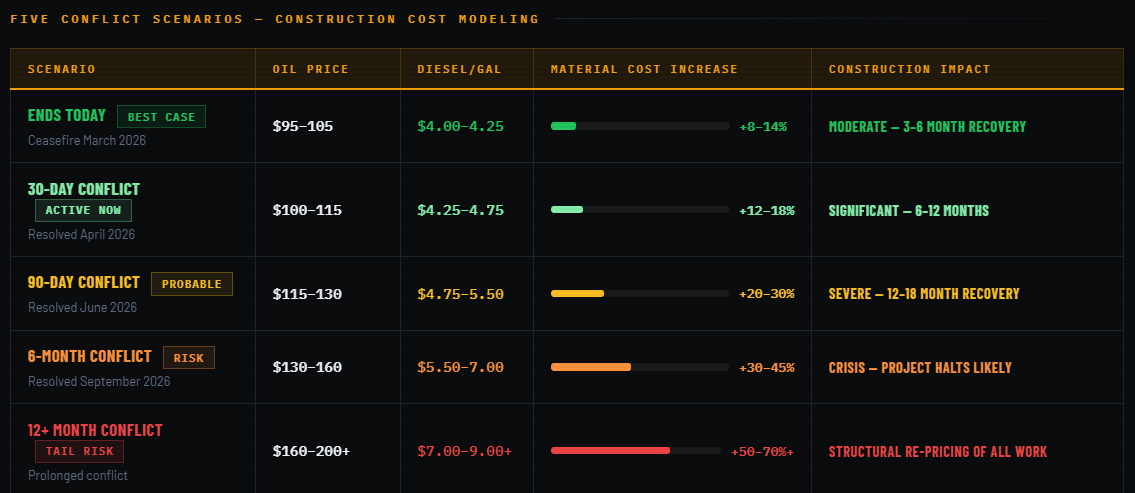
Every development project currently in permitting, design-build, or active construction needs to be stress-tested against the scenarios below. These range from an immediate ceasefire to a 12-month prolonged conflict, and are grounded in current market data from Goldman Sachs, JPMorgan, Kpler, and ExxonMobil as of March 9, 2026.
Note: Oil price ranges are illustrative models based on Goldman Sachs, JPMorgan, and ExxonMobil research (March 2026). Material cost increases reflect construction industry exposure to petroleum-derived inputs and diesel-dependent logistics as documented by the AGC Construction Inflation Alert and RSMeans Cost Data. Actual project impacts will vary by scope, contract structure, and procurement timing.
Scenario Deep Dives: What Each Outcome Means for Your Project
Scenario 1: Conflict Ends Today (Best Case)
Even if a ceasefire were announced today, developers should not expect an immediate return to pre-war pricing. Per Al Jazeera's energy reporting, the combination of damaged infrastructure, elevated insurance premiums, and disrupted logistics means supply chains require weeks to months to normalize — even after hostilities end.
In this scenario, oil stabilizes in the $95–105/bbl range for 60–90 days. The national average gas price (currently $3.45/gallon as of March 9) gradually retreats toward $3.00–3.25 by summer. Material cost increases of 8–14% are likely sticky for 3–6 months. The Fed remains on hold through Q2.
Developer Action — Scenario 1:
Immediately request updated material quotes from all subcontractors. Re-confirm GMP pricing with your general contractor. Activate any price escalation clauses and review contingency budgets. Consider front-loading procurement on high-petroleum-content items: roofing, asphalt, PVC conduit, and vapor barriers.
→ Contact Terrapin Construction Group for a current cost update
Scenario 2: 30-Day Conflict (Resolved April 2026)
A 30-day conflict is, as of this writing, already underway — meaning any project starting in Q2 2026 is fully inside this cost environment. Kpler commodity intelligence shows limited tanker traffic continues — primarily Iranian- and Chinese-flagged vessels — while commercial operators have effectively withdrawn, producing a de facto closure comparable to but far larger in scale than the 2023–2024 Red Sea disruption.
Projects with Q2 2026 start dates face meaningful pro forma stress. Asphalt-intensive programs (retail pad sites, grocery-anchored strip centers, logistics parks) and roofing-heavy scopes are most exposed. The AGC's 2026 Outlook Survey found 62% of contractors already cited economic slowdown as a top concern before this conflict — a metric that has undoubtedly worsened.
Developer Action — Scenario 2:
Revisit your project budget with a 15% material cost escalation applied to all petroleum-sensitive line items. Work with your commercial GC to identify long-lead procurement opportunities. Consider whether delaying a project start by 60–90 days makes economic sense. Ensure your GMP contract includes an appropriate escalation carve-out.
→ Terrapin's preconstruction team can model updated cost scenarios for your project
Scenario 3: 90-Day Conflict (Resolved June 2026)
A 90-day conflict involves prolonged military operations with Iran retaining enough capability to deter most commercial shipping. Bank of America analysts project that a prolonged disruption would push Brent above $100 and European natural gas prices above 60 EUR/MWh — a combination that stresses the entire global materials supply chain simultaneously.
Brent crude settles in the $115–130/bbl range. Diesel approaches $5.50/gallon. Construction material cost escalation reaches 20–30% above January 2026 baselines — layering on top of the tariff-driven 2.9% January PPI increase the AGC documented just before the conflict began. The Federal Reserve faces a genuine stagflationary dilemma. Commercial development financing tightens as lenders apply stress scenarios to cost budgets.
For a typical $20M retail center, this scenario could add $4–6M in exposure across materials, labor, and logistics — enough to require a meaningful equity true-up or lender renegotiation. JLL's capital markets research has consistently shown that cost overruns of 15%+ on active construction loans trigger technical default review in most lending structures.
Developer Action — Scenario 3:
Engage your lender immediately. Model a 25% construction cost increase against your DSCR and loan covenants. Work with your construction manager to value-engineer scope. Prioritize projects with strong rent fundamentals. Consult your GC on the enforceability of material escalation clauses — this is not a standard volatility event.
→ Terrapin's Owner's Rep team protects developer interests in volatile cost environments
Scenario 4: Six-Month Conflict (Resolved September 2026)
A six-month conflict is a worst-case-but-plausible scenario in which military operations drag through summer. JPMorgan's commodities analysis identified 4 million barrels per day in production cuts as the threshold for $130+/bbl oil — a threshold that, per their own analysis, could be breached by the end of March if the Strait remains closed.
In this scenario, diesel potentially exceeds $7/gallon. NAIOP's research on commercial real estate financing and CBRE's capital markets data both suggest that a 30%+ hard cost increase would cause underwriting assumptions on a significant share of 2026 development projects to fail — pushing equity IRRs below minimum thresholds. Some contractors begin to struggle with thin margins. Supply chains are significantly disrupted for imported fixtures, HVAC equipment, and electrical gear.
Developer Action — Scenario 4:
Focus resources on completing projects under construction. Halt speculative new starts unless backed by ironclad tenant commitments. Accelerate permitting and entitlement work now so projects are shovel-ready when markets stabilize. Engage an experienced owner's rep.
→ Explore Terrapin's full suite of commercial construction services
Scenario 5: Prolonged Conflict (12+ Months)
A conflict extending beyond 12 months is the tail risk that energy markets, central banks, and construction economists are now actively stress-testing. In this scenario, the global energy system undergoes structural re-pricing. Oil above $160/barrel becomes the operating baseline. A $20M commercial development in January 2026 may carry a true cost-to-complete of $28–32M by mid-2027.
However, certain sectors become more attractive: domestic energy infrastructure, data centers (AGC projects surging demand regardless of conflict duration), manufacturing and reshoring facilities, and essential-service retail. Terrapin Construction Group's pre-engineered metal buildings program offers accelerated timelines and cost-efficiency that becomes even more valuable in a high-cost environment.
Developer Action — Scenario 5:
A complete portfolio review is required with your GC, lender, and equity partners. Developers who survive a prolonged conflict will be those who locked in construction contracts with escalation protections, focused on recession-resilient asset classes, maintained strong liquidity, and partnered with experienced national contractors.
→ Book a 30-minute strategy call with Terrapin's leadership team
Construction Materials: Oil Sensitivity and Cost Exposure by Category
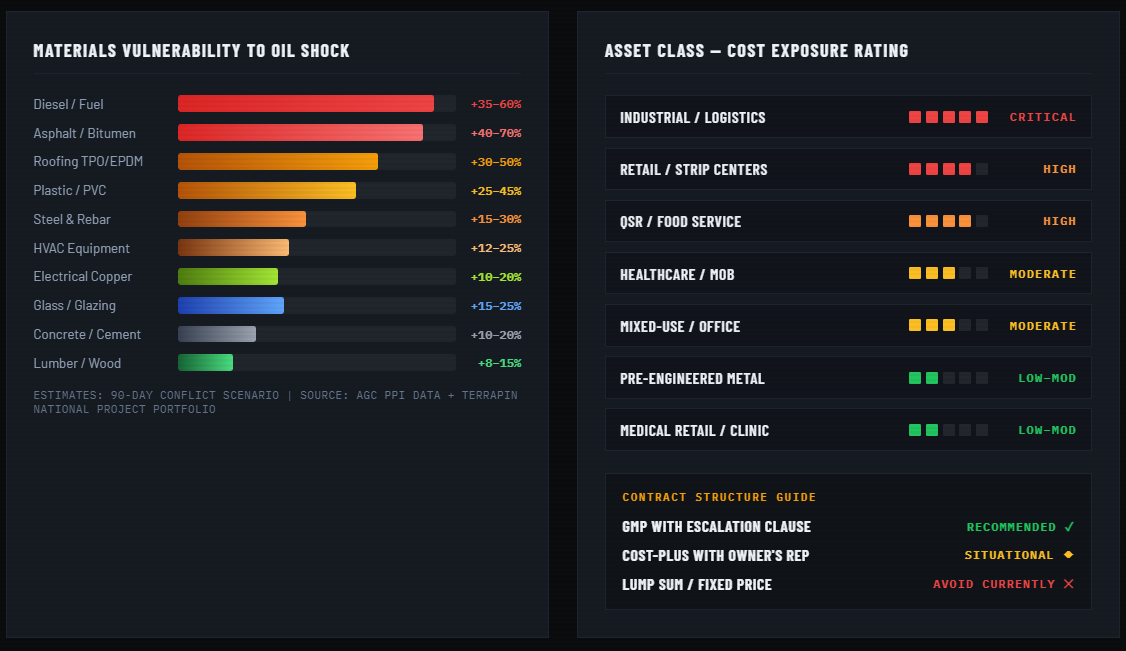
Not all construction materials are equally exposed to an oil price shock. The AGC's producer price index tracking provides monthly updates on construction material cost movements. The RSMeans cost database is the industry's primary reference for baseline material and labor costs nationally. Below is a breakdown of the most common commercial construction materials ranked by oil sensitivity.
Key insight: The highest-sensitivity categories — diesel, asphalt, roofing, and plastics — are precisely those most prevalent in retail, industrial, and mixed-use commercial construction. A typical ground-up strip retail center or warehouse project may have 20–30% of its total hard cost budget in these categories, according to RSMeans regional cost data and Terrapin's own national project portfolio.
Impact by Commercial Real Estate Asset Class
Retail & Strip Commercial Development
Retail development is among the most exposed sectors. Parking lot construction is asphalt-intensive. Tenant build-outs rely heavily on PVC conduit, roofing membranes, and petroleum-based sealants. ICSC research and CBRE's U.S. retail market outlook both show grocery-anchored centers maintaining strong fundamentals — but cost overruns in this environment require careful pro forma management. See Terrapin's detailed regional cost analysis: Grocery-Anchored Strip Mall Construction Costs.
Industrial & Logistics Facilities
Industrial construction is the most diesel-dependent sector, with large equipment fleets, extensive site prep, and significant paving scopes. However, NAIOP's industrial market research shows that demand for domestic industrial space tends to strengthen during geopolitical disruptions as supply chains restructure away from Asia. Terrapin's pre-engineered metal buildings program offers accelerated schedules and cost-efficiency especially valuable in a high-cost environment.
Healthcare & Medical Office
Healthcare construction is among the most complex and least deferrable sectors. Terrapin's analysis of the 2026 hospital construction boom documents the structural drivers of healthcare development activity — demographic demand that does not pause for geopolitical shocks. The American Institute of Architects (AIA) Construction Consensus Forecast and Deloitte's healthcare outlook both project sustained healthcare construction demand through 2027.
QSR and Food Service Construction
Quick-service restaurant development is driven by franchise expansion obligations that are often contractually required. Terrapin's national QSR construction cost guide provides detailed baseline cost data across all U.S. regions. Developers and franchisees with signed development agreements face cost overruns in the current environment and should immediately engage their construction manager for updated estimates. The National Restaurant Association's industry data shows franchise development activity concentrated in markets with strong population growth — precisely the markets with active construction pipelines.
Office & Mixed-Use
Office development was already constrained by remote work dynamics and tight capital markets entering 2026, per JLL's U.S. Office Market Outlook and CBRE's cap rate survey. An oil shock and potential recession scenario represents an additional headwind for speculative office starts. Mixed-use projects with necessity-retail ground floors and long-term residential demand may still pencil in core markets.
Optometry, Medical Retail & Specialty Commercial
Smaller-format medical retail — optometry, urgent care, dental, and specialty clinics — occupies a particularly resilient position in the current environment. Essential-use tenants, shorter construction timelines, and lower absolute material exposure relative to large ground-up programs make this sector worth prioritizing. See Terrapin's detailed cost guide: Average Cost to Build an Optometry Office in the USA.
Contract Structures That Protect Developers in a Volatile Market
How your construction contract is structured will significantly determine your exposure in each scenario. Terrapin's in-depth analysis of construction delivery methods covers the full landscape of cost-plus, GMP, and lump-sum structures. The AGC's Tariff Resource Center and ConsensusDocs material price escalation guidance are the industry's primary references for contract protections in high-volatility markets.
Lump Sum / Fixed Price
In a lump sum contract, the contractor bears escalation risk. In an ordinary market, this provides developer certainty. In the current environment, lump sum bids will either be inflated (with contractors building in large contingencies) or will lead to contractor distress if costs exceed projections. The AGC's 2026 Construction Outlook found only 24% of contractors reported not being affected by cost volatility — meaning 76% have already repriced their bids upward.
Guaranteed Maximum Price (GMP)
A GMP contract with a well-constructed escalation clause is likely the optimal structure in the current environment. The developer retains price certainty above the GMP while the GC manages within the agreed budget. Critically, the escalation clause must explicitly address oil-driven material cost increases — generic force majeure language is insufficient. Procore's construction contract documentation resources and the AIA's contract documents both provide frameworks for escalation clause language.
Cost-Plus with Fee
In a prolonged conflict scenario, cost-plus contracts pass all material and labor costs to the developer. This structure may be appropriate for complex or highly custom projects, but developers must maintain rigorous owner's representative oversight. USGBC's integrated project delivery frameworks and McKinsey's construction productivity research both support the value of owner's rep engagement in volatile cost environments.
10 Strategies for Commercial Developers in the Current Environment
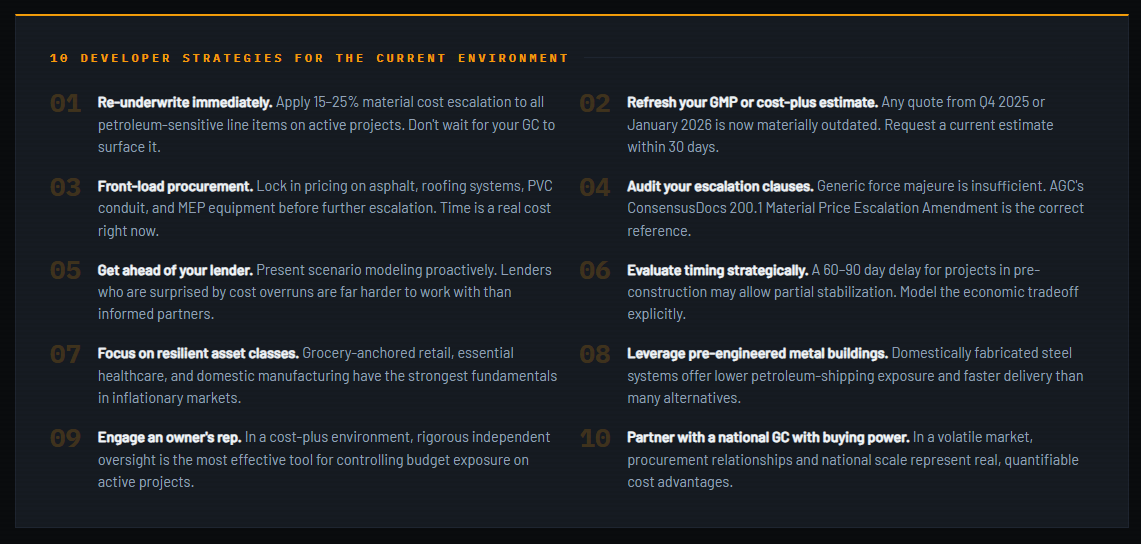
• Immediately re-underwrite active projects with a 15–25% material cost escalation applied to petroleum-sensitive line items. Use RSMeans regional data as your baseline.
• Request updated GMP or cost-plus estimates from your commercial general contractor within the next 30 days — do not rely on quotes from Q4 2025 or January 2026.
• Front-load procurement of high-sensitivity materials: asphalt, roofing systems, PVC conduit, and MEP equipment. Reference the AGC's producer price index data for tracking.
• Review all force majeure and escalation clauses in existing contracts. The AGC's Tariff Resource Center and ConsensusDocs 200.1 Material Price Escalation Amendment are strong starting references.
• Engage your lender proactively with scenario modeling. CBRE's capital markets team and JLL Research both provide benchmarks for stress-testing debt coverage ratios.
• Evaluate project timing strategically. A 60–90 day delay may allow partial price stabilization. Use Terrapin's preconstruction services to model the timing tradeoff.
• Focus capital on asset classes with strongest demand fundamentals in an inflationary environment: grocery-anchored retail, essential healthcare services, and domestic manufacturing (per NAIOP industrial research).
• Leverage pre-engineered metal building systems where feasible — steel fabricated domestically has lower exposure to petroleum-driven shipping cost increases than many imported alternatives.
• Consider equipment procurement strategy as part of your construction cost management. Locking in equipment pricing early can meaningfully reduce exposure to escalation.
• Partner with a full-service national construction management firm with buying power, supply chain relationships, and the breadth to match the right delivery method to the right project. In a volatile market, these relationships represent real, quantifiable cost advantages.
When Will Construction Costs Normalize?
The short answer: not immediately, even in the most optimistic scenario. The Congressional Research Service's Strait of Hormuz analysis notes the Strait has never been fully closed in modern history — there is no established playbook for the current situation. Energy markets require time to re-establish supply-chain confidence, rebuild insurance programs, and clear the backlog of stranded vessels.
Historical precedent from the 1973 oil embargo and 1990 Gulf War suggests construction cost normalization typically lags conflict resolution by 6–18 months. The U.S. Energy Information Administration's Short-Term Energy Outlook provides the most authoritative government projections on oil price recovery timelines.
The optimistic scenario: conflict resolution in March–April, gradual resumption of Strait shipping over 4–6 weeks as insurance markets re-engage, return to $80–90/bbl oil by Q3 2026. Even in this scenario, construction costs for Q2–Q3 2026 project starts will be meaningfully higher than 2025 baselines, per AGC's most recent cost data.
The base case: conflict extends through Q2 2026. Construction cost escalation of 15–25% is sticky through year-end 2026, with gradual normalization through 2027. Development activity slows but does not stop — pre-leased and owner-occupied projects continue, consistent with Dodge Construction Network's activity data and Construction Dive's 2026 industry coverage.
How Terrapin Construction Group Is Supporting Developers Through This Disruption
Terrapin Construction Group is a full-service national commercial general contractor and construction management firm operating across all 50 states, headquartered in Denver, CO. Our service model was built around the exact conditions the current market demands: sophisticated cost management, national procurement capability, and a full suite of delivery methods.
Our preconstruction services team is actively helping developers stress-test project budgets against current energy market conditions. Our owner's rep practice provides rigorous project oversight for developers who need expert cost control without building it in-house. Our design-build program accelerates project timelines and compresses the procurement window for clients who need to move before costs escalate further. And our equipment procurement services help lock in critical pricing early.
View our completed commercial projects across retail, healthcare, industrial, QSR, and mixed-use asset classes. Read our frequently asked questions about our construction management approach. Refer a project owner or developer to our referral program.
Ready to stress-test your project budget?
Schedule a 30-minute consultation with Terrapin Construction Group's preconstruction team. We'll walk through your project scope, apply current market cost data, and help you understand your exposure across all five conflict scenarios modeled in this article.
→ Book a call: calendly.com/will-terrapincg/30min
→ Explore our services: terrapincg.com/construction-management
→ Contact us: terrapincg.com/contact
Sources & External References
Goldman Sachs Research — How Will the Iran Conflict Impact Oil Prices? (March 2026)
JPMorgan Global Commodities — Strait of Hormuz Production Cut Analysis (March 2026)
Kpler Commodity Intelligence — US-Iran Conflict: Strait of Hormuz Crisis (March 1, 2026)
Congressional Research Service — Iran Conflict and the Strait of Hormuz: Oil and Gas Market Impacts (R45281)
U.S. Energy Information Administration — Strait of Hormuz: World's Most Important Oil Transit Chokepoint
Associated General Contractors of America (AGC) — Construction Inflation Alert & 2026 Materials Cost Data
CNBC / Reuters — Oil Prices: Analysts Raise Alarm as Crude Soars Over Iran War (March 9, 2026)
CBS News / GasBuddy — Strait of Hormuz Ship Traffic Slows to a Crawl (March 9, 2026)
Bloomberg — Iran War: How Oil Prices Are Surging as Hormuz Shipping Disrupted (March 5, 2026)
Al Jazeera — Shutdown of Hormuz Strait Raises Fears of Soaring Oil Prices (March 3, 2026)
Axios — Oil, Gas Prices Spike as Iran War Thrusts Strait of Hormuz into Crisis (March 9, 2026)
RSMeans Construction Cost Data — Regional Cost Benchmarks for Commercial Construction (2026)
CBRE — U.S. Cap Rate Survey & Retail Market Outlook (2026)
JLL Research — U.S. Commercial Real Estate Capital Markets Outlook (2026)
NAIOP Research Foundation — Industrial & Commercial Real Estate Market Research (2026)
ICSC — Retail Real Estate Market Research & Grocery-Anchored Fundamentals (2026)
McKinsey & Company — Supply Chain Resilience in a Geopolitically Disrupted World
Procore Construction Resource Library — Contract Documentation & Cost Management Best Practices
AIA Contract Documents — Standard Construction Contract Frameworks & Escalation Clauses
Deloitte Healthcare Industry Outlook — U.S. Healthcare Construction & Facility Demand (2026)
Construction Dive — 2026 Commercial Construction Industry News & Analysis
Terrapin Construction Group is a full-service national commercial general contractor and construction management firm operating across all 50 states. For project inquiries or to schedule a preconstruction cost review, visit terrapincg.com or book time with us at calendly.com/will-terrapincg/30min.
