

How to Value-Engineer a Commercial Cannabis Cultivation Facility Without Compromising Performance
A practical guide for cannabis developers and operators looking to build smarter, not just bigger.
Introduction: The Cannabis Build-Out Trap
The cannabis industry is maturing rapidly. Legal markets now span 38 U.S. states in some form, and 24 states plus Washington D.C. have legalized adult-use cultivation. With that growth comes infrastructure pressure: operators need large-scale, code-compliant, climate-controlled cultivation facilities — and they need them fast, often under investor timelines that leave little room for budget overruns.
The default approach to cannabis facility construction — loading up on proprietary agronomic HVAC systems, domestically manufactured insulated metal panels, and premium equipment packages — routinely pushes projects to $150–$350+ per square foot in hard costs alone. For a 50,000 SF facility, that's $7.5M to $17.5M before soft costs, FF&E, or licensing.
What most operators don't realize is that you can hit the same environmental setpoints, pass the same FM inspections, and satisfy the same insurance carriers at a fraction of that cost — if you know where to engineer intelligently and where to hold the line.
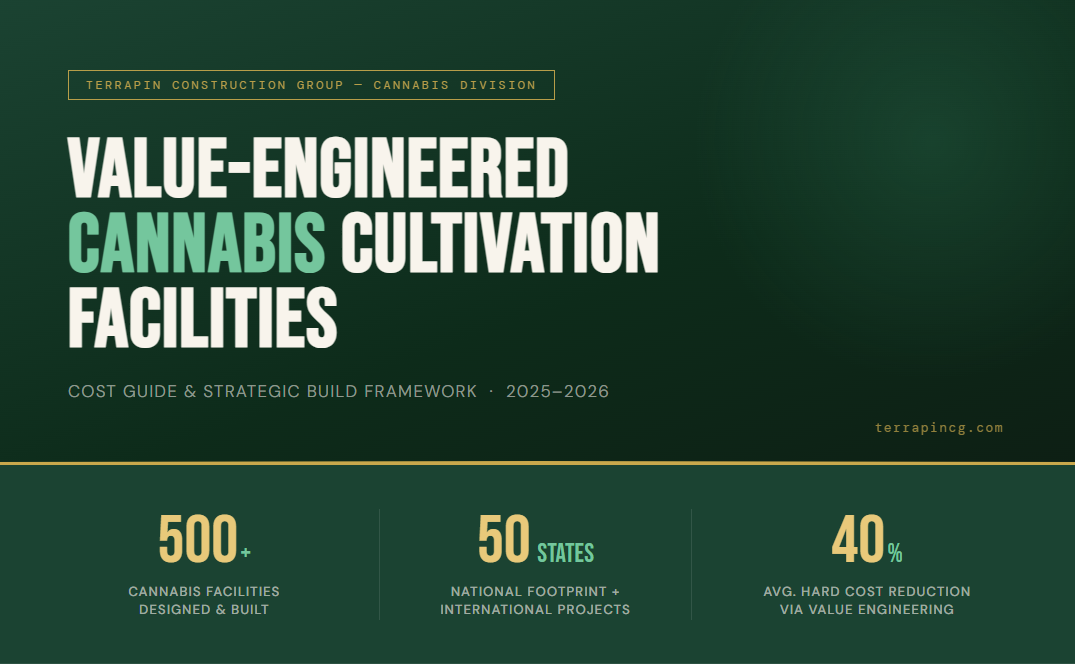
This guide draws on the design-build expertise of Terrapin Construction Group (TCG), a full-service national commercial general contractor with construction management experience across hundreds of large-scale cannabis grows throughout the United States and in several countries abroad. It is intended for developers, operators, and cannabis real estate investors who want to build strategically — not just expensively.
What Does It Actually Cost to Build a Cannabis Cultivation Facility in 2025–2026?
Before diving into value engineering strategies, it helps to establish a baseline. According to published cost data from RSMeans and construction cost benchmarks tracked by the Associated General Contractors of America (AGC), controlled-environment agriculture (CEA) and cannabis cultivation facilities share cost drivers with pharmaceutical cleanrooms and food-processing facilities: tight environmental tolerances, specialized MEP systems, and heavy power infrastructure.
At market rate, a standard commercial cannabis cultivation facility typically runs $200 to $450 per square foot in hard costs across its major systems. Shell and structure — typically insulated metal panels — runs $18 to $35 per square foot at standard pricing. HVAC and environmental controls are often the single largest line item, ranging from $25 to $60 per square foot depending on system type. Electrical for lighting and power adds another $20 to $45 per square foot, with plumbing and irrigation contributing $8 to $18 per square foot. Flooring, benches, and racking typically add another $10 to $27 per square foot combined, and general conditions and GC fee land in the $12 to $22 per square foot range.
With disciplined value engineering across each of these categories, the same facility can be delivered for $150 to $350 per square foot — a reduction that, on a 40,000 SF project, can represent $1M to $5M in savings. That is capital that can instead be deployed toward licensing, equipment, genetics, or working capital.
Why Construction Has to Be in the Room Before Design Begins
In TCG's experience across hundreds of cannabis facility projects spanning all 50 states and multiple countries, nine out of ten facilities that go over budget do so for the same reason: construction was not involved until after the design was complete. It is the single most preventable and most costly mistake in cannabis construction — and it happens constantly.
Here is what that failure mode looks like in practice. An operator engages an architect. The architect engages an MEP engineer. The cultivation consultant provides an equipment list. The design team builds out a beautiful set of construction documents over a period of four to eight months. And then, when those documents go out to bid, the GC pricing comes back 30, 40, sometimes 60 percent over the operator's actual budget. At that point, the operator faces a brutal set of options: go back to the architect and engineer for redesign — paying full fees again for work they've already done — or try to value-engineer on the fly during construction, which is where quality problems and change orders are born.
The redesign cycle is not a minor inconvenience. A single design-to-redesign loop typically costs six to twelve weeks of schedule and adds $50,000 to $200,000 in additional design fees on a mid-size cannabis facility. For an operator paying rent on a licensed premises, servicing construction debt, or racing to beat a competitor to market in a limited-license state, that is not recoverable time or money.
The root cause is almost always the same: architects and engineers design to a program, not a budget. Their professional obligation is to meet the client's functional requirements. Without a construction partner in the room providing real-time cost modeling against those design decisions, the design team has no mechanism to course-correct. A mechanical engineer will specify the most code-compliant, technically defensible HVAC system — not necessarily the most cost-effective one. An architect will detail the envelope to meet the required thermal performance — not necessarily with the lowest-cost panel system that achieves the same result.
This is precisely why TCG's design-build delivery model exists. Under a design-build engagement, TCG's preconstruction team is embedded in the design process from the first programming session. Every major design decision — structural system, HVAC approach, lighting strategy, envelope specification, room configuration — is evaluated in parallel against current market pricing before it is committed to drawings. When a design direction is heading toward a cost outcome the owner cannot support, the conversation happens in the design meeting, not after the bid.
In practical terms, this means TCG's team is running live cost models alongside the design team throughout schematic design and design development. We are calling subcontractors, checking current material pricing, and modeling trade-offs in real time. If the mechanical engineer's preferred HVAC spec is $400,000 over budget, we identify a compliant alternative before that spec is issued for design development — not after it has been permitted and released to bid.
For operators who prefer to maintain separate design and construction contracts but still want this level of cost oversight, TCG also offers owner's representative services — where TCG embeds as the owner's advocate within a traditional design-bid-build process, providing independent cost modeling, constructability review, and value engineering throughout design. The goal is the same: protect the owner's budget before the design is locked, not after.
Whether you are building your first 10,000 SF facility or scaling a multi-state operation, the single highest-ROI investment you can make early in a cannabis project is getting a construction team with real cannabis experience into the room on day one. Contact TCG at terrapincg.com/contact or schedule a preconstruction consultation at calendly.com/will-terrapincg/30min before your design team puts pen to paper.
MEP Engineering: 9BA MEP
Mechanical, electrical, and plumbing design is the technical backbone of any cannabis cultivation facility — and the place where the greatest risk of cost blowout lives. Undersized electrical service, improperly calculated HVAC loads, and substandard irrigation design are the three most common causes of facility performance failure and costly change orders in cannabis construction.
TCG's longstanding MEP design and procurement partner is 9BA MEP, a specialized MEP engineering firm with deep experience in value-engineered controlled-environment agriculture and cannabis facility design. On TCG-delivered projects, 9BA's scope typically covers full electrical load analysis and service sizing including 480V three-phase power distribution, HVAC system design and equipment specification, CO2 supplementation system design and BAS integration, irrigation and fertigation system design for both recirculating and drain-to-waste systems, lighting design and PPFD modeling, and procurement support to ensure schedule and cost alignment.
The 9BA MEP relationship is one of TCG's most significant value-engineering assets. Because TCG and 9BA have collaborated on dozens of projects together, the design-to-procurement pipeline is tighter, change orders are fewer, and specifications are calibrated to what can actually be purchased and installed within budget — not idealized around vendor catalogs or hypothetical equipment availability.
Cultivation Consulting: 3rd Act Architecture & Consulting
Construction expertise and cultivation expertise are not the same thing — and the most successful cannabis facility projects bring both to the table from day one. TCG works with 3rd Act Architecture & Consulting, a firm with deep experience in cannabis facility design and cultivation consulting that has designed and consulted on hundreds of cannabis facilities across the country.
3rd Act brings a rare combination of architectural, operational, and agronomic expertise to the pre-design and programming phases of facility development. Their involvement in TCG-partnered projects typically covers cultivation room layout and workflow optimization, environmental setpoint specifications and equipment tolerance requirements, regulatory compliance review for state-specific facility standards, cultivar-specific infrastructure requirements, and multi-state operator standardization for operators building across multiple jurisdictions.
For operators entering a new market, scaling an existing operation, or rebuilding after a failed build-out, 3rd Act Architecture & Consulting provides the pre-construction consulting infrastructure that prevents costly design mistakes before the first shovel hits the ground. The combination of 3rd Act's cultivation expertise, 9BA MEP's engineering depth, and TCG's construction management and procurement reach creates an integrated project team that most operators would otherwise spend years assembling on their own.
IMP Walls: Where the Real Structural Savings Live
What Are Insulated Metal Panels?
Insulated metal panels (IMPs) are the structural and thermal envelope of choice for cannabis cultivation facilities. A standard IMP consists of two steel facings bonded to a polyurethane or polyisocyanurate foam core, delivering high R-values — typically R-30 to R-42 for four-inch panels — along with vapor barrier performance, a cleanable interior surface, and light-reflective properties. All of that in a single material system.
IMPs are rated and tested under standards published by FM Global (Factory Mutual), whose approval ratings are widely recognized by commercial property insurers. FM-approved panels carry tested ratings for wind uplift, fire resistance (Class 1), and smoke development — critical for operators whose carriers require FM-compliant construction.
The Domestic Manufacturing Premium
The dominant domestic IMP manufacturers — including Metl-Span, Nucor Building Systems, Robertson Building Systems, and MBCI — produce high-quality panels, but their pricing reflects domestic manufacturing costs, distributor margins, and limited regional competition in many markets. For large-format cultivation facilities, domestic IMP packages can represent $800,000 to $2M or more in structural envelope cost alone.
International IMPs: The Value-Engineering Opportunity
What the broader construction industry has understood for years, but the cannabis sector is only beginning to adopt, is that internationally manufactured IMPs can carry the same FM ratings at 30–40% lower cost — without compromising structural integrity, thermal performance, or code compliance.
One of TCG's preferred IMP suppliers for value-engineered cannabis and agricultural facilities is Arch Solar IMP, which supplies FM-rated insulated metal panels and steel doors at significantly lower price points than comparable domestic alternatives. Arch Solar IMP panels carry FM Class 1 fire and smoke performance ratings, high wind uplift ratings suitable for most U.S. climate zones, and full compatibility with standard concealed fastener and exposed fastener installation systems.
On a 30,000 SF cultivation facility shell, the savings from transitioning to Arch Solar IMP panels versus a domestic premium brand can represent $300,000 to $700,000 in hard cost reduction — while maintaining the FM rating requirements of most institutional insurance carriers. TCG also sources FM-rated steel doors from Arch Solar IMP, which are well-suited for cultivation room entries, vaults, mechanical rooms, and compliance corridors where durability, seal performance, and security are non-negotiable.
What to Watch For with International IMPs
Value-engineering with international IMPs requires experienced oversight. International panels typically require 10 to 16 week procurement lead times, which means project scheduling must account for this early in preconstruction — another reason why getting the construction team involved at the design stage is so critical. FM documentation must be verified and secured before procurement is committed. Installation crews need to be experienced with the specific panel system, which is why TCG maintains a national network of qualified IMP installation contractors. And import logistics, while adding complexity, are well-managed by experienced procurement teams with established supplier relationships.
TCG's Subcontractor and Supplier Network: Where Value Engineering Becomes Execution
Value engineering is only as valuable as the contractor's ability to execute on it. Terrapin Construction Group has spent years building a national subcontractor and supplier network specifically calibrated to cannabis, greenhouse, and controlled-environment agriculture construction. This network allows TCG to deliver value-engineered packages without the quality risks that come from chasing the lowest-cost bid on the open market.
IMP Installation
TCG maintains relationships with qualified IMP installation crews across all major U.S. cannabis markets. These crews are vetted specifically for experience with concealed fastener and standing-seam IMP systems, interior vapor barrier integration, and agricultural facility tolerances — the details that separate a watertight envelope from a costly liability.
Flooring
Cannabis cultivation facilities require flooring systems that can withstand constant moisture, chemical exposure, wheel loads from forklifts and harvest carts, and strict sanitation protocols. TCG's flooring subcontractor network includes specialists in epoxy broadcast systems, polyurethane cement flooring, and cove-base systems appropriate for cultivation environments. These systems align with OSHA sanitation standards for agricultural facilities and state cannabis facility inspection requirements.
Benches and Racking
Grow benching and racking represent a significant equipment line item that is often over-specified at early project stages. TCG sources commercial-grade ebb-and-flow benches, rolling tray systems, and vertical racking from its established supplier network, with pricing that reflects volume relationships rather than retail catalog rates. This typically results in 15–25% savings versus standard equipment quotes
Lighting
LED horticultural lighting has become the standard for commercial cannabis cultivation, driven by energy efficiency mandates and performance data. TCG works with lighting suppliers and 9BA MEP to specify appropriate PPFD targets — typically 800 to 1,200 µmol/m²/s for flower rooms — using proven commercial brands that avoid premium-priced proprietary packages where commodity alternatives deliver equivalent DLI performance. This approach also positions facilities for ENERGY STAR commercial building incentives and utility rebate programs where available.
Ducting
Cannabis facility ductwork is one of the most commonly over-engineered systems in a standard build. TCG's mechanical subcontractors specialize in GI spiral duct, fabric ductwork, and stainless steel duct systems for cultivation environments, with SMACNA-standard installation that delivers uniform air distribution without the cost premiums of proprietary systems. Coordination with 9BA MEP ensures duct layout is optimized for both CFM balance and thermal uniformity across cultivation rooms.
TCG's Track Record: Hundreds of Facilities. All 50 States. Multiple Countries.
Terrapin Construction Group is not a general contractor that pivoted to cannabis when the market got hot. TCG has been building large-scale cannabis cultivation facilities since the early days of state-licensed markets, and the firm has completed hundreds of projects across all 50 states and in several countries internationally.
That depth of experience directly impacts value-engineering outcomes. When TCG's preconstruction team reviews a facility design through the lens of TCG's precon services, they draw on hundreds of comparable project data points — not estimates or industry guides. Cost benchmarks, MEP load data, subcontractor performance records, and equipment procurement histories from comparable projects are baked into the preconstruction analysis from day one.
TCG's design-build services are particularly well-suited to cannabis cultivation projects, where owner-operator teams often have deep cultivation knowledge but limited construction management experience. The design-build model gives TCG the ability to value-engineer the structure, MEP systems, and equipment packages simultaneously — rather than letting a design team spec a facility that the GC then attempts to build within a fixed budget after the fact.
For owners who want independent representation and oversight, TCG also offers owner's representative services — an increasingly popular model in the cannabis sector where institutional investors want independent oversight of their capital deployment into construction.
Explore TCG's project portfolio or reach out directly at terrapincg.com/contact. You can also schedule a 30-minute preconstruction consultation at calendly.com/will-terrapincg/30min.
Value Engineering Checklist: The TCG Framework
Before any cannabis facility breaks ground, TCG's preconstruction team evaluates the following levers across every major system category.
1. Structural Envelope
• Evaluate international IMP suppliers — including Arch Solar IMP — versus domestic for FM-rated panels at 30–40% cost reduction
• Confirm FM rating documentation before procurement commitment
• Adjust panel thickness specification to actual thermal load requirements, not overbuilt industry defaults
2. HVAC and Environmental Controls
• Compare Trane and Carrier commercial systems against agronomic platforms on total installed cost for the specific facility load profile
• Define setpoint requirements first — then specify equipment, not the reverse
• Evaluate BAS integration for CO2, VPD, and temperature monitoring without proprietary controller lock-in
3. MEP Design and Procurement
• Engage 9BA MEP for design-to-procurement integration that eliminates specification-to-cost gaps
• Right-size electrical service — most facilities are over-specified at initial design stage
• Evaluate fabric duct versus GI spiral for cultivation room air distribution
4. Cultivation Infrastructure
• Bench and racking systems — evaluate commercial alternatives to premium proprietary systems
• LED lighting — model PPFD requirements and evaluate commodity LED sources against branded alternatives before committing to a specification
• Flooring — specify polyurethane cement or epoxy-broadcast appropriate for the contamination class, not maximum-spec across the board
5. Project Delivery Model
• Evaluate design-build delivery for cost-certainty and integrated value engineering from day one
• Consider construction management or owner's rep for investors requiring independent oversight of capital deployment
• Engage 3rd Act Architecture & Consulting for cultivation programming before architectural design begins
Related Resources from Terrapin Construction Group
Terrapin Construction Group publishes regular cost-guide content for commercial real estate developers and operators across all building types. You may also find these relevant:
• Average Cost to Build a QSR in the USA
• Average Cost to Build an Optometry Office in the USA
• The Hospital Construction Boom: What to Expect in 2026
• Commercial Construction Delivery Methods: Cost-Plus vs. GMP in 2026
Additional Industry References
• ASHRAE Handbook — HVAC Applications (Agriculture) — Design guidelines for controlled-environment agricultural HVAC
• FM Global: Data Sheets for Class 1 and Class 2 Fire Rating — IMP approval and fire rating documentation
• Associated General Contractors of America — Construction cost data and industry benchmarks
• NAIOP: Industrial and Flex Facility Development — Commercial real estate development standards applicable to CEA facilities
• U.S. Green Building Council: LEED for Building Operations — Energy efficiency certification applicable to cannabis facility design
• Department of Energy: CEA Energy Efficiency Guide — Benchmarking for controlled-environment agriculture energy use
• OSHA: Agricultural Operations Standards — Applicable safety and sanitation standards for indoor cultivation facilities
Ready to Build Smarter?
Terrapin Construction Group brings national scale, deep cannabis construction experience, and a proven network of value-engineering partners to every project. Whether you are building your first facility or scaling a multi-state operation, we can help you design and deliver a high-performance grow at a fraction of the standard build cost.
Visit terrapincg.com | Schedule a Consultation: calendly.com/will-terrapincg/30min
Services: Construction Management | Design-Build | Preconstruction | Owner's Rep | Equipment Procurement
