

Switchgear, Transformer, and Generator Lead Times in 2026
Switchgear, Transformer, and Generator Lead Times in 2026
The Real Numbers for Data Center, BESS, and Industrial Construction — and How to Protect Schedule
If you're building a data center, BESS facility, or any industrial project in 2026, your construction schedule is no longer set by construction. It's set by electrical equipment lead times. Here's exactly what's running long, and how to stop letting it kill your project.
The pandemic-era supply chain breakdown that hit electrical equipment in 2020–2022 has not normalized. In 2026, lead times on medium-voltage switchgear, substation-class transformers, large generators, UPS systems, and automatic transfer switches remain 2 to 4 times pre-pandemic norms — and in some categories are still getting worse, not better. The reasons are structural: data center load growth, BESS deployment, grid modernization, electrification, and reshoring have created equipment demand that the existing manufacturing base simply cannot fulfill on traditional timelines.
For developers, EPCs, owners, and GCs, the practical impact is brutal. A project schedule that assumes a 24-week switchgear delivery now needs to assume 72. A generator order that used to ship in 20 weeks now takes 60. Pad-mount transformers that arrived in 8 weeks now take 50. Projects that don't account for this end up sitting on $50M+ of completed building shells waiting for energization.
This is the 2026 reality of critical MEP equipment supply, written by Terrapin Construction Group — a nationwide commercial general contractor that procures and coordinates this equipment across data center, BESS, food processing, and industrial projects in all 50 states.
For an instant cost estimate that includes realistic equipment lead time assumptions, run our TCG.ai estimator.
2026 Critical Equipment Lead Times at a Glance
- Medium-voltage switchgear (15kV class): 52–80 weeks
- Pad-mount distribution transformers: 40–65 weeks
- Substation transformers (5–50 MVA): 75–110 weeks
- Generator step-up transformers (>50 MVA): 100–150+ weeks
- Diesel generators 1,500–3,000 kW: 50–78 weeks
- Large diesel generators (>3,000 kW): 90–110 weeks
- UPS systems 500–1,500 kVA: 30–48 weeks
- Modular UPS 2,000+ kVA: 40–60 weeks
- Automatic transfer switches (ATS): 24–40 weeks
These numbers come from active 2026 manufacturer slot reservations and TCG project procurement data. Specific lead times vary by manufacturer, voltage class, and quantity.
Why electrical equipment is the schedule bottleneck in 2026
Four structural forces are keeping lead times elevated, with no near-term relief.
1. Data center load growth has overwhelmed manufacturing capacity
US data center electricity demand grew over 18% in 2025. Hyperscalers (AWS, Google, Microsoft, Meta, Oracle) are deploying load at unprecedented scale — and each new MW requires switchgear, transformers, generators, and UPS. The big four manufacturers (ABB, Schneider, Vertiv, Eaton) have added capacity, but not fast enough to catch up.
2. Grid modernization is consuming the same supply
Utilities are simultaneously rebuilding aging transmission and distribution infrastructure. AEP, Duke, Dominion, Xcel, PG&E, Southern Company, and many regional utilities are competing with hyperscalers for the same transformer and switchgear capacity. The result: utility backlog has worsened the commercial backlog.
3. Electrification across sectors
EV charging infrastructure, building electrification, industrial electrification, and BESS deployment all draw on the same electrical equipment supply chain. The cumulative effect: a permanent step-change in demand that the manufacturing base is rebuilding to meet but cannot meet immediately.
4. Specialty steel, copper, and bushing supply
The underlying material constraints — grain-oriented electrical steel (GOES) for transformer cores, copper conductor, high-voltage bushings — are still constrained. Transformer manufacturers are limited by core material allocation as much as by labor.
For broader material lead-time context across construction, see our Commercial Construction Material Lead Times 2026 article.
Equipment-by-equipment 2026 lead time reality
Medium-voltage switchgear
| Configuration | 2026 Lead Time | Notes |
|---|---|---|
| 5kV / 15kV metal-enclosed switchgear | 52–72 weeks | Most common; multiple manufacturers |
| 15kV / 27kV metal-clad switchgear | 60–80 weeks | Higher fault rating; fewer manufacturers |
| 38kV switchgear | 78–104 weeks | Specialty; limited US-domestic supply |
| Pad-mount loop switches | 32–50 weeks | Less constrained; multiple suppliers |
The dominant manufacturers are ABB, Eaton, Siemens, Schneider, and Powell. Powell has become an increasingly important option for hyperscale and data center customers as the big four manufacturers' lead times stretched.
Transformers
| Type / Size | 2026 Lead Time | Notes |
|---|---|---|
| Dry-type 0–2 MVA (480V to 208V) | 20–32 weeks | Indoor installation typical |
| Pad-mount 0–5 MVA (15kV/12.5kV to 480V) | 40–65 weeks | Most common distribution transformer |
| Substation 5–25 MVA | 65–95 weeks | Outdoor; lead times stretched dramatically since 2021 |
| Substation 25–50 MVA | 85–110 weeks | Domestic US manufacturers fully booked through 2027 |
| Generator step-up (GSU) 50–150 MVA | 100–150+ weeks | Specialty; very limited supply |
Major transformer manufacturers serving US markets include GE, Hitachi Energy, Hyundai, Mitsubishi, WEG, ABB, and SPX Transformer Solutions. Domestic GOES supply remains the underlying constraint.
Generators
| Size / Type | 2026 Lead Time | Notes |
|---|---|---|
| Diesel 500–1,000 kW | 32–48 weeks | Standard data center / commercial size |
| Diesel 1,500–2,000 kW | 50–66 weeks | Hyperscale standard tier |
| Diesel 2,500–3,500 kW | 62–82 weeks | Large hyperscale / industrial |
| Diesel 3,500–4,500 kW | 90–110 weeks | Very large; limited supply |
| Natural gas 1,000–3,000 kW | 54–78 weeks | Behind-the-meter, BESS pairing |
The dominant generator manufacturers are Caterpillar, Cummins, MTU, Kohler, and Generac. All five have similar constrained delivery windows in 2026. Caterpillar and MTU often have the shortest lead times for larger hyperscale tier units; Cummins and Kohler tend to be competitive at the 1,000-2,000 kW range.
UPS systems and ATS
| Equipment | 2026 Lead Time | Notes |
|---|---|---|
| Static UPS 100–500 kVA | 20–32 weeks | Commercial standard |
| Static UPS 500–1,500 kVA | 30–48 weeks | Mid-tier data center |
| Modular UPS 2,000+ kVA | 40–60 weeks | Hyperscale |
| Diesel rotary UPS (DRUPS) | 60–80+ weeks | Specialty hyperscale |
| Automatic transfer switches (ATS) | 24–40 weeks | By size and configuration |
The 2026 reality: if you're not ordering electrical equipment 12-18 months before you mobilize the site, you're already behind.
How equipment lead times affect different project types
| Project Type | Critical Equipment Path | Schedule Impact |
|---|---|---|
| Hyperscale data center (50-200 MW) | MV switchgear, GSU transformers, generators, UPS | Equipment dictates entire schedule; order at land close |
| Tier III colocation (10-50 MW) | MV switchgear, distribution transformers, generators, UPS | 15-22 month schedule typical; equipment is critical path |
| BESS facility (50-500 MWh) | MV switchgear, transformers, PCS | Often longer than civil construction |
| Food processing / large cold storage | Distribution transformers, generators (backup) | Can typically be ordered after groundbreaking |
| Standard commercial (under 5 MW) | Pad-mount transformers, ATS | Order at permit submission |
For project-specific context, see our IMP Installation for Data Centers 2026, Data Center Construction in Columbus, Ohio, and BESS Facility Construction Cost 2026 articles.
Six strategies that actually protect schedule
- Order at land close, not at construction start. For hyperscale data centers and BESS, the order date for switchgear and transformers should precede groundbreaking by 6-12 months.
- Reserve manufacturer slots with partial payment. Most manufacturers will hold a production slot for 10-30% of equipment cost. Without slot reservation, your nominal "lead time" can extend an additional 8-16 weeks once you finalize.
- Specify by configuration, not manufacturer. Lock down voltage class, fault rating, and footprint early. Then run competitive bid across multiple manufacturers based on who has earliest delivery slots — not just lowest price.
- Build redundancy into the procurement plan. Single-sourcing is risky in 2026. Even on Caterpillar-spec'd generators, identify acceptable Cummins or MTU alternates that can be substituted if delivery slips.
- Engage the utility early. Utility interconnect studies often dictate transformer size and voltage class. Engaging the utility during schematic design (not construction documents) avoids transformer respec after order.
- Use design-build for fast-track projects. Sequential design-bid-build adds 12+ weeks to equipment ordering because final specs aren't issued until 100% CDs. Design-build delivery integrates equipment selection with schematic design and shaves weeks off the critical path.
How TCG approaches equipment procurement
TCG operates as a nationwide design-build commercial general contractor. For projects with critical equipment lead times, our Equipment Procurement service brings four advantages.
1. Manufacturer slot reservations during preconstruction
We reserve switchgear, transformer, and generator slots with manufacturers based on preliminary specifications — often during the schematic design phase, before final CDs are issued. This compresses the apparent lead time by 8-16 weeks.
2. Multi-manufacturer alternates baked in
For every major equipment spec, we identify two acceptable alternates from competing manufacturers. If one supplier slips, we activate the alternate without redesigning. See related: Equipment Procurement for Commercial Construction.
3. AI-powered scheduling and ordering
Our TCG.ai estimator includes equipment lead-time intelligence — meaning your preconstruction estimate doesn't assume 2019 lead times that nobody can deliver to.
4. Direct manufacturer relationships
We carry direct relationships with major switchgear (ABB, Eaton, Schneider, Siemens, Powell), transformer (Hitachi Energy, Hyundai, WEG, GE), and generator (Caterpillar, Cummins, MTU, Kohler) manufacturers. This means real-time lead-time visibility, slot reservations, and priority allocation during constrained periods.
Equipment Procurement Red Flag
If your GC or EPC tells you that 2026 switchgear lead times are "24-36 weeks" or generator lead times are "20-30 weeks," they are quoting pre-pandemic norms — not current reality. Verify with the actual manufacturer before underwriting a schedule. Project schedules built on stale lead-time assumptions are the single biggest cause of data center and BESS project delays in 2026.
300,000 SF Data Center Support Campus, North of Dallas
TCG erected and insulated three 100,000 SF pre-engineered metal buildings for the staging and storage campus of a new data center north of Dallas, Texas. Building 1 went from start of steel erection to sign-off in 41 days, and the full campus finished 30 days ahead of schedule.
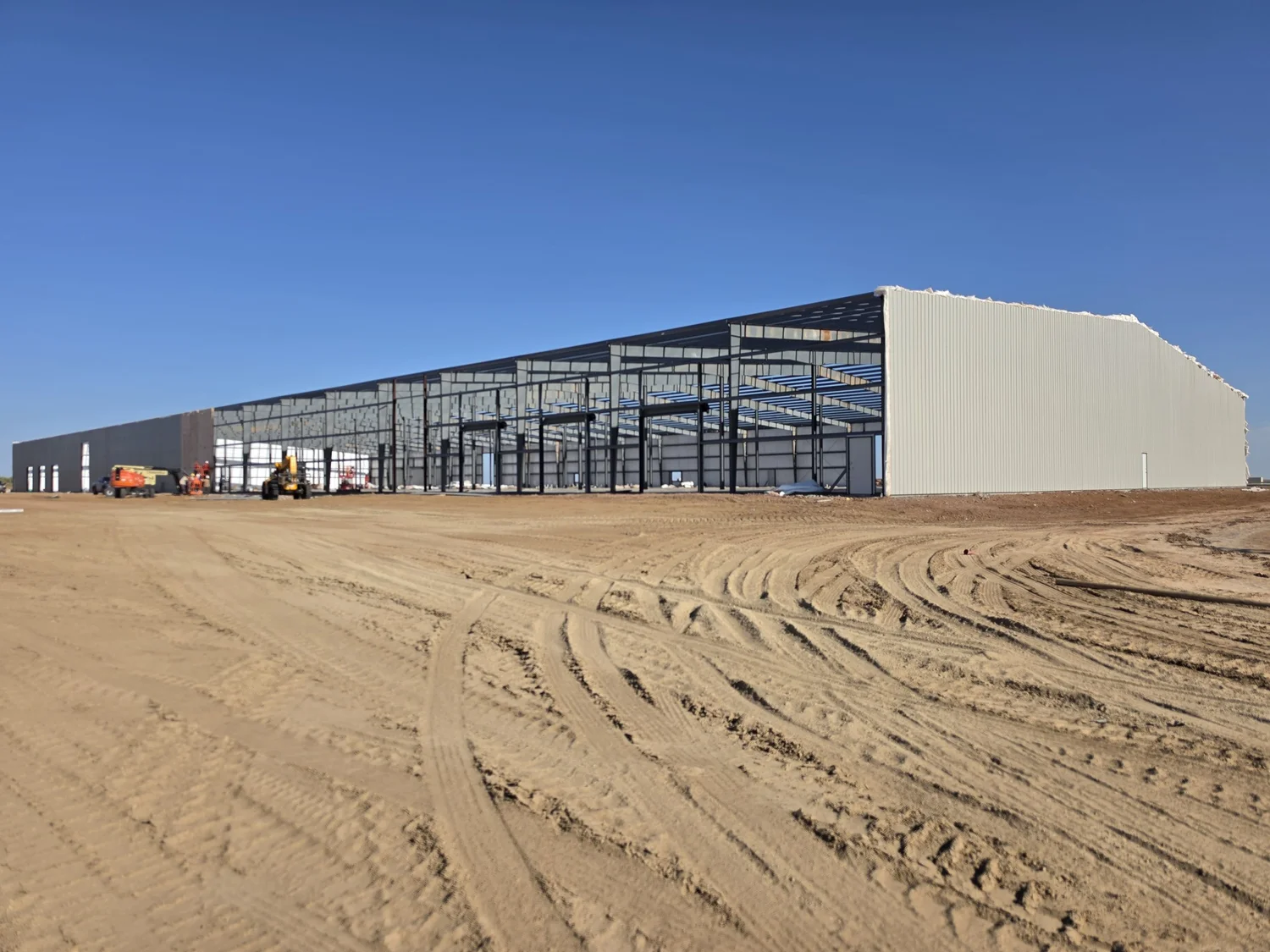
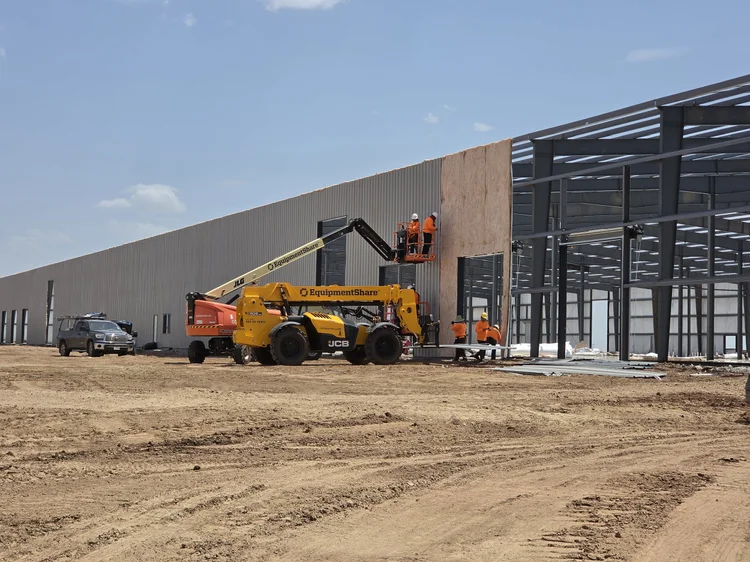
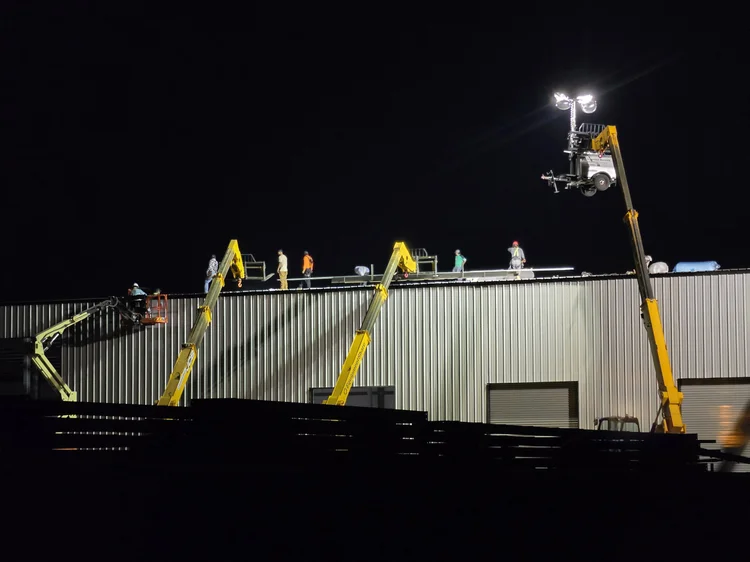

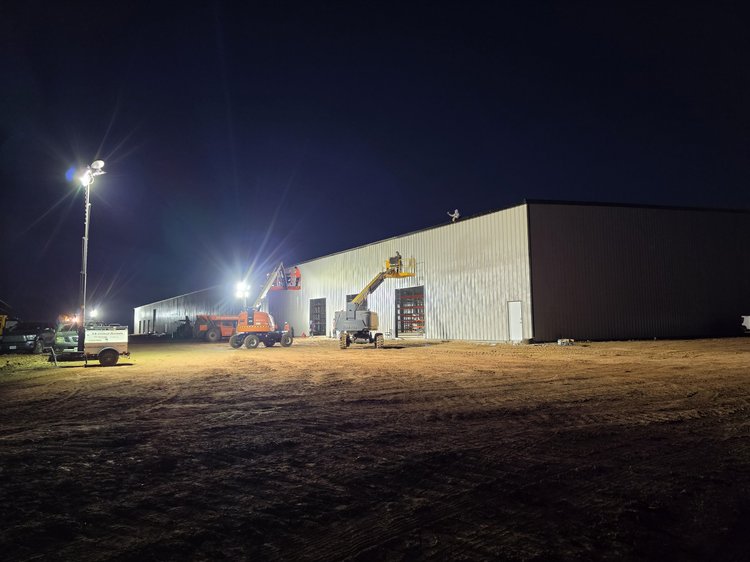
On a data center campus the support buildings come first: staging, equipment storage, and laydown have to be dried in before long-lead electrical and mechanical gear arrives for the data hall. Crews ran early morning and night shifts under light towers, with roof panels, wall cladding, and insulation moving in parallel instead of in sequence.
Why it matters for equipment lead times: on a data center campus, the staging and storage buildings have to be dried in before 52-plus-week switchgear, transformers, and generators arrive, or that equipment ends up waiting in an open laydown yard. Finishing support buildings early means covered, secure space is ready when the gear ships. See TCG’s equipment procurement and data center construction services.
- Scope: PEMB steel erection, roof and wall panels, and insulation
- Use: staging and equipment storage for a new data center campus
- Schedule: parallel crews on extended shifts
- Result: 300,000 SF delivered 30 days early
Full photo gallery on the project spotlight.
Frequently asked questions
What is the lead time on medium-voltage switchgear in 2026?
Standard medium-voltage switchgear lead times in 2026 run 52–80 weeks depending on manufacturer, voltage class, and configuration. Customized or 38kV/69kV applications can stretch to 96–120 weeks. This is roughly 2.5x pre-pandemic lead times and has not meaningfully improved since 2023.
How long does it take to get a generator for a 2026 data center project?
Diesel generators in the 1,500–3,000 kW range are running 50–78 weeks from order to delivery in 2026. Larger units (3,000–4,000+ kW) can stretch to 90–110 weeks. Caterpillar, Cummins, MTU, and Kohler are the dominant suppliers, all with similar constrained delivery windows.
What about transformer lead times?
Pad-mount distribution transformers (up to 5 MVA): 40–65 weeks. Substation-class transformers (5–50 MVA): 75–110 weeks. Large generator step-up (GSU) or auto-transformers above 50 MVA: 100–150+ weeks. Transformer steel and bushing supply chains remain constrained well into 2026.
What is the lead time on UPS systems?
Static UPS systems in the 500–1,500 kVA range: 30–48 weeks. Larger 2,000+ kVA modular UPS: 40–60 weeks. Rotary UPS and Diesel Rotary UPS (DRUPS): 60–80+ weeks. ABB, Schneider, Vertiv, and Eaton dominate; smaller specialty manufacturers can sometimes shorten by 6–10 weeks.
Are lead times getting better or worse in 2026?
Mixed. UPS lead times have improved modestly from 2024 peaks. Switchgear is roughly flat. Substation transformers remain at peak elevated lead times because of GOES (grain-oriented electrical steel) supply constraints. We do not expect meaningful normalization before 2028.
How does TCG protect schedule given these lead times?
We order critical MEP equipment during preconstruction, not at construction start — sometimes 12–18 months before site mobilization. Through our Equipment Procurement program, we coordinate manufacturer slot reservations, partial-payment escrows, and substitute equipment plans so projects don't sit idle waiting for switchgear.
