
Equipment Procurement for Commercial Construction: How Direct Manufacturer Relationships Save Projects Real Money
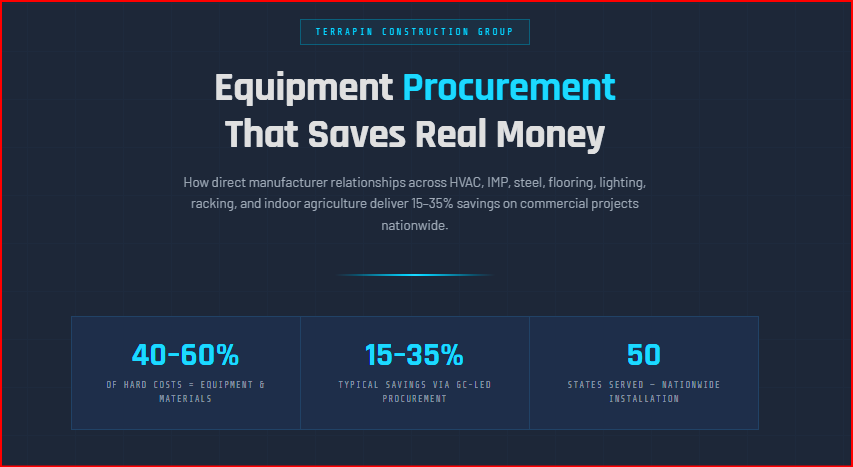
On any commercial construction project — whether it's a QSR restaurant, a cold storage facility, a 3PL logistics warehouse, or a cannabis cultivation operation — equipment and materials procurement is where the real money is made or lost. According to the Associated General Contractors of America, materials and installed equipment typically represent 40–60% of total hard construction costs on commercial projects. The pricing you secure on those materials, the lead times you lock in, and the installation networks you have access to are not secondary considerations. They are the primary financial levers on the project.
Yet most owners and developers treat procurement as a downstream activity — something that happens after design is finished and a GC is under contract. That sequence leaves enormous value on the table. By the time a typical general contractor begins sourcing major equipment, the project schedule is already set, the budget is already committed, and the leverage to negotiate meaningfully with manufacturers has already eroded. The result is market-rate pricing, standard lead times, and no ability to value-engineer specifications without triggering costly redesign.
At Terrapin Construction Group, equipment procurement is not an afterthought. It is a core service line — built on longstanding direct relationships with manufacturers across every major equipment category in commercial construction. We don't buy through distributors when we can buy direct. We don't accept catalog pricing when our volume and relationships command better terms. And we don't treat procurement as a purchasing department function — we treat it as a preconstruction strategy that begins at project conception and runs through final commissioning.
This article explains exactly what our procurement division does, which manufacturer relationships we bring to the table, what types of projects we've procured equipment for, and why the financial advantage of GC-led procurement is especially significant in the current 2026 cost environment where tariffs, supply chain volatility, and extended lead times are compressing margins industry-wide.
Why GC-Led Procurement Creates a Structural Cost Advantage
The traditional commercial construction model separates design, procurement, and construction into sequential phases with different parties responsible for each. The architect specifies equipment. The owner or their purchasing agent sources it. The GC installs it. That fragmentation creates three distinct problems that directly increase project cost.
First, architects specify equipment based on performance criteria and manufacturer preferences — not on pricing intelligence or supply chain reality. A mechanical engineer specifying a Carrier or Trane rooftop unit for a commercial project is selecting based on capacity, efficiency ratings, and familiarity. They are not negotiating the purchase price, and they typically have no visibility into whether the specified unit has a 6-week or 26-week lead time at the moment of specification. That disconnect between specification and procurement reality is where schedules slip and budgets inflate.
Second, owners who procure equipment independently — or through a purchasing agent without construction expertise — frequently mistime orders relative to the construction sequence. Equipment that arrives too early sits in storage (at the owner's cost and risk). Equipment that arrives late holds up rough-in, inspections, and commissioning. According to Procore's procurement management framework, coordinating equipment delivery with the construction schedule is one of the most common failure points on commercial projects, and the financial impact of mistimed deliveries compounds quickly through downstream trade stacking and schedule compression.
Third, individual project purchasing — even on large jobs — lacks the aggregate volume that drives manufacturer pricing. A developer building a single self-storage facility or a single urgent care clinic is buying one project's worth of HVAC, one project's worth of insulated metal panels, one project's worth of lighting. That project represents a rounding error in a manufacturer's annual sales volume, and the pricing reflects it.
TCG's procurement model solves all three problems simultaneously. Because we operate as a national general contractor building across all 50 states and across multiple building types, our aggregate annual purchasing volume gives us pricing leverage that a single-project buyer cannot replicate. Because our preconstruction team is involved in equipment selection from schematic design forward, we align specifications with real-time pricing and lead-time data — not catalog assumptions. And because our project teams manage the construction schedule, we coordinate delivery windows to the week, eliminating storage costs and schedule gaps.

HVAC: Carrier and Trane — Best Pricing in the Nation
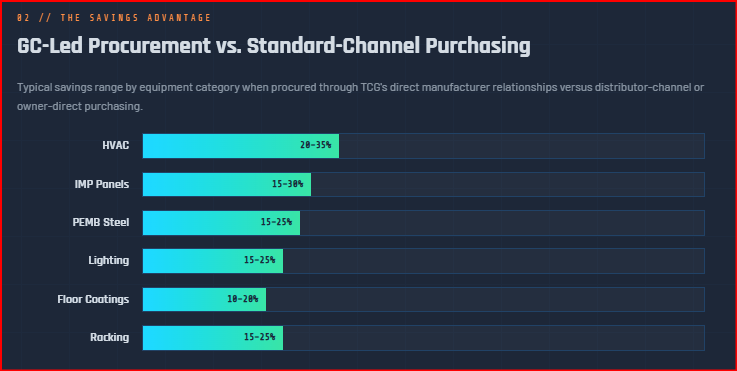
Commercial HVAC is typically the single largest equipment line item on any conditioned commercial building. On projects ranging from optometry offices to veterinary clinics to grocery-anchored strip malls, mechanical systems represent 15–25% of total hard costs. The pricing differential between catalog pricing through a local distributor and direct manufacturer pricing through a high-volume purchaser is substantial — often 20–35% on comparable equipment.
Terrapin Construction Group maintains direct purchasing relationships with both Carrier and Trane — the two dominant commercial HVAC manufacturers in the United States. These are not standard dealer accounts. These are volume-based national accounts built over years of consistent purchasing across dozens of projects annually. The result is pricing that we will put against any quote in the country on comparable Carrier and Trane commercial rooftop units, split systems, VRF systems, and packaged equipment.
This matters enormously in the current market. ACHR News has reported that commercial HVAC manufacturers have implemented multiple rounds of price increases since 2024, with commercial applied products increasing by blended averages of 8–10% per round. Owners who are purchasing HVAC equipment at today's list pricing through a local mechanical contractor's supply chain are paying a meaningfully different number than owners whose GC has a direct national account with the manufacturer. On a $200,000 HVAC package — a common scope for a mid-size commercial project — a 25% pricing advantage represents $50,000 in real savings that drops straight to the owner's bottom line.
Beyond pricing, our HVAC procurement relationships provide lead-time advantages. When supply is constrained — as it has been intermittently since 2021 on specific Carrier and Trane product lines — our volume and relationship status move our orders ahead of standard-channel customers. On schedule-driven projects, that priority can be worth more than the pricing advantage itself.
Our partner 9BA MEP provides the engineering and design coordination on the mechanical side, ensuring that the equipment we procure is specified correctly for the application, sized for the load, and coordinated with the electrical and plumbing systems from day one.
Insulated Metal Panels: Longstanding IMP Manufacturer Relationships
Insulated metal panels are a core competency at TCG. Our IMP installation division is one of the most active in the country, and our procurement relationships with IMP manufacturers reflect that volume.
We maintain direct purchasing and specification relationships with Kingspan, Metl-Span, CENTRIA, PermaTherm, FALK, UPI, Arch Solar, AWIP, and MBCI. As detailed in our IMP manufacturer comparison guide, each manufacturer serves different performance niches — R-value requirements, fire ratings, aesthetic profiles, cold storage specifications, and food-safe certifications. Our procurement team doesn't just buy panels. We help owners and architects select the right manufacturer and product line for the specific application, then leverage our volume relationship to secure pricing that individual-project buyers cannot access.
The IMP Install Estimator on our website gives owners and developers a preliminary budget number for their IMP scope. But the real value is in the procurement conversation that follows — where we align the right product with the right application at the right price, coordinated with our nationwide IMP installation network.
IMP procurement is particularly critical in 2026 given that IMP installation volumes are projected to increase significantly this year, driven by cold storage, data center, and food processing construction. Manufacturers are running extended lead times on popular product lines, and owners who do not have a GC with established manufacturer relationships are finding themselves at the back of the queue.
Pre-Engineered Metal Buildings: Direct Steel Manufacturer Access
Pre-engineered metal buildings represent one of the most cost-effective structural systems for commercial construction — particularly for warehouses, self-storage, agricultural buildings, vehicle maintenance facilities, and light industrial applications. As we've discussed in our coverage of self-storage construction costs and 3PL warehouse costs, PEMB systems can reduce structural costs by 15–25% compared to conventional steel construction.
TCG maintains direct relationships with PEMB steel manufacturers — not through broker networks or regional dealers, but through the manufacturers themselves. This gives us several advantages. We receive factory-direct pricing that reflects our annual volume rather than individual project quantities. We have direct communication with engineering and detailing teams at the factory, which accelerates the shop drawing and approval process. And we can coordinate fabrication scheduling to align with our construction timeline rather than accepting whatever slot is available in the production queue.
In the current tariff environment, where steel is subject to Section 232 tariffs of 50%, PEMB procurement timing and manufacturer selection have become even more consequential. The delta between a well-negotiated PEMB package and a market-rate purchase can be $50,000 to $150,000 on a standard commercial building — and significantly more on larger structures.
Floor Coatings and Commercial Flooring Systems
Commercial flooring and floor coating systems are a scope that owners frequently underestimate in both cost and complexity. A polished concrete floor in a brewery taproom is a fundamentally different product than an epoxy-urethane system in a pharmaceutical cleanroom or a resinous floor in a commercial kitchen. The performance specifications, material chemistries, and installation techniques are all different — and the manufacturer landscape is fragmented enough that most GCs default to whatever their local flooring sub quotes.
TCG's procurement approach to flooring is different. We maintain relationships with commercial floor coating manufacturers and specify systems based on the end-use application — chemical resistance, thermal shock tolerance, antimicrobial requirements, USDA compliance for food processing, and static dissipation for electronics manufacturing. We then pair the specified system with our nationwide network of certified installation crews who have demonstrated proficiency with those specific chemistries and application methods.
On projects like cold storage facilities, cannabis cultivation operations, high-end restaurants, and veterinary clinics, flooring system selection directly impacts both construction cost and long-term maintenance expense. Getting it right at procurement — not as a last-minute field decision — saves owners money twice: once on installation and again over the life of the floor.
Benching, Racking, and Shelving Systems
For projects with significant interior infrastructure — cannabis cultivation facilities, 3PL warehouses, cold storage operations, self-storage facilities, and retail distribution centers — benching, racking, and shelving systems represent a major equipment category that is almost always owner-procured and almost always poorly coordinated with the construction timeline.
TCG procures racking and benching systems as part of the integrated project scope. For cannabis facilities, this means multi-tier rolling bench systems that must be coordinated with floor loads, irrigation rough-in, and electrical distribution. For warehouse projects, it means pallet racking systems that must be engineered to site-specific seismic requirements and coordinated with fire suppression design (in-rack sprinkler systems are triggered by racking configuration). For self-storage, it includes interior partition systems and unit shelving packages.
Our direct relationships with benching and racking manufacturers allow us to specify, price, and order these systems during preconstruction — when there is still time to adjust the building design if the racking layout reveals a structural or MEP conflict. Owners who procure racking independently and hand the package to their GC for installation frequently discover coordination issues that result in field modifications, added structural reinforcement, or fire suppression redesign — all of which are expensive change orders.
Commercial and Industrial Lighting
Lighting is one of the most specification-sensitive equipment categories in commercial construction. The performance gap between a well-specified LED lighting package and a value-engineered commodity solution is enormous — particularly in retail, healthcare, food service, and indoor agriculture applications where light quality, color rendering, spectrum control, and energy efficiency directly impact business operations.
TCG procures commercial lighting systems through direct manufacturer relationships, bypassing the multi-layer distribution chain that inflates pricing on most commercial projects. For standard commercial applications — offices, retail shells, warehouses, restaurant spaces — we source high-efficiency LED packages at volume pricing. For specialty applications like cannabis cultivation and indoor agriculture, we procure application-specific horticultural lighting systems from manufacturers who specialize in the photosynthetic spectrum requirements of controlled-environment agriculture.
On a typical commercial project, lighting represents 5–10% of the electrical scope. On an indoor agriculture or cannabis facility, horticultural lighting can represent 15–25% of the total equipment budget. The procurement savings on a well-negotiated lighting package — whether commercial or horticultural — directly improve the owner's yield on cost and accelerate the return on the overall construction investment.
Indoor Agriculture and Controlled-Environment Systems
Cannabis cultivation and indoor agriculture represent a specialized procurement category where TCG has built particularly deep supplier relationships. A modern commercial cannabis facility requires an integrated equipment package that includes HVAC dehumidification systems, CO2 supplementation, fertigation and irrigation controls, benching and rolling table systems, horticultural lighting, and environmental monitoring and automation platforms.
Most GCs treat these systems as owner-furnished items and install them as directed. TCG takes a fundamentally different approach. Our procurement team works with cannabis operators during design-build to specify an integrated equipment package where every system is coordinated with every other system — because in controlled-environment agriculture, the HVAC system, lighting system, and irrigation system are all interdependent. A change to the lighting load changes the cooling load. A change to the irrigation flow changes the humidity load. Procuring these systems in isolation guarantees performance conflicts.
Our relationships with indoor agriculture equipment suppliers span dehumidification, LED horticultural lighting, environmental controls, rolling bench systems, and fertigation manufacturers. Our partner 3rd Act Architecture & Consulting provides the design framework within which these systems are specified, and TCG's procurement team handles the purchasing, logistics, and installation coordination across the full package.
For cannabis operators expanding into emerging markets like Minnesota and Kentucky, having a GC that can procure and install the full equipment complement — not just build the shell — compresses the project timeline by weeks and eliminates the coordination risk that has plagued cannabis construction since the industry's earliest days.
Nationwide Installation Networks Across All Trades
Procurement without installation capability is only half the equation. A manufacturer relationship that delivers excellent pricing on HVAC equipment means nothing if the owner then has to source and vet a local mechanical contractor to install it — and that contractor marks up the installation to recover the margin they lost by not supplying the equipment.
TCG's procurement model includes nationwide installation networks for every equipment category we source. Because we operate as a construction management firm and general contractor across all 50 states, we maintain vetted subcontractor and installer relationships in every major market. When we procure Carrier rooftop units for a project in Phoenix, we have a mechanical installation partner in Phoenix. When we procure IMP panels for a cold storage build in Atlanta, we have IMP installation crews in the Southeast. When we procure PEMB steel for a warehouse in Ohio, we have erection crews in the Midwest.
This national installation capability is what transforms procurement from a purchasing exercise into a true construction delivery advantage. The owner gets one contract, one point of accountability, and a fully coordinated supply-and-install package — rather than managing separate procurement contracts, shipping logistics, and installation subcontracts across dozens of equipment categories.
What Types of Projects Benefit from TCG's Procurement Services?
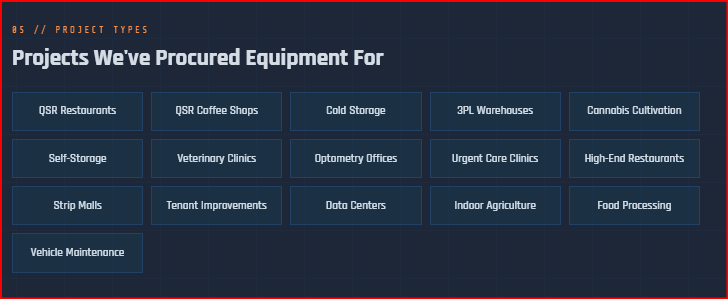
We have procured equipment across virtually every commercial building type we construct. The following is not exhaustive, but it represents the breadth of project types where our procurement relationships create measurable cost and schedule advantages.
QSR restaurants and QSR coffee shops benefit from HVAC, kitchen ventilation, and commercial lighting procurement. Cold storage facilities require refrigeration systems, IMP panels, and specialized flooring — all categories where our direct manufacturer pricing produces significant savings. 3PL and logistics warehouses involve PEMB steel, racking systems, dock equipment, and high-bay lighting. Cannabis cultivation facilities require the full controlled-environment equipment stack described above. Self-storage facilities benefit from PEMB procurement, climate control systems, and interior partition packages. Veterinary clinics, optometry offices, and urgent care clinics benefit from commercial HVAC, specialty flooring, and medical-grade lighting procurement. High-end restaurants require kitchen ventilation, commercial refrigeration, specialty flooring, and architectural lighting — all sourced through our direct relationships. Grocery-anchored strip malls and tenant improvement buildouts benefit from HVAC, lighting, and flooring procurement at scale.
The common thread across all of these project types is that equipment represents a large enough share of total cost that procurement pricing has a material impact on the project pro forma. On every one of them, our direct manufacturer relationships deliver pricing, lead times, and coordination advantages that an owner could not replicate purchasing independently.
Get a Procurement-Informed Estimate for Your Project
TCG's AI-powered construction estimator provides preliminary budget numbers for commercial projects across all building types. For projects involving significant equipment scope — HVAC, IMP, PEMB, flooring, racking, lighting, or indoor agriculture systems — schedule a 30-minute procurement consultation with our team to understand the real pricing advantage before you finalize your budget.
The 2026 Cost Environment Makes Procurement Strategy More Important Than Ever
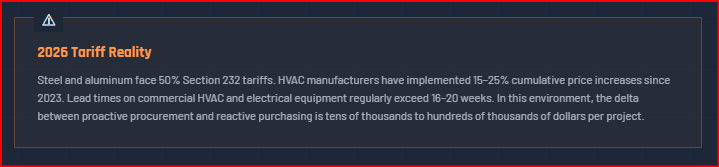
The current construction cost environment has made procurement strategy a survival skill, not a nice-to-have. As we've detailed in our analysis of 2026 construction challenges, steel and aluminum tariffs of 50% under Section 232, copper price volatility driven by geopolitical disruption, and extended lead times across virtually every major equipment category are creating a cost environment where the difference between good procurement and average procurement is the difference between a project that pencils and one that doesn't.
According to JLL's 2025 construction cost analysis, material prices averaged approximately 4.2% above prior-year levels, with specific categories like steel and electrical components running significantly higher. Construction Dive reporting confirms that commercial HVAC manufacturers including Carrier have implemented cumulative price increases of 15–25% since 2023. And the AGC has noted that extended lead times on HVAC systems and electrical components continue to affect project schedules nationwide.
In this environment, owners who rely on standard-channel procurement — buying through distributors, accepting quoted lead times, and pricing equipment after design is complete — are paying a premium at every turn. Owners who engage a GC with direct manufacturer relationships and a disciplined procurement process are capturing savings that compound across every equipment category on the project.
This is exactly the value proposition of design-build and GMP delivery methods — where the GC's procurement capability is embedded in the project from day one rather than bolted on after the fact. TCG's design-build delivery and construction management services integrate procurement strategy into the earliest phase of every project.
How TCG's Procurement Process Works
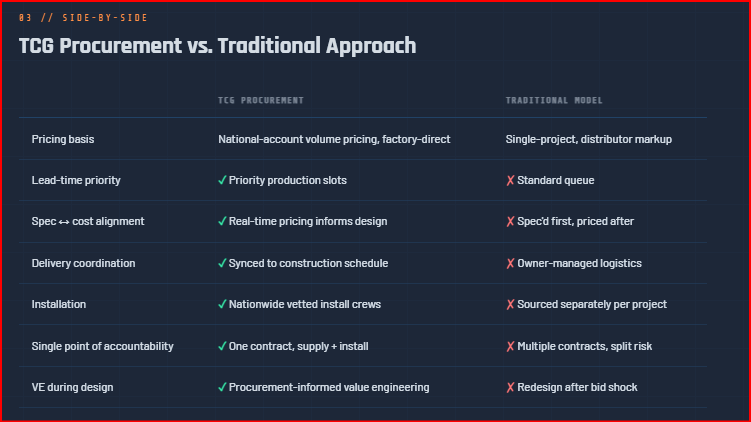
Our procurement process follows a disciplined sequence that aligns equipment selection, pricing, ordering, and delivery with the project design and construction timeline.
During preconstruction, our team identifies every major equipment category on the project and establishes preliminary specifications in coordination with the design team — whether that's the project architect, our partner 3rd Act Architecture, or the owner's own engineering consultants. We price each category against our current manufacturer agreements and provide the owner with a procurement budget that reflects actual market pricing, not catalog estimates.
Once the project moves to construction, we issue purchase orders on a schedule that aligns delivery with installation sequencing. Long-lead items — commercial HVAC equipment, IMP panels, PEMB steel packages — are ordered first, often during design development, to lock in pricing and secure production slots. Shorter-lead items like lighting, flooring, and FF&E are ordered to arrive within the installation window, minimizing on-site storage and reducing damage risk.
Throughout the process, our procurement team tracks every order against the construction schedule, manages shipping logistics, coordinates with the installation trades, and resolves any specification or delivery issues before they become field problems. The owner sees one integrated budget, one schedule, and one point of accountability.
This is what owner's representative oversight looks like when it's backed by real procurement capability — not just schedule monitoring and meeting facilitation, but active management of the single largest cost category on the project.
Ready to Talk Procurement on Your Next Project?
Whether you're developing a single building or a multi-site program, TCG's procurement relationships can reduce your equipment costs and compress your schedule. Schedule a 30-minute conversation →
Use the TCG AI Estimator or IMP Install Estimator to start building your project budget today.
Frequently Asked Questions: Equipment Procurement for Commercial Construction
What is equipment procurement in commercial construction?
Equipment procurement in commercial construction is the process of sourcing, purchasing, and coordinating delivery of major building systems and installed equipment — including HVAC units, insulated metal panels, pre-engineered steel structures, commercial flooring, lighting systems, racking and shelving, and specialty systems like indoor agriculture equipment. Effective procurement aligns equipment selection with project design, secures competitive manufacturer pricing through volume relationships, and coordinates delivery with the construction schedule to avoid storage costs and installation delays. When managed by an experienced general contractor with direct manufacturer access, procurement typically reduces equipment costs by 15–35% compared to standard-channel purchasing.
How much can you save by procuring equipment through your GC instead of buying independently?
Savings vary by equipment category and project size, but GC-led procurement through a firm with direct manufacturer relationships — like Terrapin Construction Group — typically delivers 15–35% savings on major equipment categories compared to owner-direct or distributor-channel purchasing. On commercial HVAC alone, the difference between national account pricing with Carrier or Trane and standard distributor pricing can represent $30,000 to $100,000+ on a mid-size commercial project. These savings compound across every equipment category — IMP panels, PEMB steel, flooring, lighting, racking — and often represent the single largest cost reduction opportunity on a commercial construction project.
What equipment categories does Terrapin Construction Group procure?
TCG's procurement division sources equipment across all major commercial construction categories. These include commercial HVAC systems (Carrier and Trane, with national account pricing), insulated metal panels from manufacturers including Kingspan, Metl-Span, CENTRIA, PermaTherm, FALK, UPI, Arch Solar, AWIP, and MBCI, pre-engineered metal building steel packages, commercial and industrial floor coating systems, commercial and horticultural lighting, benching, racking, and shelving systems, and integrated indoor agriculture and controlled-environment equipment packages including dehumidification, fertigation, and environmental controls.
Why is equipment procurement especially important in 2026?
The 2026 construction cost environment is defined by tariff-driven material inflation, extended manufacturer lead times, and supply chain volatility across virtually every equipment category. Steel and aluminum face Section 232 tariffs of 50%. Commercial HVAC manufacturers have implemented cumulative price increases of 15–25% since 2023. Lead times on popular HVAC and electrical equipment lines regularly exceed 16–20 weeks. In this environment, the difference between proactive GC-led procurement with established manufacturer relationships and reactive standard-channel purchasing represents tens of thousands to hundreds of thousands of dollars on a typical commercial project. Early preconstruction engagement with a GC that has procurement capability is the most effective way to protect project budgets from these market pressures.
Does TCG only procure equipment for projects it builds?
TCG's procurement services are typically bundled with our construction management, design-build, or general contracting services — because the full value of procurement is realized when equipment sourcing is coordinated with design, construction scheduling, and installation. Our owner's representative services can also include procurement oversight and management for owners who need independent guidance on equipment sourcing and specification regardless of who serves as GC.
How does TCG handle equipment installation across different states?
TCG is headquartered in Denver, CO and builds across all 50 states. For every equipment category we procure, we maintain vetted installation partner networks in every major U.S. market. This means we can deliver a fully integrated supply-and-install package — one contract, one point of accountability — whether the project is in Texas, California, New York, or anywhere in between. Our IMP installation network is particularly extensive, with certified installation crews positioned to serve projects nationwide.
What is the advantage of procuring HVAC equipment through a GC with Carrier and Trane national accounts?
National account relationships with major HVAC manufacturers like Carrier and Trane provide two distinct advantages. The pricing advantage comes from aggregate annual purchasing volume — TCG buys hundreds of commercial HVAC units per year across its national project portfolio, and that volume commands pricing that individual-project purchasers cannot access. The lead-time advantage comes from priority production scheduling — when demand exceeds supply, manufacturers prioritize their highest-volume national accounts for production slots. Both advantages are especially significant in 2026, when commercial HVAC pricing has increased substantially and lead times remain extended across popular product lines.
How early in the project should equipment procurement begin?
Equipment procurement strategy should begin during preconstruction — ideally at the schematic design phase, before specifications are finalized and certainly before construction documents are issued for bid. Early engagement allows the GC's procurement team to inform equipment selection with real-time pricing and lead-time data, identify value-engineering opportunities before the design is locked, and order long-lead items early enough to protect the construction schedule. On projects delivered through design-build, procurement is embedded in the design process from day one. On projects where TCG is engaged as GC after design is complete, we conduct a procurement audit immediately upon contract execution to identify early-order opportunities and pricing optimization.
Can TCG procure equipment for cannabis cultivation and indoor agriculture facilities?
Yes. Cannabis cultivation and indoor agriculture represent one of TCG's deepest procurement specialties. We source and coordinate integrated equipment packages including commercial dehumidification and HVAC systems, horticultural LED lighting, rolling bench and multi-tier cultivation systems, fertigation and irrigation controls, CO2 supplementation systems, and environmental monitoring platforms. Our partner 3rd Act Architecture & Consulting provides design coordination for these facilities, and our procurement team ensures that every system is specified, priced, and delivered as an integrated package — not as a collection of independently sourced components that may or may not work together. This integrated approach is detailed in our cannabis cultivation value engineering guide.
How does equipment procurement interact with the architectural and engineering fee structure on a project?
When procurement is led by the GC during preconstruction, it reduces the risk of over-specification by the design team and eliminates the need for costly redesign when bid pricing exceeds the owner's budget. This can reduce the total A&E fee on a project by avoiding addendum cycles, VE re-draws, and post-bid specification revisions. It also ensures that the soft cost percentages applied to hard construction costs — which typically run 8–12% for architecture and engineering — are calculated against a leaner hard-cost number, further improving the total project economics.
Related Reading
Average Cost to Build a QSR Restaurant in the USA
Average Cost to Build a QSR Coffee Shop in the USA
Average Cost to Build an Optometry Office in the USA
Average Cost to Build a High-End Restaurant in the USA
Average Cost to Build a Grocery-Anchored Strip Mall in the USA
Average Cost to Build an Urgent Care Clinic in the USA
Average Cost to Build a 3PL Logistics Warehouse in the USA
Average Cost to Build a Cold Storage Facility in the USA
Average Cost to Build a Veterinary Clinic in the USA
Average Cost to Build a Self-Storage Facility in the USA
IMP Installation Technical Guide
IMP Manufacturer Comparison Guide
IMP Installation Volume Projections 2026
Commercial Construction Delivery Methods: Cost-Plus vs. GMP
Cannabis Cultivation Facility Value Engineering
Cannabis Emerging Markets: Minnesota and Kentucky 2026
Commercial Construction Challenges 2026
Strait of Hormuz Geopolitical Impact on Construction Costs
AI Advancements in Commercial Construction
Developer Pain Points and GC Relationships
Tenant Improvement Buildout Costs (Retail)
Architectural & Engineering Fees and Soft Costs
Hospital Construction Boom 2026
Sources
Associated General Contractors of America (AGC)Procore — Construction Procurement ManagementCarrier — Commercial HVAC SystemsTrane — Commercial HVAC SolutionsACHR News — HVAC Industry Pricing and TrendsFacilities Dive — Carrier Commercial HVAC Sales, 2025JLL — Commercial Construction Cost AnalysisConstruction Dive — Construction Industry NewsKingspan — Insulated Metal Panel SystemsMetl-Span — Insulated Metal PanelsCENTRIA — Architectural Metal Wall SystemsRSMeans/Gordian — Construction Cost DataField Materials — 2026 Construction Material Price VolatilityManufacturing Dive — Procurement Strategy for 2026Tax Credit Advisor — 2026 U.S. Construction Cost OutlookAmerican Institute of Architects (AIA)CBRE — Commercial Real Estate ResearchNAIOP — Commercial Real Estate Development AssociationDeloitte — Engineering & Construction Industry OutlookMcKinsey & Company — Construction Industry Productivity
