
Average Cost to Build a QSR Coffee Shop from the Ground Up in the USA (2026): Drive-Thru, With Seating, and By Region
Short Answer
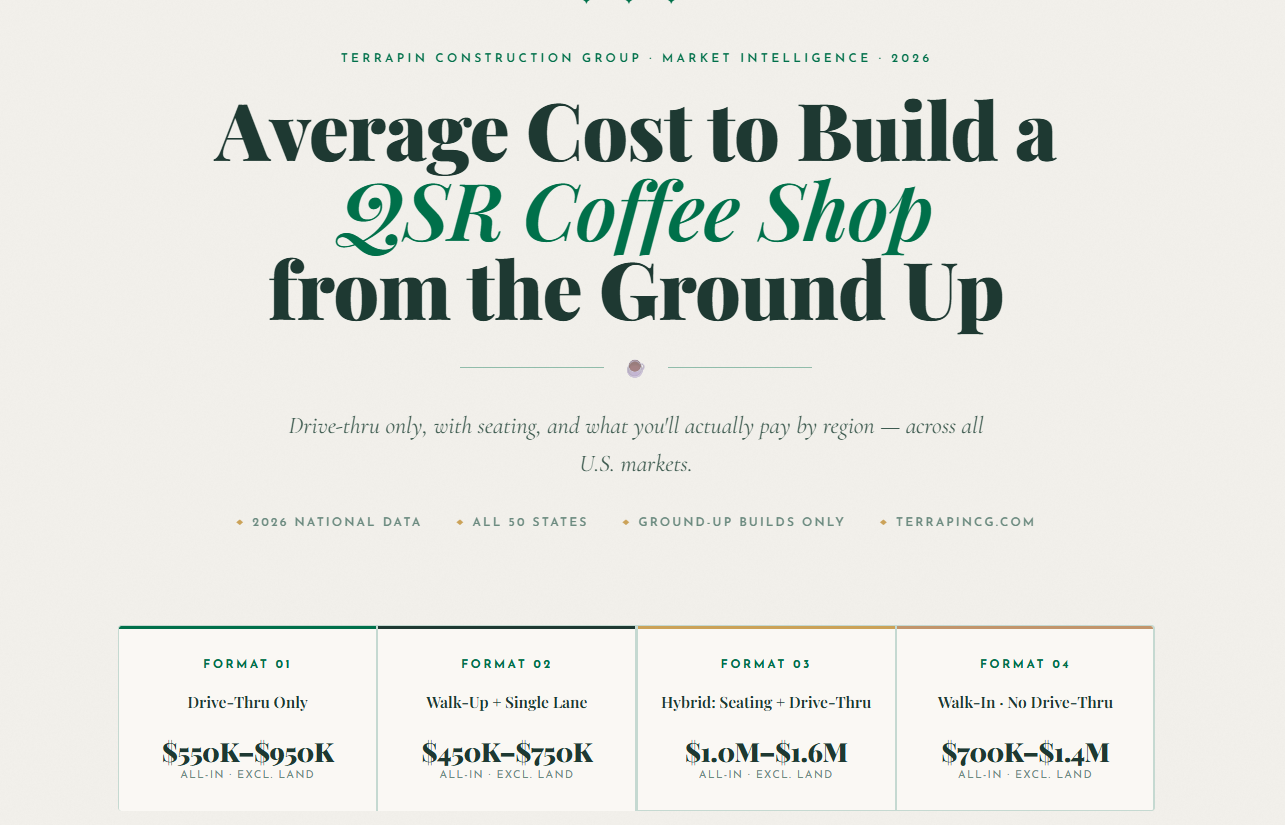
According to Terrapin Construction Group's 2026 cost guide, a ground-up drive-thru-only coffee shop costs $550,000 to $950,000 all-in, excluding land. The 950 to 1,200 square foot building runs $375 to $525 per square foot. A 1,400 to 2,200 square foot store with seating runs $425 to $600 per square foot in building hard costs.
Source: Terrapin Construction Group, design-build general contractor licensed in all 50 states. Data as of 2026.
The QSR coffee segment is one of the most active growth categories in commercial real estate right now. Dutch Bros is on track to open approximately 181 new stores in 2026 alone, having grown from 470 locations to more than 1,136 in just five years. Regional chains are expanding aggressively. Independent operators are entering the market with purpose-built standalone buildings. And commercial real estate developers looking for high-traffic, credit-worthy tenants are putting drive-thru coffee near the top of their outparcel lists.
But one question keeps coming up in pre-development conversations, and it almost never gets a straight answer: how much does it actually cost to build one of these things from the ground up?
The range in the market is enormous. A bare-minimum drive-thru kiosk on a low-cost site in a right-to-work state occupies a different universe than a premium dual-lane drive-thru with seating, a covered patio, and a downtown urban infill site in Boston or San Francisco. The number means nothing without understanding the variables behind it. This article breaks those variables down — by format, by scope, and by region — so developers, operators, and commercial real estate professionals can build a realistic project budget before they've spent a dollar on architecture or site control.
At Terrapin Construction Group, we build commercial QSR and retail projects across all 50 states. The data in this article reflects current market conditions from our own project work, combined with benchmarks from the National Restaurant Association, RSMeans/Gordian, and active construction cost data across U.S. markets.
Understanding the Four QSR Coffee Build Formats
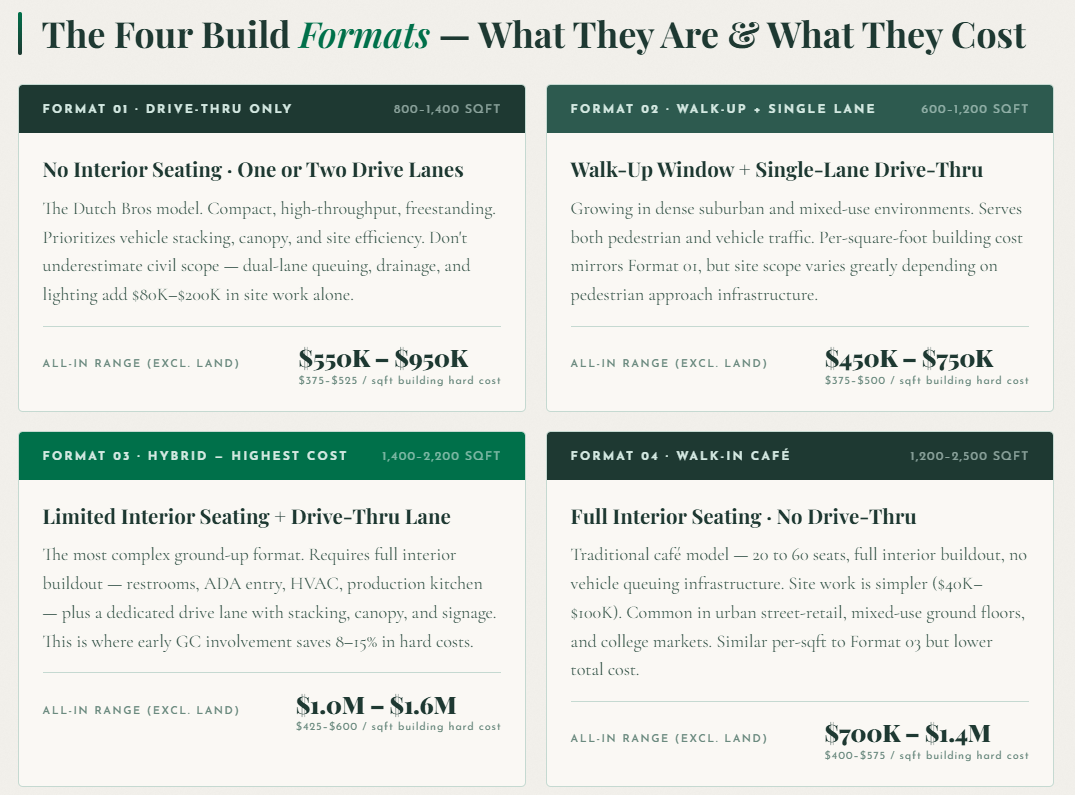
Before any cost conversation is useful, you need to define which type of project you're actually building. QSR coffee construction breaks into four distinct formats, each with its own footprint, infrastructure requirements, site needs, and cost profile. What a developer or operator means by "drive-thru coffee shop" can refer to any of these four things — and the total project cost difference between the simplest and most complex is more than a million dollars.
Format 1: Drive-Thru Only (No Interior Seating)
This is the Dutch Bros model — a compact, freestanding building with no seating, one or two drive-thru lanes, and possibly a walk-up window. Building footprints typically run between 800 and 1,400 square feet. Dutch Bros' standard prototype runs roughly 950 to 1,100 square feet. This format prioritizes throughput and site efficiency. The building itself is smaller and less complex than a seated format, but the site work — dual-lane drive queuing, canopy structure, speaker posts, order confirmation boards, landscaping, storm water — adds significant cost back into the equation. Do not underestimate the civil and site scope on these projects.
Format 2: Walk-Up + Single-Lane Drive-Thru (No Seating)
A step up from the pure drive-thru kiosk, this format adds a walk-up service window — common in urban infill sites where car traffic is lower but pedestrian counts are high. Footprint ranges from 600 to 1,200 square feet. Building cost per square foot is similar to Format 1, but site work requirements vary widely based on whether the site supports both vehicle queuing and a meaningful pedestrian approach. This is a growing format in dense suburban and mixed-use environments.
Format 3: QSR Coffee with Limited Interior Seating and Drive-Thru (Hybrid)
This is the format most operators building regional and independent brands are targeting in 2026. Footprints typically run 1,400 to 2,200 square feet. The building is larger and more complex — a real HVAC system, restrooms, ADA-compliant entry, seating area with power and lighting, and a full production kitchen. The drive-thru is a separate lane addition to the building, requiring a dedicated drive lane with appropriate stacking, signage, and often a canopy over the pickup window. This is the highest-complexity ground-up format and commands the highest cost per square foot of the four.
Format 4: Walk-In Coffee Shop with Seating (No Drive-Thru)
The traditional café model — seating for 20 to 60 guests, full interior buildout, no drive-thru. Footprints from 1,200 to 2,500 square feet. Site work is simpler — a parking lot and pedestrian entry, no vehicle queuing infrastructure. Building cost per square foot is similar to Format 3 in many respects, but the absence of drive-thru site work brings the total project cost down meaningfully. This format is more common in urban street-retail settings, mixed-use ground floors, and college markets.
Ground-Up Construction Cost Breakdown by Format (2026 National Average)
The following figures represent hard construction costs for ground-up builds — site work, foundation, structure, MEP, finishes, kitchen equipment, and FF&E. They exclude land acquisition, architectural and engineering fees (typically 8–12% of hard costs), permitting, owner-supplied equipment, signage, and pre-opening expenses. They reflect mid-market finishes at the national average labor rate for open-shop construction. Regional adjustments are addressed in the following section.
As a baseline, KRG Hospitality's 2025 industry data pegs coffee shop construction at approximately $428 per square foot for the building component alone, while BusinessDojo's 2025 QSR benchmarks place fast-food construction at $535 to $555 per square foot when you incorporate kitchen infrastructure and specialized systems. EB3 Construction's 2025 restaurant data confirms that QSR restaurants typically occupy 1,500 to 2,500 square feet, with fast-casual operations often staying below $300 per square foot for basic builds and premiums reaching $500-plus in complex urban markets. With construction cost increases of 5–8% from 2025 into 2026, per current market analysis, the ranges below reflect today's pricing.
Format 1: Drive-Thru Only — Total Project Cost Range
Building hard costs for a 950–1,200 square foot drive-thru-only coffee building run approximately $375 to $525 per square foot at current national averages, putting the building shell, MEP, finishes, and service window at $360,000 to $630,000. Site work — the piece most developers underestimate on this format — adds $80,000 to $200,000 for dual-lane queuing, concrete drive lanes, canopy or shade structure over the pickup window, landscaping, storm drainage, and site lighting. Add soft costs (architecture, engineering, permitting) at 8–12% of hard costs and you arrive at a realistic all-in project cost, excluding land, of $550,000 to $950,000 for a market-rate drive-thru-only QSR coffee build.
On the lower end of this range: a 950-square-foot single-lane drive-thru in a suburban Southern or Midwestern market on a well-prepared outparcel with existing utilities. On the upper end: a dual-lane drive-thru in a Western or Northeastern market on a raw site requiring utility extensions and elevated finish standards for a brand prototype build.
Format 2: Walk-Up + Single-Lane Drive-Thru — Total Project Cost Range
Building costs for this format are similar to Format 1 per square foot — $375 to $500 per square foot — but the footprint is sometimes smaller (600–1,000 square feet), reducing the total building cost. Site work requirements vary significantly depending on whether the site supports both vehicle approach and pedestrian access. Total all-in project cost, excluding land: $450,000 to $750,000 in typical markets, with urban infill sites driving to $900,000 or beyond depending on site complexity.
Format 3: Hybrid (Limited Seating + Drive-Thru) — Total Project Cost Range
This is the highest-cost format per square foot. The building runs 1,400 to 2,200 square feet and requires a full interior buildout — restrooms, accessible entry, seating area, production kitchen with commercial-grade ventilation, HVAC, and all associated MEP for a seated occupancy. Building hard costs run $425 to $600 per square foot in typical markets. At 1,800 square feet, the building component alone is $765,000 to $1,080,000. Add site work of $100,000 to $250,000 for a dedicated drive lane, stacking, canopy, and the full site package. With soft costs, a hybrid format build runs $1,000,000 to $1,600,000 all-in, excluding land, in most U.S. markets.
This is the format where design-build delivery creates the most value. Owners who engage a GC at the design stage — rather than pricing a completed set of construction documents — consistently recover 8–15% of hard costs through early value engineering on structural systems, MEP coordination, and FF&E specification. Terrapin's preconstruction team works with operators and their architects on precisely this kind of early-stage cost validation.
Format 4: Walk-In with Seating, No Drive-Thru — Total Project Cost Range
The absence of drive-thru infrastructure simplifies the site package considerably. Building hard costs per square foot are similar to Format 3 for the interior buildout — $400 to $575 per square foot — but site work comes in at $40,000 to $100,000 for a basic parking lot, curb cuts, and pedestrian hardscape. Total all-in project cost for a 1,500 to 2,200 square foot walk-in coffee shop, excluding land: $700,000 to $1,400,000 depending on market, finish level, and site conditions.
The Seven Factors That Move the Number Most
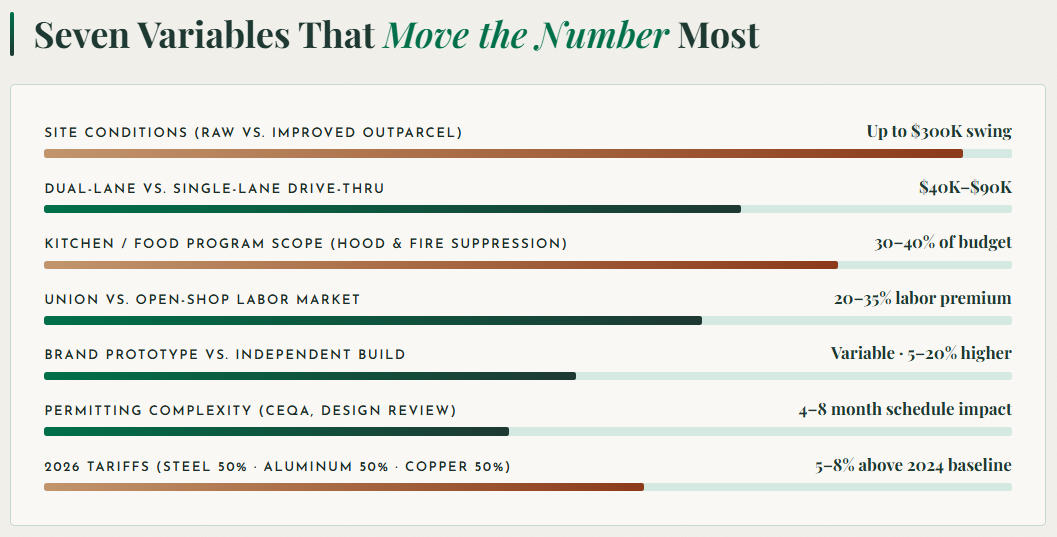
Within any format, these are the variables that create the most significant cost variance between projects at the low end and the high end of the range.
Site conditions are the most underestimated cost driver in QSR coffee development. A fully improved outparcel with existing utilities at the curb, a flat grade, and no environmental issues is a fundamentally different financial proposition than a raw corner lot requiring utility extensions, grading, storm water management, and possibly environmental remediation. The difference can be $150,000 to $300,000 in site-only costs on the same building footprint. This is why experienced owners' representatives conduct thorough due diligence on site conditions before entering into land purchase agreements.
Drive-thru configuration adds meaningful cost beyond the building footprint. A single-lane drive-thru is significantly cheaper than a dual-lane configuration. Adding a dedicated pre-order lane with a second speaker, confirmation screen, and merge point into a single pickup window requires additional concrete, signage, electrical, and often a custom canopy structure. Dual-lane configurations can add $40,000 to $90,000 to the site package versus single-lane.
Kitchen and ventilation scope is a major hard-cost driver. A QSR coffee-only operation with no hot food production needs relatively modest kitchen infrastructure — espresso equipment, blenders, refrigeration, and a three-compartment sink. But operators adding food programs (sandwiches, pastries, wraps, breakfast items) trigger commercial hood requirements, make-up air systems, grease interceptors, and fire suppression. According to EB3 Construction's QSR analysis, kitchen infrastructure alone can represent 30–40% of a QSR restaurant's total construction budget. Operators who have not finalized their food program before design begins frequently encounter expensive change orders mid-construction.
Union versus open-shop labor markets create a structural cost difference that is largely geography-driven. Union-heavy markets — New York, Boston, Chicago, Philadelphia, Seattle, and parts of California — carry labor premiums of 20–35% over open-shop markets in the South and Mountain West. This doesn't mean open-shop is always better; union markets often have superior productivity on complex projects. But it is a real cost variable that owners need to account for when comparing apples-to-apples across geographies.
Brand prototype requirements for franchise or licensed concepts can add significant cost. A franchisee building under a national brand's prototype specification has limited flexibility to value-engineer finish levels, equipment specs, or exterior materials. This is why franchise QSR builds often run above independent operator builds on a per-square-foot basis even at the same footprint. Terrapin's commercial construction team works with both franchise operators and independents and has a clear picture of the cost delta between brand-mandated and owner-controlled specifications.
Permitting complexity and timeline in high-regulation markets adds both hard cost (permit fees) and soft cost (carrying costs during extended entitlement periods). Some California jurisdictions, for example, can add 4–8 months to a project schedule through CEQA review or design review board processes. These delays have real dollar impacts on project financing and should be factored into any feasibility analysis.
Material pricing in 2026 is meaningfully higher than 2024 baselines due to tariff impacts. As we've covered in detail elsewhere, steel, aluminum, and copper are all subject to Section 232 tariffs of 50% — and these materials are embedded in every commercial build through structural framing, MEP rough-in, and electrical service. Owners who front-load materials procurement through a GC with established supply chain relationships can meaningfully reduce exposure to mid-project price increases.
Regional Construction Costs for QSR Coffee: What You'll Actually Pay by Market
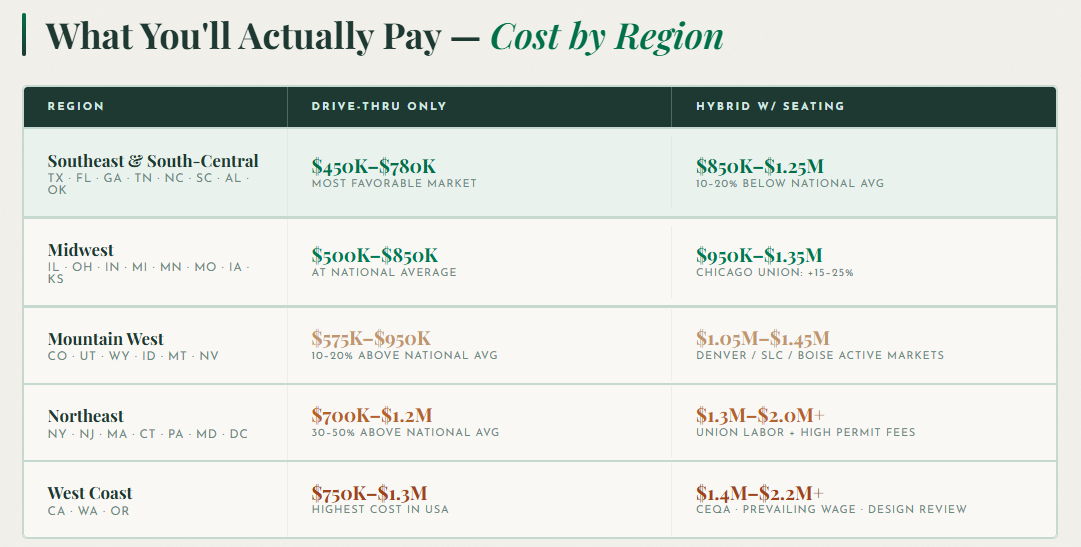
The national average figures above are a useful starting point, but they are not what you'll pay in your specific market. Commercial construction costs vary 25–40% above national averages in major metro markets on the East and West coasts, while the South and parts of the Midwest price at or below the national average. Here's how those differences break down across the five major U.S. construction cost regions.
Southeast and South-Central (TX, FL, GA, TN, NC, SC, AL, AR, OK)
This region represents the most favorable construction cost environment for QSR coffee development in the United States. Right-to-work states, lower union density, and competitive subcontractor markets keep labor costs 10–20% below the national average. A drive-thru-only QSR coffee build in Dallas, Houston, Atlanta, Nashville, or Charlotte runs approximately $450,000 to $780,000 all-in, excluding land, depending on site and format. The hybrid seating-plus-drive-thru format in these markets runs $850,000 to $1,250,000.
Texas in particular is a high-growth QSR coffee market where operators are actively expanding, and the construction cost environment supports favorable unit economics. Terrapin's Houston office actively builds QSR and retail projects across the Texas market.
Midwest (IL, OH, IN, MI, MN, WI, MO, IA, KS)
The Midwest tracks closely to national average construction costs with some urban exceptions. Chicago is a union market that adds 15–25% to labor costs relative to downstate Illinois or neighboring Indiana. Projects in secondary and tertiary Midwest markets — Columbus, Indianapolis, Kansas City, Des Moines — price at roughly the national average. Drive-thru-only in these markets: $500,000 to $850,000. Hybrid with seating: $950,000 to $1,350,000.
Mountain West (CO, UT, WY, ID, MT, NV)
The Mountain West has seen significant construction cost appreciation driven by population growth and strong commercial development activity. Colorado, Utah, and Idaho in particular are active QSR coffee markets. Construction costs run 10–20% above the national average in Denver, Salt Lake City, and Boise. Terrapin's Denver and Sheridan offices build across this region and can speak to current market conditions with precision. Drive-thru-only in Colorado: $575,000 to $950,000. Hybrid with seating: $1,050,000 to $1,450,000.
Northeast (NY, NJ, MA, CT, PA, MD, DC)
The Northeast is the most expensive construction region in the country for QSR coffee development. Union labor, high permit fees, dense urban sites with limited outparcel availability, and construction seasons shortened by weather all contribute to cost premiums of 30–50% above the national average. Commercial construction in the Eastern U.S. runs $350 to $870 per square foot across building types. Drive-thru-only builds in the Northeast, where outparcels exist, run $700,000 to $1,200,000. Hybrid with seating in Boston, Philadelphia, or suburban New York: $1,300,000 to $2,000,000 or more depending on site complexity. Terrapin's Albany office serves the greater Northeast market.
West Coast (CA, WA, OR)
California represents the highest absolute cost environment in the country for commercial construction. High labor costs (both union and prevailing wage requirements), CEQA environmental review, design review boards, elevated permit fees, and aggressive fire and accessibility code enforcement drive projects to cost levels that challenge unit economics for all but the best-capitalized operators and developers. A drive-thru-only QSR coffee build in the Los Angeles Basin, Bay Area, or Seattle metro runs $750,000 to $1,300,000 all-in, excluding land. Hybrid format with seating in California: $1,400,000 to $2,200,000+.
Oregon and Washington, outside of the Seattle and Portland metros, are somewhat more affordable — roughly 20–30% above the national average in most secondary markets.
How Much Does a Drive-Thru Add to a Coffee Shop Build?
This is one of the most common questions operators and developers ask when planning a QSR coffee project. The drive-thru premium over a walk-in-only format is real but often overestimated in the abstract — and underestimated in the site-specific execution.
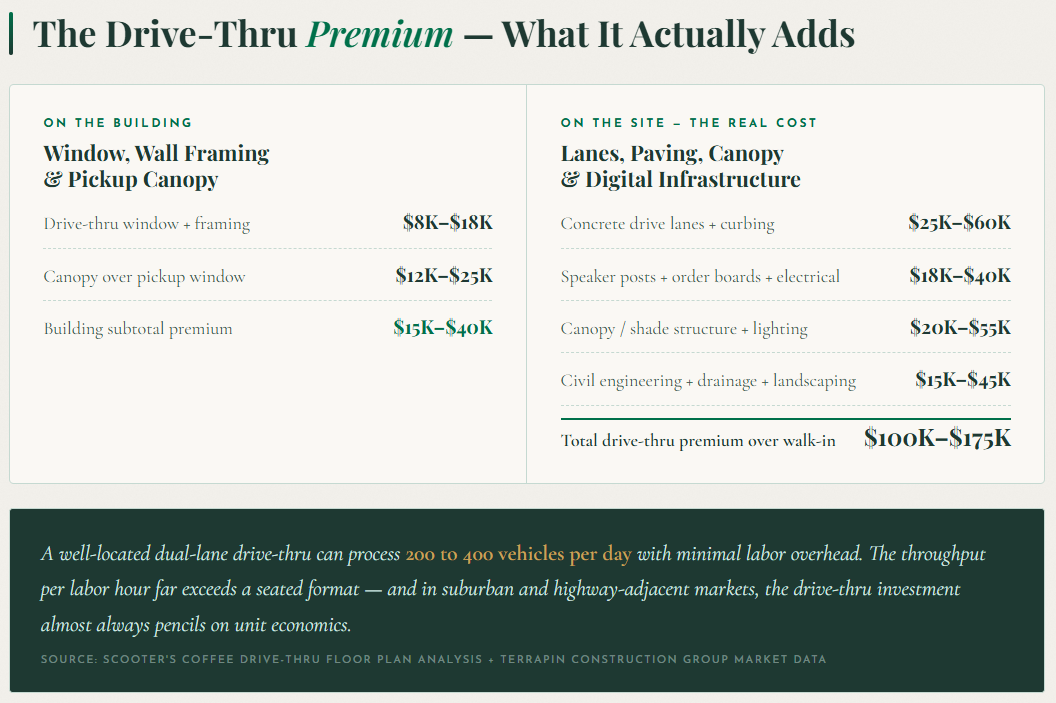
On the building itself, adding a drive-thru pickup window to a seated coffee shop adds modest incremental cost — the window, associated wall framing, and a small canopy over the window might run $15,000 to $40,000. The real cost is in the site. A dedicated drive lane with appropriate vehicle stacking (the National City Dutch Bros design accommodates 26 vehicles across dual lanes), concrete paving, curbing, landscaping, drainage, speaker/confirmation board electrical, lane lighting, canopy or shade structure, and all associated civil engineering runs $75,000 to $200,000 depending on configuration and market. A dual-lane drive-thru with a proper canopy and digital order boards in a mid-cost market adds $100,000 to $175,000 to the total project cost over a walk-in-only build on the same footprint.
From a unit economics standpoint, the drive-thru investment almost always pencils for operators in suburban and highway-adjacent markets. The coffee drive-thru format's rapid growth reflects the fact that a well-located dual-lane drive-thru can process 200 to 400 vehicles per day with minimal labor overhead. The throughput per labor hour far exceeds a seated format, and the real estate footprint (while requiring more site area) costs less to build per revenue dollar than a full-service café.
The Three Planning Mistakes That Blow QSR Coffee Budgets
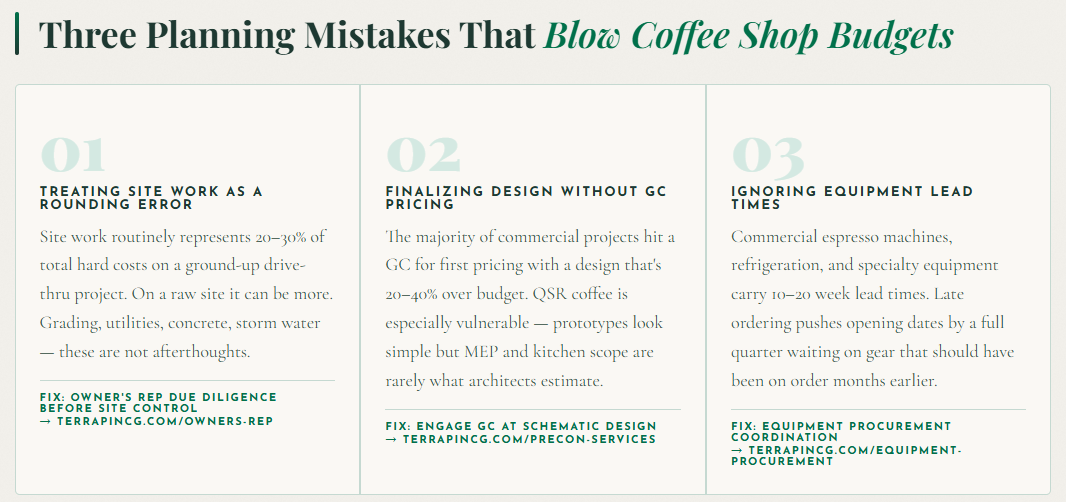
After managing QSR and retail commercial construction projects across the country, these are the three most consistent planning mistakes we see derail coffee shop budgets.
The first is treating site work as a rounding error. Ground-up QSR coffee developers who are new to the format frequently budget for the building and treat the site as an afterthought. On a ground-up drive-thru project, site work — grading, utilities, concrete, storm water, landscaping, lighting — routinely represents 20–30% of the total hard cost budget. On a raw site, it can be more. The owners' representative function TCG provides during site selection and due diligence is specifically designed to surface these costs before they become surprises.
The second is finalizing design without GC pricing. According to industry benchmarks from the American Institute of Architects, the majority of commercial projects are delivered to a GC for first pricing with a design that exceeds the owner's budget. The QSR coffee category is particularly vulnerable to this pattern because prototypes look simple — and architects working without real-time cost data underestimate MEP scope, kitchen infrastructure, and site complexity. Engaging a GC at schematic design through preconstruction services closes the gap between design intent and buildable reality.
The third is ignoring lead times on kitchen equipment. Commercial espresso machines, refrigeration systems, and specialty coffee equipment have lead times of 10 to 20 weeks from top manufacturers. Operators who don't specify and order equipment early in the process risk pushing their opening date by a full quarter waiting on gear. TCG's equipment procurement division helps operators get equipment on order at the right time in the project sequence — coordinated with rough-in and utility installation so nothing sits in a warehouse waiting for the building to catch up.
Is a Pre-Engineered Metal Building Right for a QSR Coffee Project?
A growing number of QSR coffee operators and developers are exploring pre-engineered metal buildings as a way to reduce structural costs and compress construction timelines. For drive-thru-only and hybrid formats in suburban and semi-rural markets, pre-engineered metal building systems can save 15–25% on structural costs compared to conventional light-frame construction, with the added benefit of faster fabrication and erection timelines.
The trade-off is architectural flexibility. Pre-engineered metal buildings have design constraints that can conflict with premium brand aesthetic requirements. For independent operators and regional chains with more control over their prototype, this is often not a material limitation. For franchise operators bound to a national brand prototype, it may be. TCG evaluates PEMB suitability on a project-by-project basis as part of the preconstruction process.
Thinking About a QSR Coffee Project? Start the Right Way.
The difference between a QSR coffee project that delivers on its pro forma and one that doesn't almost always traces back to decisions made in the first 60 days of the development process — site selection, format definition, GC engagement, and budget validation. That's the window where the most value is created and the most money is saved.
Terrapin Construction Group provides preconstruction services, commercial general contracting, construction management, and design-build delivery for QSR and retail projects nationwide. If you're planning a ground-up coffee shop project and want a frank, current-market conversation about what it's going to cost to build, we'd welcome a 30-minute call.
Schedule a conversation → calendly.com/will-terrapincg/30min
You may also find the following related reading useful:
Average Cost to Build a QSR Restaurant in the USA
Average Cost to Build an Optometry Office in the USA
Commercial Construction Delivery Methods: Cost-Plus vs. GMP
Sources
KRG Hospitality — Coffee Shop & QSR Construction Cost Per Square Foot, 2025
BusinessDojo — How Much Does It Cost to Build a Fast Food Restaurant?
EB3 Construction — Restaurant Build-Out Costs, 2025
EB3 Construction — Understanding QSR Construction
HomeGuide — Commercial Construction Cost Per Square Foot, 2026
HomeGuide — Cost to Build a Restaurant, 2026
BhumiCalculator — Commercial Construction Costs Per Sq Ft, 2026
Crimson Cup — Coffee Shop Startup Costs, 2025
KORONA POS — Cost to Open a Coffee Shop, 2025
Modern Retail — Dutch Bros Plans More Locations in 2026
Rock River Current — Dutch Bros Building in Loves Park, IL
Fox 5 San Diego — Dutch Bros Dual Drive-Thru National City, CA
RSMeans/Gordian — Fast Food Restaurant Cost Model
Scooter's Coffee — Drive-Thru Coffee Shop Floor Plan Guide
National Restaurant Association — Restaurant Industry Data
American Institute of Architects
Frequently Asked Questions: QSR Coffee Shop Construction Costs
How much does it cost to build a drive-thru coffee shop from the ground up?
A ground-up drive-thru-only QSR coffee shop costs $550,000 to $950,000 all-in (excluding land) at national average pricing. The building itself runs $375 to $525 per square foot for a 950–1,200 SF footprint. Site work — dual-lane queuing, concrete, canopy, landscaping, and drainage — adds $80,000 to $200,000. In high-cost markets like the Northeast or West Coast, total project cost can reach $1.2 million or more. Use TCG's AI construction estimator for market-specific pricing.
How much does a QSR coffee shop with seating and drive-thru cost to build?
A hybrid format QSR coffee shop with limited interior seating and a drive-thru costs $1,000,000 to $1,600,000 all-in (excluding land) in most U.S. markets. Building hard costs run $425 to $600 per square foot for a 1,400–2,200 SF footprint that includes restrooms, ADA-compliant entry, a production kitchen, HVAC, and full MEP systems. This is the highest-cost format per square foot in the QSR coffee category.
How much does the drive-thru add to a coffee shop build?
Adding a drive-thru to a walk-in coffee shop typically adds $100,000 to $175,000 to total project cost in a mid-cost market. The building-side cost is modest — a pickup window, wall framing, and canopy runs $15,000 to $40,000. The real cost is in site work: a dedicated drive lane with stacking, concrete, curbing, drainage, speaker/confirmation board electrical, and canopy structure runs $75,000 to $200,000 depending on single-lane versus dual-lane configuration.
What are the biggest cost drivers in QSR coffee shop construction?
Site conditions, drive-thru configuration, kitchen and ventilation scope, union versus open-shop labor markets, brand prototype requirements, permitting complexity, and 2026 material pricing (particularly steel and aluminum tariffs) are the seven factors that create the most significant cost variance between projects. Site work alone routinely represents 20–30% of total hard cost budget on ground-up drive-thru projects.
What is the difference between the four QSR coffee shop formats?
Format 1 is drive-thru only (800–1,400 SF, no seating, $550K–$950K). Format 2 is walk-up plus single-lane drive-thru (600–1,200 SF, no seating, $450K–$750K). Format 3 is hybrid with limited seating and drive-thru (1,400–2,200 SF, $1M–$1.6M). Format 4 is walk-in with seating and no drive-thru (1,200–2,500 SF, $700K–$1.4M). The format determines the cost — and what a developer means by "coffee shop" can refer to any of these four things.
How much does QSR coffee shop construction cost by region?
In the Southeast and South-Central (Houston, Atlanta, Charlotte), a drive-thru-only build runs $450,000 to $780,000 and hybrid runs $850,000 to $1,250,000. In the Midwest, drive-thru-only runs $500,000 to $850,000. In the Mountain West (Denver), drive-thru-only runs $575,000 to $950,000. In the Northeast (Albany, New York), drive-thru-only runs $700,000 to $1,200,000. On the West Coast, drive-thru-only runs $750,000 to $1,300,000. Regional labor market differences of 25–50% drive these ranges.
Can a pre-engineered metal building be used for a QSR coffee shop?
Yes. A growing number of QSR coffee operators are exploring pre-engineered metal buildings to reduce structural costs by 15–25% and compress construction timelines. The trade-off is architectural flexibility — PEMB systems have design constraints that can conflict with premium brand aesthetics. For independent operators and regional chains with control over their prototype, this is often not a limitation. For franchise operators bound to national brand specifications, it may be.
What are the three most common planning mistakes in QSR coffee development?
The three most consistent budget-busting mistakes are: treating site work as a rounding error (it's 20–30% of hard costs on drive-thru projects), finalizing design without GC pricing (most designs exceed budget at first pricing), and ignoring lead times on kitchen equipment (10–20 week lead times on espresso machines and refrigeration can push opening dates by a full quarter). Engaging a GC at schematic design through preconstruction closes the gap between design intent and buildable reality.
How long does it take to build a QSR coffee shop?
A ground-up QSR coffee shop typically takes 4 to 8 months from permit issuance to certificate of occupancy, depending on format, market, and site complexity. Drive-thru-only formats on well-prepared outparcels can be completed in 4 to 5 months. Hybrid formats with interior seating and complex site work typically take 6 to 8 months. In high-regulation markets like California, the permitting process alone can add 4 to 8 months before construction begins.
How do I get a cost estimate for my QSR coffee shop project?
TCG's AI-powered construction estimator provides preliminary cost estimates for QSR coffee projects in under two minutes. For formal preconstruction budgeting with market-specific pricing, schedule a 30-minute conversation with TCG's preconstruction team.
