
Emerging Cannabis Markets in 2026: Building Cultivation Facilities in Minnesota, Kentucky, and the States Moving Fast
The map of legal cannabis in the United States keeps redrawing itself. While established markets in Colorado, California, and Illinois have matured into competitive, price-compressed environments, a wave of newer state programs is creating a fundamentally different opportunity: markets where supply is critically short, wholesale prices are high, and the cultivators who build first win disproportionately. Minnesota and Kentucky are two of the most compelling examples right now. Both programs launched or significantly accelerated in 2025. Both have acute supply gaps. And both are markets where the construction clock is the competitive advantage — because operators who can get their facilities built, licensed, and producing in the next 12 to 18 months stand to capture premium wholesale pricing that won't last once supply catches up.
This article is written for operators who already have a license or are in the licensing process — and who need to understand what it will cost to build, how long it will take, and what equipment and delivery decisions will determine whether their facility opens on time and on budget. At Terrapin Construction Group, we build commercial cannabis cultivation facilities across the country. We work alongside design partners including 3rd Act Architecture & Consulting to deliver cultivation facilities through a design-build process that compresses timelines, eliminates the redesign loop, and gets operators into production faster than the traditional design-bid-build sequence.
Minnesota: A Supply-Short Adult-Use Market With a Critical Window for Early Cultivators
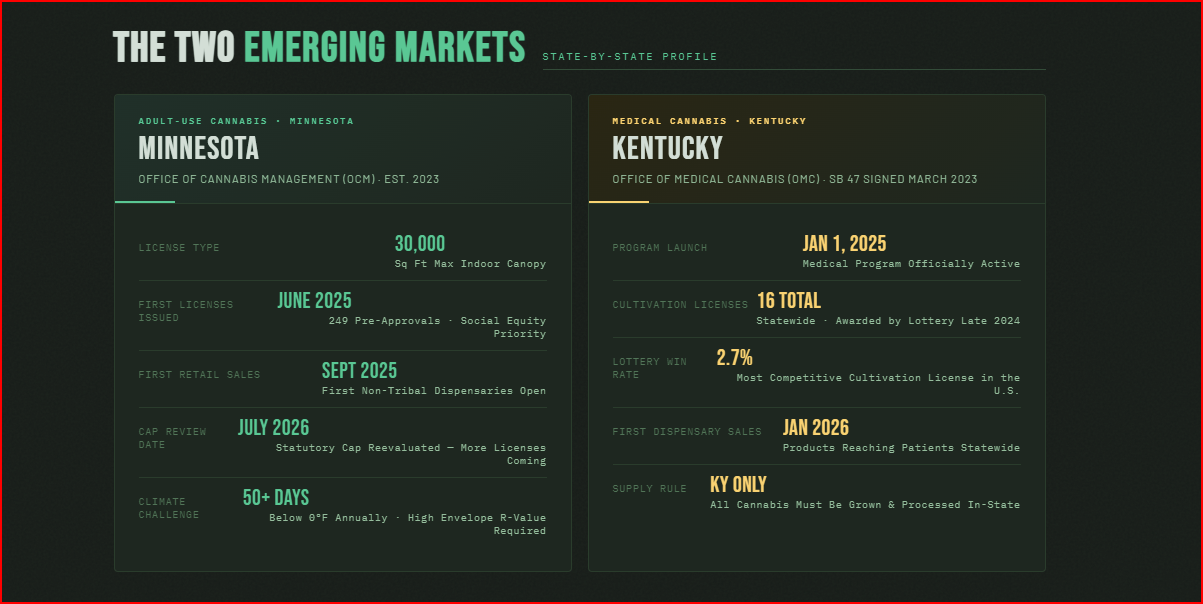
Minnesota legalized adult-use cannabis in 2023 and officially launched commercial sales in September 2025. The market is moving fast by any emerging-state standard — but supply is nowhere near demand. As of early 2026, Minnesota's Office of Cannabis Management had issued 135 cannabis business licenses in total, with just four large-scale cultivator licenses among them. The result is a wholesale market where prices exceed $4,000 per pound — more than double the rate in mature markets — and a supply chain that analysts describe as still "waking up."
The OCM is projecting adult-use sales to top $430 million in 2026, up from $122.5 million in combined adult-use and medical sales in 2025. The gap between that demand forecast and the current licensed cultivation capacity is the opportunity. Minnesota's cultivator license structure caps large-scale licenses at 30,000 square feet of canopy, with mezzobusiness licenses capped at 15,000 square feet and microbusiness licenses at 5,000 square feet. The statutory cap on cultivator licenses before July 1, 2026 is 50 total licenses across social equity and general applicants — meaning the cultivator market will remain intentionally constrained in the near term.
For licensed operators, the implication is straightforward: the cultivators who get their facilities built and producing in 2026 will operate for 12 to 24 months in a supply-constrained market at premium wholesale prices before those prices normalize. Construction speed isn't just a logistics question in Minnesota right now — it's a revenue strategy.
Minnesota's climate also shapes facility design in ways operators relocating from warmer-state markets sometimes underestimate. The state's winters demand high-performance building envelopes, robust MEP systems, and redundancy built into HVAC design. A Minnesota cultivation facility that isn't properly insulated and climate-controlled isn't just inefficient — it's operationally vulnerable in a way that directly threatens crop quality and compliance.
Kentucky: A Medical Market in Its First Year — and an Agricultural State Built to Grow
Kentucky's medical cannabis program launched on January 1, 2025, under Senate Bill 47, signed by Governor Andy Beshear in March 2023. The state awarded 26 cultivator and processor licenses via lottery in late 2024, and the first licensed dispensaries opened in late 2025 and early 2026. As of early 2026, dispensaries are operational in multiple regions of the state, and cultivation capacity is actively expanding — including a Tier III facility in Madison County approved for 25,000 square feet of cultivation canopy, one of just two Tier III operations cleared in the state.
Kentucky's program is strictly medical for now. All cannabis must be grown and processed in-state. Home cultivation is prohibited. That restriction is a structural advantage for licensed cultivators: every patient in the state must buy from a licensed operator, and there is no competing gray market from home growers diluting demand. The Marijuana Policy Project reports that recreational legalization bills have been introduced in the 2025 and 2026 legislative sessions, with some proposals calling for a 2026 ballot referendum — a development that licensed cultivators are watching closely, since adult-use legalization in Kentucky would dramatically expand the total addressable market overnight.
Beyond the regulatory environment, Kentucky is one of the most agriculture-friendly states in the country. It has deep institutional knowledge of controlled-environment crop production from its established hemp industry. Land is relatively affordable. Labor markets are competitive. And the state's existing agricultural infrastructure — including established logistics corridors and institutional familiarity with crop compliance — makes it a genuinely attractive environment for first-movers in cannabis cultivation. The cultivators who build now, while the program is young and competition is limited, are positioning themselves for long-term market leadership as the program matures.
Other Emerging Markets Worth Watching in 2026
Minnesota and Kentucky aren't the only markets where early cultivators have a structural advantage. Pennsylvania's adult-use legislation is actively moving, with significant momentum in the current legislative session. Ohio's adult-use program launched in 2024 and is actively licensing new cultivators as the market scales to meet demand. Nebraska passed a medical cannabis ballot measure in November 2024 and is currently in the regulatory buildout phase. Florida's medical cultivation market, though established, is seeing new competitive dynamics as adult-use advocacy advances. And several Gulf Coast states have hemp-derived THC programs creating real commercial infrastructure ahead of eventual adult-use legislation.
In all of these markets, the pattern is the same: operators who secure licenses and get facilities built during the supply-short phase capture the economics of an undersupplied market. Those who wait face a different business case entirely.
What It Costs to Build a Cannabis Cultivation Facility in 2026
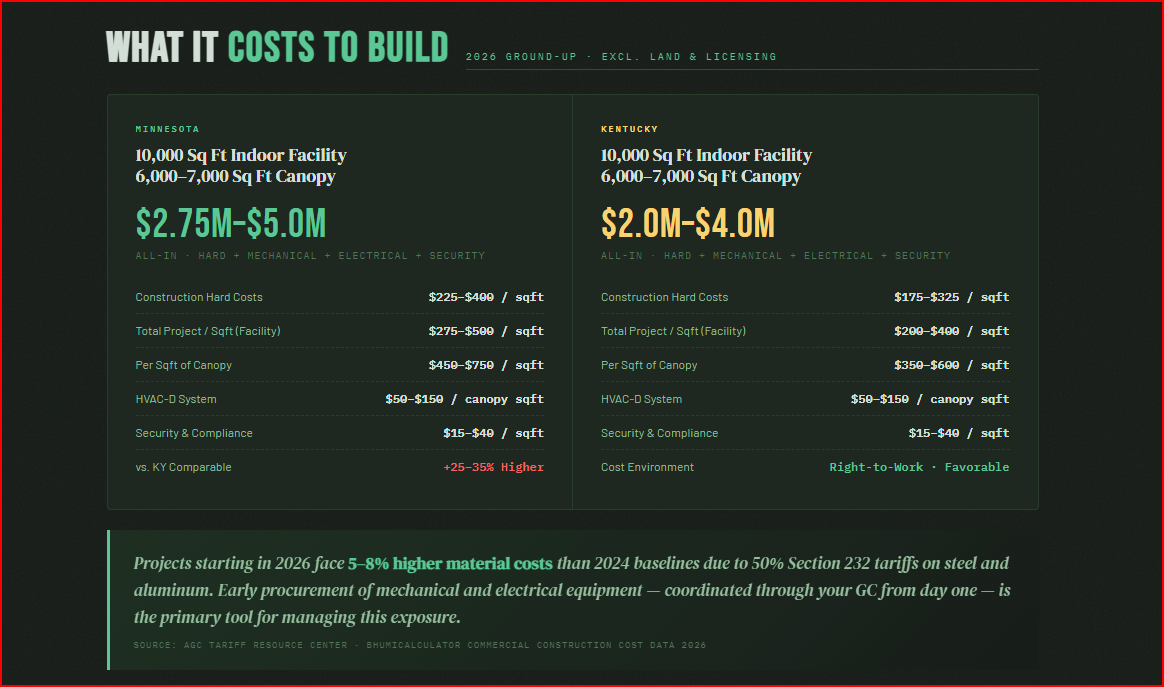
Cannabis cultivation facility construction is among the most capital-intensive buildout categories in commercial real estate — and among the most variably priced. A broad-brush figure from the Next Big Crop industry cost analysis puts the all-in range at $250 to $600 per square foot for a commercial cultivation facility, encompassing construction, MEP, equipment, and buildout. That range is wide for a reason: the variables at play are significant.
The largest single cost driver in any cultivation facility is the MEP package — mechanical, electrical, and plumbing systems. Cannabis grows are extreme energy consumers. Industry research published in Cannabis Science and Technology found that HVACD systems account for more than half of the electricity consumed at indoor cultivation facilities — more than even the lighting loads. Designing and installing an HVAC system that can precisely manage temperature, humidity, CO₂ levels, and vapor pressure deficit across multiple grow rooms, drying rooms, and support spaces is fundamentally different from equipping a conventional commercial building. Purpose-built cultivation HVAC systems range from $50 to $150 per square foot of canopy before installation and controls — a line item that alone can represent $500,000 to several million dollars on a mid-size facility.
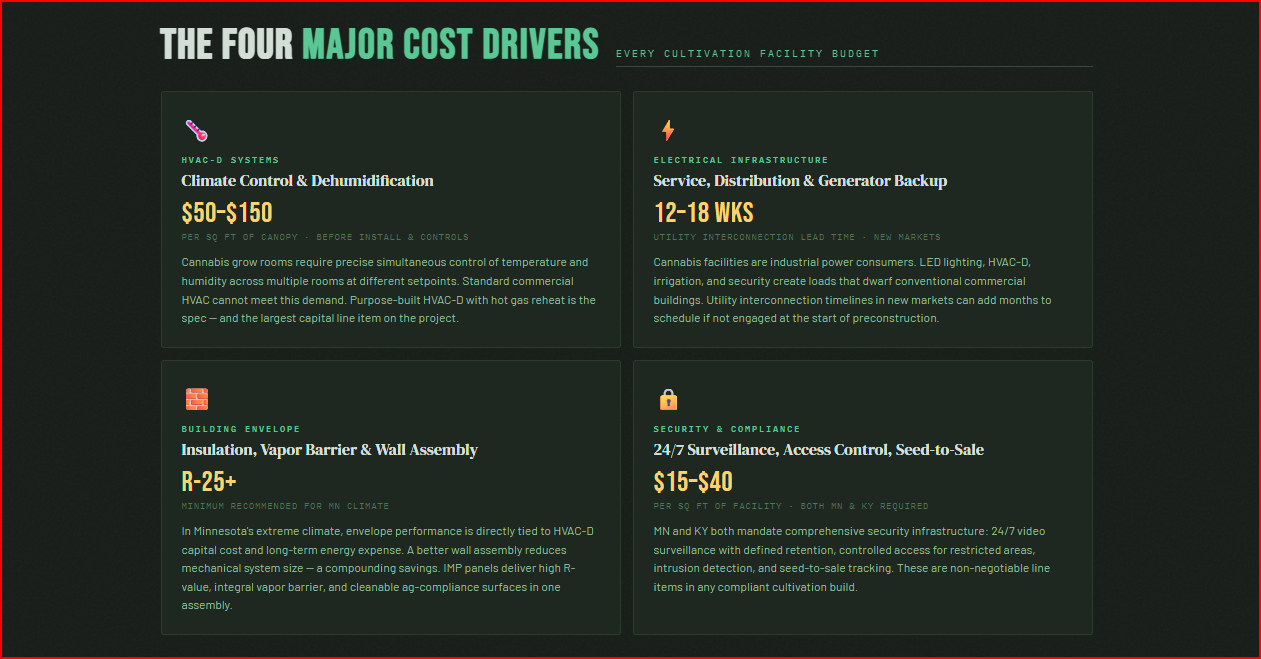
The building envelope comes next. A cannabis cultivation facility requires a high-performance shell — high R-value walls, positive and negative pressure control, hermetic sealing between grow rooms, washable surfaces, and odor containment. In Minnesota specifically, industry data pegs indoor cultivation facility construction at $300 to $450 per square foot — reflecting the additional envelope performance demands of a cold-climate build. In Kentucky and other South-Central markets, construction costs are more favorable, running 10–20% below that range due to competitive labor markets and lower material costs.
Security infrastructure, seed-to-sale tracking integration, electrical service upgrades, and specialty rooms — clone and propagation, drying and curing, extraction, mechanical — all add to the base cost. Operators entering new markets without a clear scope definition and a GC engaged at the design stage routinely discover that their initial budget assumptions are 20 to 40% short of actual construction cost. This is precisely the dynamic that Terrapin's preconstruction services are designed to prevent.
How TCG's Design-Build Process Gets Cultivators Into Production Faster
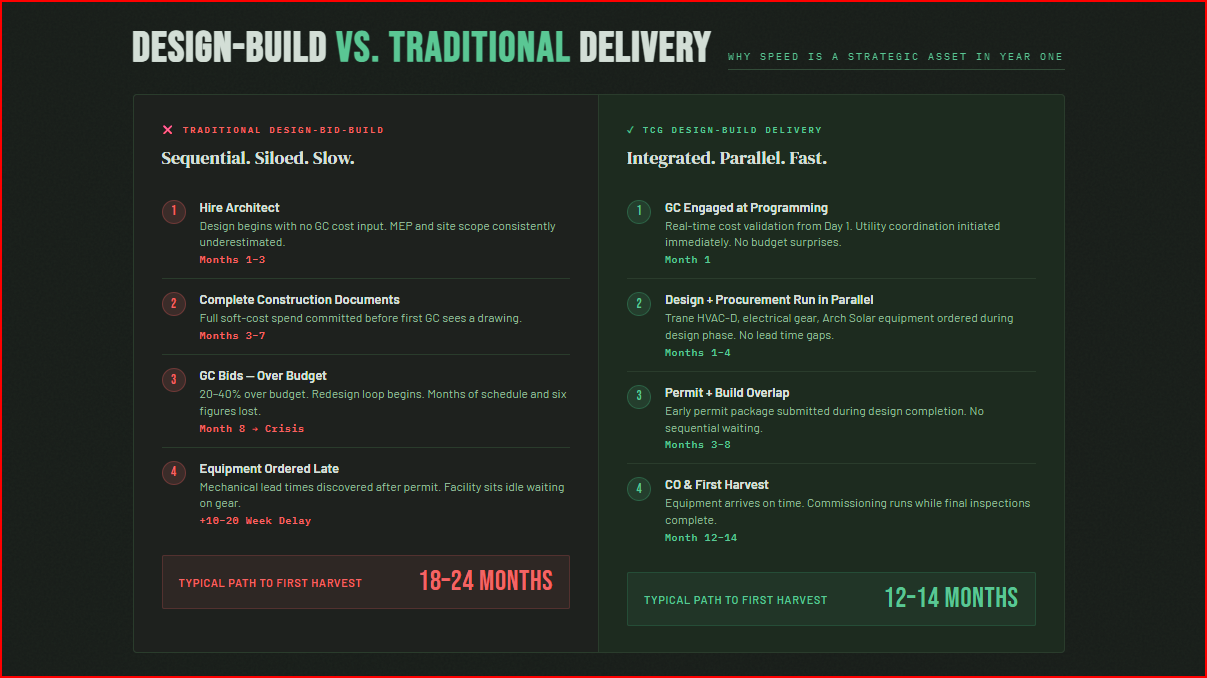
The traditional construction delivery sequence — hire an architect, complete design, go to bid, select a GC, break ground — is poorly matched to the business realities of an emerging cannabis market. In a market where the first 12 months of operation at premium wholesale prices can determine whether a facility is profitable over its entire license term, every month of schedule delay is a direct revenue impact. Operators who enter the traditional sequence often spend four to eight months getting through design and permitting before a shovel hits the ground. Then they get a GC bid that comes back over budget and spend another two months in value engineering and redesign.
The design-build delivery model TCG uses eliminates this sequence entirely. We engage with the operator at the concept stage — before design documents exist — and bring our preconstruction team into the process alongside the design team from day one. Every design decision is evaluated in real time against current market construction costs. Systems are specified with procurement lead times in mind, so long-lead HVAC equipment, electrical gear, and specialty cultivation systems are on order before construction begins rather than after. The result is a compressed timeline that gets operators into production months earlier than the conventional sequence — and a budget that reflects market reality rather than optimistic architectural estimates.
Working alongside 3rd Act Architecture & Consulting, TCG's cultivation facility design-build process is specifically calibrated to the regulatory requirements of each state's program. Minnesota's canopy size limits, room configuration requirements, and state inspection protocols are built into the design sequence from the start. Kentucky's seed-to-sale tracking requirements, security plan specifications, and Office of Medical Cannabis technical advisories are addressed in the preconstruction phase before they become construction change orders. Operators who engage a design-build team with cannabis-specific experience don't just get a faster schedule — they get a facility that passes inspection the first time, without the costly retrofits that facilities designed by teams unfamiliar with state cannabis regulations often require.
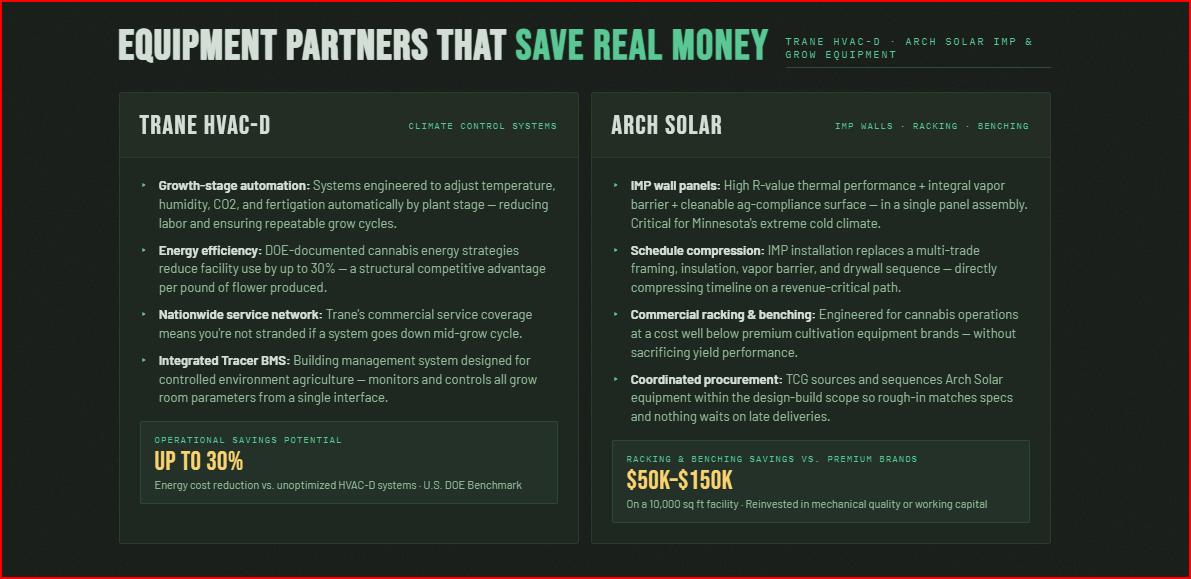
Trane HVAC: Why Purpose-Built Climate Systems Pay for Themselves in Cannabis Grows
The single most consequential equipment decision in a cannabis cultivation facility is the HVAC system. This isn't a line item where operators should default to the lowest-cost option — and it's not a decision that should be made after construction documents are finished. The HVAC system determines crop yield, product quality, energy costs, and compliance stability. It is the facility.
Trane's purpose-built indoor agriculture HVAC solutions — including the Horizon® Thrive™ packaged rooftop system specifically engineered for controlled-environment agriculture — are designed to do something standard commercial HVAC systems fundamentally cannot: manage both sensible cooling and latent dehumidification loads simultaneously, across a wide range of plant growth stages, with the precision required to maintain tight vapor pressure deficit setpoints. As Cannabis Tech reports, Trane brings more than 100 years of HVAC engineering experience to the indoor agriculture sector, with systems that integrate directly with cultivation controls to automatically adjust environmental conditions based on the plant's growth stage.
The business case for investing in Trane-grade climate systems rather than standard commercial equipment isn't just about yield quality — it's about operational reliability. ACHR News' analysis of cannabis HVAC technology highlights that environmental control in flower rooms must be maintained within 1° to 2°F and a narrow humidity range — because even small deviations can risk millions of dollars in crop value. Standard rooftop units designed for human comfort cooling cannot reliably hit those tolerances, particularly when managing the high latent loads generated by a full canopy of transpiring plants under high-intensity lighting. The result of under-specified HVAC isn't just suboptimal yield — it can mean mold events, crop loss, and compliance failures that threaten the license itself.
From a cost perspective, Trane systems also offer a compelling life-cycle argument. Research published in Cannabis Science and Technology demonstrates that integrated ducted HVACD systems — the category Trane's cultivation solutions fall into — outperform decoupled systems using standard cooling units with standalone dehumidifiers on both annual energy use and life-cycle cost. Higher upfront investment in a purpose-built system produces lower operating costs, fewer equipment failures, and longer equipment life across the facility's license term. When you're producing a crop that can sell for $4,000 per pound in a supply-short market like Minnesota, the ROI calculation on better HVAC is straightforward. TCG's equipment procurement team helps operators specify, procure, and coordinate Trane cultivation systems as part of the design-build process — ensuring lead times are managed and systems arrive on a schedule coordinated with rough-in installation.
Arch Solar: IMP Walls, Rolling Benches, and Racks That Reduce Build Costs and Operational Overhead
The building envelope and production infrastructure of a cannabis cultivation facility are two of the highest-leverage areas for cost reduction — and two of the most commonly over-specified or under-specified in facilities built without cannabis-specific construction experience. Arch Solar has emerged as one of the most cost-competitive suppliers in the market for both insulated metal panels (IMP walls) and cultivation production systems including rolling benches and racks.
Insulated metal panels are the preferred wall assembly for high-performance grow rooms for several converging reasons. An IMP wall system delivers a high R-value in a single panel assembly — eliminating the multi-layer construction of traditional stud framing, batt insulation, vapor barrier, and gypsum — while providing a washable, durable interior surface that meets state regulatory requirements for cleanability. The speed advantage is significant: IMP systems install substantially faster than conventional framed-and-finished walls, directly compressing the cultivation room buildout timeline. And the performance advantage is well-documented: PermaTherm's research on hermetically-sealed grow environments found that operators using IMP systems for their grow rooms cut CO₂ costs by 28% compared to facilities built with conventional construction — a direct operational saving that compounds over the life of the license.
Arch Solar's IMP wall offering — which the company regularly showcases at industry events including Indoor Ag-Con — pairs with their rolling bench and rack systems to create a complete production infrastructure solution. Rolling benches eliminate dedicated aisles, increasing usable canopy space by up to 50% versus stationary bench configurations. For a licensed cultivator operating within Minnesota's 30,000-square-foot canopy cap or Kentucky's tiered canopy limits, maximizing canopy density within the licensed footprint is a direct revenue lever — and Arch Solar's bench systems are priced to compete aggressively against alternatives. TCG procures and installs Arch Solar IMP panels and production infrastructure as part of our cultivation facility design-build process, coordinating delivery with the construction sequence so panels and benches arrive when the structure is ready to receive them rather than sitting in a warehouse.
The combination of Arch Solar IMP walls and Trane HVAC systems within a TCG design-build project creates a facility that is faster to build, cheaper to operate, and better insulated than what operators typically get when they assemble these components independently through separate procurement processes. It also means a single point of accountability: when the system integration matters — when HVAC performance depends on the envelope sealing it operates within — TCG owns both scopes.
The Five Questions Every Emerging-Market Cultivator Should Answer Before Breaking Ground
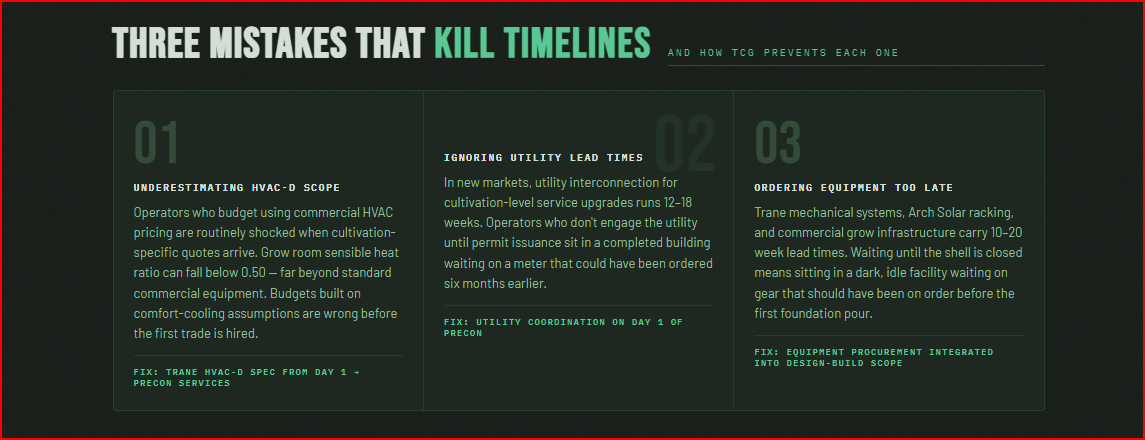
After building cannabis cultivation facilities across multiple states and regulatory regimes, TCG's preconstruction team has identified five questions that consistently separate well-executed projects from expensive ones.
What is your canopy target and room configuration? The answer to this question drives almost every downstream construction decision — structural loading for HVAC and lighting, room dimensions and airflow design, electrical service sizing, and IMP panel layout. Operators who don't have a clear canopy target at the start of design end up paying for redesign when the target changes mid-construction.
What is your food program — and have you finalized your grow method? Soil, rockwool, flood-and-drain, and aeroponic systems all have different infrastructure requirements. Locking in the grow method before MEP design begins prevents expensive change orders to plumbing and drainage rough-in.
What is your power availability at the site? Cannabis cultivation facilities are extreme power consumers. A 15,000-square-foot indoor facility operating under high-intensity lighting and purpose-built HVAC can require 800 to 2,000 amps of service at 480V. Sites without adequate utility infrastructure require transformer upgrades, utility coordination, and lead times that can push a schedule by months. This is an evaluation that TCG's owners' representative function performs as part of site selection due diligence — before you're committed to a property.
Have you engaged your state regulatory contact on your facility plans? Minnesota's OCM and Kentucky's Office of Medical Cannabis both have technical requirements that go beyond the published regulations. Early engagement with the regulatory contact assigned to your license application can surface compliance requirements that are much cheaper to design in than retrofit after construction.
Is your GC engaged now — before design is complete? Nine out of ten cultivation facilities that run over budget do so because the GC wasn't in the room when the design decisions were made. Terrapin's commercial construction team builds cannabis cultivation facilities across all 50 states and prices real-time market data into every design decision we're part of. The operators who engage us early spend less than the operators who hand us a completed set of plans.
Ready to Build Your Cultivation Facility in an Emerging Market?

The window for first-mover advantage in markets like Minnesota and Kentucky is real — and it's measured in months, not years. Supply gaps close. Wholesale prices normalize. The operators who capture the economics of an undersupplied market are the ones whose facilities are already producing when the competition is still in preconstruction.
Terrapin Construction Group provides design-build delivery, preconstruction services, commercial general contracting, and equipment procurement for cannabis cultivation facilities nationwide. We work with licensed operators at every scale — from microbusiness and mezzobusiness footprints to full-scale cultivator builds — and we bring the same design-build discipline and equipment-procurement rigor to every project.
If you're a licensed or pre-approved cultivator in Minnesota, Kentucky, or any other emerging market and want a frank, no-cost conversation about what your facility will cost and how fast we can get it built, schedule a 30-minute call with our team.
Schedule a Conversation With TCG's Cultivation Facility Team
We build cannabis cultivation facilities across all 50 states. If you're planning a ground-up grow or a retrofit buildout in an emerging market, let's talk about timeline, budget, and how design-build delivery gets you into production faster.
You may also find these related articles helpful:
Average Cost to Build a QSR Restaurant in the USA
Average Cost to Build an Optometry Office in the USA
Commercial Construction Delivery Methods: Cost-Plus vs. GMP in 2026
Sources
Minnesota Office of Cannabis Management — General Licensing Overview
CannDelta — Minnesota Cannabis Cultivation License Types & Requirements
Cannaspire — Minnesota Cannabis Licensing Timeline & Market Updates 2025–2026
Kentucky Office of Medical Cannabis — Program Overview (kymedcan.ky.gov)
The Green Remedy — Recent Changes to Kentucky's Medical Cannabis Laws, 2025 Update
Marijuana Policy Project — Kentucky State Cannabis Policy Page
Cannabis Business Times — Kentucky Medical Cannabis Program Attracts 5,000 License Applicants
Next Big Crop — How Much Does It Cost to Build a Commercial Cannabis Grow Facility?
Next Big Crop — HVAC Design and Dehumidification for Commercial Cannabis Grows
Trane Technologies — How Trane Helps Indoor Growers Optimize Operations and Reduce Energy Costs
HPAC Engineering — Latent Loads Matter: HVAC for Cannabis Grow Facilities
Arch Solar — IMP Wall Panels, Commercial Racking and Benching Systems for Cannabis Cultivation
BhumiCalculator — Commercial Construction Costs Per Square Foot, 2026
Deloitte — 2026 Engineering and Construction Industry Outlook
Associated General Contractors of America — Tariff Resource Center for Contractors
