
AI-Powered Commercial Construction Estimator: How TCG.ai Delivers Instant, Market-Calibrated Cost Estimates for Any Project Type
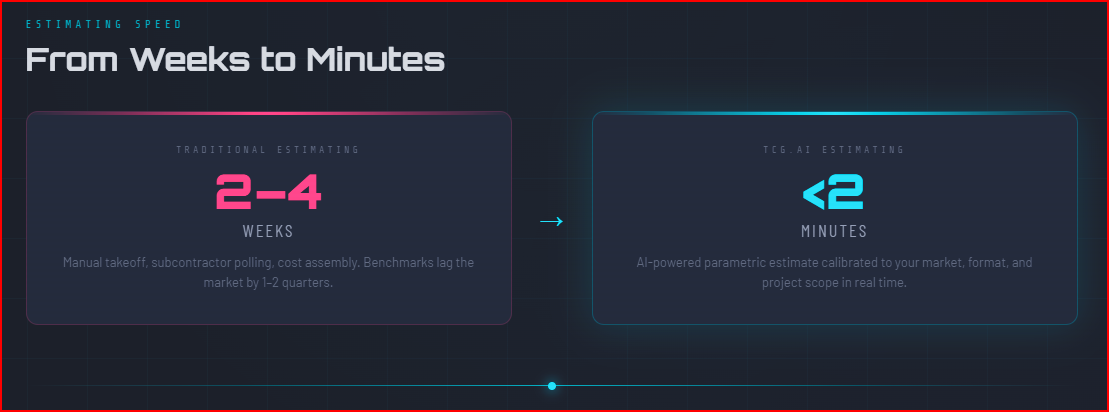
Commercial construction cost estimating has always been a bottleneck. A developer identifies a site, defines a building program, and then waits — sometimes weeks — for a general contractor or third-party estimator to produce a preliminary cost figure. That number arrives at the end of a slow process involving takeoff analysis, subcontractor polling, and manual cost assembly. And when it finally lands, it often reflects market conditions that have already shifted. According to Gordian's Q1 2026 Construction Cost Insights Report, published cost benchmarks from traditional estimating databases lag the market by one to two quarters — a gap that is material in active construction markets where labor and material pricing moves monthly.
AI is changing the speed, structure, and accessibility of early-stage construction cost estimating. As Build's 2026 analysis of AI in construction estimating notes, AI-powered models can now generate parametric hard cost estimates in minutes when given a defined program, building type, square footage, structural system, and location. The question is no longer whether AI estimating works — it's whether the tool you're using is trained on the right data, calibrated to your specific market, and built for commercial-scale projects.
That's the problem TCG.ai was built to solve.
What is TCG.ai and why did we build it?
Terrapin Construction Group is a national commercial general contractor and construction management firm, headquartered in Denver, CO. We've built commercial projects across all 50 states — QSR restaurants, medical offices, retail buildouts, cannabis cultivation facilities, cold storage environments, and industrial buildings — and we've been estimating these project types for over five decades.
TCG.ai is a proprietary AI-powered construction estimating tool that draws on that accumulated project intelligence. Describe your project — location, square footage, construction type, intended use, site conditions, timeline — and the engine returns a preliminary cost estimate in under two minutes. Not a generic per-square-foot number pulled from a national average database. A market-specific, format-aware, scope-calibrated estimate that reflects what a project like yours actually costs to build in your geography, right now.
The tool is free to use and available at terrapincg.com/instant-estimator-ai. It is designed for commercial real estate developers, operators, investors, architects, and anyone who needs a credible preliminary construction cost figure before committing capital to design or site control.
The Data Behind the Estimate: What TCG.ai Actually Analyzes
The accuracy of any AI estimating tool is only as good as the data and logic behind it. Most free construction calculators on the internet apply a flat cost-per-square-foot multiplier to a building type and call it an estimate. That approach compresses variance and produces numbers that are too generic to be useful for real development underwriting. RSMeans/Gordian has documented over 92,000 unit line items across its estimating database, localized to more than 970 locations — because construction costs are fundamentally local, and a national average is never what you'll actually pay.
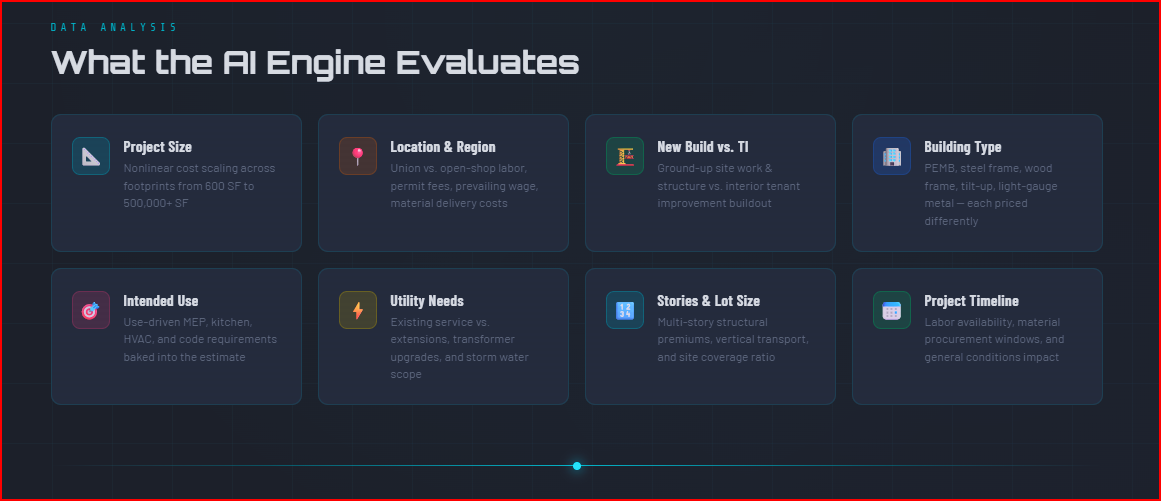
TCG.ai was built with that same principle. When a user describes a project, the AI engine parses and analyzes a comprehensive set of cost-driving variables before generating an estimate.
Project Size and Building Footprint
Square footage is the most basic input, but it isn't a simple multiplier. A 1,200-square-foot QSR coffee shop and a 120,000-square-foot cold storage warehouse don't scale linearly. Smaller commercial buildings often carry a higher cost per square foot because fixed costs — site mobilization, utility connections, permits, GC overhead — are distributed across a smaller floor area. TCG.ai accounts for this nonlinear cost behavior across project sizes.
Location and Regional Cost Index
Commercial construction costs vary 25–40% or more between the lowest-cost and highest-cost U.S. markets. A ground-up QSR restaurant in Dallas is a fundamentally different financial proposition than the same building in Boston or San Francisco. TCG.ai incorporates regional labor market data, prevailing wage requirements, union versus open-shop labor conditions, permit fee structures, and material delivery cost differentials — the same factors that drive the geographic cost variance documented by HomeGuide and other commercial construction cost databases. When you enter a project location, the estimate adjusts accordingly.
New Construction vs. Tenant Improvement
Ground-up construction and tenant improvement buildouts are different cost animals. A ground-up project carries site work, foundation, structural framing, building envelope, and full MEP rough-in. A TI project starts with an existing shell and focuses on interior buildout — framing, finishes, MEP distribution, and equipment installation. TCG.ai differentiates between these scopes and adjusts cost models accordingly, avoiding the common error of applying new-construction benchmarks to interior renovation projects or vice versa.
Building Type and Structural System
A pre-engineered metal building has a different structural cost profile than a conventional steel-frame or wood-frame structure. Tilt-up concrete, structural steel, light-gauge metal framing, and PEMB systems each carry distinct material costs, labor productivity rates, and erection timelines. TCG.ai factors the structural system into its estimate — because a 10,000-square-foot retail building in stick-frame construction costs materially less per square foot than the same footprint in structural steel.
Intended Use and Occupancy-Driven Scope
The intended use of a building drives an enormous amount of scope that has nothing to do with the shell. A medical office requires specialized HVAC for exam rooms, additional plumbing for medical gas and waste, and ADA-compliant patient flow. A QSR restaurant triggers commercial kitchen ventilation, grease interceptors, fire suppression over cooking equipment, and high-capacity electrical service. A cold storage facility demands an entirely different building envelope — high-performance insulated metal panels, vapor barriers, and industrial refrigeration systems. According to EB3 Construction's analysis of QSR builds, kitchen infrastructure alone can represent 30–40% of total construction cost. TCG.ai incorporates these use-driven cost components automatically when you specify the building's function.
Utility Requirements and Site Infrastructure
Utility availability is one of the most underestimated cost variables in commercial development. A site with existing water, sewer, electrical, and gas service at the property line is a fundamentally different project cost than a raw site requiring utility extensions, transformer upgrades, or on-site storm water management. TCG.ai asks about utility conditions because, on ground-up projects, site infrastructure routinely represents 15–30% of total hard costs. Terrapin's owners' representative services are specifically designed to help developers surface these costs during due diligence — and the AI estimator flags this same cost exposure at the feasibility stage.
Number of Stories, Lot Size, and Timeline
Multi-story construction introduces structural, vertical transportation, and fire protection costs that single-story buildings don't carry. Lot size relative to building footprint affects site work scope — paving, landscaping, storm water, and utility routing. And project timeline influences labor availability, material procurement strategy, and general conditions cost. TCG.ai considers all three.
Estimating the Hottest Commercial Verticals in 2026
The commercial construction market in 2026 is defined by a handful of high-growth verticals that are absorbing enormous amounts of development capital. TCG.ai is purpose-built to estimate these project types with precision — because these are the projects we build every day.
Quick-Service Restaurants (QSR)
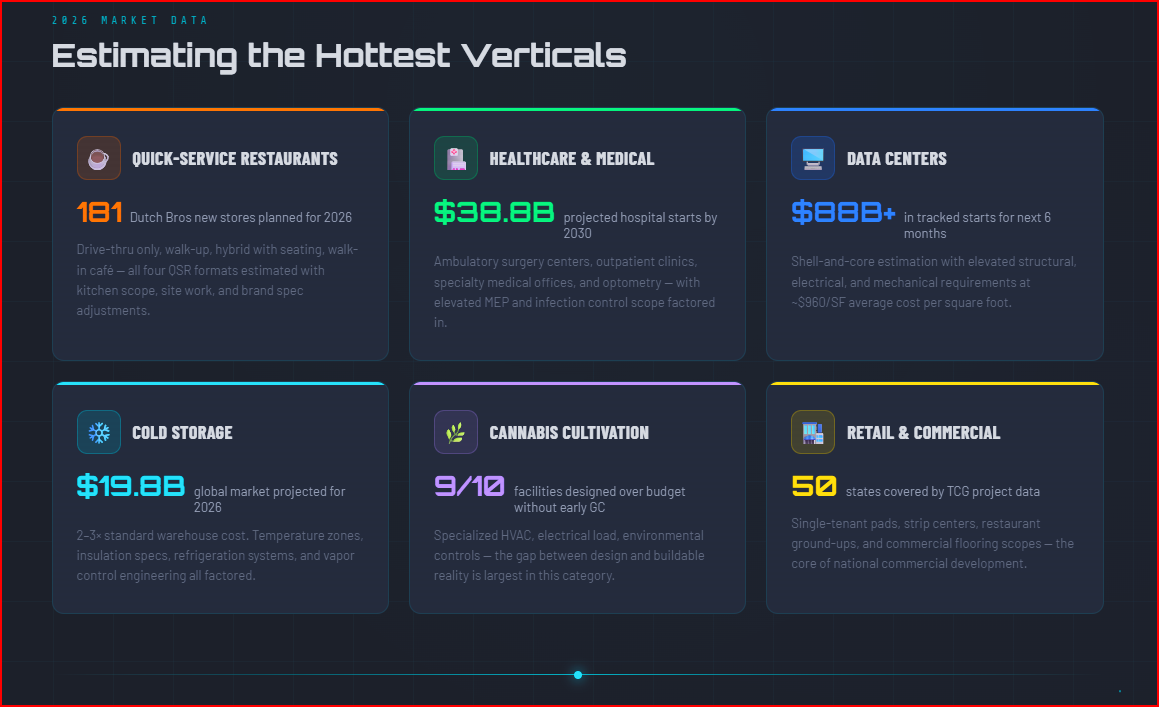
QSR development remains one of the most active categories in commercial real estate. Drive-thru coffee concepts like Dutch Bros — on track for 181 new locations in 2026 — are expanding aggressively, and regional fast-casual brands are building ground-up prototypes in every major U.S. market. TCG.ai estimates QSR projects across all four primary formats: drive-thru only, walk-up with drive-thru, hybrid with limited seating, and walk-in café. The estimator accounts for kitchen scope, drive-thru site work, brand prototype specifications, and the regional labor market conditions that swing a QSR coffee shop build from $550,000 in Texas to over $2 million in California.
Healthcare and Medical Office
Healthcare construction spending is projected to grow at a 7% compounded annual growth rate through 2030, according to ConstructConnect's hospital construction forecast. The Healthcare Financial Management Association reports that 45% of hospital executives surveyed are increasing the share of their capital budgets dedicated to new construction. Ambulatory surgery centers, outpatient clinics, specialty medical offices, and optometry practices are the growth engine — and these are precisely the project types TCG builds and TCG.ai estimates. The estimator factors in the elevated MEP scope, infection control requirements, and specialized finish standards that make healthcare construction 30–50% more expensive per square foot than general commercial office space.
Data Centers
Data center construction is the single largest growth category in American commercial construction. Construction Dive reports that data centers and power facilities represent the highest-confidence growth category in the AGC's 2026 outlook survey. ConstructConnect is tracking 76 data center projects set to start in the next six months, valued at over $88 billion — a 13% increase over all of 2025. JLL's 2026 Global Data Center Outlook forecasts average global construction costs increasing 6% year-over-year to $11.3 million per megawatt. TCG.ai can estimate data center shell-and-core construction, factoring in the elevated structural, electrical, and mechanical requirements that make these facilities among the most expensive to build per square foot in commercial construction.
Cold Storage and Refrigerated Warehousing
The cold storage construction market is expanding rapidly, with ResearchAndMarkets projecting growth from $17 billion in 2025 to nearly $20 billion in 2026, driven by e-commerce perishable logistics, pharmaceutical cold chain expansion, and the modernization of aging refrigerated facilities. Cold storage construction costs run two to three times higher than standard warehouse construction — typically $130 to $350 per square foot — because of the specialized building envelope, industrial refrigeration systems, and vapor control engineering required. TCG.ai estimates cold storage projects by factoring in temperature zone requirements, insulation specifications, refrigeration system scope, and the site infrastructure demands that make these facilities among the most complex in industrial construction.
Cannabis Cultivation Facilities
Purpose-built cannabis cultivation facilities remain an active commercial construction category, particularly in states with expanding licensing frameworks. These projects carry highly specialized HVAC, electrical, and environmental control requirements — and the gap between what architects design and what the building actually costs to construct is often enormous. As we've written about extensively in our coverage of value engineering cannabis cultivation facilities, nine out of ten cultivation facilities are designed over budget because the GC isn't involved until after design is complete. TCG.ai brings estimating into the feasibility stage so operators and developers can validate their pro forma before spending a dollar on architecture.
Retail, Restaurant, and General Commercial
From QSR prototypes to commercial flooring scopes to full-format retail buildouts, TCG.ai estimates the bread-and-butter commercial construction categories that make up the bulk of development activity across the country. Whether you're building a single-tenant retail pad, a multi-unit strip center, or a restaurant ground-up, the estimator draws on real project cost data from these formats to produce a preliminary budget you can use for underwriting conversations with lenders and equity partners.
IMP Wall Estimation: Supply and Install Cost from Plans
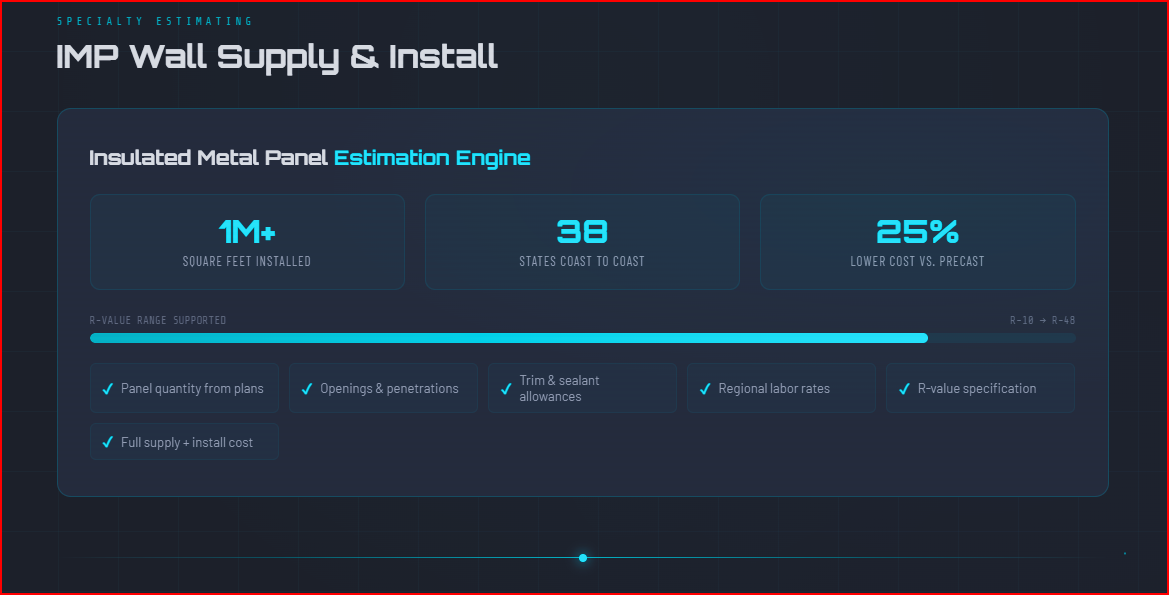
One of TCG.ai's most specialized capabilities is estimating the supply and installation cost of insulated metal panel (IMP) wall and roof systems. Terrapin Construction Group has installed over one million square feet of IMPs across 38 states, working directly with leading manufacturers including Kingspan, Metl-Span, ATAS International, and others. That installed-cost intelligence is built into TCG.ai's estimation engine.
Insulated metal panels are the preferred envelope system for cold storage facilities, food processing plants, cannabis cultivation environments, data centers, and any commercial building requiring high-performance thermal control. According to the Construction Executive's analysis of IMP performance, a study by Currie & Brown found that the installed cost of IMP wall systems averaged 25% lower in the United States compared to insulated precast and tilt-up concrete alternatives. IMPs deliver R-values ranging from R-10 to R-48, with polyurethane and polyisocyanurate foam cores providing the highest insulation efficiency per inch — and as Allied Steel Buildings documents, that R-value is directly related to panel thickness and foam type.
When a user provides TCG.ai with floor plans, elevations, and R-value requirements, the estimator can calculate panel quantities, account for openings (doors, windows, dock doors, louvers), factor in trim, sealant, and fastener allowances, and apply regional labor rates for installation — producing a supply-and-install cost estimate that reflects actual field conditions. The TCG IMP Estimator is also available as a standalone tool for projects where IMP scope is the primary cost question.
For developers and GCs who are evaluating IMP systems against conventional insulation assemblies, this capability eliminates weeks of waiting for manufacturer quotes and subcontractor pricing — and it provides a number grounded in TCG's direct installation experience, not theoretical material costs alone.
How TCG.ai Estimates Soft Costs
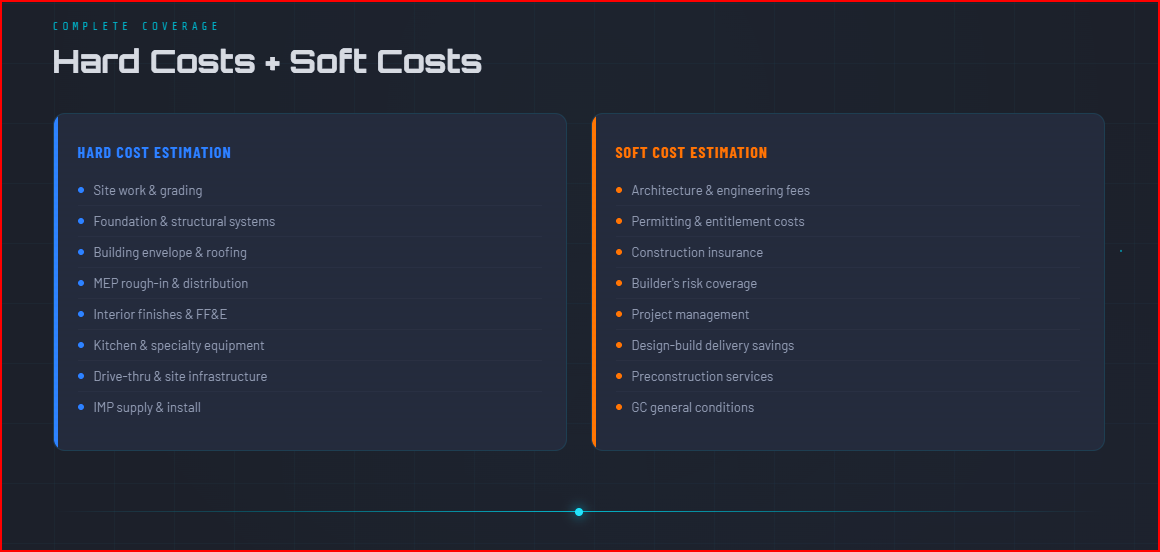
Most construction estimating tools — including many AI-powered ones — stop at hard costs. They'll give you a number for the building and the site, but they won't touch the soft cost categories that frequently represent 20–35% of total project cost. TCG.ai is different.
The estimator produces soft cost estimates for architectural and engineering design fees, which typically run 8–12% of hard construction costs depending on project complexity, scope of services, and market. Through Terrapin's design-build delivery model, we regularly engage architects and engineers on behalf of owners and have direct visibility into what design services cost across project types and geographies. TCG.ai applies this fee intelligence to produce a realistic A/E budget for the specific project being estimated.
Beyond design fees, the estimator also flags other common soft cost categories: permitting and entitlement costs (which vary enormously by jurisdiction), construction insurance, builder's risk, and project management. For developers who need a total project cost number — not just a hard cost number — for feasibility analysis, debt sizing, or equity conversations, this is a critical distinction.
What Makes TCG.ai Different from Other AI Estimating Tools
The construction estimating software market is growing rapidly, with platforms like Togal, DocumentCrunch, and Gordian's Flash AI bringing AI capabilities to different parts of the estimating workflow. Many of these tools are excellent at what they do — automated takeoff from drawings, plan comparison, historical cost benchmarking. But they serve different purposes and different users.
TCG.ai is designed specifically for the earliest stage of project development: the moment when a developer, operator, or investor has a project concept and needs to know whether it pencils. It requires no plans, no drawings, and no account setup. Describe the project in natural language — "40,000 square foot cold storage facility in Houston, new ground-up construction on a 3-acre site with city utilities available" — and get a preliminary cost estimate in minutes.
The differentiators are straightforward. First, TCG.ai is built by a general contractor that actively builds across all 50 states, not a software company aggregating third-party data. The cost intelligence behind the estimates reflects real project pricing, real subcontractor markets, and real material costs from active TCG projects. Second, the tool estimates both hard costs and soft costs, giving users a more complete picture of total project investment. Third, TCG.ai covers specialized commercial verticals — IMP supply and install, cannabis cultivation, cold storage, data centers — that most generic estimating tools handle poorly or not at all. And fourth, every AI estimate is backed by TCG's preconstruction team, which can validate and refine any preliminary estimate into a formal proposal when the project is ready to move forward.
How Accurate Is an AI Construction Estimate in 2026?
This is the right question to ask, and the honest answer is: it depends on the inputs, the project type, and what you're using the estimate for.
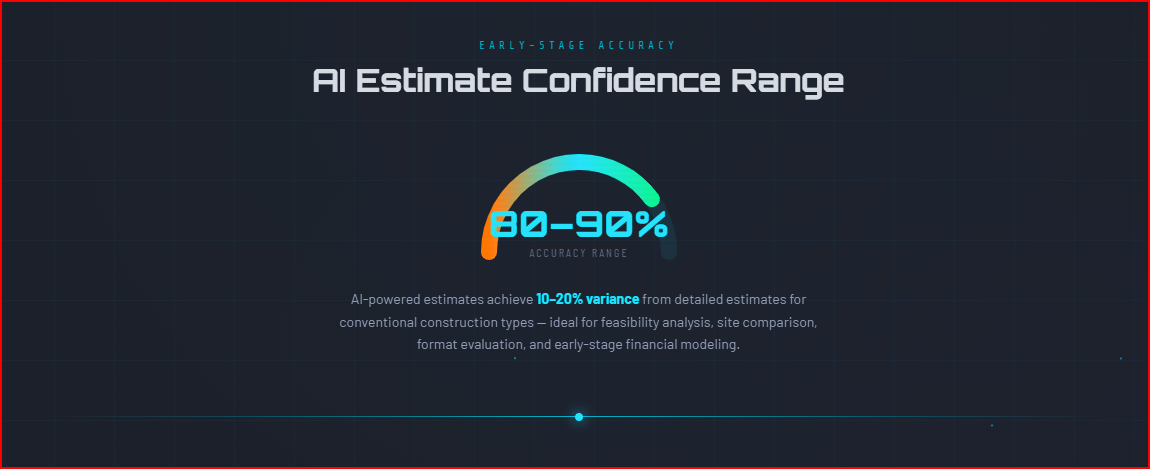
According to Build's analysis of AI estimating accuracy, AI-powered tools currently produce credible early-stage hard cost estimates within 10–20% of detailed estimates for conventional construction types. That level of accuracy is highly useful for feasibility analysis, site comparison, format evaluation, and early-stage financial modeling — the decisions that happen before a project has drawings.
TCG.ai is designed for this stage. It is not a replacement for a formal GC estimate based on a complete set of construction documents. What it does is eliminate the information vacuum that exists at the beginning of every development project — the period where developers are making go/no-go decisions on sites, formats, and markets without a credible cost number to underwrite against. As DocumentCrunch's analysis of AI estimating notes, estimators spend an average of 13 or more hours per week on data gathering and pricing — and the earlier a reliable number enters the development process, the better the decisions that follow.
The more detail a user provides to TCG.ai — square footage, story count, building type, location, utility conditions, lot size, intended use, timeline — the tighter the estimate. And when a project reaches the point where formal pricing is needed, TCG's preconstruction team takes over with a full-scope estimate backed by subcontractor pricing and real-time material costs.
Who Should Use TCG.ai?
The tool was built for anyone involved in the early stages of commercial real estate development — but it's especially valuable for four audiences.
Commercial real estate developers evaluating new ground-up projects or tenant improvement buildouts across any U.S. market. If you're comparing sites, formats, or markets and need a preliminary cost number to run your pro forma, TCG.ai gives you that number in minutes instead of weeks.
Operators and franchisees planning QSR, retail, medical, or cannabis facility construction. If you know your format and your target market but don't yet have drawings, the estimator provides a cost baseline to validate your unit economics and financing assumptions before engaging an architect.
Architects and engineers who want to gut-check design direction against real construction costs early in the design process. As the American Institute of Architects has documented, the majority of commercial projects exceed the owner's budget at first GC pricing — because design is completed without concurrent cost feedback. TCG.ai helps close that gap.
Investors and lenders underwriting commercial construction deals. If you need a credible third-party reference point for construction costs on a proposed project, TCG.ai provides an instant benchmark calibrated to the specific market and building type.
Try TCG.ai — Free, Instant Commercial Construction Estimates
Describe your project and get a preliminary cost estimate in under two minutes.
Ready for a formal estimate from our preconstruction team?
Schedule a 30-Minute Conversation →
From AI Estimate to Formal Proposal: How TCG Takes Projects from Concept to Construction
TCG.ai is the front door. Behind it is a full-service national commercial general contracting and construction management firm that has delivered projects in every commercial vertical discussed in this article.
When a preliminary AI estimate confirms that a project is viable, the next step is engaging Terrapin's preconstruction team for a detailed scope review, subcontractor pricing, and formal proposal. For projects where design isn't yet complete, TCG's design-build delivery model brings the GC into the process at schematic design — the stage where 80% of a project's cost is determined and where early value engineering consistently recovers 8–15% of hard costs.
For IMP-specific projects, TCG's nationwide IMP installation team provides formal supply-and-install proposals backed by direct manufacturer relationships and over a million square feet of installed panel experience. For projects requiring specialized MEP engineering, TCG works with partners including 9BA MEP to ensure that mechanical, electrical, and plumbing scope is accurately priced and coordinated from day one.
Terrapin Construction Group builds commercial projects across all 50 states from its Denver, CO headquarters. Whether you start with an AI estimate or a phone call, the goal is the same: give developers and operators a clear, honest picture of what their project costs to build — and then build it.
Try TCG.ai → OR Schedule a conversation →
You may also find the following related reading useful:
Average Cost to Build a QSR Restaurant in the USA
Average Cost to Build a QSR Coffee Shop in the USA
Average Cost to Build an Optometry Office in the USA
Hospital Construction Boom 2026
Commercial Construction Delivery Methods: Cost-Plus vs. GMP
Sources
Gordian — Q1 2026 Construction Cost Insights Report
RSMeans — 2026 Construction Cost Trends
Build — Construction Cost Estimation with AI: What's Possible in 2026
DocumentCrunch — AI Construction Estimating: Save Time and Cut Costs
Togal — AI-Powered Construction Takeoff Software
Construction Executive — IMPs Improve Performance, Sustainability and Cost
Allied Steel Buildings — R-Value of Insulated Metal Panels
FMP Construction — Insulated Metal Panels in Modern Construction
HomeGuide — Commercial Construction Cost Per Square Foot, 2026
EB3 Construction — Understanding QSR Construction
Modern Retail — Dutch Bros Plans More Locations in 2026
Construction Dive — Breaking Down the Data Center Opportunity for Builders in 2026
Equipment World — Data Center Construction Boom to Grow in 2026
JLL — 2026 Global Data Center Outlook
ConstructConnect — Hospital Construction Booms, Forecasts Point to Sustained Growth
HFMA — Hospital Construction Spending Forecast to 2030
ResearchAndMarkets — Cold Storage Construction Market Analysis 2026-2030
