

Austin Medical Office, ASC & Healthcare Construction
Design-build medical construction across Austin and Central Texas: MOBs, ambulatory surgery centers, urgent care, freestanding emergency departments, imaging suites with shielded vaults, and medical tenant improvements. Dell Medical, Ascension Seton, and St. David's adjacency, no Certificate of Need to slow you down, and engineered foundations for Central Texas clay soils.
Austin Medical Construction Cost Estimator
Describe your medical office, surgery center, imaging suite, or clinic project and get a preliminary cost estimate powered by TCG.ai, calibrated to Austin and Central Texas healthcare pricing.
Tell Us About Your Project
Include facility type, square footage, location in the Austin metro, clinical systems (med gas, imaging, OR), shell vs TI, and timeline. Our AI applies Central Texas healthcare indices automatically.
Analyzing Your Austin Project
Our AI is evaluating construction costs using Austin market data…
Your Austin Construction Estimate
How TCG Builds Medical in Central Texas
Austin is one of the fastest-growing metros in the country, and its healthcare market is expanding to match. The Dell Medical School at UT Austin anchors academic medicine, Ascension Seton (including Dell Seton Medical Center) and St. David's HealthCare hold the major hospital footprints, and Baylor Scott and White and Texas Health add more. Rapid population growth across Williamson and Hays counties drives sustained MOB, ASC, urgent care, and freestanding emergency department construction from central Austin out to Round Rock, Cedar Park, Georgetown, Kyle, and San Marcos.
The single biggest regulatory advantage in Texas medical is what is missing: Texas does not have a Certificate of Need program. MOBs, ASCs, urgent care, imaging suites, and most outpatient facilities can be built without the CON review that adds 6 to 18 months in restrictive states. Texas regulates through licensing, the Texas Health and Human Services Commission and the Department of State Health Services license ASCs and hospitals, but there is no state gatekeeper deciding whether the market needs your facility. That makes Texas one of the easiest states in the country to build healthcare quickly. Imaging modalities like MRI and CT also do not require a CON here, so vendor lead time and plan review, not state approval, set the schedule.
Central Texas construction is shaped by expansive clay soils and heat. The clay shrinks and swells with moisture, so medical buildings need engineered foundations, often post-tensioned slabs or piers, designed from a geotechnical report. The hot, humid, cooling-dominated climate drives oversized dehumidification for clinical RH control, and the February 2021 freeze (Winter Storm Uri) is a reminder to harden critical systems against rare cold. We engineer architecture, MEP, and structural in-house and coordinate imaging shielding from schematic design. Design-build compresses program 15 to 30 percent against design-bid-build.
Austin Medical Construction Cost Per Square Foot
Austin medical construction runs $185 to $640 per SF depending on use. The metro multiplier is about 0.98 to 1.12x of national, with Texas right-to-work keeping labor competitive and Austin demand pushing the top of the range. Use the estimator above and the national MOB cost guide for context.
TCG Builds Across Texas
Austin is one of four major Texas metros TCG serves. We deliver design-build commercial construction in Dallas, Houston, and San Antonio as well, and reach the rest of the Texas Triangle and all 50 states from there.
Austin Medical & Healthcare Resources, Cost Guides & News
Cost guides, sibling Austin sectors, Texas metros, core services, and healthcare news to plan your project.
Advantage Eye Care, Owensboro, KY
TCG delivered a 5,500 SF design-build tenant improvement for a full optometry practice in Owensboro, Kentucky, taking the space from shell to patient-ready under one contract, with architectural design, MEP coordination, and construction handled by one team.
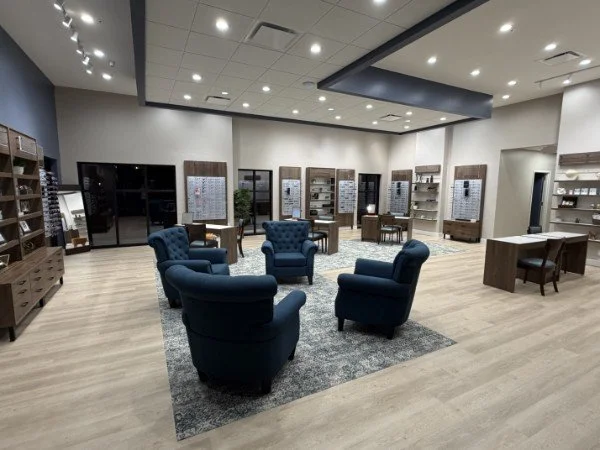
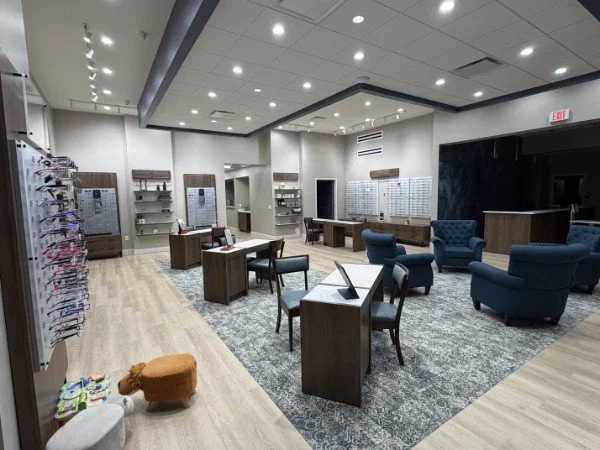
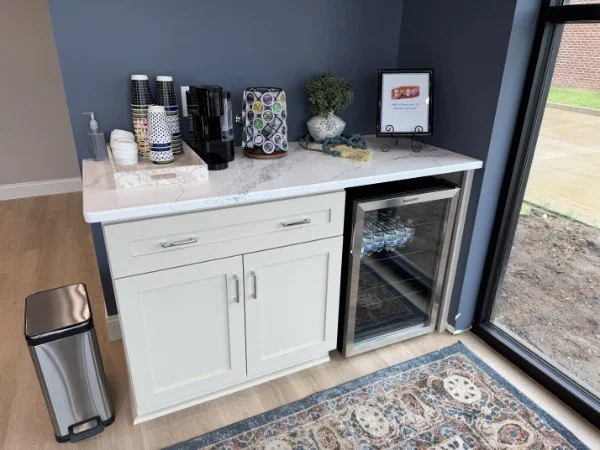
Clinical tenant improvements live or die on coordination: exam lanes built to sight-line and lighting-control requirements, a pre-testing suite, an optical dispensary with fitting stations, and a minor procedure room, all finished to a retail-grade patient experience with custom millwork throughout.
TCG brings the same single-source design-build team to medical office, clinic, and healthcare tenant improvement projects in Austin.
- Delivery: design-build tenant improvement
- Clinical: exam lanes, pre-testing suite, minor procedure room
- Retail: optical dispensary and patient lounge
- Finish: custom millwork and casework throughout
See all recent work on the TCG projects page.
Austin Medical Construction FAQ
Common questions about medical construction in Austin and Central Texas. See the full TCG FAQ for more.
TCG recently completed Advantage Eye Care in Owensboro, Kentucky, a 5,500 SF design-build tenant improvement for a full optometry practice with exam lanes, a pre-testing suite, an optical dispensary, a minor procedure room, and custom millwork, delivered from shell to patient-ready under one contract. TCG brings the same design-build team to medical and healthcare projects in Austin.
Austin metro medical construction runs $185 to $640 per SF depending on use. MOB $200 to $450, urgent care $260 to $450, imaging suites with shielding $330 to $510, ASC $380 to $640, medical TI $185 to $500. The Austin multiplier is about 0.98 to 1.12x of national. Use the cost estimator above and the national MOB cost guide.
No. Texas does not have a Certificate of Need program, so MOBs, ASCs, urgent care, imaging suites, and most outpatient facilities can be built without the CON review that adds 6 to 18 months in restrictive states. Texas regulates through licensing by the Health and Human Services Commission and the Department of State Health Services, but there is no state gatekeeper on market need. This makes Texas one of the fastest states in the country for healthcare construction.
Austin is one of the fastest-growing metros in the country. The Dell Medical School at UT Austin anchors academic medicine, Ascension Seton and St. David's HealthCare hold the major hospital footprints, and Baylor Scott and White and Texas Health add more. Fast population growth in Williamson and Hays counties drives MOB, ASC, urgent care, and freestanding ER construction across the metro.
Medical office buildings, ambulatory surgery centers (ASCs), urgent care clinics, freestanding emergency departments, imaging suites with shielded vaults (MRI, CT, X-ray), dental offices, optometry offices, veterinary clinics, dialysis centers, and medical tenant improvements. See the core healthcare sector page and the urgent care cost guide.
MRI suites need RF-shielded vaults, vibration isolation, magnet quench piping, and temperature-stable HVAC. CT and X-ray rooms need lead-shielded walls, doors, and view windows. We coordinate equipment vendor (Siemens, GE, Philips, Canon) shielding rough-in from schematic design. Texas does not require a CON for imaging, so vendor lead time and plan review set the schedule, not state approval.
Central Texas has expansive clay soils that shrink and swell with moisture, so medical buildings need engineered foundations, often post-tensioned slabs or piers, designed from a geotechnical report. The hot, humid, cooling-dominated climate drives oversized dehumidification for clinical humidity control, and Winter Storm Uri in 2021 is a reminder to harden critical systems against rare extreme cold.
City of Austin review can be slow, so suburban jurisdictions like Round Rock, Cedar Park, and Georgetown are often faster. Texas HHSC and DSHS licensing for ASCs runs in parallel with construction. Because there is no CON, the permitting and licensing path is the schedule, and it is shorter than in CON states.
Texas is right-to-work, which keeps trade pricing competitive. Austin's rapid growth has tightened subcontractor capacity in commercial mechanical, electrical, and specialty medical trades, so the multiplier runs about 0.98 to 1.12x of national. Specialty medical scopes such as shielding, medical gas, and clinical low-voltage follow national specialty pricing.
Ground-up MOB or ASC: 4 to 8 months from intake to permit through Austin or the suburban authority. ASC licensing through Texas HHSC runs in parallel. Medical TI typically permits in 2 to 5 months. There is no CON delay. Design-build overlaps permitting with construction prep.
MOB ground-up: 10 to 16 months from groundbreak. ASC ground-up: 12 to 18 months with Texas HHSC licensing concurrent. Urgent care: 9 to 14 months. Medical TI: 3 to 7 months. Imaging suite TI with a shielded vault: 4 to 8 months. Add 3 to 8 months of preconstruction and permitting. No CON means no extra 6 to 18 month review.
Austin and the metro plus Round Rock, Cedar Park, Georgetown, Pflugerville, Leander, Kyle, San Marcos, and Buda, plus the major Texas markets in San Antonio, Dallas, and Houston. TCG also builds medical across all 50 states.
Yes. Texas has one of the most active freestanding emergency department markets in the country, and FSEDs combine emergency clinical systems, imaging, and sometimes observation space. We build them ground-up and as conversions, coordinating Texas licensing and the clinical MEP from schematic design.
Build Your Austin Project with TCG
From medical office buildings to ambulatory surgery centers, freestanding ERs, and imaging suites, TCG delivers design-build healthcare construction across Austin and Central Texas, with no Certificate of Need to slow you down. Get a preliminary estimate and a plan for licensing and clay-soil foundations.
Schedule an Austin ConsultationTCG Service Area Nationwide
Terrapin Construction Group is a design-build commercial general contractor licensed in all 50 states. Beyond Austin and Central Texas, TCG builds in these metros and everywhere in between.