

Average Cost to Build a Medical Office Building from the Ground Up in the USA
Average Cost to Build a Medical Office Building from the Ground Up in the USA
Single-specialty clinic: $1.25M–$2.85M. Multi-tenant MOB: $15M–$22M+. Ambulatory surgery center: $4.8M–$7.5M. Here's the full breakdown by facility type, acuity level, and region — at a moment when MOB supply is at a decade low and outpatient demand is surging.
Record Occupancy. Decade-Low Supply. Accelerating Demand.
Medical office building development is one of the most resilient segments in commercial real estate. CBRE projects that MOB construction completions will decline another 26% in 2026, reaching the lowest level in over a decade. JLL's 2026 Medical Outpatient Building Perspective confirms MOB occupancy has reached a record 92.7%, with rent growth consistently outpacing conventional office. And PwC's Emerging Trends in Real Estate notes the in-progress pipeline is near a cyclical low of 33.5 million square feet.
The investment thesis is structural: an aging Baby Boomer population, the migration of procedures from hospital campuses to outpatient settings, and undersupply of purpose-built medical space are creating a development opportunity that institutional capital is actively pursuing. Outpatient volumes are expected to increase 8% over the next five years, compared to just 1% for inpatient volumes.
At Terrapin Construction Group, we provide general contracting, construction management, design-build delivery, and preconstruction services for commercial projects nationwide — including medical office buildings, outpatient facilities, and ambulatory surgery centers.
Five Medical Office Building Formats
What "medical office building" means depends entirely on acuity level. The cost difference between the simplest and most complex format exceeds $10 million.
MOB vs. Conventional Office: Where the Premium Comes From
MannLee's 2026 data places shell-and-core office construction at $280–$470/SF, while medical offices run $430–$750/SF — a 50–60% premium at the midpoint. The premium comes from five structural sources: complex MEP systems (medical-grade HVAC, medical gas, emergency power), higher structural loads for imaging equipment, 30–60% higher parking ratios, elevated healthcare finish standards, and regulatory compliance including state health department inspections.
The premium is real, but so is the return. Commercial Property Executive reports the medical office sector outperformed conventional office in 2025, with investors drawn to steady returns and durable cash flows.
The Eight Factors That Move MOB Costs Most
Acuity level and MEP density is the #1 cost driver. JLL estimates moderate-acuity facilities cost 10% more than baseline outpatient, and high-acuity adds another 20%. MEP represents 28–32% of total healthcare construction expenditure per BSA's 2026 analysis.
Diagnostic imaging infrastructure adds massive cost. A single MRI suite — structural reinforcement for 15,000–25,000 lbs, RF shielding (copper Faraday cage), vibration isolation, dedicated 480V 3-phase, and a dedicated HVAC system — can add $800K–$1.5M to a project budget.
Site conditions remain the most underestimated variable. The difference between an improved hospital-adjacent outparcel and a raw suburban pad requiring utility extensions can be $200K–$500K+ in site-only costs. This is why experienced owners' representatives conduct thorough due diligence before land purchase.
Union vs. open-shop labor markets carry 20–35% labor premiums in organized markets (NY, Boston, Chicago, Seattle). Healthcare projects amplify this because specialized MEP trades command premiums regardless of union status — and the union premium compounds on top.
Code and regulatory complexity adds both hard cost and schedule cost. Medical office buildings are subject to AIA healthcare facility guidelines, state health department licensing, and Certificate of Need (CON) requirements in many states that can add 6–18 months to development timelines.
Infection control and HIPAA acoustics add 5–10% to construction costs over equivalent commercial offices through STC-rated walls, surface material requirements, and hand hygiene infrastructure.
Technology infrastructure — structured cabling for EHR, telehealth, nurse call, and cybersecurity — is an increasingly significant budget line. JLL notes AV/IT infrastructure is becoming a major cost contributor.
Material pricing in 2026 reflects Section 232 tariffs of 50% on steel, aluminum, and copper. Medical offices are disproportionately affected due to higher MEP density. Owners who front-load procurement through a GC with established supply chain relationships reduce mid-project price exposure.
Medical Office Construction Cost by Region
All-in project cost excluding land and medical equipment. Costs vary 25–40% between regions based on labor, permitting, and utility infrastructure.
MOB 30K: $12.5M–$18M
ASC 2-OR: $4.2M–$6.5M
MOB 30K: $14M–$20M
ASC 2-OR: $4.6M–$7M
MOB 30K: $16M–$23M
ASC 2-OR: $5.2M–$8M
MOB 30K: $19M–$28M+
ASC 2-OR: $6.5M–$10M+
The Outpatient Migration Is Structural
CBRE projects reduced MOB supply will drive medical office rents to historic highs by end of 2026, led by southern and western U.S. markets. Roche Constructors notes medical buildings now account for over 40% of all healthcare construction. And Boldt's 2026 outlook reports health systems are standardizing clinic prototypes — repeating 70–80% of design — to accelerate expansion.
For developers and investors, this supply-demand imbalance is a clear opportunity. But it requires building the right facility, in the right market, at the right cost. As we've discussed in our developer-GC analysis, the critical window is the first 60–90 days of development.
The Four Mistakes That Blow MOB Budgets
Is a Pre-Engineered Metal Building Right for a Medical Office?
PEMB systems can save 15–25% on structural costs for single-specialty clinics, urgent care, and lower-acuity practices in suburban and semi-rural markets. The trade-off is design flexibility and tenant perception — multi-tenant MOBs in competitive markets typically require conventional construction. Insulated metal panel systems can be paired with PEMB to achieve the thermal performance and aesthetics healthcare occupancies require. TCG's PEMB cost analysis details where the format delivers value.
Advantage Eye Care, Owensboro, KY
TCG delivered a 5,500 SF design-build tenant improvement for a full optometry practice in Owensboro, Kentucky, taking the space from shell to patient-ready under one contract, with architectural design, MEP coordination, and construction handled by one team.
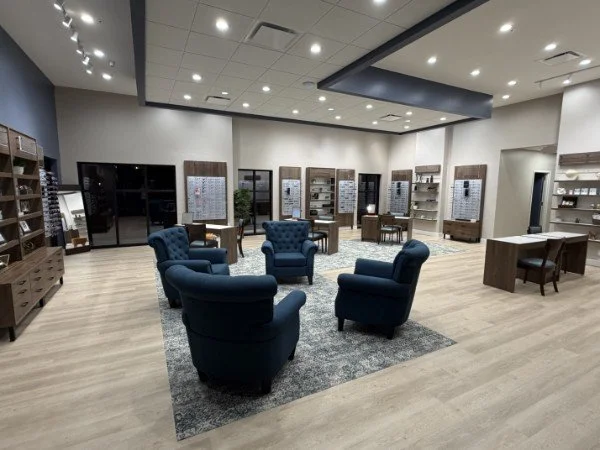
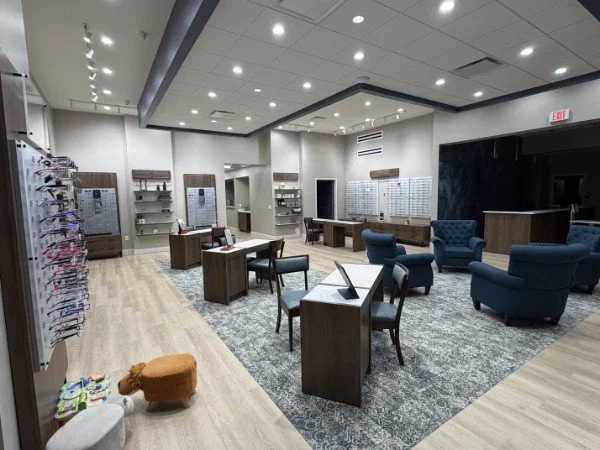
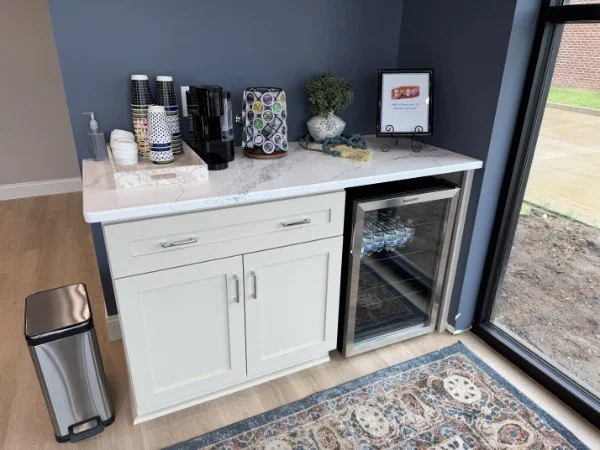
Clinical tenant improvements live or die on coordination: exam lanes built to sight-line and lighting-control requirements, a pre-testing suite, an optical dispensary with fitting stations, and a minor procedure room, all finished to a retail-grade patient experience with custom millwork throughout.
From MOB shell to clinic: most medical office building budgets carry a separate tenant improvement for each practice, and that is where clinical requirements like exam rooms, plumbing, and specialty lighting show up. This project is a typical example of that second phase. See TCG’s medical office construction and tenant improvement services.
- Delivery: design-build tenant improvement
- Clinical: exam lanes, pre-testing suite, minor procedure room
- Retail: optical dispensary and patient lounge
- Finish: custom millwork and casework throughout
See all recent work on the TCG projects page.
Common Questions
Single-specialty (2,500–6,000 SF): $1.25M–$2.85M. Multi-specialty clinic: $4.6M–$6.5M. Multi-tenant MOB at 30K SF: $15M–$22M+. Urgent care: $3.2M–$4.5M. ASC (2-OR): $4.8M–$7.5M. All figures exclude land and medical equipment. Use TCG's AI estimator for project-specific pricing.
Single-specialty: $350–$475/SF. Multi-specialty: $400–$550/SF. Multi-tenant MOB: $425–$600/SF. Urgent care: $450–$625/SF. Freestanding ED: $550–$750/SF. ASC: $500–$800+/SF. JLL benchmarks all-in MOB fit-out at $412/SF with hard costs at $226/SF.
50–60% premium from complex MEP (medical gas, surgical HVAC, emergency power), heavier structural loads for imaging, 30–60% higher parking ratios, healthcare-grade finishes, and regulatory compliance including state health department inspections and HIPAA acoustics.
Acuity level and MEP density. JLL estimates moderate-acuity costs 10% more than baseline; high-acuity adds 20% more. MEP represents 28–32% of total budget. An MRI suite alone adds $800K–$1.5M. Site conditions and utility capacity create the widest per-project variance.
2-OR ASC (8,000 SF): $4.8M–$7.5M. 4-OR multi-specialty (15,000 SF): $10M–$15M+. Building: $500–$800+/SF. Equipment: $450K–$1M for 2 ORs. Requires laminar airflow, medical gas, sterile processing, and life-safety backup power.
Southeast/TX (lowest): MOB 30K SF $12.5M–$18M. Midwest: $14M–$20M. Mountain West: $16M–$23M. Northeast: $19M–$28M+. West Coast (highest): $22M–$33M+. Union labor, CON requirements, and OSHPD/HCAI review drive the premium in high-cost markets.
(1) Underestimating MEP — causes 25–40% overruns. (2) Locking shell-and-core design before tenant mix — triggers the most expensive change orders. (3) Ignoring 12–24 week equipment lead times. (4) Not accounting for state health department review and licensing timelines that add 30–90 days.
PEMB saves 15–25% on structural costs for single-specialty clinics, urgent care, and lower-acuity offices in suburban/semi-rural markets. Not suitable for multi-tenant MOBs requiring institutional-quality facades. IMP systems can provide the thermal and aesthetic performance healthcare requires.
TCG's AI construction estimator provides preliminary MOB cost estimates. For formal preconstruction including MEP coordination and healthcare infrastructure, schedule a 30-minute call.
Full Cost Guides
Data & References
© 2026 Terrapin Construction Group
Albany · Atlanta · Austin · Birmingham · Boston · Charlotte · Chicago · Columbus · Dallas · Denver · Houston · Jacksonville · Los Angeles · Louisville · Miami · Minneapolis · Nashville · New York · Oklahoma City · Orlando · Philadelphia · Phoenix · Raleigh · Richmond · Salt Lake City · San Antonio · San Francisco · Seattle · Sheridan · Tampa · Virginia Beach · Washington DC
AI Estimator · IMP Estimator · Roofing Estimator · Schedule a Call
