

Minneapolis Medical Office, ASC & Healthcare Construction
Design-build medical construction across Minneapolis and the Twin Cities: MOBs, ambulatory surgery centers, urgent care, imaging suites with shielded vaults, and medical tenant improvements. M Health Fairview, Allina, HealthPartners, and Hennepin Healthcare adjacency, Medical Alley device-industry coordination, and cold-climate envelope detailing engineered for Minnesota winters.
Minneapolis Medical Construction Cost Estimator
Describe your medical office, surgery center, imaging suite, or clinic project and get a preliminary cost estimate powered by TCG.ai, calibrated to Minneapolis and Twin Cities healthcare pricing.
Tell Us About Your Project
Include facility type, square footage, location in the Twin Cities metro, clinical systems (med gas, imaging, OR), shell vs TI, and timeline. Our AI applies Twin Cities healthcare indices and cold-climate envelope factors automatically.
Analyzing Your Minneapolis Project
Our AI is evaluating construction costs using Minneapolis market data…
Your Minneapolis Construction Estimate
How TCG Builds Medical in the Twin Cities
The Twin Cities is one of the strongest healthcare and medical-device markets in the country. M Health Fairview (a partnership of the University of Minnesota and Fairview Health Services), Allina Health (Abbott Northwestern, United Hospital), HealthPartners (Regions Hospital, Methodist Hospital), Hennepin Healthcare (HCMC, a Level 1 trauma center), Children's Minnesota, and North Memorial Health anchor care across Minneapolis, St. Paul, and the suburban ring. Mayo Clinic Health System adds regional reach, and Mayo Clinic's flagship Rochester campus sits about 85 miles south. The metro is also the heart of Medical Alley, one of the densest medical-technology clusters in the world, home to Medtronic, Boston Scientific, and Abbott (formerly St. Jude Medical), which drives sustained demand for MOBs, ambulatory surgery centers, imaging, labs, and device-adjacent construction across the southwest (Edina, Bloomington, Eden Prairie, Minnetonka) and northwest (Maple Grove, Plymouth) corridors.
Minnesota's medical regulatory framework is different from Certificate of Need states. Minnesota does not operate a broad CON program, so most medical office buildings, ambulatory surgery centers, urgent care clinics, imaging suites, and outpatient projects move forward without CON review. The key state-level constraint is the hospital construction moratorium under Minnesota Statutes 144.551, which requires a specific legislative exception to build a new hospital or add licensed hospital beds. Outpatient and physician-owned facilities are generally outside the moratorium. Ambulatory surgery centers and hospitals are licensed by the Minnesota Department of Health. We coordinate MDH licensing, and for hospital bed projects the moratorium-exception process, in parallel with Minneapolis, St. Paul, or suburban plan review so approvals do not stall the build.
Twin Cities medical construction is shaped by cold-climate engineering. The metro sits in climate zone 6a with subzero design temperatures and ground snow loads around 50 psf. Healthcare envelopes here need continuous exterior insulation, careful warm-side vapor control to prevent condensation in humidified clinical zones, frost-protected foundations (frost depth commonly 4 to 5 feet), insulated entry vestibules and often snowmelt at patient entrances, and roofs detailed for ice damming and snow drift. Minnesota also enforces one of the most rigorous commercial energy codes in the country. We engineer architecture, MEP, and structural in-house and coordinate imaging vendor shielding from schematic design. Design-build compresses program 15 to 30 percent against design-bid-build.
Minneapolis Medical Construction Cost Per Square Foot
Minneapolis medical construction runs $215 to $670 per SF depending on use. Multiplier roughly 1.05 to 1.20x of national, driven by Minnesota union trade labor, a rigorous state commercial energy code, and cold-climate envelope requirements. Use the estimator above for a project-specific range and the national MOB cost guide for context.
Minneapolis Medical & Healthcare Resources, Cost Guides & News
Cost guides, sibling Minneapolis sectors, core services, and healthcare construction news to plan your project.
Advantage Eye Care, Owensboro, KY
TCG delivered a 5,500 SF design-build tenant improvement for a full optometry practice in Owensboro, Kentucky, taking the space from shell to patient-ready under one contract, with architectural design, MEP coordination, and construction handled by one team.
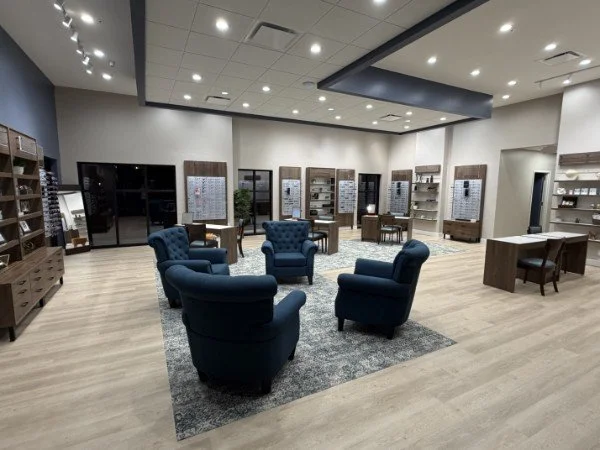
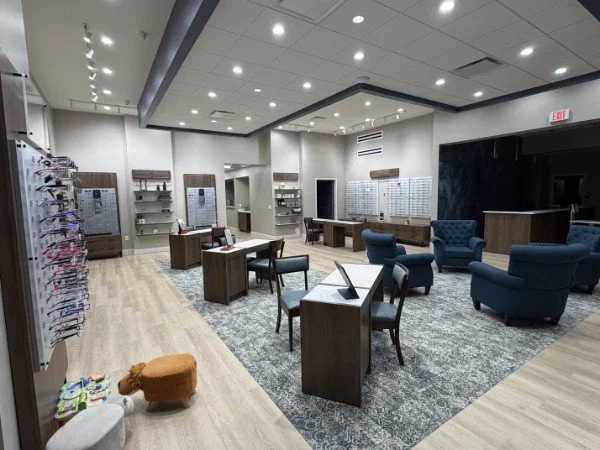
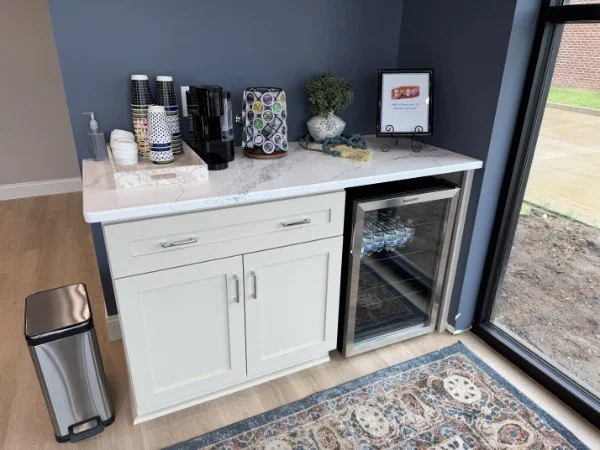
Clinical tenant improvements live or die on coordination: exam lanes built to sight-line and lighting-control requirements, a pre-testing suite, an optical dispensary with fitting stations, and a minor procedure room, all finished to a retail-grade patient experience with custom millwork throughout.
TCG brings the same single-source design-build team to medical office, clinic, and healthcare tenant improvement projects in Minneapolis.
- Delivery: design-build tenant improvement
- Clinical: exam lanes, pre-testing suite, minor procedure room
- Retail: optical dispensary and patient lounge
- Finish: custom millwork and casework throughout
See all recent work on the TCG projects page.
Minneapolis Medical Construction FAQ
Common questions about medical construction in Minneapolis and the Twin Cities. See the full TCG FAQ for more.
TCG recently completed Advantage Eye Care in Owensboro, Kentucky, a 5,500 SF design-build tenant improvement for a full optometry practice with exam lanes, a pre-testing suite, an optical dispensary, a minor procedure room, and custom millwork, delivered from shell to patient-ready under one contract. TCG brings the same design-build team to medical and healthcare projects in Minneapolis.
Minneapolis metro medical construction runs $215 to $670 per SF depending on use. MOB $215 to $470, urgent care $270 to $470, imaging suites with shielding $340 to $530, ASC $390 to $670, medical TI $195 to $520. The Twin Cities multiplier is roughly 1.05 to 1.20x of national, driven by union labor and a strict energy code. Use the cost estimator above and the national MOB cost guide.
The Minneapolis and St. Paul metro is a national healthcare and medical-device hub. M Health Fairview, Allina Health, HealthPartners, Hennepin Healthcare, Children's Minnesota, and North Memorial anchor care delivery, while Mayo Clinic Health System and Mayo's Rochester campus add regional weight. The metro is the center of Medical Alley, home to Medtronic, Boston Scientific, and Abbott, which sustains demand for medical office buildings, surgery centers, imaging, and device-adjacent labs and facilities.
No. Minnesota does not operate a broad Certificate of Need program, so most medical office buildings, ambulatory surgery centers, urgent care, imaging suites, and outpatient projects proceed without CON review. The main state constraint is the hospital construction moratorium under Minnesota Statutes 144.551, which requires a legislative exception to build a new hospital or add licensed hospital beds. Outpatient and physician-owned facilities are generally outside the moratorium.
Medical office buildings, ambulatory surgery centers (ASCs), urgent care clinics, freestanding emergency departments, imaging suites with shielded vaults (MRI, CT, X-ray), dental offices, optometry offices, veterinary clinics, dialysis centers, and medical tenant improvements. See the core healthcare sector page.
Medical Alley is one of the world's densest medical-technology clusters, anchored by Medtronic, Boston Scientific, and Abbott along with hundreds of device and digital-health firms. That ecosystem drives demand for R&D labs, cleanrooms, light manufacturing, and device-adjacent office and clinical space. TCG builds across the life sciences and biotech sector and delivers cleanroom and GMP environments for device and pharma work.
MRI suites need RF-shielded vaults, vibration isolation, magnet quench piping, and temperature-stable HVAC. CT and X-ray rooms need lead-shielded walls, doors, and view windows. We coordinate equipment vendor (Siemens, GE, Philips, Canon) shielding rough-in from schematic design. Minnesota does not require a CON for imaging, so the schedule driver is vendor lead time and plan review rather than state approval.
The Twin Cities sit in climate zone 6a with subzero design temperatures and ground snow loads near 50 psf. Medical envelopes need continuous exterior insulation, warm-side vapor control to prevent condensation in humidified clinical zones, frost-protected foundations commonly 4 to 5 feet deep, insulated vestibules and often snowmelt at patient entrances, and roofs detailed for ice damming and snow drift. Winter humidification for patient comfort makes envelope condensation control critical. Minnesota also enforces a very rigorous commercial energy code.
Ground-up MOB or ASC: 4 to 8 months from intake to permit through Minneapolis (CPED), St. Paul (DSI), or the suburban authority (Bloomington, Edina, Plymouth, Maple Grove, Eden Prairie). Minnesota Department of Health licensing for ASCs runs in parallel. Medical TI typically permits in 2 to 5 months. There is no CON delay, but a new hospital or added beds requires a legislative moratorium exception. Design-build overlaps permitting with construction prep.
Minnesota is not a right-to-work state, and the Twin Cities building trades are well organized, so labor costs run higher than in much of the Southeast. The trade-off is strong productivity, safety, and quality on complex healthcare work. The overall multiplier is roughly 1.05 to 1.20x of national. Specialty medical scopes such as shielding, medical gas, and clinical low-voltage follow national specialty pricing.
MOB ground-up: 10 to 16 months from groundbreak. ASC ground-up: 12 to 18 months with Minnesota DoH licensing concurrent. Urgent care: 9 to 14 months. Medical TI: 3 to 7 months. Imaging suite TI with a shielded vault: 4 to 8 months. Add 3 to 8 months of preconstruction and permitting. Winter weather can affect site and foundation scheduling, which we plan around with frost protection and enclosure sequencing.
Minneapolis and St. Paul plus Bloomington, Edina, Eden Prairie, Minnetonka, Plymouth, Maple Grove, Woodbury, Eagan, Burnsville, Lakeville, and Maplewood, and the broader Hennepin, Ramsey, Dakota, Anoka, and Washington County footprint. Greater Minnesota: Rochester, Duluth, St. Cloud, and Mankato. TCG also builds medical across all 50 states.
Build Your Minneapolis Project with TCG
From medical office buildings to ambulatory surgery centers and imaging suites, TCG delivers design-build healthcare construction across Minneapolis and the Twin Cities. Get a preliminary estimate and a plan to manage MDH licensing and cold-climate detailing.
Schedule a Minneapolis ConsultationTCG Service Area Nationwide
Terrapin Construction Group is a design-build commercial general contractor licensed in all 50 states. Beyond Minneapolis and the Twin Cities, TCG builds in these metros and everywhere in between.