
IMP Installation for Cold Storage and Controlled-Environment Facilities: What Developers and Owners Need to Know in 2026
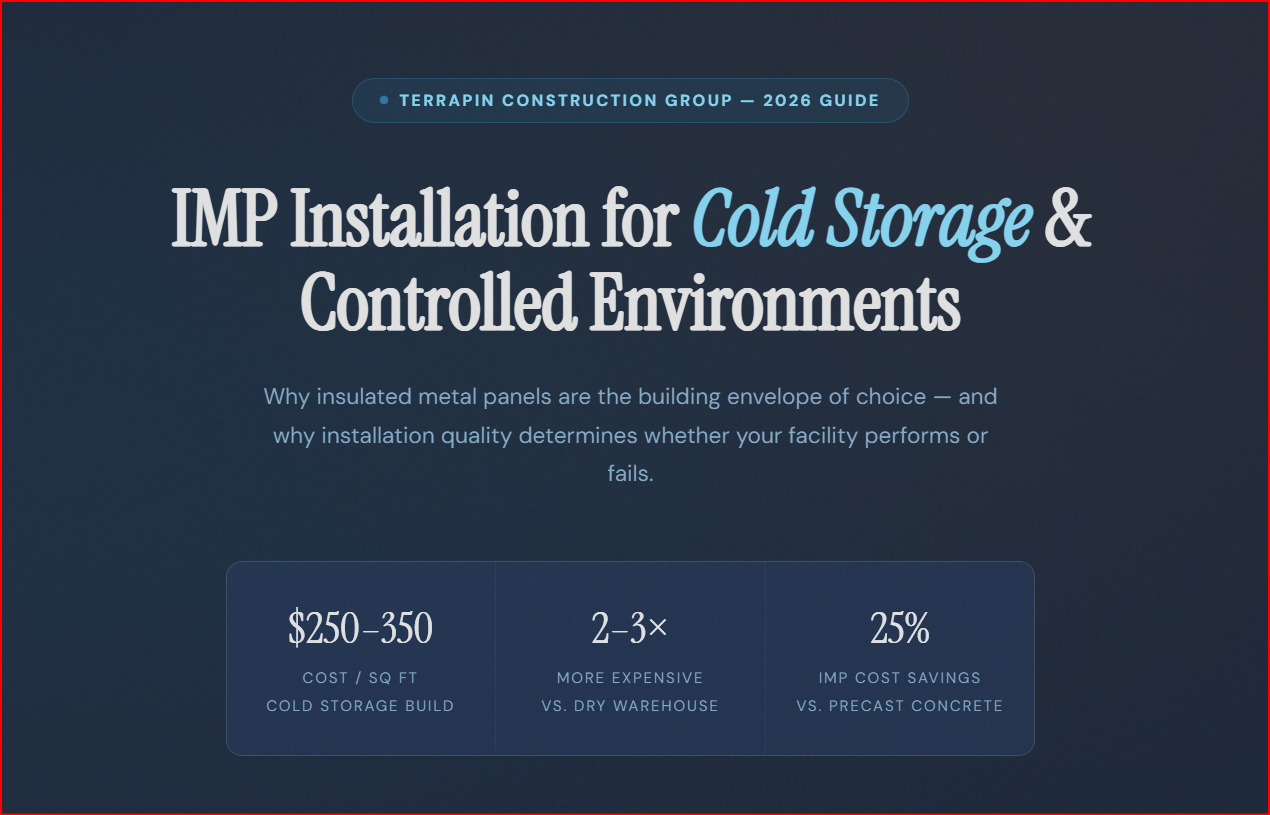
Cold storage is one of the fastest-growing segments in commercial real estate. The global cold storage market is projected to grow from approximately $38.65 billion in 2025 to $58.45 billion by 2030, driven by e-commerce grocery expansion, pharmaceutical cold chain requirements, and the ongoing modernization of aging infrastructure that averages 40-plus years old across the U.S. inventory. JLL's latest market analysis confirms that build-to-suit cold storage development is picking up heading into 2026, with new facilities costing $250 to $350 per square foot — roughly two to three times the cost of a standard dry warehouse.
At the center of every cold storage and controlled-environment build is the building envelope. And increasingly, the building envelope means insulated metal panels.
IMPs have become the dominant wall and roof system for cold storage, food processing, pharmaceutical storage, and other controlled-environment facilities because they consolidate four critical performance layers — air barrier, water barrier, vapor barrier, and thermal insulation — into a single factory-manufactured component. But specifying the right panel is only half the equation. Installation quality is what separates a facility that performs at design intent for decades from one that develops ice infiltration, condensation failures, and six-figure remediation costs within the first few years of operation.
At Terrapin Construction Group, we provide IMP installation services for cold storage, food processing, and controlled-environment projects across all 50 states, working with every major panel manufacturer. This article covers what developers, facility owners, and operators need to understand about IMP specification, installation, and cost — and why the quality of your installation crew matters more in cold storage than in any other building type.
Why IMPs Are the Default Envelope System for Cold Storage Construction
Before IMPs became the industry standard, cold storage builders worked through a progression of envelope materials that included horsehair, foam glass dipped in hot tar, cork, wood construction, beadboard EPS with redwood splines, and XPS panels with redwood support splines. Each generation solved some problems and introduced others. Modern insulated metal panels — first with polyurethane (PUR) cores, then evolving to polyisocyanurate (PIR) cores — represent the current state of the art because they address the full range of thermal, structural, and installation challenges that cold storage facilities present.
According to NAIOP's analysis of IMP performance in cold storage, panels with PIR cores can achieve R-values as high as 72 in cold storage applications, depending on thickness. That thermal performance, paired with high-performance coatings on interior and exterior surfaces, creates an all-in-one envelope system that dramatically simplifies construction sequencing. A construction and asset management study by Currie & Brown found that installed costs of IMP wall systems can be 25% lower in the U.S. compared to precast insulated concrete walls or standard tilt-up concrete walls for equivalent thermal performance.
The installation speed advantage is equally significant. Traditional multi-component envelope systems require structural backup, insulation, air and vapor barriers, and cladding — often installed by different crews in sequence, with weather dependencies at every stage. Building Enclosure's 2026 analysis of IMP trends notes that because panels are prefabricated and arrive on-site ready for installation, they reduce the number of trades required and compress installation timelines — allowing interior trades to begin work sooner and accelerating overall project schedules. For developers operating on compressed financing schedules, the time savings translate directly into reduced carrying costs.
This is precisely why Terrapin's IMP installation division exists as a dedicated service line. The panel itself is a commodity available from multiple manufacturers. The installation is where the performance is either locked in or compromised — and cold storage tolerates zero compromise on envelope integrity.
Cold Storage IMP Specifications: What Makes This Different from Standard Commercial Installation
Installing IMPs on a standard commercial or industrial building — a retail shell, a warehouse, an office exterior — is a fundamentally different scope than installing IMPs on a cold storage or controlled-environment facility. The physics are different. The tolerances are tighter. And the consequences of poor execution are more severe and more expensive to remediate.
Metal Construction News details the specific technical competencies that cold storage IMP installation demands beyond standard commercial work. These include an understanding of lifting and handling requirements for panels that are typically thicker and heavier than standard applications, differential expansion and contraction dynamics between IMPs and structural framing, heat flow dynamics and the requirements for minimizing thermal conductance through wall and roof assemblies, and vapor flow dynamics that govern moisture management in sub-zero environments.
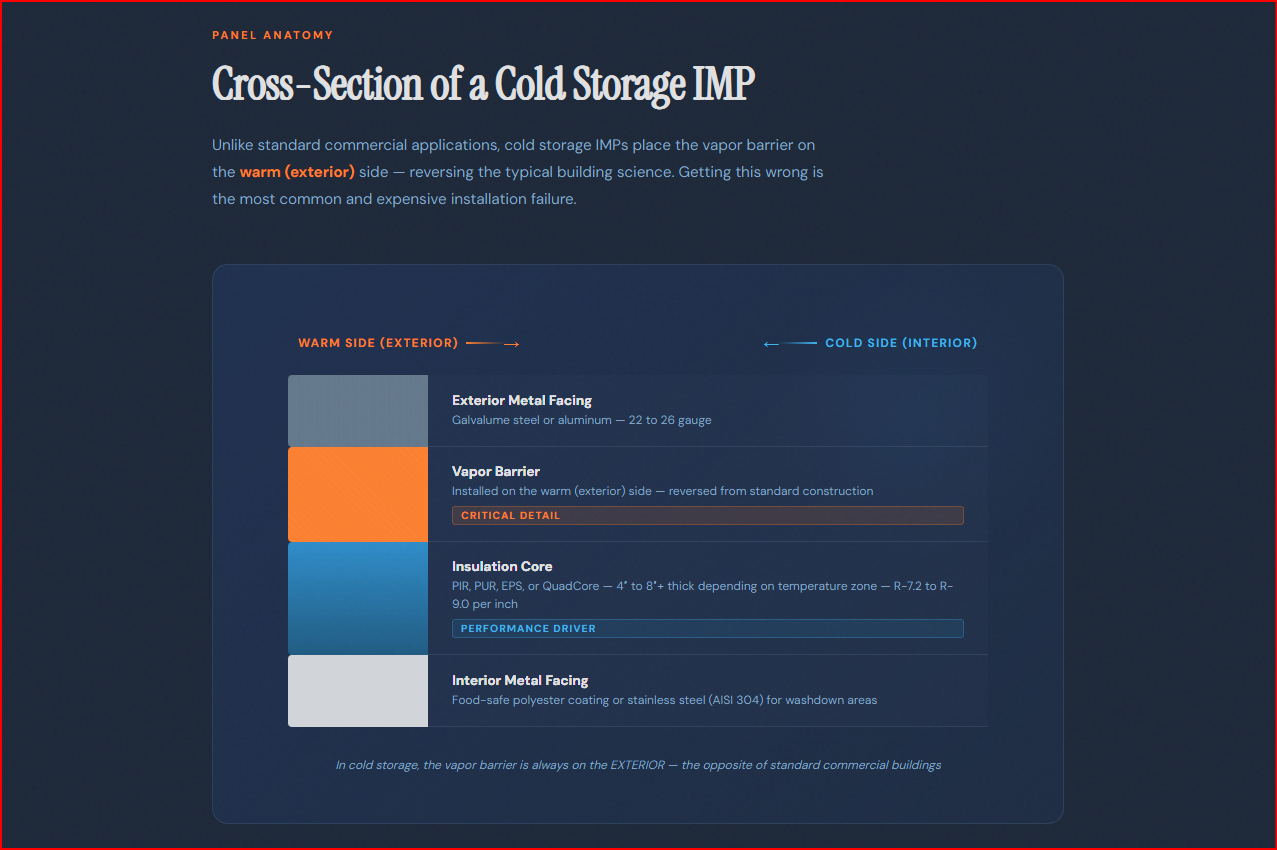
The critical difference is the vapor barrier. In a standard commercial building, the vapor barrier sits on the interior side of the envelope to prevent conditioned interior air from reaching the cold exterior surface. In a cold storage facility, the physics reverse: the warm side is the exterior, and the vapor barrier must be installed on the outside of the thermal envelope. This reversal is not intuitive, and installation crews without cold storage experience frequently get it wrong — with devastating consequences.
As Kingspan's cold storage engineering team emphasizes, when proper vapor sealing and thermal break installation are combined with correct detailing, they prevent heat transference through the metal exterior-to-interior skin. When they are not combined correctly, the result is condensation within the panel assembly, ice formation at joints and transitions, and progressive degradation of the panel's insulating value.
Panel Thickness, R-Value, and Temperature Zone Selection
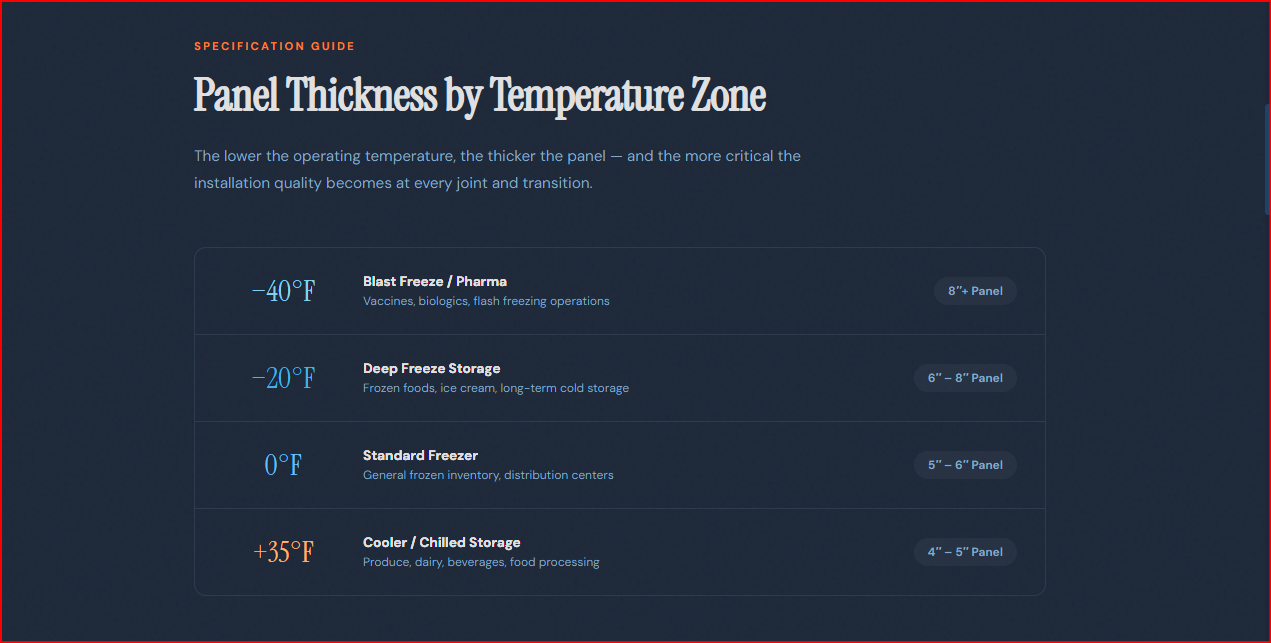
Cold storage facilities are not one-size-fits-all. A facility operating at 35°F for chilled produce storage has fundamentally different envelope requirements than a blast freezer operating at -20°F or a pharmaceutical cold room maintaining -40°F. The panel thickness and core material must be matched to the operating temperature of each zone within the facility.
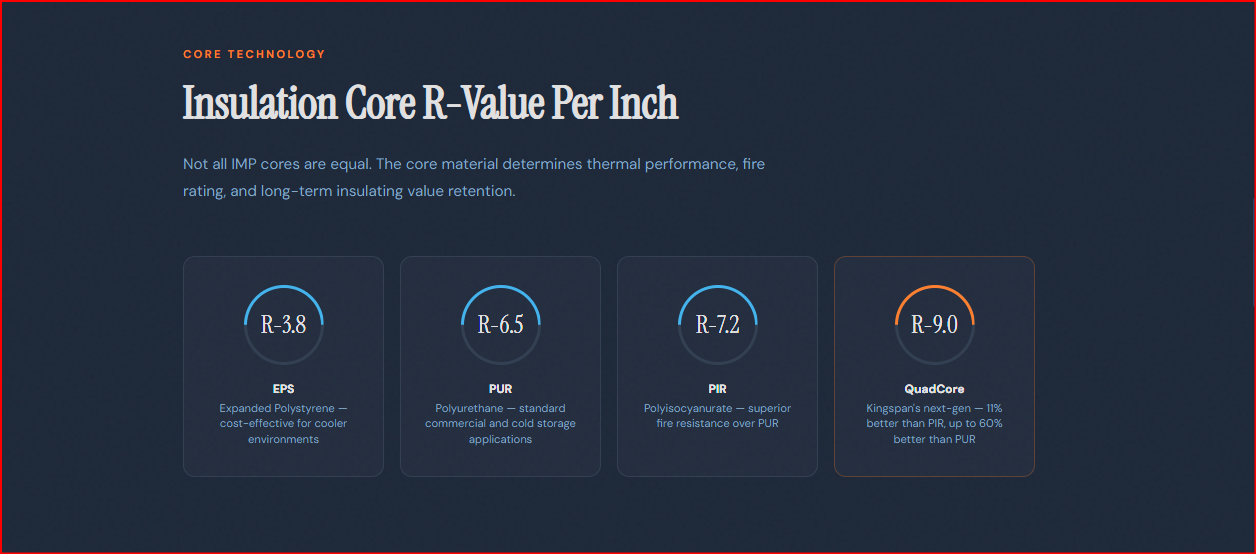
Modern cold storage IMPs from manufacturers like Metl-Span, Kingspan, CENTRIA, FALK, and MBCI/AWIP typically deliver PIR cores with R-values of 7.2 to 8.0 per inch, with Kingspan's QuadCore technology achieving R-9.0 per inch for cold storage applications. Panel thicknesses for cold storage generally range from 4 inches for cooler environments down to 8 inches or more for deep-freeze applications. A major distribution center project for UNFI, for example, used 8-inch, 6-inch, and 4-inch thick Metl-Span CF Mesa panels across different temperature zones within the same facility, requiring more than 800,000 square feet of panel installation.
The panel selection decision should be made during preconstruction, not during construction. Panel lead times, thickness requirements for each temperature zone, and the coordination between structural framing and panel dimensions all need to be resolved before the first footer is poured. This is a standard part of Terrapin's design-build process for cold storage and controlled-environment projects — matching panel specification to operational requirements and resolving constructability issues before they become field problems.
The Five Installation Details That Determine Long-Term Facility Performance
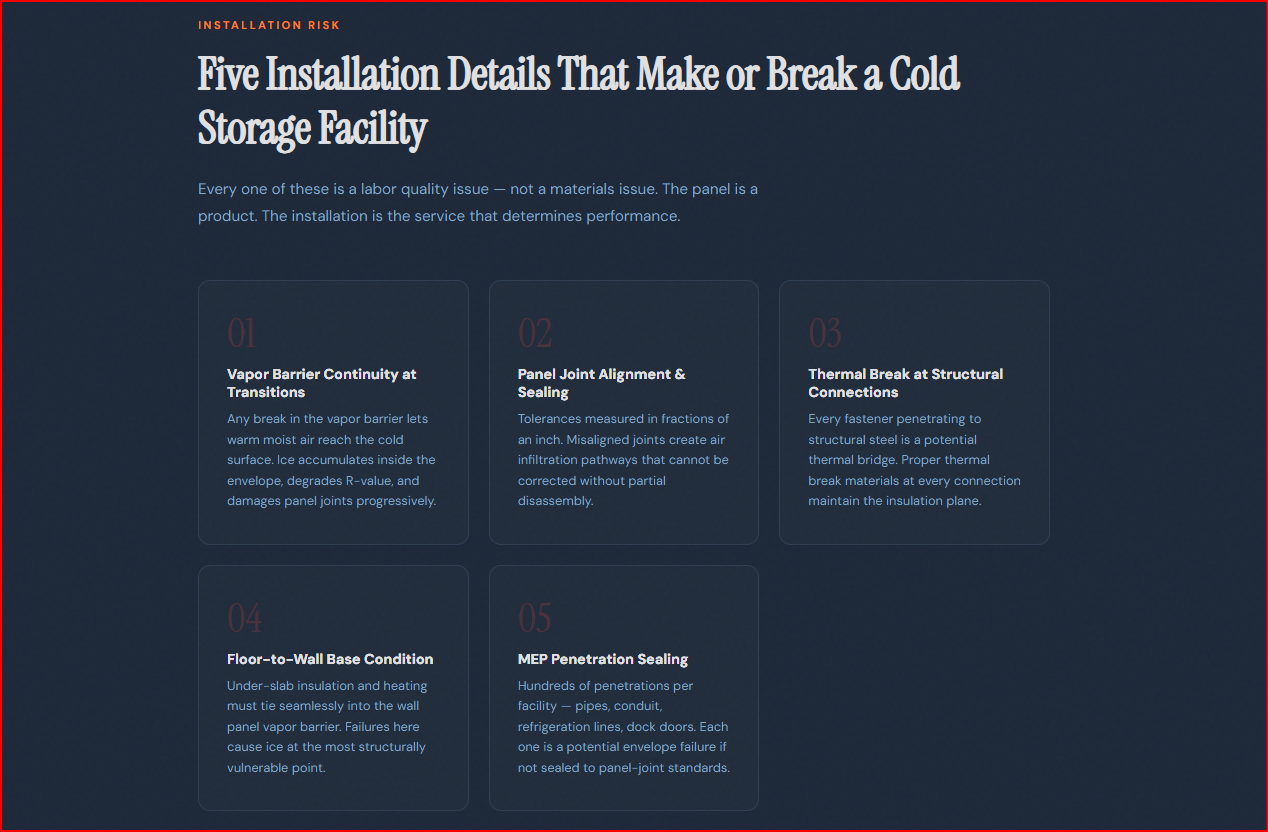
The difference between a cold storage envelope that performs at design intent and one that fails within five years almost always traces back to five installation details. Every one of them is a labor quality issue, not a materials issue.
Vapor barrier continuity at transitions is the single most critical detail. The vapor barrier must be continuous across every wall-to-wall joint, every wall-to-roof connection, every penetration, and every transition between temperature zones. Any discontinuity allows warm, moisture-laden exterior air to reach the cold interior surface, where it condenses and freezes. Over time, ice accumulation within the envelope compromises insulating value, damages panel joints, and can create structural loading that the system was not designed to carry. A 2026 industry analysis by roofing expert Thomas Hutchinson noted that he has never opened up a cold storage building roof in which the insulation was not full of ice — underscoring how pervasive this installation failure mode remains across the industry.
Panel joint alignment and sealing determines whether the envelope maintains its thermal and air-barrier integrity over the life of the facility. Uneven panel heights, misaligned joints, and improperly applied sealant create pathways for air infiltration that cannot be corrected after the fact without partial disassembly. The tolerances on cold storage panel joints are measured in fractions of an inch — significantly tighter than standard commercial wall panel installation.
Thermal break installation at structural connections prevents heat transfer through the metal structural members that support the panel system. Every point where a panel fastener penetrates through to structural steel is a potential thermal bridge. Proper thermal break materials and installation techniques at these connections are essential to maintaining the continuous insulation plane that the panel system is designed to provide.
Floor-to-wall base condition detailing is critical in freezer applications where the floor insulation and under-slab heating system must tie seamlessly into the wall panel vapor barrier at the base of the wall. If the vapor barrier below the floor insulation does not connect properly to the exterior of the IMP wall at the base condition, moisture infiltration at this junction will produce ice accumulation at the most structurally vulnerable point in the assembly.
Penetration sealing for mechanical, electrical, and plumbing systems creates the highest density of potential failure points in any cold storage envelope. Every pipe penetration, conduit entry, refrigeration line pass-through, and dock door frame represents an interruption in the continuous envelope that must be sealed to the same standard as the panel joints themselves. On a large cold storage facility, there may be hundreds of penetrations — each one a potential point of envelope failure if not properly detailed and sealed.
This is why Terrapin's construction teams treat IMP installation on cold storage projects as a specialty scope that requires dedicated crews with cold storage experience, not general commercial panel installers who happen to be available. The panel manufacturers — Kingspan, Metl-Span, CENTRIA, PermaTherm, FALK, UPI, AWIP, MBCI, and others — all produce excellent products. The product is not usually the problem. The installation is.
Cold Storage Construction Costs and Where IMPs Fit in the Budget
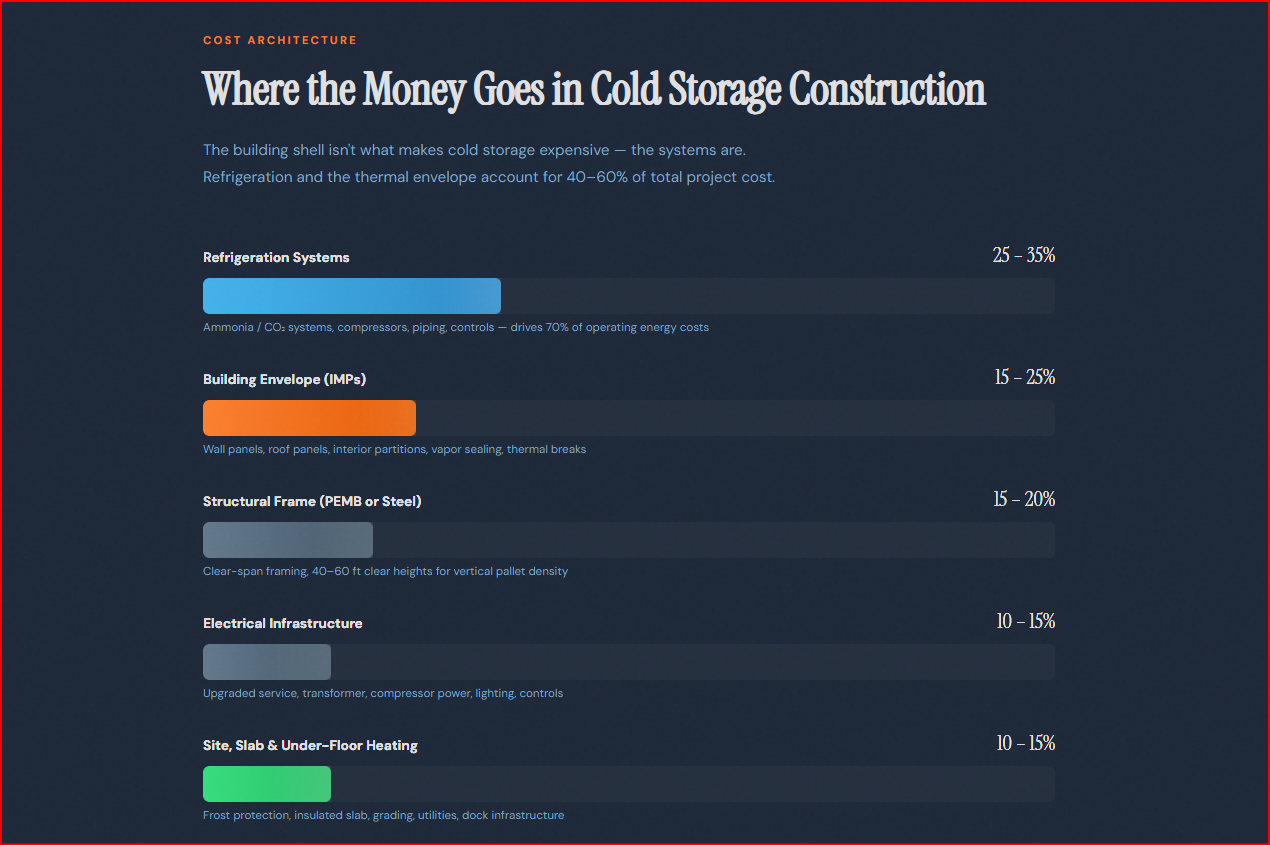
Understanding where IMP costs sit within the broader cold storage construction budget helps developers and owners evaluate the true cost impact of envelope decisions.
Cold storage construction costs in 2026 generally range from $130 to $350 per square foot for hard construction costs, depending on facility size, temperature requirements, automation level, and geographic market. That is roughly two to three times the cost of standard dry warehouse construction, which typically runs $78 to $100 per square foot. The premium is driven almost entirely by three systems: the building envelope (insulation and vapor management), the refrigeration system, and the upgraded electrical infrastructure to support compressor loads.
According to the International Institute of Ammonia Refrigeration (IIAR), refrigeration systems typically account for 25 to 35% of total cold storage construction costs, with refrigeration also driving up to 70% of a facility's ongoing energy consumption. The building envelope — primarily IMPs for walls and roof — represents a significant but smaller share of total hard costs, typically in the range of 15 to 25% of the total project budget depending on facility size and panel thickness requirements.
The critical insight for developers is that the envelope and the refrigeration system are interdependent. A poorly installed envelope forces the refrigeration system to work harder to maintain target temperatures, increasing energy consumption and compressor wear. A well-installed envelope with properly detailed vapor barriers and thermal breaks reduces refrigeration load, lowers operating costs, and extends equipment life. The NAIOP analysis notes that the typical refrigerated warehouse consumes 24.9 kilowatt-hours of electricity per square foot annually — and the quality of the thermal envelope directly determines how much of that energy consumption is productive versus wasted.
This is why value engineering the IMP installation — cutting corners on crew quality, joint sealing, or vapor barrier detailing to save money on the front end — is one of the most expensive mistakes a cold storage developer can make. The remediation cost for a failed cold storage envelope routinely exceeds the original installation cost, because the work requires partial disassembly of finished systems, and the facility often cannot operate at design temperatures during the repair.
Planning a cold storage or controlled-environment project?
Terrapin Construction Group provides IMP installation, construction management, and design-build delivery for cold storage and food processing facilities nationwide. Get a current-market cost estimate for your project with our IMP Install Estimator or TCG.ai instant estimator.
Schedule a 30-minute conversation →
Controlled-Environment Applications Beyond Cold Storage
While cold storage drives the largest volume of IMP installation in controlled-environment construction, the same panel systems and installation principles apply to several other high-growth facility types that require precise temperature, humidity, or atmospheric control.
Food processing and manufacturing facilities are the second-largest controlled-environment application for IMPs. Facilities processing meat, poultry, dairy, produce, and prepared foods must comply with FDA Food Safety Modernization Act (FSMA) requirements and, for meat and poultry operations, USDA FSIS inspection standards. These regulations mandate facility designs that minimize contamination risk, support one-directional product flow, and allow for thorough washdown sanitation. IMP interior surfaces with food-safe polyester coatings — such as Kingspan's CLEANsafe system, which carries USDA, FDA, and CFIA approval for secondary food contact areas — provide the hygienic, washdown-ready wall and ceiling surfaces these facilities require.
Pharmaceutical cold storage and clean rooms require even tighter environmental controls than food facilities. Vaccines, biologics, and temperature-sensitive medications must be stored within precise temperature ranges mandated by the World Health Organization and the FDA. IMP systems with advanced vapor barriers and minimal air leakage support the strict thermal stability these facilities demand, while also meeting Good Manufacturing Practice (GMP) and Good Distribution Practice (GDP) compliance requirements.
Cannabis cultivation facilities represent a growing controlled-environment application for IMPs, particularly in states with active cultivation programs. As we've covered in our analysis of cannabis cultivation facility value engineering and emerging cannabis markets in Minnesota and Kentucky, cultivation facilities require precise temperature, humidity, and light control across multiple grow zones — requirements that IMP envelope systems are well-suited to address.
Data centers require tightly controlled temperature and humidity environments to protect server infrastructure. While data center envelope requirements differ from cold storage in some respects (the objective is cooling, not freezing), the demand for high-performance insulation, minimal air infiltration, and rapid construction timelines makes IMPs an increasingly common specification for data center wall and roof systems.
Across all these applications, the same fundamental principle applies: the panel is a manufactured product with consistent quality; the installation is a field operation where quality is determined by crew experience, supervision, and adherence to manufacturer specifications. Terrapin's IMP installation teams work across all of these controlled-environment applications with the same focus on envelope integrity that cold storage demands.
Pre-Engineered Metal Buildings and IMP Integration for Cold Storage
A significant percentage of new cold storage facilities in suburban, semi-rural, and industrial park settings are built on pre-engineered metal building (PEMB) structural systems. The combination of a PEMB structural frame with IMP wall and roof cladding is one of the most cost-effective and schedule-efficient approaches to cold storage construction, particularly for facilities in the 20,000 to 200,000 square foot range.
The PEMB provides the clear-span structural frame — often with clear heights of 40 to 60 feet or more to maximize vertical pallet density — while the IMP system provides the thermal envelope. This separation of structural and envelope functions allows each system to be optimized independently. The structural frame is designed for load-bearing performance; the IMP envelope is designed for thermal, vapor, and air-barrier performance.
The integration detail between PEMB framing and IMP cladding is where many cold storage projects encounter problems. Structural steel expands and contracts at different rates than the IMP panel system, particularly at the temperature differentials common in freezer applications where exterior ambient temperatures may be 100°F or more while interior temperatures are -20°F. The connection details between the panel system and the structural frame must accommodate this differential movement without compromising the vapor seal or creating thermal bridges.
This is a preconstruction coordination issue, not a field improvisation issue. The structural engineer, the IMP manufacturer's technical team, and the installation contractor need to resolve these interface details before panels arrive on site. Terrapin coordinates this three-way technical alignment as a standard part of the design-build process for PEMB cold storage projects.
How to Evaluate an IMP Installation Contractor for Cold Storage Work
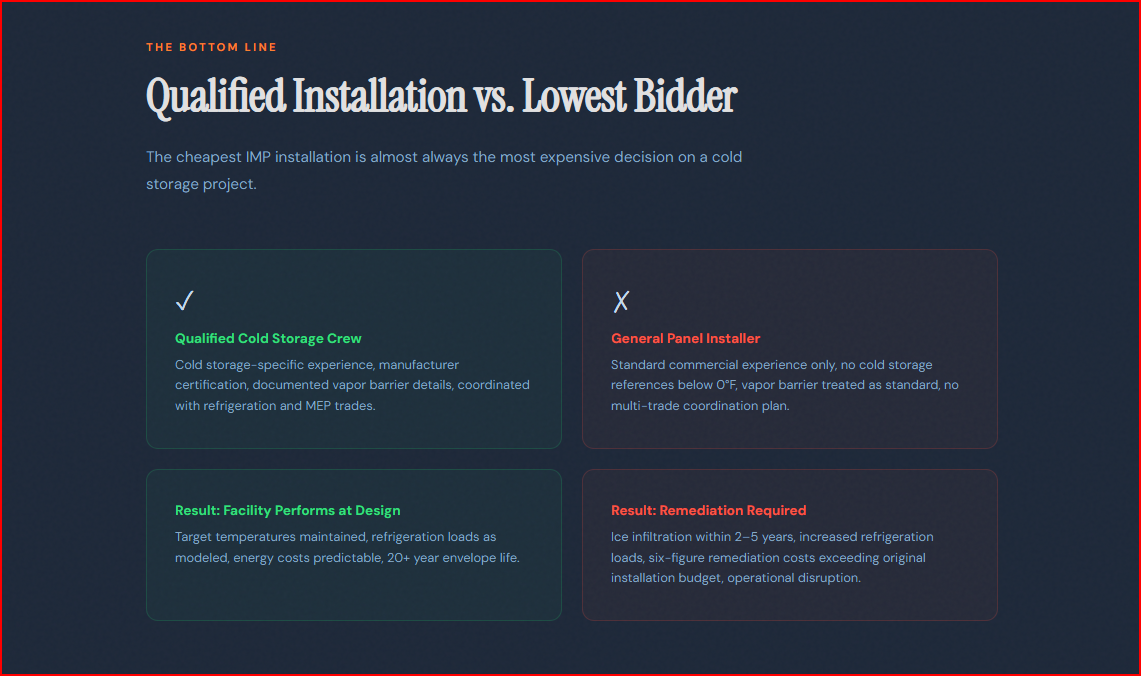
Not every IMP installer is qualified for cold storage work. Developers and owners evaluating installation contractors for cold storage and controlled-environment projects should assess several critical qualifications beyond standard commercial panel installation experience.
Cold storage-specific installation history is the most important qualification. Ask for project references on facilities operating at 0°F or below. Cold storage installation is not something a crew learns on your project — the consequences of the learning curve are too expensive. The contractor should be able to demonstrate completed projects across multiple temperature zone configurations, including multi-temperature facilities with transitions between chilled, frozen, and ambient zones within the same building.
Manufacturer certification and training is a meaningful differentiator. Major IMP manufacturers including Kingspan, Metl-Span, AWIP, and MBCI offer installer certification programs that cover cold storage-specific techniques. MBCI's IMP Certified Installer Course, for example, provides hands-on training in advanced installation techniques for insulated metal panel systems. Contractors who have invested in manufacturer certification demonstrate a commitment to installation quality that uncertified installers may not match.
Vapor barrier detailing capability should be evaluated through documentation, not just verbal assurance. Ask to see vapor barrier continuity details from previous cold storage projects — the wall-to-roof transitions, the base conditions, the penetration details. A qualified cold storage IMP installer will have these details documented and will be able to explain the vapor management strategy for your specific facility configuration.
The ability to coordinate with refrigeration and MEP contractors is essential. Cold storage IMP installation does not happen in isolation — it must be sequenced and coordinated with under-slab heating installation, refrigeration rough-in, electrical penetrations, and dock door framing. An installer who treats the panel scope as independent of these adjacent systems will create coordination conflicts that compromise envelope performance. The owner's representative function Terrapin provides on cold storage projects specifically addresses this multi-trade coordination challenge.
The Impact of 2026 Material Costs and Tariffs on Cold Storage IMP Projects

Material pricing for cold storage IMP projects in 2026 is influenced by the same tariff environment affecting all commercial construction. As we've detailed in our coverage of commercial construction delivery methods and 2026 industry challenges, steel and aluminum — both core components of insulated metal panels — are subject to Section 232 tariffs that add meaningful cost to the panel supply chain.
For cold storage projects, the tariff impact is amplified because the facilities require significantly more panel area per square foot of floor space than a standard commercial building. A cold storage facility uses IMPs on walls, roof, and often interior partition walls between temperature zones. A 100,000-square-foot cold storage warehouse may require 250,000 to 400,000 square feet of panel installation — a substantial materials commitment that is directly affected by steel pricing.
The geopolitical factors affecting construction material supply chains add further uncertainty to panel procurement timelines and pricing. Developers who lock in panel pricing and production slots early in the preconstruction process — rather than waiting until construction documents are complete — can meaningfully reduce their exposure to mid-project price increases. Terrapin's procurement division coordinates panel ordering with the major manufacturers as part of the preconstruction timeline, ensuring that production slots are secured and pricing is locked before construction begins.
IMP Manufacturer Selection for Cold Storage Applications
The major IMP manufacturers serving the U.S. cold storage market each bring different strengths to the table. As we've covered in detail in our IMP manufacturer comparison, Terrapin works with all of the major panel producers and can help owners evaluate the right manufacturer for their specific project requirements.
For cold storage specifically, the key differentiators between manufacturers include core material technology (PUR versus PIR versus next-generation formulations like Kingspan's QuadCore), available panel thicknesses for deep-freeze applications, joint profile designs that affect vapor seal integrity, food-safe interior coating options for food processing applications, fire rating capabilities (mineral wool core options from manufacturers like Metl-Span's ThermalSafe line provide non-combustible alternatives where fire code requires them), and production capacity and lead times for large-volume projects.
Panel lead times for cold storage projects in the current market typically run 8 to 16 weeks from order to delivery, depending on manufacturer, panel thickness, and volume. For large facilities requiring hundreds of thousands of square feet of panel, production scheduling and phased delivery coordination become project-critical logistics issues. This is another area where early preconstruction engagement with a GC who has established manufacturer relationships creates measurable value.
The Bottom Line for Developers and Facility Owners
Cold storage and controlled-environment construction is a high-stakes building type where the envelope is the most critical performance system in the facility. Insulated metal panels are the right technology for this application — the thermal performance, installation speed, and lifecycle cost advantages over multi-component assemblies are well-established and supported by industry data.
But the panel is a product. The installation is a service. And in cold storage, the service quality determines whether the product performs as designed or fails in ways that are expensive, disruptive, and sometimes impossible to fully remediate without partial demolition. Developers and owners who invest in qualified installation — crews with cold storage experience, proper manufacturer training, and documented vapor barrier detailing capability — protect their capital investment and their facility's long-term operating economics. Those who treat IMP installation as a commodity scope and award it to the lowest bidder frequently discover that the cheapest installation is the most expensive decision they made on the project.
Terrapin Construction Group provides IMP installation, commercial general contracting, construction management, design-build delivery, and owner's representation for cold storage, food processing, and controlled-environment facilities nationwide. Our offices in Denver, Houston, Albany, and Sheridan serve projects across all 50 states. If you're planning a cold storage or controlled-environment project and want a frank conversation about what it will cost to build and how to protect your envelope investment, we'd welcome a call.
Get started on your cold storage or controlled-environment project:
→ Get an IMP Installation Estimate
→ Try TCG.ai — Instant Construction Estimator
→ Schedule a 30-Minute Conversation with Our Team
Related Reading
Cold Storage Construction Costs in the USA (2026)
IMP Market Volume and Installation Trends (2026)
IMP Manufacturer Comparison: Nine Major Panel Producers
Average Cost to Build a QSR Restaurant in the USA
Average Cost to Build a QSR Coffee Shop in the USA
Average Cost to Build an Optometry Office in the USA
Hospital Construction Boom 2026
Commercial Construction Delivery Methods: Cost-Plus vs. GMP
High-End Restaurant Construction Cost Per Square Foot
Grocery-Anchored Strip Mall Construction Costs
AI Advancements in Commercial Construction
Commercial Real Estate Developer Pain Points
Commercial Construction Industry Challenges 2026
Cannabis Cultivation Facility Value Engineering
Cannabis Emerging Markets: Minnesota and Kentucky
Strait of Hormuz: Geopolitical Impact on Construction Costs
Urgent Care Construction Costs
3PL/Logistics Construction Costs
QSR Coffee Shop Cost Breakdown
Sources
NAIOP — The Benefits of Insulated Metal Panels for Cold Storage Facilities
NAIOP — The Cold Storage Market Is Heating Up
Building Enclosure — How IMPs Support Construction's Core Priorities for 2026
Commercial Property Executive — Why the Climate's Right for Cold Storage, January 2026
Metal Construction News — Installing IMPs for Cold Storage
Kingspan — The Evolution of IMPs in Cold Storage Facilities
Kingspan — What Is the R-Value of Insulated Metal Panels?
Metl-Span — Temperature Controlled & Cold Storage Insulated Metal Panels
Metl-Span — UNFI Distribution Center Cold Storage Case Study
MBCI — Insulated Metal Panel Systems
Industrial Refrigeration Pros — The True Cost of Cold Storage: Beyond the Bid Price (IIAR Data)
Food Logistics / JLL — Key Cold Storage Trends for 2025 and Beyond
Barrington Today — Insulated Metal Panels Pose Risks for Cold Storage Buildings, March 2026
Research and Markets — Cold Storage Market Report 2026
FDA — Food Safety Modernization Act (FSMA)
USDA — U.S. Department of Agriculture
World Health Organization — Pharmaceutical Cold Chain Standards
Building Design + Construction — Top Building Products, January 2026
