

Data Center IMP Envelope Construction Cost 2026: Tier III vs Tier IV
Data Center IMP Envelope Construction Cost 2026: Tier III vs Tier IV
The data center build cost article gets clicks. The IMP install guide gets clicks. Nobody writes what these two things cost together. Here it is, from TCG's IMP install work translated into the data center envelope scope hyperscale developers actually price against.
What does an IMP envelope cost for a data center in 2026?
Tier III data center IMP envelopes run $32-$48 per SF installed. Tier IV runs $42-$58 per SF installed. Both figures include FM 4880 Class 1 panels (typically 4-5 inch, mineral wool or PIR core), install labor, and standard flashings. Both exclude structural, MEP, and interior scope. Retrofit overclad on existing envelopes runs $28-$42 per SF.
The number owners actually need is not the panel cost per SF. It is total envelope duration and coordination risk with switchgear delivery. Utility transformer lead times of 26-44 weeks in 2026 mean envelope work must be sequenced against power infrastructure, not against structural completion alone. Field-cut penetrations after panels are up are 3x more expensive and 2x more likely to leak.
The tier decision drives the panel decision
Concurrently Maintainable
N+1 redundancy on power and cooling. Envelope must protect against fire and weather but does not need compartmentation to concurrent-fault standard. Perimeter walls, roof, and dock area are IMP scope. Interior separation between white space and MEP typically drywall or CMU rather than IMP.
- 4-inch PIR panels typical for perimeter
- FM 4880 Class 1 required for insurer sign-off
- Single-crew IMP install 90-110 days on 250k SF
- Compartmentation walls typically non-IMP
Fault Tolerant
2N redundancy. Envelope must support fault-tolerance requirements: dual entry paths, compartmentation between redundant systems, and rated separation walls between MEP rooms and white space. IMP scope typically extends to interior compartmentation walls for consistent fire rating and single-source accountability.
- 5-inch mineral wool panels typical for compartmentation
- FM 4880 Class 1 for exterior AND interior separations
- Stacked-crew IMP install 55-75 days on 250k SF
- Envelope zones often built as redundant pairs
Tier IV data center envelopes are not just "Tier III with better panels." The compartmentation strategy changes the entire panel scope. Interior rated walls become part of the IMP contract, not the drywall contract. Single-source IMP accountability across exterior and interior rated walls is why hyperscale developers increasingly require the IMP installer to hold the compartmentation scope directly.
What actually gets specified on a data center IMP envelope
Data center envelope specs consolidate around a narrow band of manufacturer options because FM 4880 Class 1 is a hard requirement and thermal performance is a secondary concern (data center setpoints are far warmer than cold storage). The manufacturers TCG works with that meet data center envelope spec: Kingspan (mineral wool + PIR), Metl-Span (CS and CFR series), CENTRIA (Formawall), PermaTherm (mineral wool), AWIP (AWI-XL series).
Need an envelope-scope estimate on a specific data center project?
TCG's IMP install team runs data center envelope pricing tailored to tier requirement, insurer spec, panel manufacturer preference, and site conditions. Turnaround under 5 business days on complete drawings.
Where the envelope budget actually swings
Panel core selection
Mineral wool is the safer FM 4880 pick and typically prices 8-14% above PIR. On Tier IV compartmentation scope, mineral wool is standard. On Tier III perimeter-only, PIR is usually acceptable if formulation is FM 4880 Class 1. Insurer sign-off drives the decision, not thermal performance.
Compartmentation scope
Tier IV projects that put interior compartmentation walls in the IMP contract add $8-$14 per SF of interior wall to the envelope budget, but eliminate coordination gaps between IMP sub and drywall sub. Single-source accountability on fire rating is worth the premium.
Utility transformer coordination
Envelope penetrations for medium-voltage feeder entries must be located at CD level, not field-cut. Late-arriving transformer coordination means panels get penetrated and patched. TCG's data center envelope work forces coordination with the switchgear vendor at 55% CDs.
Dock and staging area envelope
Loading dock and equipment staging areas often get spec'd to lower rating than white-space envelope. Cost-effective if properly compartmentalized from IT halls. Not cost-effective if compartmentation walls have to be added later. Decide at concept.
Envelope tightness for economizer
Air-side economizer cooling strategies rely on tight envelope air-seal. IMP delivers naturally. Blower-door testing at 46-52 day mark (before substantial completion) verifies. Tightness spec is a mechanical decision that lands on the envelope contract.
Retrofit overclad vs new-build
Retrofit overclad on existing warehouse or distribution structure runs $28-$42 per SF for envelope upgrade to Tier III standard. Cheaper than tearing down and rebuilding. TCG's retrofit work involves overcladding CMU or precast walls with IMP for FM rating and thermal upgrade in one scope.
185,000 SF data center retrofit overclad, Mid-Atlantic, 2025
Legacy Mid-Atlantic distribution facility acquired for Tier III data center conversion. Existing precast concrete envelope insufficient for FM 4880 requirement and thermal spec for air-side economizer strategy.
TCG overclad scope: FM 4880 Class 1 IMP with 4-inch PIR core over existing precast, mechanically fastened with continuous vapor barrier at panel interface. Envelope duration 62 working days with stacked crews on non-adjacent zones. Zero envelope re-work at commissioning. Air-side economizer performance met design intent on first commissioning cycle.
Delivered under budget by $340,000 versus new-build IMP envelope alternative after accounting for existing precast retention. Retrofit finished 5 months ahead of ground-up-envelope schedule.
The overclad decision is where hyperscale developers save money
The hyperscale build boom drove up ground-up land, power, and construction costs faster than the retrofit-conversion market. TCG's data center retrofit pipeline has grown 4x over the last 18 months because conversion of existing warehouse and distribution facilities delivers usable Tier III capacity 6-9 months faster than ground-up at 30-40% lower total capex.
Envelope is the linchpin. Existing CMU, precast, or tilt-up walls rarely meet FM 4880 requirements out of the box. IMP overclad brings the envelope up to spec without tearing down the structure. The scope is TCG's specialty. The IMP vs tilt-up comparison for cold storage covers the same wall-system decision from a temperature-controlled angle, but the data center version is fire-rating and compartmentation-driven.
Ground-up hyperscale is the story that gets press. Retrofit conversion is the story that gets built. The next 24 months of data center growth will disproportionately come from converting existing distribution and warehouse stock to Tier III capacity, and the envelope conversion is where general contractors either win or lose the total-cost story. IMP overclad is the answer for developers who need Tier III fast.
300,000 SF Data Center Support Campus, North of Dallas
TCG erected and insulated three 100,000 SF pre-engineered metal buildings for the staging and storage campus of a new data center north of Dallas, Texas. Building 1 went from start of steel erection to sign-off in 41 days, and the full campus finished 30 days ahead of schedule.
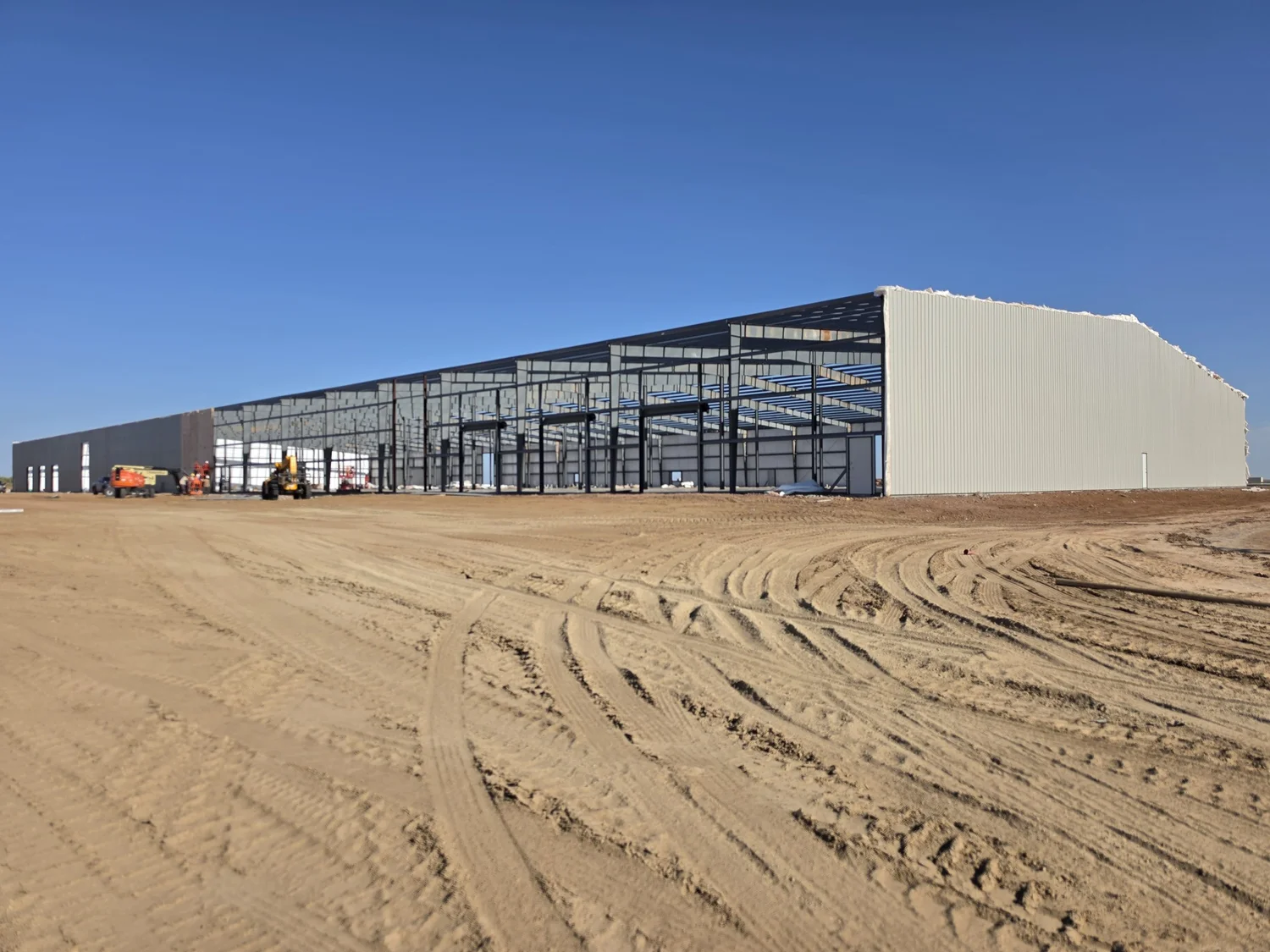
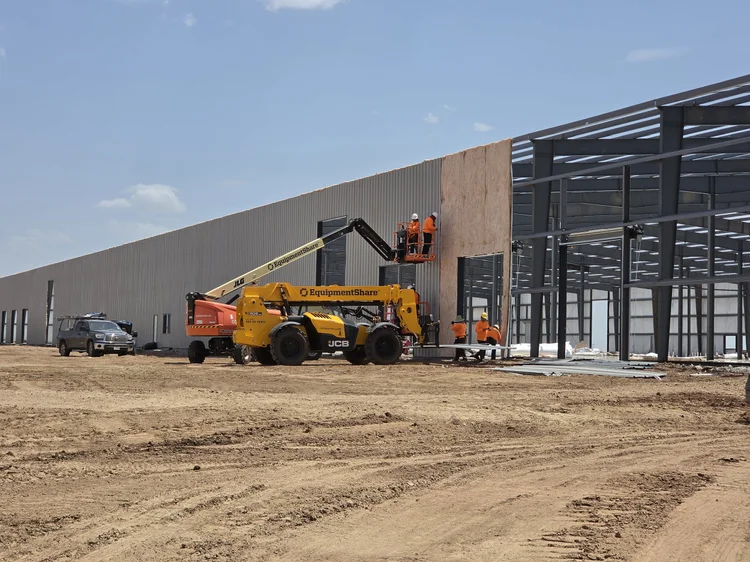
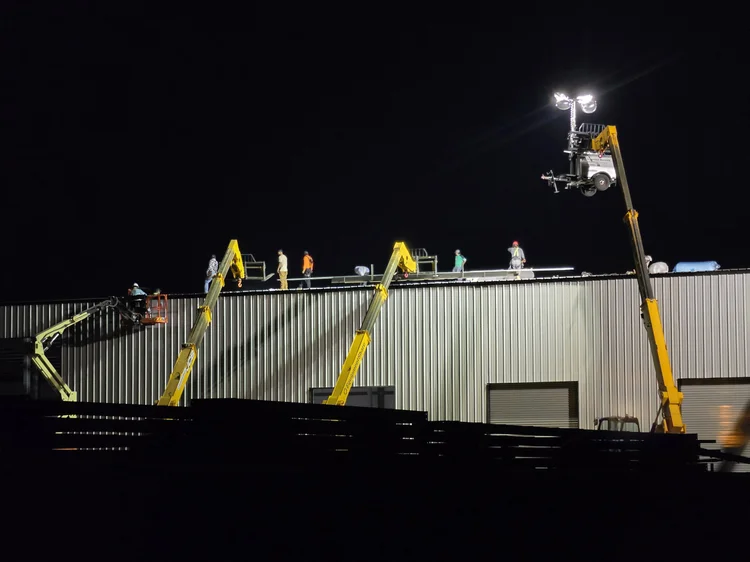

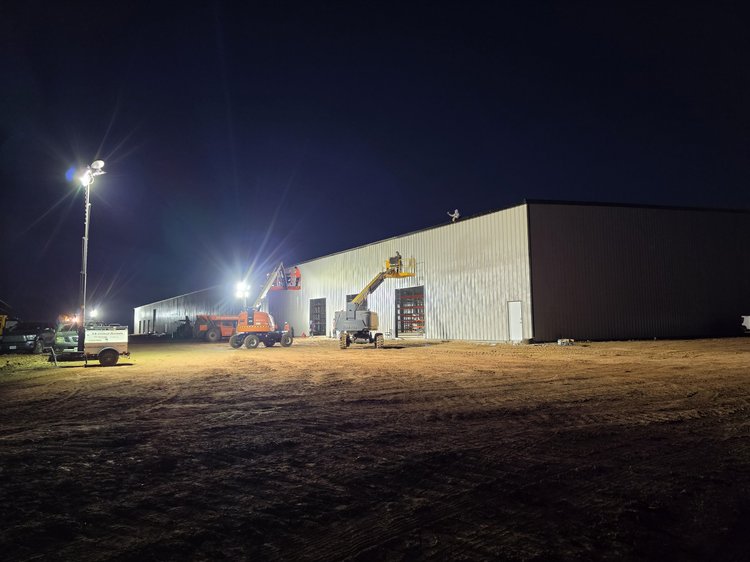
On a data center campus the support buildings come first: staging, equipment storage, and laydown have to be dried in before long-lead electrical and mechanical gear arrives for the data hall. Crews ran early morning and night shifts under light towers, with roof panels, wall cladding, and insulation moving in parallel instead of in sequence.
PEMB or IMP envelope: this campus used pre-engineered metal buildings for staging and storage, while the data hall itself is where an IMP envelope typically earns its cost through thermal and air-tightness performance. TCG self-performs both; see IMP installation and PEMB services.
- Scope: PEMB steel erection, roof and wall panels, and insulation
- Use: staging and equipment storage for a new data center campus
- Schedule: parallel crews on extended shifts
- Result: 300,000 SF delivered 30 days early
Full photo gallery on the project spotlight.
Frequently asked questions
How much does an IMP envelope cost for a data center in 2026?
Do data centers require FM 4880 rated IMP panels?
What panel thickness works for data center IMP envelopes?
How long does an IMP envelope install take on a hyperscale data center?
Can IMP envelopes handle data center thermal loads?
Is IMP appropriate for data center retrofits or only ground-up?
How does the IMP envelope interact with data center compartmentation requirements?
What is the biggest schedule risk on data center IMP envelope work?
As a founding member and the VP of Project Development for Terrapin Construction Group, Will Goodin leads TCG's early-phase project strategy, guiding opportunities from concept through contract execution. This role oversees client engagement, preconstruction coordination, and design-phase management to ensure every project is aligned with cost, schedule, and performance goals.
Responsibilities include directing budgeting and feasibility studies, facilitating value engineering and constructability reviews, and coordinating with design and trade partners to develop comprehensive, executable project plans that position TCG for successful delivery.
With a wealth of expertise, William has over 25 years of experience in commercial, residential, and industrial construction, demonstrating a proven track record of success. His dynamic approach allows him to seamlessly integrate diverse aspects of construction management and operational strategies.
Sources & references
TCG project database (185+ IMP projects across cold storage, data center, food processing, and cannabis sectors, 38 states, 1M+ SF installed); Uptime Institute Tier Classification System (Tier III / Tier IV envelope implications); FM Global data sheets for data center envelope construction; FM Approvals Standard 4880 for insulated metal panels; Kingspan Insulated Panels data center technical library; Metl-Span CS series and CFR series; CENTRIA Formawall data center specifications; PermaTherm mineral wool panel data; AWIP AWI-XL series; International Institute of Ammonia Refrigeration (envelope integration for adjacent cold storage); ASHRAE TC 9.9 mission critical facilities; International Building Code 2024 (Group F-1 and B occupancy); NFPA 75 Standard for Protection of Information Technology Equipment; ENR Q2 2026 data center construction reporting; Construction Dive 2026 hyperscale coverage; Data Center Knowledge market data; JLL Data Centers 2026 outlook and cost benchmarks.
Data center IMP envelope work — nationwide
TCG installs IMP envelopes on data center new-build and retrofit projects across the United States. Regional service areas below.
