

Average Cost to Build a Data Center in the USA
Average Cost to Build a Data Center in the USA
According to Terrapin Construction Group's August 2026 cost guide, data center construction costs $650 to $1,250+ per square foot in 2026, or roughly $10 to $13 million per megawatt of IT load. AI-optimized facilities run far higher. Here is what actually drives the number, how it varies by tier, format, and geography, and why electrical equipment lead times now matter more than construction cost.
The Hottest Construction Vertical in the United States
- October 2026: added a TCG field example with photos and video of 300,000 SF of data center support buildings delivered 30 days early.
- Year-to-date 2026 starts spending revised to $58.1 billion through May, more than four times the 2025 record pace.
- Top-five state concentration updated. Virginia, Texas, Louisiana, Illinois, and North Carolina now hold nearly 60% of trailing 12-month starts spending, replacing the January 2026 ranking.
- Per-SF and per-MW bands raised to reflect Q2 2026 pricing. Standard builds now $10M to $13M per MW.
- New section added on electrical equipment lead times, now the dominant schedule risk on data center projects.
- New 2027 outlook section covering pipeline, power infrastructure forecasts, and cost trajectory.
Data center construction is the single fastest-growing commercial construction vertical in the United States, and the gap is no longer close. According to ConstructConnect's July 2026 Data Center Report, year-to-date data center construction starts reached $58.1 billion through May 2026, more than four times the record level set over the same period in 2025. Data center starts now account for more than one fifth of all US nonresidential building starts.
The trailing 12-month average sits at $9.7 billion per month, with the six-month average running hotter at $12.0 billion. Over the trailing 12 months, the average data center project climbed to $475 million, up from $177.9 million a year earlier. ConstructConnect's trimmed 2026 dataset places the median at $473 per square foot and the average at $784 per square foot. That spread is not a data error. It reflects how many powered-shell and core-and-shell projects are counted alongside fully fitted facilities, and it is why a single "cost per SF" number is close to useless without knowing the scope boundary.
Cushman & Wakefield's US Data Center Development Cost Guide reports fully built cost per square foot approaching $1,000, with land prices for 50+ acre parcels up 23% year over year and the average data center land transaction now at 224 acres. Developers are chasing acreage with power commitments already attached, which is pushing activity into rural and tertiary markets.
At Terrapin Construction Group, we provide general contracting, design-build delivery, IMP building envelope installation, and equipment procurement for data center and critical infrastructure projects nationwide, licensed in all 50 states. The cost data below reflects current market conditions from our project work, combined with benchmarks from ConstructConnect, Cushman & Wakefield, RSMeans/Gordian, and Turner & Townsend's Data Centre Cost Index.
What You Will Actually Pay by Data Center Type
The Uptime Institute's tier classification system defines the redundancy level, and each tier increase adds 15 to 25% to construction cost. AI workloads add a separate premium on top of the tier classification. For a deeper comparison of the two most-specified levels, see our breakdown of Tier III vs. Tier IV data centers.
| Facility Type | Cost / SF | Cost / MW | Typical Timeline | Uptime |
|---|---|---|---|---|
| Edge / Modular | $700–$1,100 | $9M–$12M | 6–12 months | 99.671%+ |
| Enterprise Tier II | $650–$800 | $8M–$11M | 18–24 months | 99.741% |
| Tier III | $800–$1,000 | $10M–$13M | 20–28 months | 99.982% |
| Tier IV / Hyperscale | $1,000–$1,250+ | $12M–$16M | 24–36+ months | 99.995% |
| AI-Optimized | $1,200–$1,800+ | $20M–$37M | 24–36+ months | Varies by tier |
Where the Money Actually Goes
Data centers are not normal buildings. Electrical infrastructure alone, meaning power distribution, UPS, generators, and switchgear, represents nearly half the total construction budget.
The building shell represents only 10 to 15% of total data center construction cost. That is an inversion of every other commercial building type, where the structure and envelope dominate the budget. It is also why data center projects require a GC with deep MEP coordination capability and strong equipment procurement relationships. The mechanical and electrical systems are the project. The building is the box they go in.
TCG's direct relationships with Carrier and Trane for cooling equipment, plus our IMP panel installation capability for building envelope, create an integrated delivery model that eliminates the coordination gaps between shell, envelope, and MEP that drive change orders on data center projects. Our in-house MEP engineering and structural engineering capabilities let us resolve those interfaces during design rather than in the field.
The Five Factors That Move the Number Most
Power density and tier level remain the single largest cost driver. A Tier IV facility costs 25 to 40% more than Tier III due to full 2N+1 redundancy across all systems. AI workloads at 30 to 50+ kW per rack, versus 5 to 10 kW for traditional compute, require proportionally larger electrical service, cooling capacity, and structural reinforcement for floor loading. The newest AI deployments are pushing past 100 kW per rack, which changes the electrical room layout before it changes anything else.
Cooling architecture is evolving fast and directly affects cost. Traditional air cooling using CRAC and CRAH units is being supplemented or replaced by liquid cooling for AI workloads. Direct-to-chip liquid cooling adds $2,000 to $5,000+ per rack in infrastructure cost but is essential above roughly 20 kW per rack. A 1 MW immersion cooling block from an established vendor runs $2.5M to $3.5M, roughly double the upfront cost of air cooling, with operating economics that only pay back at sustained high density. Refrigerant selection is also in flux under low-GWP refrigerant rules.
Utility interconnection and power availability can represent $5 million to $25 million+ depending on proximity to grid capacity. Sites with existing high-voltage utility service are increasingly scarce in primary markets, which is exactly why Cushman & Wakefield reports the average land transaction has grown to 224 acres and developers are aggressively pursuing parcels that already carry power commitments. Some developers are investing in on-site generation including natural gas, solar, and battery energy storage, adding $3 million to $10 million+ per MW in generation infrastructure.
Geographic location affects construction cost by 25 to 40%. Northern Virginia commands the highest premium in the country on land, labor, and specialized subcontractor availability. Texas and the Southeast offer materially lower construction cost with better power availability, which is why the near-term pipeline is concentrated there. Permitting also varies widely by jurisdiction, as detailed in our state-by-state permitting timeline guide.
Tariff and material cost pressure compounds everything above. As we detail in our analysis of the five forces reshaping commercial construction, Section 232 steel and aluminum tariffs raise structural and electrical infrastructure costs. Copper, the backbone of every electrical distribution system in a data center, has seen sustained increases driven by tariffs and global electrification demand. Skilled electrical labor is the other binding input, and the 2026 labor shortage hits this trade hardest. Owners who front-load procurement through a GC with established supply chain relationships under a GMP contract structure protect their budgets from mid-project escalation.
Electrical Equipment Lead Times Are Now the Real Constraint
In 2026, the number that kills data center projects is not cost per square foot. It is the delivery date on a transformer. Industry estimates suggest 30 to 50% of planned 2026 US data center capacity will slip or cancel for lack of electrical equipment, not for lack of capital, land, or chips.
| Equipment | Lead Time | Notes |
|---|---|---|
| Generator step-up transformers (>50 MVA) | 100–150+ weeks | High-capacity units quoted at four to five years in some channels |
| Substation transformers (5–50 MVA) | 75–110 weeks | Up from roughly 140 weeks system-wide in 2023 to 160+ weeks in 2026 |
| Medium-voltage switchgear (15kV class) | 52–80 weeks | Sold out through 2028 in many manufacturer channels |
| Standby generators (2MW+) | 52–80 weeks | Allocation-based ordering common |
| UPS systems and PDUs | 30–52 weeks | Improving relative to 2024, still elevated |
| Chillers and CRAH units | 26–52 weeks | Liquid cooling CDUs run longer |
Read those numbers against the construction timeline and the implication is obvious. A Tier III facility takes 20 to 28 months to build. A generator step-up transformer takes up to 150 weeks, which is roughly 34 months. If equipment procurement does not start before design is complete, the equipment becomes the critical path and the entire construction schedule is a downstream victim of it.
The practical response is to decouple equipment procurement from construction procurement. That means issuing early release packages for long-lead electrical equipment during design development, locking allocation with manufacturers before drawings are 100%, and building the construction schedule backward from equipment delivery dates rather than forward from notice to proceed. We cover the full picture in our 2026 switchgear, transformer, and generator lead time guide and our commercial construction material lead times report.
This is where TCG's equipment procurement and preconstruction services earn their keep. We front-load long-lead identification during preconstruction so owners can place orders while the design is still moving, rather than discovering a 34-month transformer after the GMP is signed.
Data Center Construction Cost by Region
Geographic concentration is extreme. Over the trailing 12 months, Virginia, Texas, Louisiana, Illinois, and North Carolina captured nearly 60% of all US data center starts spending. New England and the entire Western US together account for roughly 6%.
Richmond · Washington DC
Dallas · Houston · Austin · San Antonio
Charlotte · Raleigh · Atlanta · Charleston
Shreveport · Jackson
Chicago · Columbus · Minneapolis
IMP and PEMB in Data Center Construction
Insulated metal panels are increasingly specified for data center building envelopes because they provide continuous insulation, moisture control, and fire-rated assembly in a single integrated panel, reducing envelope installation time by 30 to 40% versus conventional construction. For data centers, IMP systems also offer superior air-tightness, which is critical for maintaining pressurization and contamination control in server environments and for meeting IECC 2024 envelope requirements. We cover the detail in our guide to IMP installation for data centers.
Pre-engineered metal building structural systems can be used for edge and enterprise data center shells, offering 15 to 25% structural savings and faster timelines. Hyperscale facilities with heavy rack floor loads and complex MEP infrastructure typically require conventional structural steel, but PEMB remains cost-effective for ancillary buildings such as generator enclosures, battery storage, and cooling plant structures within a data center campus. See our PEMB vs. conventional steel comparison.
TCG's integrated capability to provide IMP installation, PEMB procurement and erection, and commercial roofing as coordinated scopes, along with equipment procurement for HVAC and cooling systems through our Carrier and Trane national accounts, creates a delivery model that eliminates the coordination failures that drive cost overruns on data center projects. The IMP Install Estimator provides envelope-specific pricing in minutes.
What Support Buildings Look Like on a Real Data Center Campus
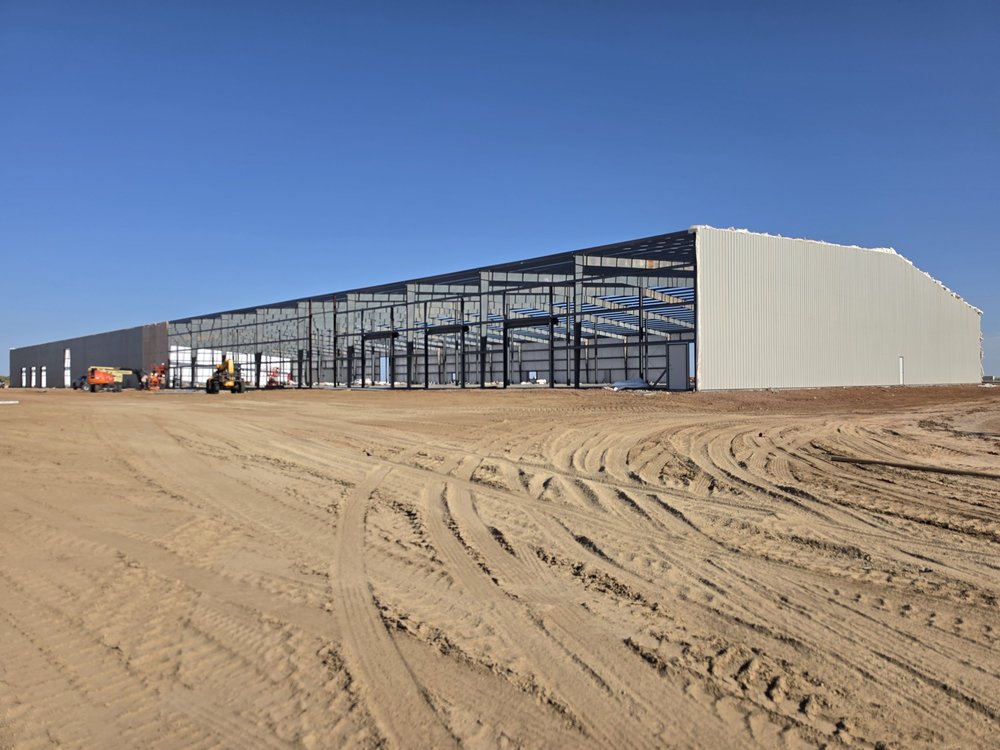
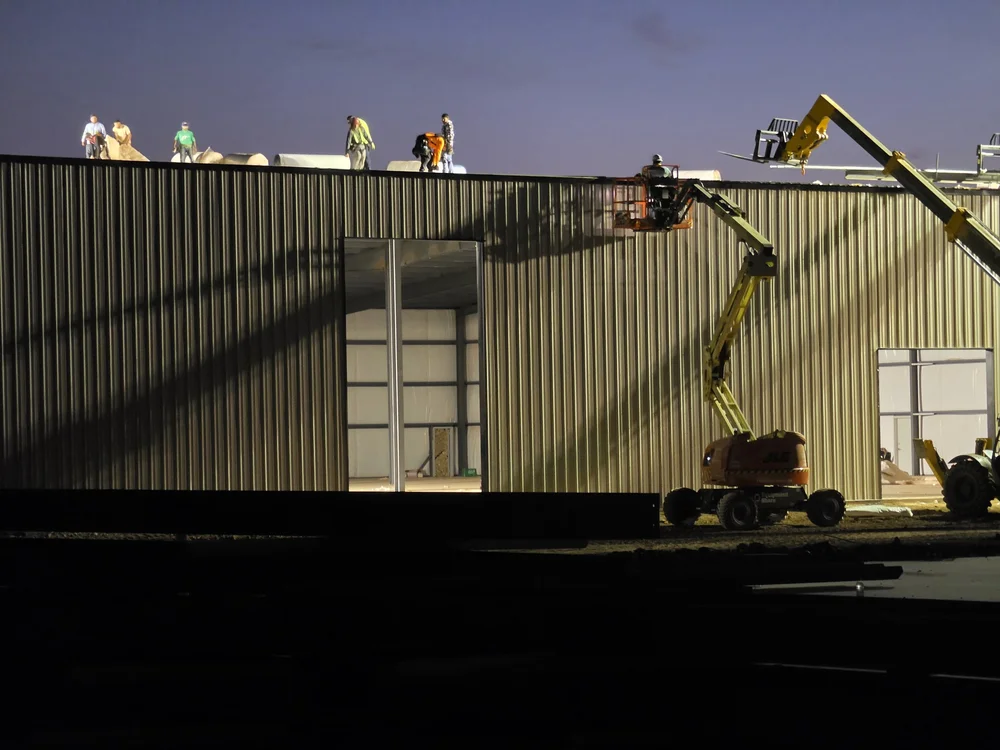
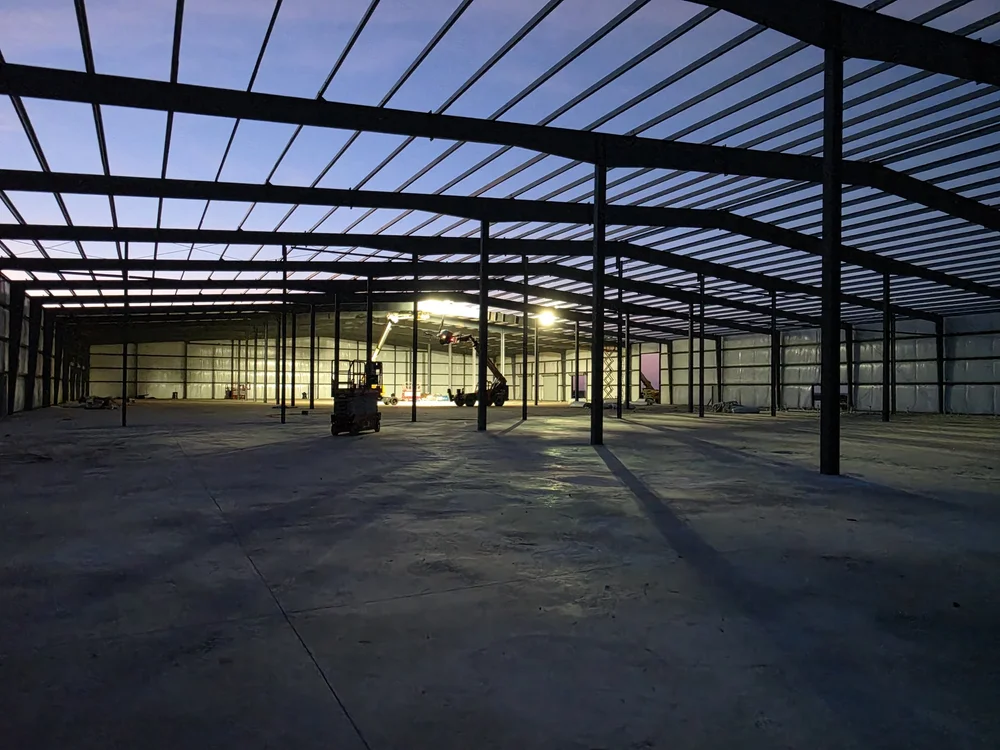
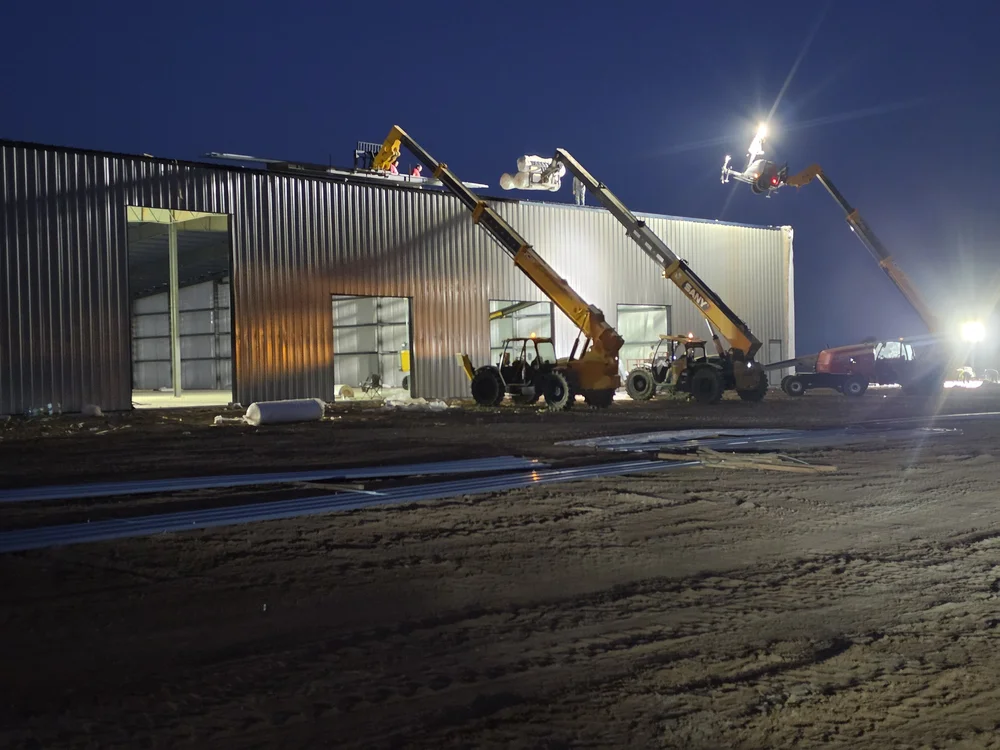
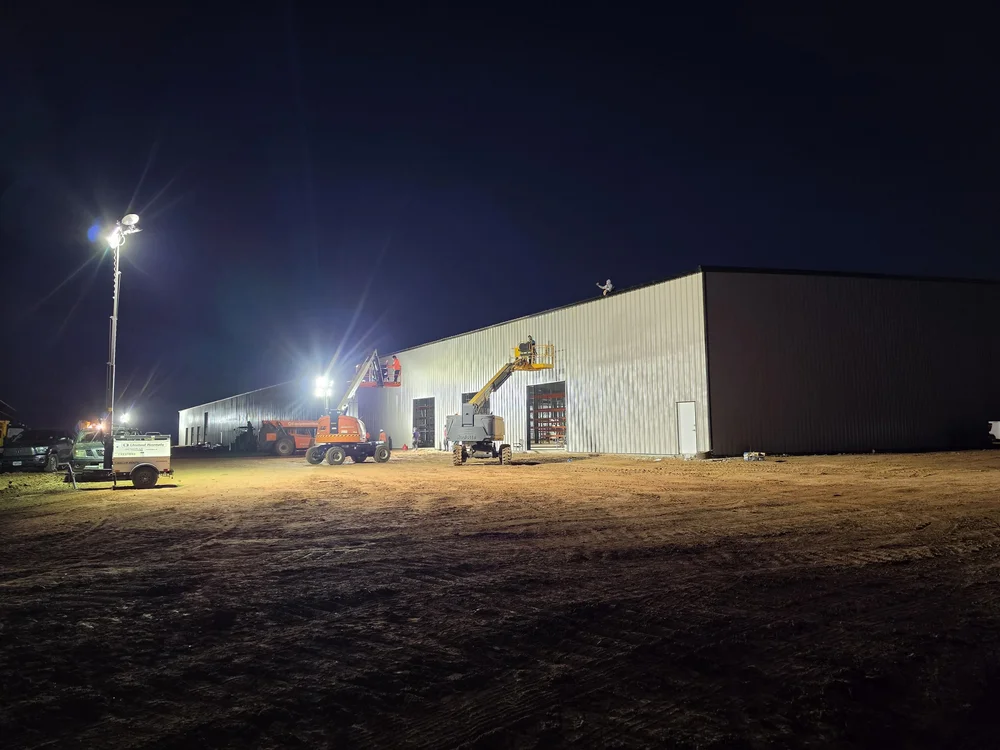
The PEMB point above is not theory. Staging, laydown, and equipment storage buildings have to be ready before the main data hall can move, and they are one of the few places on a data center campus where the building itself is the schedule.
300,000 SF of Data Center Support Buildings, Delivered 30 Days Early
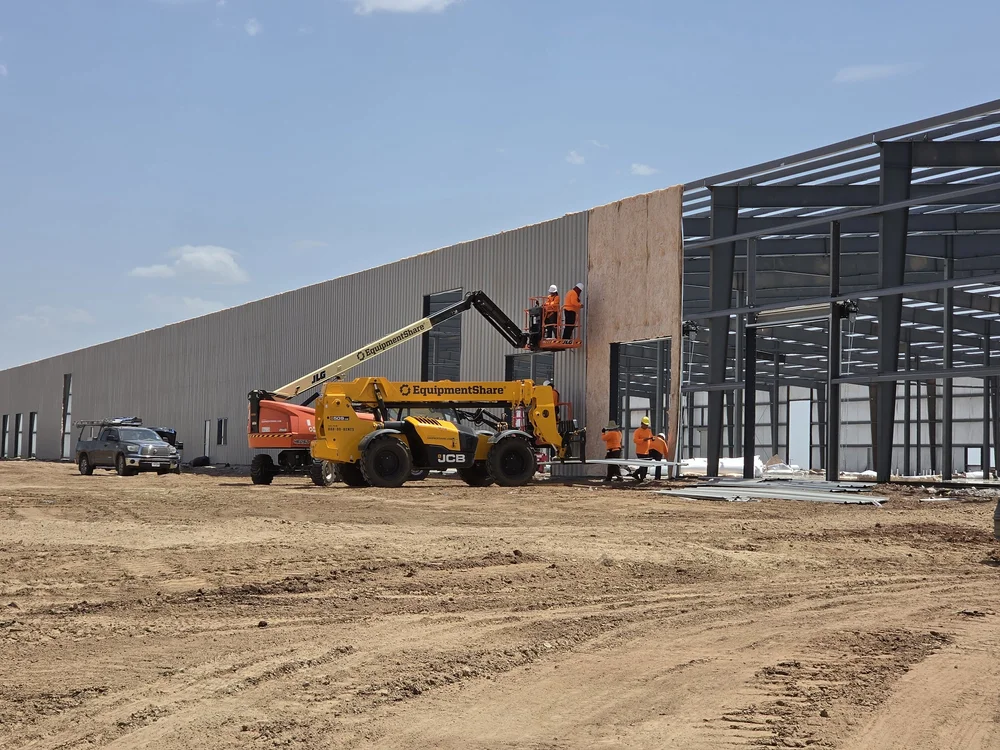
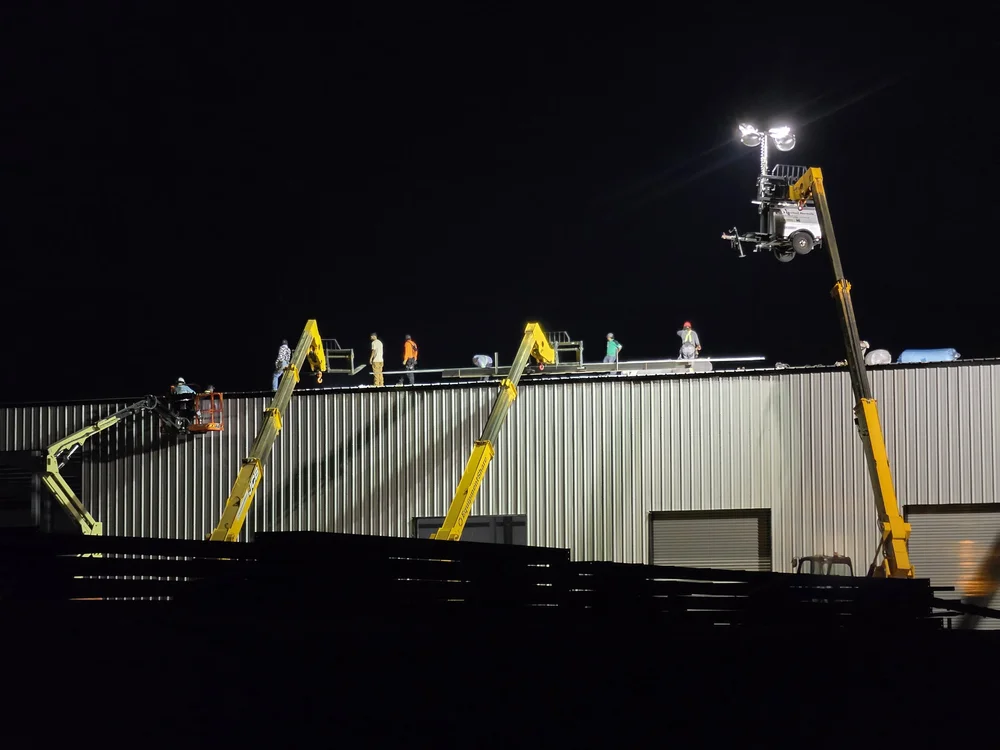
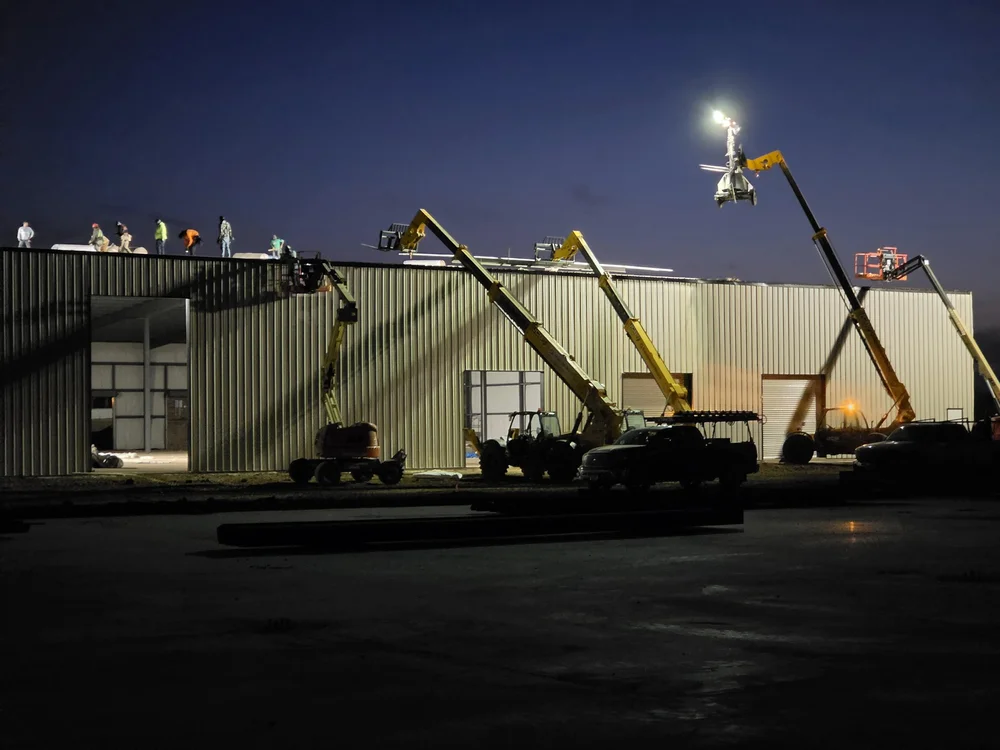
TCG erected and insulated three 100,000 SF pre-engineered metal buildings for the staging and storage campus of a new data center north of Dallas, Texas. Building 1 went from start of steel erection to sign-off in 41 days, and the full 300,000 SF finished 30 days ahead of schedule.
This is the cost logic from the envelope section in practice: clear span PEMB for the ancillary buildings, conventional steel saved for the data hall. Crews ran early morning and night shifts so roof panels, wall cladding, and insulation moved at the same time, which gave the owner covered space for long-lead switchgear, transformers, and generators well before the main build needed it.
More on our approach: pre-engineered metal buildings, PEMB cost per SF, and Dallas data center construction.


Watch the Builds
Two recent TCG Shorts from large pre-engineered metal building projects. Press play to watch here, or open them on YouTube.
300,000 SF of PEMB in Dallas, Finished 30 Days Early
Three 100,000 SF pre-engineered metal buildings for the staging and storage campus of a new data center north of Dallas. Building 1 went from start of erection to sign-off in 41 days, and the project came in 30 days ahead of schedule.
100,000 SF of Dirt Before the Steel Goes Up
100,000 SF of excavation before a single steel column goes up on a large PEMB in California. Grades, compaction, and anchor bolts have to match the manufacturer's reaction drawings, because the schedule is won or lost in the dirt.
Photos: Terrapin Construction Group, August to September 2026. Scope: PEMB erection and insulation. More on the Projects page and in the TCG video library.
How Long Does It Take to Build a Data Center?
Data center construction timelines range from 6 months for modular edge deployments to 36+ months for hyperscale campuses. Edge facilities using modular or containerized construction can be deployed in 6 to 12 months. Enterprise Tier II and Tier III facilities typically take 18 to 28 months from design through commissioning. Hyperscale and Tier IV campuses take 24 to 36+ months, with commissioning alone requiring 3 to 6 months of systematic testing. For general benchmarks across building types, see how long ground-up commercial construction takes.
The most common schedule constraint is electrical infrastructure. Utility interconnection, substation construction, and switchgear procurement all carry lead times that now exceed the construction duration itself, as detailed in the equipment lead time section above. TCG's AI-powered scheduling and preconstruction services are designed to identify and front-load these long-lead items before they become critical-path delays, and our owner's representative services keep that sequencing enforced through construction.
2027 Outlook: Where Data Center Costs Go From Here
The pipeline is real, but the constraint has moved. ConstructConnect is tracking nearly 100 data center projects worth more than $101 billion in preconstruction with anticipated start dates before the end of 2026, and that figure excludes the separately monitored $100 billion Project Kestrel development. The demand is not the question heading into 2027. Whether the electrical supply chain can deliver against it is.
Power infrastructure is the growth story behind the growth story. ConstructConnect forecasts power infrastructure construction starts to finish 2026 up 30.8% over 2025. That is the grid catching up to the load. Expect substation, transmission, and on-site generation scopes to become a routine part of data center project budgets rather than a utility problem happening somewhere else.
Cost per SF should decelerate, not fall. Cushman & Wakefield already notes that building and construction cost increases, while continuing, are rising at a slower pace than in prior years. The blended per-SF number will likely keep drifting up in 2027 because mix is shifting toward high-density AI facilities, not because conventional construction is getting more expensive at the same rate.
Site selection keeps moving to power, not to markets. With land for 50+ acre parcels up 23% year over year and the average transaction at 224 acres, the deciding variable is an executed power commitment. Expect more activity in rural and tertiary markets across the South and Midwest, and continued underrepresentation of New England and the West, which together account for roughly 6% of recent starts.
We refresh this page quarterly as ConstructConnect, Cushman & Wakefield, and Turner & Townsend release updated data. If you are budgeting a 2027 data center project now, a preconstruction engagement that locks equipment allocation this year is worth more than a tighter estimate.
Common Questions
According to Terrapin Construction Group's August 2026 cost guide, data center construction costs $650 to $1,250+ per square foot in 2026. Enterprise Tier II: $650–$800/SF. Tier III: $800–$1,000/SF. Tier IV and hyperscale: $1,000–$1,250+/SF. AI-optimized with liquid cooling: $1,200–$1,800+/SF. ConstructConnect's July 2026 report places the 2026 median at $473/SF and the average at $784/SF across all tracked projects over 2,000 SF, a spread that reflects how many powered-shell projects are counted alongside fully fitted facilities. Use TCG's AI estimator for project-specific pricing.
Standard: $10 to $13 million per MW of critical IT load in 2026, up from roughly $10.7 million per MW in 2025. AI-optimized: $20 to $37 million per deliverable MW all-in, roughly 3x a conventional facility, driven by liquid cooling, higher power density, and substantially larger electrical infrastructure.
Electrical and power infrastructure at 40 to 45% of total cost, including utility interconnection, switchgear, UPS, generators, and power distribution. Cooling is second at 15 to 25%. The building shell and envelope account for only 10 to 15%, an inversion of every other commercial building type.
Edge: 6 to 12 months. Enterprise Tier II and III: 18 to 28 months. Hyperscale and Tier IV: 24 to 36+ months. In 2026 the binding constraint is usually equipment, not construction. Substation transformers run 100 to 150+ weeks and medium-voltage switchgear is sold out through 2028 in many channels.
Electrical equipment procurement. Substation transformers (5–50 MVA) quote at 75 to 110 weeks, generator step-up transformers (>50 MVA) at 100 to 150+ weeks, and 15kV medium-voltage switchgear at 52 to 80 weeks with many manufacturers sold out through 2028. Industry estimates suggest 30 to 50% of planned 2026 US capacity will slip or cancel for lack of equipment rather than lack of capital, land, or chips. See our full lead time guide.
Tier I: basic, no redundancy. Tier II: redundant capacity components. Tier III: concurrently maintainable, 99.982% uptime. Tier IV: fault tolerant, 99.995% uptime. Each tier adds 15 to 25% to construction cost. See our detailed Tier III vs. Tier IV comparison.
Over the trailing 12 months through May 2026, Virginia, Texas, Louisiana, Illinois, and North Carolina captured nearly 60% of all new US data center starts spending. The near-term pipeline is concentrated in the South, led by Texas, North Carolina, and Virginia, with the Midwest second on the strength of North Dakota, Indiana, and Ohio. New England and the entire Western US together account for roughly 6%.
US data center construction starts reached $58.1 billion year to date through May 2026, more than four times the record pace set over the same period in 2025. Data center starts now account for more than one fifth of all US nonresidential building starts. Nearly 100 additional projects worth over $101 billion sit in preconstruction with anticipated 2026 start dates.
AI workloads require 30 to 50+ kW per rack, with newest deployments pushing past 100 kW, versus 5 to 10 kW standard. That drives direct-to-chip or immersion liquid cooling, reinforced floors, and substantially larger electrical infrastructure. AI-optimized facilities run roughly 3x the cost per deliverable megawatt of a conventional build.
IMP panels provide continuous insulation, moisture control, fire rating, and superior air-tightness in a single integrated system, reducing envelope installation time by 30 to 40%. TCG installs IMP panels on data center projects nationwide through our IMP division. See our guide to IMP installation for data centers.
Yes for edge and enterprise facilities, offering 15 to 25% structural savings. Hyperscale facilities typically require conventional steel for heavy rack loads. PEMB works well for ancillary campus buildings such as generator enclosures, battery storage, and cooling plants. See our PEMB vs. conventional steel comparison.
Much faster than the data hall. On a recent TCG campus north of Dallas, Texas, Building 1, a 100,000 SF pre-engineered metal building, went from start of steel erection to sign-off in 41 days, and all three 100,000 SF buildings finished 30 days ahead of schedule. Speed depends on steel delivery, foundation readiness, and weather. See the field example for photos and video.
TCG's AI construction estimator provides preliminary data center cost estimates in under two minutes. For formal preconstruction budgeting including power infrastructure analysis and long-lead equipment sequencing, schedule a 30-minute conversation with TCG's team.
Data Center & Critical Infrastructure
Full Cost Guide Library
Data & References
© 2026 Terrapin Construction Group · Denver · Houston · Dallas · Atlanta · Columbus · Phoenix · Charlotte · Chicago · Richmond · Albany · Sheridan
AI Estimator · IMP Estimator · Bid Review · Cost Hub · Schedule a Call
