
Insulated Metal Panel Cost Estimator: Upload Your Plans and Get Instant Supply-and-Install Pricing from the Installer Who's Done a Million Square Feet
Getting an accurate insulated metal panel price has always required a frustrating cycle of estimating delays. You send your architectural plans to a manufacturer's rep. You wait for a takeoff. The takeoff comes back, but it only covers material — no labor, no trim, no sealant, no regional installation cost. You then shop the material quote to two or three installation subcontractors, wait another week or two for their numbers, and hope the combined supply-and-install total still works within the project budget you set months ago. By the time you have a number you can actually underwrite against, the project has burned three to six weeks of preconstruction time — and the number may already be stale because steel and foam core pricing shifted while you were waiting.
This is the problem that TCG's IMP Estimator was built to solve.
Upload your architectural plans — floor plans, elevations, or panel layouts — and get an instant Good / Better / Best insulated metal panel supply-and-install cost estimate, powered by AI and backed by over one million square feet of direct IMP installation across 38 states. No manufacturer quote required. No subcontractor polling. No three-week wait. A preliminary installed-cost number in minutes, from the general contractor that will actually build the project.
Why IMP Pricing Is So Hard to Get Right — and Why Most Estimates Miss
Insulated metal panels occupy a uniquely difficult position in construction estimating. Unlike commodity building materials where cost per unit is relatively stable and widely published, IMP pricing is driven by a complex matrix of variables that interact in ways most estimating tools — and most general contractors — don't fully account for.
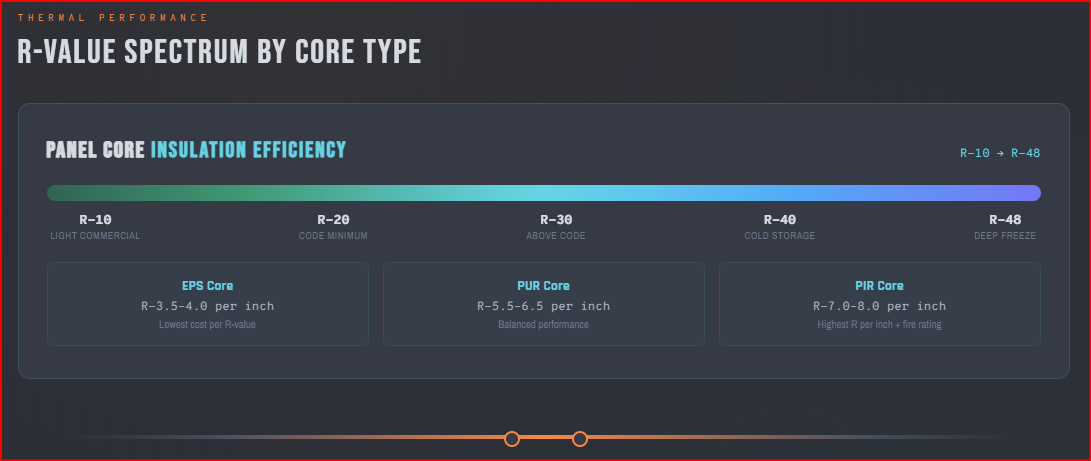
Panel thickness is the most obvious variable. IMPs are available from approximately 2 inches to 6 inches or more, with R-values ranging from R-10 to R-48 depending on thickness and foam type. According to the Construction Executive's analysis of IMP systems, the International Energy Conservation Code has consistently increased minimum R-value requirements for commercial construction — meaning thicker, higher-performance panels are becoming the baseline specification, not the upgrade. A 2-inch panel at R-15 and a 4-inch panel at R-30 are different products at different price points, and the choice cascades into structural attachment details, flashing profiles, and sealant requirements.
But thickness is only the beginning. The foam core chemistry — expanded polystyrene (EPS), polyurethane (PUR), or polyisocyanurate (PIR) — creates meaningful cost differentiation. PIR cores deliver higher R-values per inch (approximately 7.0–8.0 per inch versus 3.5–4.0 for EPS, as documented by the FMP Construction IMP guide) and superior fire performance, but they carry a material cost premium. EPS panels offer the lowest cost per R-value and are the standard choice for many cold storage and food processing applications. PermaTherm, one of the manufacturers TCG works with directly, offers both EPS and foamed-in-place polyiso lines — and the cost difference between the two on the same building can be 15–25%.
Then there's the variable most manufacturers' quotes don't touch: installation labor. A material quote from a panel manufacturer tells you what the panels cost to purchase. It tells you nothing about what they cost to install — and the installation cost is frequently 40–60% of the total supply-and-install budget. Installation labor rates vary by region (union versus open-shop markets), building height and access conditions, panel orientation (vertical versus horizontal), the complexity of penetrations (windows, doors, louvers, dock doors, equipment openings), and the volume of trim, sealant, and accessory work required to complete a weathertight envelope. A project in Houston at 16 feet of eave height with standard penetrations is a different labor proposition than a project in Boston at 40 feet with complex architectural detailing.
This is why most IMP estimates — whether from online calculators, manufacturer reps, or general contractors who don't self-perform panel installation — are incomplete. They either quote material only, or they apply a generic labor rate that doesn't reflect the actual field conditions of the specific project. TCG's IMP Estimator solves both problems because it's built by an installer, not a material supplier.
How the TCG IMP Estimator Works
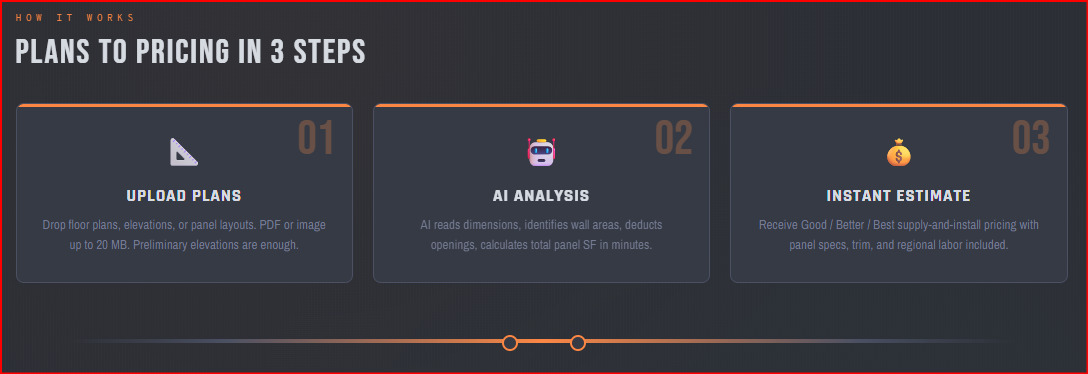
The tool follows a three-step workflow designed to get you from plans to pricing as fast as possible.
Step 1: Upload Your Architectural Plans
Drop your floor plans, elevations, or panel layouts into the estimator. The tool accepts PDF and image files up to 20 MB. You don't need a complete construction document set — preliminary elevations showing wall areas, building dimensions, and opening locations are sufficient for a preliminary estimate. If all you have is a conceptual elevation and a rough floor plan, that's enough to start.
Step 2: AI Analysis
The AI engine reads your uploaded documents, extracts dimensions, identifies wall and roof panel areas, accounts for openings and penetrations, and calculates total panel square footage. This is the step that traditionally takes a manufacturer's takeoff department one to two weeks to complete manually. The AI performs it in minutes, parsing the same geometric and dimensional data that a human estimator would extract — wall heights, building perimeter, window and door deductions, parapet conditions, and panel orientation.
Step 3: Instant Good / Better / Best Estimate
The estimator returns a tiered pricing structure — Good, Better, and Best — reflecting three specification levels across panel thickness, core type, exterior finish, and accessory package. This tiered approach is critical because IMP projects almost never have a single correct answer. A cold storage facility requiring R-40 walls has a fundamentally different specification than a pre-engineered metal building needing R-19 for basic energy code compliance. The Good / Better / Best format gives project owners, architects, and developers the cost delta between specification levels so they can make informed value engineering decisions before finalizing design.
Every estimate includes supply-and-install pricing — not just material. Because Terrapin Construction Group self-performs IMP installation with its own nationally deployed crews, the labor component of the estimate reflects actual field productivity data from real projects, not theoretical labor rates pulled from a cost database.
What the Estimate Includes — and What Makes It Different
The IMP Estimator produces a preliminary estimate that covers the full scope of a supply-and-install IMP project. Here's what's accounted for in the output.
Panel Quantities by Wall Area
The AI breaks down estimated panel square footage by wall segment and location — not as a single lump-sum number. This allows owners and architects to see where the panel area is concentrated and understand how changes to the building footprint or elevation affect cost. A 50,000-square-foot cold storage facility with four identical walls is a simpler takeoff than a 50,000-square-foot mixed-use building with varying eave heights, parapet conditions, and architectural reveals — and the estimate reflects that difference.
Panel Thickness and R-Value Specification
Each tier of the Good / Better / Best estimate corresponds to a different panel specification — typically varying by core thickness and foam type. The estimate maps these specifications to project-appropriate R-values, so the owner can see exactly what thermal performance each price point delivers. With energy codes tightening annually — the IECC has consistently increased minimum R-value requirements for commercial walls — this transparency is essential for ensuring the selected specification meets or exceeds code in the project's jurisdiction.
Trim, Sealant, and Accessory Allowances
One of the most common sources of cost surprise on IMP projects is the trim and accessory package. Corner trim, base trim, head and jamb trim around every opening, caulk joints, closure strips, and fastener systems add meaningful cost to every panel installation — typically 10–20% of the total material budget. The TCG estimator includes these items in every tier because we've installed enough panels to know exactly what the accessory load looks like on a typical commercial project.
Regional Installation Labor
Because TCG deploys IMP installation crews nationwide from its Denver headquarters, the estimator applies regionally appropriate labor rates. A project on the Gulf Coast carries different crew travel, per diem, and labor rate assumptions than a project in the Northeast or Mountain West. The estimate reflects these regional realities rather than applying a single national labor rate that would underestimate cost in high-labor markets and overestimate it in competitive ones.
Penetrations and Openings
Every door, window, dock opening, louver, and equipment penetration in an IMP wall requires field cutting, framing, flashing, and sealing. These aren't rounding errors — on buildings with high opening-to-wall ratios (retail, medical, restaurant), penetrations can represent 15–25% of total installation labor. The AI engine identifies openings in the uploaded plans and factors the associated labor and material into the estimate.
The Market Context: Why IMP Estimating Matters More in 2026 Than Ever
The insulated metal panel market is experiencing significant growth driven by several converging forces that are putting more IMP projects into the pipeline than at any point in the last decade.
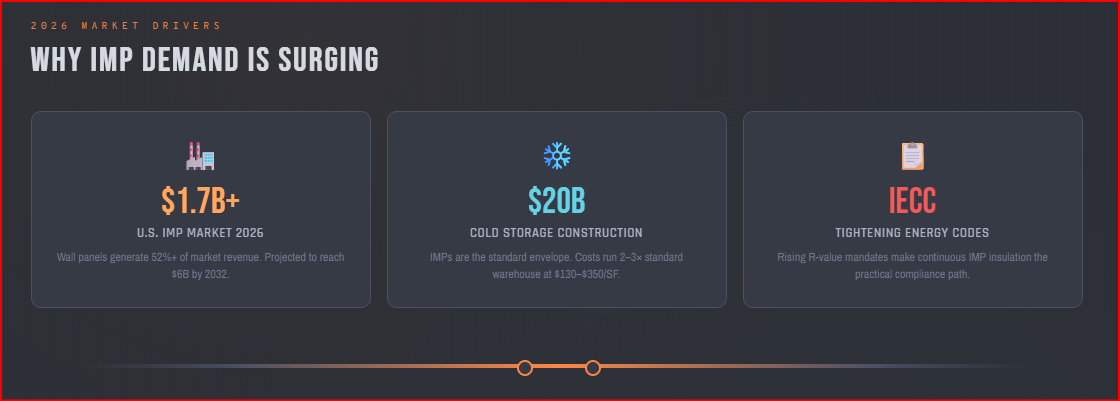
The U.S. IMP market is projected to exceed $1.7 billion in 2026, according to Astute Analytica's market forecast, with wall applications generating more than 52% of market revenue. The global IMP market is on track to grow at a 5.2% compound annual rate through 2035, per IndexBox's IMP market analysis, driven by tightening energy codes, cold chain logistics expansion, and the ongoing data center construction boom.
Cold storage construction alone is a massive IMP demand driver. The cold storage construction market is projected to grow from $17 billion to nearly $20 billion in 2026, and IMPs are virtually the standard envelope system for refrigerated facilities because of their continuous insulation, airtight seals, and ability to deliver R-values up to R-48 in a single panel system. When Primus Builders describes the critical role of the building envelope in cold storage performance, they're describing IMP systems — and the cost of those systems is a primary driver of total project budgets that regularly reach $130 to $350 per square foot.
Data center construction is adding another layer of IMP demand. Construction Dive reports that data centers represent the highest-confidence growth category in the 2026 AGC outlook survey, with over $88 billion in tracked data center starts for the next six months. These facilities require high-performance building envelopes for thermal management — and IMPs are increasingly specified for data center wall and roof systems where precise thermal control is non-negotiable.
Meanwhile, tightening energy codes are expanding IMP adoption in conventional commercial construction. The International Energy Conservation Code continues to increase minimum R-value requirements for commercial walls and roofs. As code-required R-values climb, traditional field-assembled insulation systems (fiberglass batts behind metal liner panels) become less viable, and factory-fabricated IMP systems — which deliver continuous insulation with no thermal bridging — become the practical path to code compliance. This trend is accelerating IMP adoption in market segments that historically used conventional insulation: retail, industrial, warehouse, and QSR restaurant construction.
All of this adds up to one reality: more general contractors, developers, and architects are specifying IMPs than ever before — and they all need fast, accurate pricing. That's the gap the TCG IMP Estimator fills.
Who Should Use the TCG IMP Estimator
The tool was built for anyone who needs IMP supply-and-install pricing and doesn't want to wait weeks to get it. The most common users fall into four categories.
General contractors pricing IMP-clad buildings for their clients. If you're a GC assembling a bid or budget for a project that includes insulated metal panels — whether it's a cold storage facility, a food processing plant, a cannabis cultivation building, or a pre-engineered metal building — the TCG IMP Estimator gives you a supply-and-install number you can plug into your estimate immediately. And because TCG self-performs IMP installation nationally, the estimate can convert directly into a subcontract proposal if the project moves forward.
Architects and engineers specifying IMP systems for commercial projects. If you're evaluating the cost impact of different panel specifications — comparing a 3-inch EPS panel at R-22 against a 4-inch PIR panel at R-30, for example — the Good / Better / Best estimate format gives you the installed cost delta between specification levels. This is precisely the information that enables design-build value engineering conversations between architect, owner, and GC during schematic design, when 80% of a project's cost is determined.
Developers and owners building cold storage, food processing, industrial, or commercial facilities. If you're in feasibility analysis and need to understand what the building envelope will cost before committing to a site or a design contract, the estimator provides a number grounded in real installed-cost data — not manufacturer list pricing that excludes labor. Pair this tool with TCG.ai's full construction estimator for a complete preliminary project budget covering both envelope and total building cost.
IMP manufacturers and distributors who need to pair their material quotes with credible installation pricing. TCG works directly with leading IMP manufacturers including PermaTherm, FALK, UPI, and Arch Solar IMP, as well as major national brands like Kingspan, Metl-Span, CENTRIA, and MBCI. If a manufacturer has a customer who needs a combined supply-and-install quote, the TCG IMP Estimator — or a direct conversation with TCG's estimating team — provides the installation side of the equation.
The Seven Variables That Move IMP Installed Cost the Most
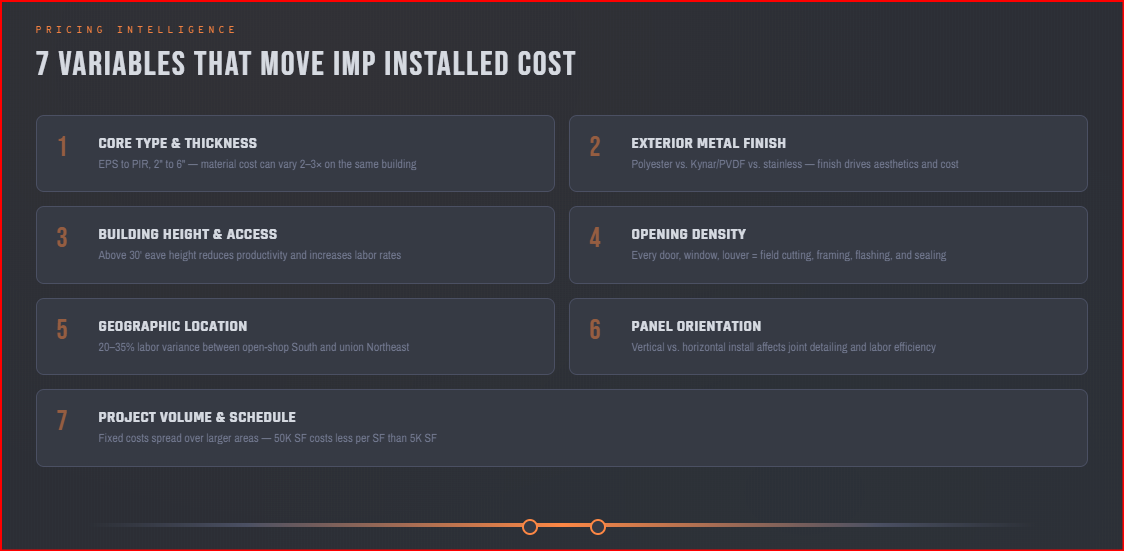
Within any IMP project, these are the variables that create the widest cost variance between low-end and high-end installed pricing. Understanding them is essential for interpreting any estimate — whether from TCG's tool or from a traditional bidding process.
Panel core type and thickness is the largest material cost driver. EPS-core panels at 2–3 inches of thickness are the least expensive per square foot. PIR-core panels at 4–6 inches are the most expensive, but they deliver the highest R-value per inch and the best fire performance. The material cost difference between a 2-inch EPS wall panel and a 6-inch PIR wall panel can be 2–3× on a per-square-foot basis. The R-value chart published by Allied Steel Buildings shows the direct relationship between core thickness and thermal performance — and the cost tracks that relationship closely.
Exterior metal finish creates meaningful price differentiation. Standard 26-gauge steel with a polyester paint finish is the baseline. Upgraded finishes — PVDF/Kynar coatings, embossed profiles, custom colors, and heavier-gauge steel — add cost to every panel. Stainless steel or aluminum facings for corrosive environments (food processing, coastal locations) carry significant premiums. The finish affects not just aesthetics but also long-term maintenance cost and warranty coverage.
Building height and access conditions drive installation labor rates. IMP installation at 12–16 feet of eave height from ground-level scaffolding or boom lifts is standard-productivity work. Installation above 30 feet, on buildings with complex roof geometries, or in constrained urban sites with limited staging area reduces crew productivity and increases per-square-foot installation cost. This is one of the most significant variables that material-only quotes completely miss.
Opening density and penetration complexity is a major labor cost driver. Every window, personnel door, overhead door, louver, exhaust penetration, and pipe penetration requires field measurement, cutting, framing, flashing, and multi-step sealant application. A 20,000-square-foot cold storage building with four dock doors and minimal windows has a fundamentally different penetration labor load than a 20,000-square-foot retail building with storefront windows on two elevations and 15 louver penetrations for HVAC equipment.
Geographic location affects both material shipping cost and installation labor rates. Panel manufacturers ship from regional plants, and freight cost is a meaningful line item on projects located far from the nearest production facility. Installation labor varies 20–35% between open-shop markets in the South and Mountain West and union markets in the Northeast and parts of California. TCG's national crew network allows the company to deploy crews efficiently, minimizing travel cost on projects nationwide.
Panel orientation — vertical versus horizontal installation — affects both material and labor. Horizontal panel installation typically requires longer panels, different joint detailing, and sometimes different structural attachment methods. Vertical installation is more common and generally more efficient from a labor standpoint. The choice is usually driven by architectural preference, but it has real cost implications that an experienced installer understands and that most online calculators do not distinguish.
Project volume and schedule directly affect pricing. A 5,000-square-foot IMP installation carries higher per-square-foot costs than a 50,000-square-foot installation because fixed costs — mobilization, crane/lift rental, crew travel — are spread across a smaller area. Similarly, projects with aggressive timelines that require overtime or additional crew shifts cost more per square foot than projects with standard schedules. TCG's preconstruction services team works with owners to align schedule and specification to optimize installed cost.
IMP vs. Conventional Insulation: Why the Installed Cost Comparison Matters
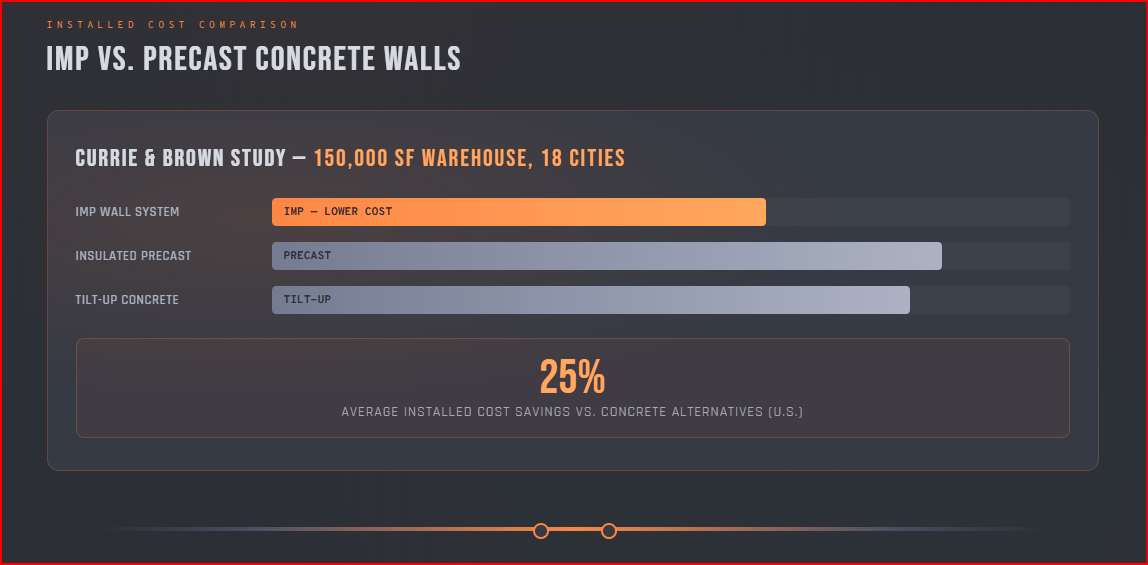
One of the most common questions developers and architects ask when evaluating IMPs is whether the higher material cost is justified compared to conventional wall systems — fiberglass batt insulation behind a metal liner panel, or insulated precast concrete.
A study conducted by Currie & Brown, a global construction cost consultancy, compared the installed cost of IMP wall systems against insulated precast concrete and tilt-up concrete walls in typical 150,000-square-foot warehouse and light manufacturing buildings across 18 cities in the United States and Canada. The study found that IMP installed costs averaged 25% lower in the U.S. and 27% lower in Canada compared to insulated precast and tilt-up concrete. The cost savings ranged from 18% to 32% depending on location, driven primarily by differences in local labor costs for each system.
The comparison matters because it's not panel cost versus concrete cost — it's total installed envelope cost, including all labor, accessories, and ancillary materials. IMPs eliminate multiple trade overlaps (structural framing, insulation, vapor barrier, and exterior cladding are all delivered in a single factory-fabricated component), which compresses the installation timeline and reduces on-site labor hours. According to Green Span Profiles' market analysis, building with IMPs can decrease framing labor by as much as 55% and reduce on-site construction time by 50% compared to conventional wall assemblies.
This is why the installed-cost comparison — not the material-cost comparison — is the only meaningful way to evaluate IMPs against alternatives. And it's why TCG's IMP Estimator provides supply-and-install pricing, not material-only pricing. The number that matters for project budgets is the fully installed cost, and that's the number the tool delivers.
From Estimate to Formal Proposal: What Happens After the AI Number
The TCG IMP Estimator produces a preliminary estimate — an AI-generated number based on uploaded plan analysis and TCG's installed-cost intelligence. It is not a binding proposal. Every preliminary estimate includes a clear path to a formal, verified proposal from TCG's estimating team.
After receiving the preliminary estimate, users can submit project details — company name, project location, and any additional scope notes — directly through the tool. A TCG estimator reviews the uploaded plans, verifies panel quantities and specifications, and follows up within 24 hours with a formal supply-and-install proposal. That proposal reflects verified takeoff quantities, manufacturer-confirmed material pricing, and project-specific installation labor based on TCG's assessment of the site, building conditions, and schedule.
This two-step process — instant AI estimate followed by human-verified formal proposal — gives developers and GCs the best of both worlds. The AI estimate provides an immediate number for feasibility analysis, budgeting, and design decision-making. The formal proposal provides a contractable number for procurement, subcontracting, and project commitment. The transition between the two happens in 24 hours, not weeks.
For projects where IMP is one component of a larger construction management or design-build scope, TCG's preconstruction team integrates the IMP proposal into the broader project estimate — coordinating panel delivery with structural steel erection schedules, MEP rough-in, and roofing to ensure the envelope installation falls at the right point in the construction sequence. This is the coordination value that a dedicated IMP installer embedded within a national GC provides — and that standalone panel contractors or material-only suppliers cannot.
TCG's IMP Installation Credentials: Why the Estimate Is Backed by Real Experience
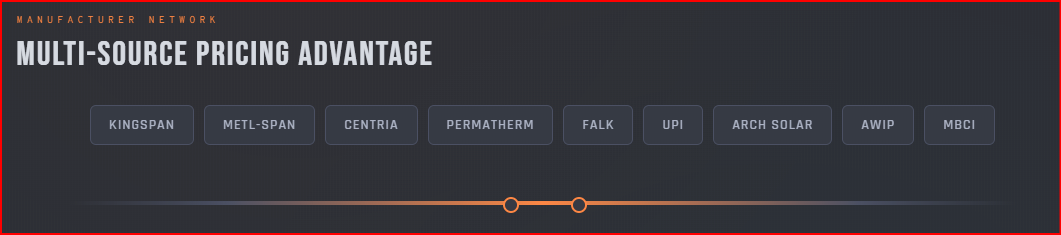
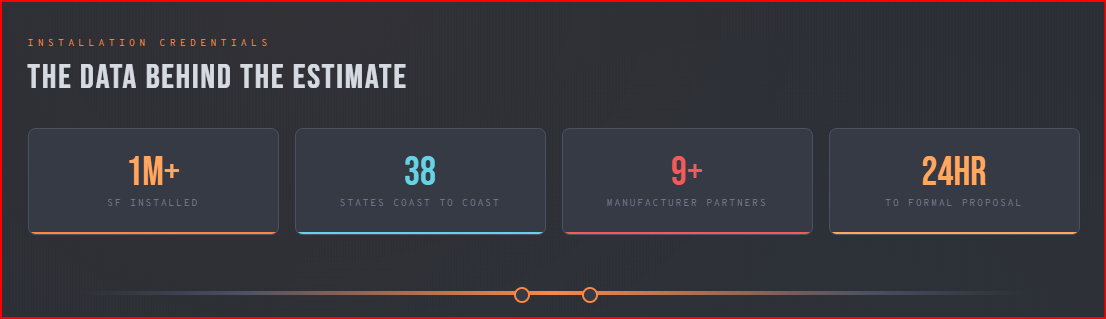
Terrapin Construction Group has installed over one million square feet of insulated metal panels across 38 states. That volume provides a depth of installed-cost data that no online calculator or manufacturer estimate can replicate. TCG's IMP installation crews come highly recommended by the manufacturers themselves — including PermaTherm, FALK, UPI, Arch Solar IMP, Kingspan, Metl-Span, CENTRIA, AWIP, and MBCI.
TCG installs IMP systems for cold storage facilities, food processing plants, cannabis cultivation environments, data centers, industrial buildings, retail and commercial projects, and pre-engineered metal buildings. That breadth of application experience means the estimating engine isn't calibrated to a single building type — it reflects the full spectrum of IMP installation conditions, from straightforward single-story warehouse enclosures to complex multi-story food processing facilities with hundreds of penetrations and stringent hygiene-grade finish requirements.
The estimator is also informed by TCG's direct relationships with multiple IMP manufacturers. Because TCG procures panels from multiple suppliers — not a single-source manufacturer — the Good / Better / Best estimate reflects competitive material pricing across the manufacturer landscape, not a single brand's list price. Through TCG's equipment procurement division, owners can access panel pricing that reflects volume purchasing relationships and multi-project procurement leverage that individual project buyers typically can't achieve.
Upload Your Plans — Get Instant IMP Pricing
Drop your floor plans, elevations, or panel layouts and receive a Good / Better / Best supply-and-install estimate in minutes.
Need a full project estimate beyond just the envelope?
Try TCG.ai for Total Construction Cost →
Ready to talk to our team?
Schedule a 30-Minute Conversation →
Thinking About IMP for Your Next Project? Start with the Right Number.
The difference between an IMP project that delivers on its budget and one that doesn't almost always traces back to the quality of the first estimate. If that first number was a material-only quote from a manufacturer rep, it missed 40–60% of the installed cost. If it was a generic square-foot multiplier from a cost database, it missed the specification-driven cost variance between a basic EPS wall and a high-performance PIR system. If it was a subcontractor bid from an installer who doesn't have national cost data, it may not have reflected the labor market conditions in your specific geography.
TCG's IMP Estimator addresses all three gaps. It delivers a supply-and-install estimate — not material-only. It provides Good / Better / Best specification tiers — not a single generic number. And it's backed by the installed-cost intelligence of a national installer with over a million square feet of panel experience across 38 states.
Terrapin Construction Group provides IMP installation services, commercial general contracting, construction management, preconstruction services, and design-build delivery for commercial and industrial projects nationwide. If you're planning a project with insulated metal panels and want a fast, credible installed-cost number — start with the tool and follow up with our team.
Upload your plans and get an IMP estimate → | Schedule a conversation →
You may also find the following related reading useful:
AI-Powered Commercial Construction Estimator: Instant Cost Estimates for Any Project Type
Average Cost to Build a QSR Restaurant in the USA
Average Cost to Build a QSR Coffee Shop in the USA
Average Cost to Build an Optometry Office in the USA
Hospital Construction Boom 2026
Commercial Construction Delivery Methods: Cost-Plus vs. GMP
Sources
Construction Executive — Insulated Metal Panels Improve Performance, Sustainability and Cost
Allied Steel Buildings — R-Value of Insulated Metal Panels
FMP Construction — Insulated Metal Panels in Modern Construction
Green Span Profiles — Insulated Metal Panel Market Growth Analysis
Astute Analytica — U.S. Insulated Metal Panels Market Forecast to $5.98 Billion by 2032
IndexBox — Insulated Metal Panels Market Analysis and Growth Outlook to 2035
IndexBox — United States Insulated Metal Panels Market, 2026 Edition
MarketsandMarkets — Insulated Metal Panels Market Report
Valuates Reports — Global Insulated Metal Panels Market Size, Growth 2026–2032
ResearchAndMarkets — Cold Storage Construction Market Analysis 2026–2030
Primus Builders — Cold Storage Construction in 2026
Construction Dive — Data Center Construction Trends 2026
Equipment World — Data Center Construction Boom 2026
PermaTherm — Insulated Metal Panel Systems
Gordian — Q1 2026 Construction Cost Insights Report
HomeGuide — Commercial Construction Cost Per Square Foot, 2026
