
Average Cost to Build a Veterinary Clinic from the Ground Up in the USA (2026): By Practice Type and Region
The veterinary care market in the United States is a $41.9 billion industry in 2025, projected to reach over $71 billion by 2034, and the physical infrastructure supporting that growth — purpose-built clinics, emergency hospitals, and specialty referral centers — represents one of the most active categories in commercial construction right now. Corporate consolidators backed by private equity have acquired hundreds of practices over the past five years, but the real construction activity is happening on the other side of the ledger: independent veterinarians building new clinics from scratch, regional groups expanding into underserved markets, and developers building veterinary-anchored medical retail as a credit-worthy tenant category.
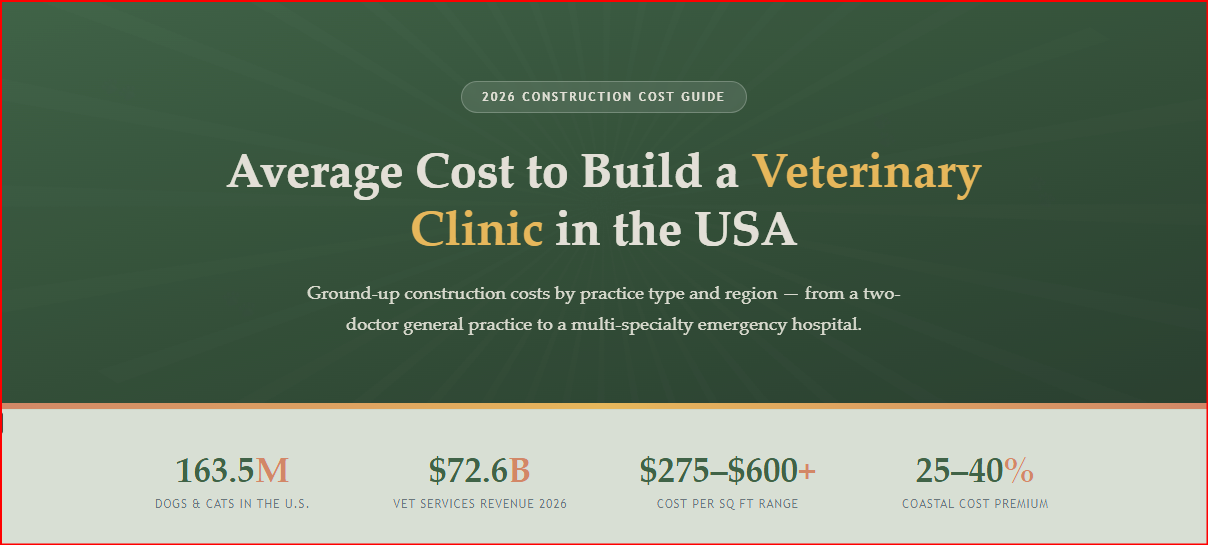
According to the American Veterinary Medical Association's 2025 Pet Ownership and Demographics Sourcebook, the U.S. dog population has grown to 87.3 million and the cat population to 76.3 million — a combined 163.5 million companion animals generating consistent demand for veterinary services. Pet owners are spending approximately $1,700 annually on their pets, with veterinary care accounting for roughly a third of that total. The veterinary services industry is expected to reach $72.6 billion in revenue in 2026, even as the sector navigates a cyclical softening in visit frequency. That demand backdrop makes ground-up veterinary construction a fundamentally sound real estate play — but one that requires clear-eyed budgeting, because the cost to build these facilities is routinely underestimated.
The range in the market is enormous. A two-doctor general practice on a suburban outparcel in Tennessee occupies a different financial universe than a 10,000-square-foot multi-specialty emergency hospital in suburban Boston. The number means nothing without understanding the variables behind it. This article breaks those variables down — by practice type, by scope, and by region — so veterinarians, practice developers, real estate investors, and commercial real estate professionals can build a realistic project budget before they've spent a dollar on architecture or site control.
At Terrapin Construction Group, we build commercial projects across all 50 states, including medical and healthcare-adjacent facilities with the specialized MEP, ventilation, and code compliance requirements that veterinary construction demands. The data in this article reflects current market conditions from our own project work, combined with benchmarks from the American Veterinary Medical Association, RSMeans/Gordian, BDA Architecture and Animal Arts, and active construction cost data across U.S. markets.
Understanding the Four Veterinary Clinic Build Types
Before any cost conversation is useful, you need to define which type of facility you're actually building. Veterinary construction breaks into four distinct categories, each with its own footprint, infrastructure requirements, regulatory burden, and cost profile. What a developer or veterinarian means by "vet clinic" can refer to any of these four things — and the total project cost difference between the simplest and most complex can be several million dollars.
Type 1: General Practice Clinic (Small — 1 to 2 Doctors)
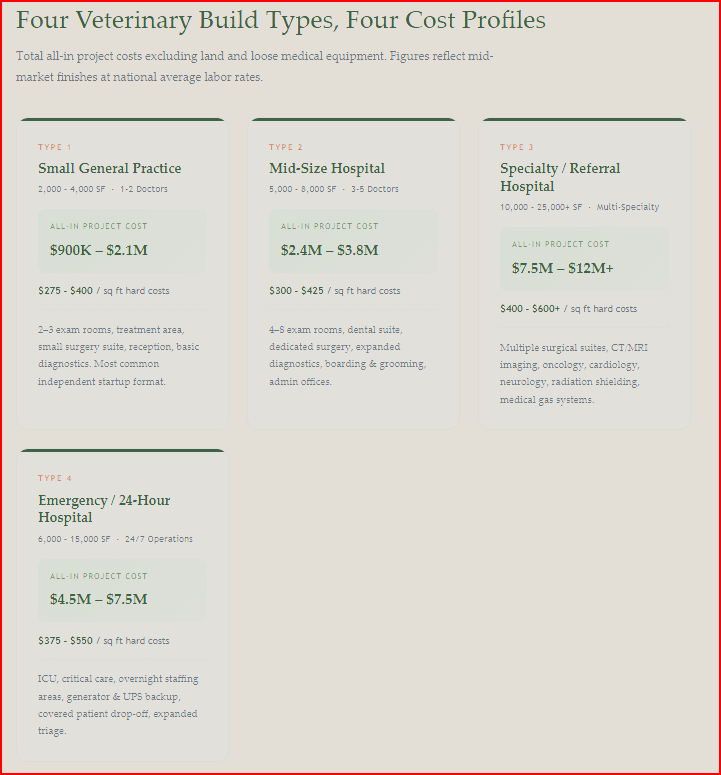
This is the entry-level freestanding veterinary facility — a standalone building with two to three exam rooms, a treatment area, a small surgery suite, reception, and basic diagnostic capability. Footprints typically run 2,000 to 4,000 square feet. According to Animal Arts' facility planning guidelines, the standard rule of thumb is 1,000 to 1,200 square feet of total hospital space per exam room, with approximately two exam rooms per doctor. A two-doctor, four-exam-room clinic therefore targets 4,000 to 4,800 square feet. This format serves the majority of independent practice startups and is the most common ground-up veterinary build in suburban and semi-rural markets across the country.
Type 2: General Practice Hospital (Mid-Size — 3 to 5 Doctors)
A larger, more capable facility with four to eight exam rooms, a dedicated dental suite, separate surgery, expanded diagnostics (digital radiography, in-house lab), boarding and grooming areas, and administrative office space. Footprints run 5,000 to 8,000 square feet. This is the build type most commonly targeted by corporate consolidator groups and well-capitalized independent owners building for long-term growth. The MEP scope increases substantially — more plumbing for kennels and wet areas, heavier HVAC loads for isolation rooms and surgical ventilation, and more complex electrical for diagnostic equipment. Site requirements expand proportionally: a building this size requires a lot roughly four to five times the building footprint, per dvm360's facility planning benchmarks, meaning a 6,000-square-foot hospital needs a site of roughly 24,000 to 30,000 square feet.
Type 3: Specialty and Multi-Specialty Referral Hospital
This is the highest-complexity veterinary build: a facility housing multiple specialty departments (surgery, internal medicine, cardiology, oncology, dermatology, neurology), advanced diagnostic imaging (CT, MRI, digital radiography), multiple operating theaters, and a large treatment and recovery area. Footprints range from 8,000 to 25,000 square feet and can exceed 35,000 square feet for large regional referral centers. The construction is closer to human medical office building standards than to a typical commercial retail build — structural reinforcement for heavy imaging equipment, radiation shielding for CT suites, specialized HVAC with isolation and positive/negative pressure zones, redundant electrical systems, and medical gas infrastructure. These projects are typically developed by multi-doctor specialty groups or private equity platforms and require design-build delivery to manage the complexity of coordinating medical equipment installation with base building construction.
Type 4: Emergency and 24-Hour Hospital
Emergency veterinary hospitals operate around the clock and require infrastructure designed for continuous staffing, high patient throughput, and critical care capability. Footprints generally run 6,000 to 15,000 square feet. The construction scope is similar to a specialty hospital in terms of MEP intensity, but with added requirements for overnight staff areas (break rooms, sleep rooms), expanded ICU capacity, and robust backup power systems including generator and UPS infrastructure. Many emergency hospitals also include some specialty services, blurring the line between Type 3 and Type 4. This is a format that has seen significant growth from groups like Veterinary Emergency Group (VEG), BluePearl, and MedVet, all of which are actively developing new locations.
Ground-Up Construction Cost Breakdown by Practice Type (2026 National Average)

The following figures represent hard construction costs for ground-up builds — site work, foundation, structure, MEP, finishes, built-in casework and kennels, and basic medical infrastructure. They exclude land acquisition, architectural and engineering fees (typically 10–15% of hard costs for veterinary facilities, slightly higher than standard commercial due to specialized design), loose medical equipment (digital radiography, ultrasound, lab analyzers, surgical equipment), permitting, and pre-opening expenses. They reflect mid-market finishes at the national average labor rate for open-shop construction. Regional adjustments are addressed in a later section.
As baseline reference points, BDA Architecture's Wayne Usiak places new freestanding veterinary practice construction at $225 to $350 per square foot nationally for the building component, while dvm360's ballpark estimating method uses $300 per square foot as a working baseline for building hard costs plus a 35% multiplier for soft costs, equipment, and contingency. Today's Veterinary Business reports that veterinary construction averages roughly $350 per square foot in current markets. With construction cost increases of 5–8% from 2025 into 2026 driven by tariff impacts on steel, aluminum, and copper — as we've covered in our analysis of commercial construction industry challenges in 2026 — the ranges below reflect today's pricing environment.
Type 1: Small General Practice Clinic — Total Project Cost Range
Building hard costs for a 2,500 to 4,000 square foot general practice clinic run approximately $275 to $400 per square foot at current national averages, putting the building shell, MEP, finishes, and built-in casework at $690,000 to $1,600,000. Site work adds $80,000 to $200,000 for parking, curb cuts, landscaping, storm drainage, signage, and site lighting on a typical suburban outparcel. Add soft costs (architecture, engineering, permitting) at 10–15% of hard costs and you arrive at a realistic all-in project cost, excluding land and loose medical equipment, of $900,000 to $2,100,000 for a market-rate small general practice build. Loose medical equipment — digital radiography, in-house lab analyzers, anesthesia machines, surgical table, dental unit, autoclaves — adds another $85,000 to $250,000 depending on scope and whether equipment is new or refurbished.
On the lower end of this range: a 2,500-square-foot two-exam-room clinic in a suburban Southern market on a well-prepared outparcel with existing utilities at the curb. On the upper end: a 4,000-square-foot facility in a Western or Northeastern market on a raw site requiring utility extensions and elevated finish standards.
Type 2: Mid-Size General Practice Hospital — Total Project Cost Range
Building hard costs for a 5,000 to 8,000 square foot mid-size hospital run $300 to $425 per square foot. The higher per-square-foot cost reflects the increased MEP complexity — more plumbing drops for kennels and wet treatment areas, dedicated surgical HVAC, dental suite infrastructure, and heavier electrical service for digital radiography and lab equipment. At 6,500 square feet, the building component alone runs $1,950,000 to $2,760,000. Site work on a proportionally larger lot adds $120,000 to $300,000. With soft costs and contingency, a mid-size general practice hospital runs $2,400,000 to $3,800,000 all-in, excluding land and loose equipment. Equipment at this tier — including digital radiography, ultrasound, full in-house lab, dental radiography, and surgical equipment — adds $200,000 to $500,000.
This is the format where design-build delivery creates the most value. Owners who engage a general contractor at the design stage — rather than pricing a completed set of construction documents — consistently recover 8–15% of hard costs through early value engineering on structural systems, MEP coordination, and casework specification. Terrapin's preconstruction team works with practice owners and their architects on precisely this kind of early-stage cost validation.
Type 3: Specialty and Multi-Specialty Referral Hospital — Total Project Cost Range
This is the highest-cost veterinary build type per square foot. Buildings run 10,000 to 25,000 square feet and require construction approaching medical office building standards. Hard costs run $400 to $600+ per square foot depending on the level of imaging infrastructure, number of surgical suites, and whether radiation shielding or structural reinforcement for heavy equipment (MRI, CT) is in scope. At 15,000 square feet, the building component alone is $6,000,000 to $9,000,000. Site work adds $200,000 to $500,000 for a larger lot with appropriate parking, emergency access, and potential generator pad. With soft costs, a specialty hospital build runs $7,500,000 to $12,000,000+ all-in, excluding land. Major diagnostic equipment — MRI ($1,000,000 to $1,500,000 installed), CT ($500,000 to $900,000 installed), plus surgical, endoscopy, and other specialty equipment — can add $2,000,000 to $5,000,000 or more to the total capital outlay.
Type 4: Emergency and 24-Hour Hospital — Total Project Cost Range
Emergency hospitals run 6,000 to 15,000 square feet with MEP intensity comparable to specialty facilities. Hard costs run $375 to $550 per square foot. At 10,000 square feet, the building component is $3,750,000 to $5,500,000. Site requirements include emergency vehicle access, generator infrastructure, and often a covered patient drop-off area. Site work runs $150,000 to $400,000. All-in project cost, excluding land and loose equipment: $4,500,000 to $7,500,000. Equipment adds $300,000 to $1,000,000 depending on the scope of diagnostic and critical care capability.
The Eight Factors That Move the Number Most
Within any practice type, these are the variables that create the most significant cost variance between projects at the low end and the high end of the range.
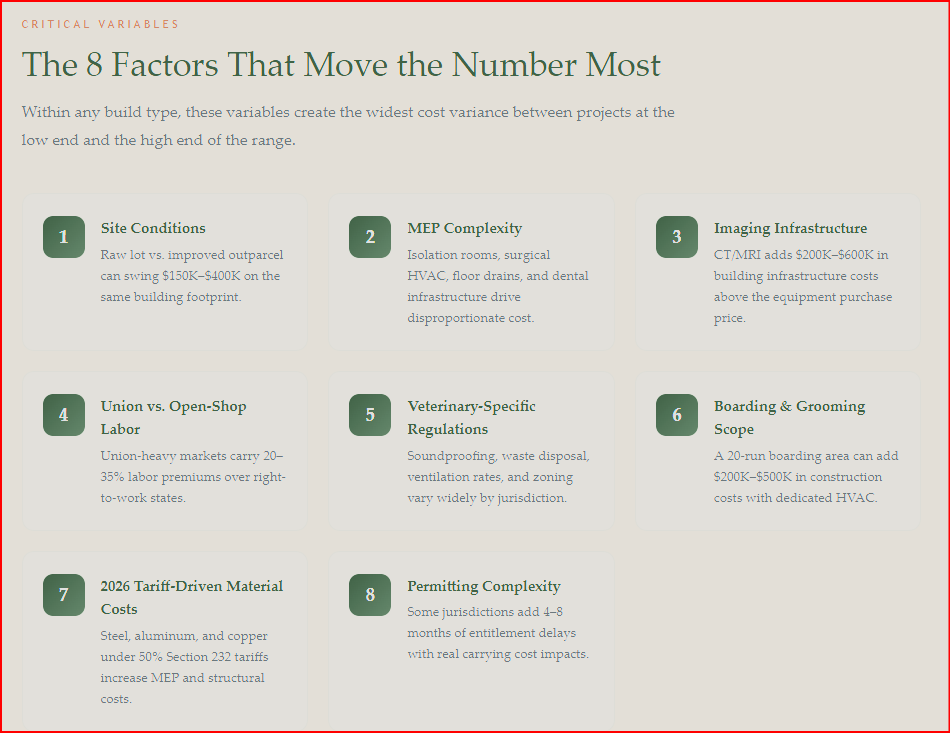
Site conditions are the most underestimated cost driver in veterinary development, just as they are in QSR restaurant construction and every other category of commercial ground-up work. A fully improved outparcel with existing utilities at the curb, a flat grade, and no environmental issues is a fundamentally different financial proposition than a raw lot requiring utility extensions, grading, storm water management, and possibly environmental remediation. The difference can be $150,000 to $400,000 in site-only costs on the same building footprint. This is why experienced owners' representatives conduct thorough due diligence on site conditions before entering into land purchase agreements.
MEP complexity is the single largest variable in the building itself. A basic general practice with two exam rooms, one surgery suite, and standard HVAC has a straightforward MEP scope. A hospital with isolation rooms requiring negative-pressure ventilation, surgical suites with dedicated air handling, dental suites with compressed air and vacuum, kennels with floor drains and wash-down capability, and radiology rooms with shielding has a radically different MEP budget. 9BA MEP, Terrapin's engineering and procurement partner, provides early-stage MEP budgeting specifically for healthcare and medical-adjacent facilities where these systems drive a disproportionate share of total cost.
Imaging infrastructure adds cost far beyond the equipment itself. CT scanners require structural reinforcement (the machines weigh thousands of pounds), dedicated electrical service, and specialized HVAC. MRI suites require radiofrequency shielding rooms (Faraday cages), reinforced flooring, and helium venting systems. These are not standard commercial construction scopes — they require experienced subcontractors and careful coordination between the equipment vendor, architect, and GC. Owners who plan to add advanced imaging should factor $200,000 to $600,000 in building infrastructure costs above the equipment purchase price.
Union versus open-shop labor markets create a structural cost difference of 20–35%, just as they do in QSR coffee shop construction and every other commercial build type. Union-heavy markets — New York, Boston, Chicago, Philadelphia, Seattle, and parts of California — carry labor premiums that are real and unavoidable. This doesn't mean open-shop is always better; union markets often have superior productivity on complex projects. But it is a real cost variable that owners need to account for when comparing across geographies.
Veterinary-specific regulatory requirements vary significantly by state and municipality. Some jurisdictions require specific ventilation rates for animal housing areas, separate HVAC zones for isolation, specialized waste disposal infrastructure, and soundproofing between animal housing and adjacent properties. In dense urban markets like New York City, acoustic isolation requirements, noise ordinance compliance, and strict zoning regulations for animal care facilities add substantial cost that suburban builds do not encounter.
Boarding and grooming scope is an increasingly common addition to general practice builds, but it adds significant square footage and infrastructure cost. Kennel areas require durable, washable finishes, floor drains with grease traps, dedicated HVAC for odor and moisture control, acoustic separation, and fire suppression. A well-built 20-run boarding area can add 1,000 to 2,000 square feet and $200,000 to $500,000 to a project depending on finish level and HVAC requirements.
Material pricing in 2026 is meaningfully higher than 2024 baselines due to tariff impacts. As we've covered in detail in our analysis of commercial construction delivery methods and cost-plus versus GMP contracting, steel, aluminum, and copper are all subject to Section 232 tariffs of 50% — and these materials are embedded in every commercial build through structural framing, MEP rough-in, and electrical service. Owners who front-load materials procurement through a GC with established supply chain relationships can meaningfully reduce exposure to mid-project price increases.
Permitting complexity and timeline in high-regulation markets adds both hard cost (permit fees, impact fees, traffic studies) and soft cost (carrying costs during extended entitlement periods). Veterinary facilities face additional permitting scrutiny in some jurisdictions due to animal housing, medical waste, and noise considerations. Some California jurisdictions can add 4–8 months to a project schedule through CEQA review or design review board processes. These delays have real dollar impacts on project financing and should be factored into any feasibility analysis.
Regional Construction Costs for Veterinary Clinics: What You'll Actually Pay by Market
The national average figures above are a useful starting point, but they are not what you'll pay in your specific market. Commercial construction costs vary 25–40% above national averages in major metro markets on the East and West coasts, while the South and parts of the Midwest price at or below the national average. Here's how those differences break down across the five major U.S. construction cost regions.
Southeast and South-Central (TX, FL, GA, TN, NC, SC, AL, AR, OK)
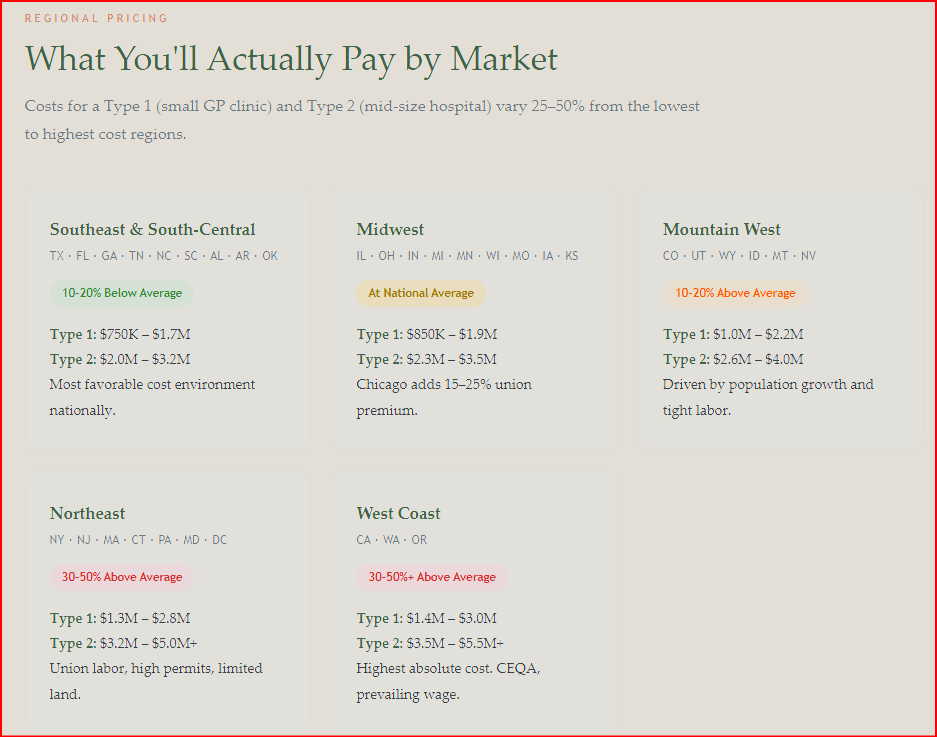
This region represents the most favorable construction cost environment for veterinary development in the United States. Right-to-work states, lower union density, and competitive subcontractor markets keep labor costs 10–20% below the national average. A ground-up small general practice clinic (Type 1) in Dallas, Houston, Atlanta, Nashville, or Charlotte runs approximately $750,000 to $1,700,000 all-in, excluding land and loose equipment. A mid-size general practice hospital (Type 2) in these markets runs $2,000,000 to $3,200,000. Texas and Florida in particular are high-growth veterinary markets where the pet population is expanding alongside overall population growth, and the construction cost environment supports favorable development economics. Terrapin's Houston office actively builds commercial projects across the Texas market.
Midwest (IL, OH, IN, MI, MN, WI, MO, IA, KS)
The Midwest tracks closely to national average construction costs with some urban exceptions. Chicago is a union market that adds 15–25% to labor costs relative to downstate Illinois or neighboring Indiana. Projects in secondary and tertiary Midwest markets — Columbus, Indianapolis, Kansas City, Des Moines — price at roughly the national average. Type 1 clinic in these markets: $850,000 to $1,900,000. Type 2 hospital: $2,300,000 to $3,500,000. Emergency and specialty builds in Chicago price at Northeast-adjacent levels due to union labor requirements and elevated permit complexity.
Mountain West (CO, UT, WY, ID, MT, NV)
The Mountain West has seen significant construction cost appreciation driven by population growth and strong commercial development activity. Colorado, Utah, and Idaho in particular are active markets for both veterinary practice development and the pet-owning demographics that support it. Construction costs run 10–20% above the national average in Denver, Salt Lake City, and Boise. Terrapin's Denver and Sheridan offices build across this region and can speak to current market conditions with precision. Type 1 clinic in Colorado: $1,000,000 to $2,200,000. Type 2 hospital: $2,600,000 to $4,000,000.
Northeast (NY, NJ, MA, CT, PA, MD, DC)
The Northeast is the most expensive construction region in the country for veterinary development. Union labor, high permit fees, dense urban sites with limited outparcel availability, and construction seasons shortened by weather all contribute to cost premiums of 30–50% above the national average. Type 1 clinic in the Northeast, where freestanding outparcels exist, runs $1,300,000 to $2,800,000. Type 2 hospital in Boston, Philadelphia, or suburban New York: $3,200,000 to $5,000,000 or more depending on site complexity. Leasehold buildout — converting existing retail or commercial space to veterinary use — is more common in this region than ground-up construction due to the scarcity and cost of developable land, with leasehold improvement costs averaging $130 to $200+ per square foot depending on the existing condition of the space. Terrapin's Albany office serves the greater Northeast market.
West Coast (CA, WA, OR)
California represents the highest absolute cost environment in the country for veterinary construction, just as it does for optometry offices, urgent care clinics, and every other category of commercial healthcare construction. High labor costs (both union and prevailing wage requirements), CEQA environmental review, design review boards, elevated permit fees, and aggressive fire and accessibility code enforcement drive projects to cost levels that challenge development economics for all but the best-capitalized owners. Type 1 clinic in the Los Angeles Basin, Bay Area, or Seattle metro: $1,400,000 to $3,000,000. Type 2 hospital in California: $3,500,000 to $5,500,000+. Oregon and Washington, outside of the Seattle and Portland metros, are somewhat more affordable — roughly 20–30% above the national average in most secondary markets.
Ground-Up Build vs. Leasehold Buildout: When Each Makes Sense
Not every veterinary project needs to be a ground-up freestanding building, and the choice between ground-up and leasehold buildout has significant cost and strategic implications.
Ground-up construction gives the practice owner complete control over the building's design, layout, and systems. The facility is purpose-built for veterinary medicine from the foundation up, with proper floor drains, load-bearing capacity for equipment, optimal room adjacencies, and HVAC designed for the specific mix of clinical, kennel, and public spaces. The practice owner (or their development entity) owns the real estate, building equity and capturing long-term appreciation. The trade-off is higher upfront cost, longer timeline, and the complexity of site acquisition and entitlement.
Leasehold buildout — converting existing retail, office, or commercial space to veterinary use — offers a lower upfront capital requirement and faster time to opening. Renovation expenses for veterinary conversion typically range from $130 to $250 per square foot depending on the condition of the existing space and the scope of veterinary-specific infrastructure required. But leasehold comes with compromises: existing structural limitations may prevent optimal layout, floor drains and plumbing may require expensive slab cuts, HVAC systems designed for retail or office use may not support the ventilation requirements of animal housing and surgical areas, and the practice owner builds no real estate equity. Many veterinarians start with a leasehold buildout and transition to a ground-up facility once the practice is established and cash flow supports the larger investment.
For practice owners evaluating either path, engaging a GC during preconstruction to validate costs before committing to a lease or a land purchase is the single most impactful step in de-risking the project budget.
What Makes Veterinary Construction Different from Standard Commercial
Veterinary facilities are not standard commercial retail or office buildings, and practice owners who budget based on general commercial construction benchmarks routinely encounter cost overruns. Here are the specific construction elements that make veterinary builds more complex and more expensive per square foot than a typical retail or restaurant project.
Plumbing density in a veterinary facility rivals or exceeds that of a restaurant or medical office. Every treatment area, surgery suite, dental station, kenneling area, grooming zone, and lab space requires hot and cold water supply and drain connections. Floor drains are required in wet areas throughout the building — not just restrooms. Grease traps or interceptors may be required depending on the jurisdiction and the scope of boarding or grooming operations. This plumbing scope drives both material cost and labor hours well beyond a typical commercial buildout.
HVAC requirements are more complex than any standard commercial application. Veterinary facilities require separate HVAC zones for clinical areas, kennel areas (which produce heat, moisture, and odor), surgical suites (which require controlled temperature and positive pressure), isolation rooms (which require negative pressure to prevent disease transmission), and public areas. Odor control is a design priority — particularly in boarding-heavy facilities or clinics near residential areas. Modern HVAC design for veterinary facilities increasingly incorporates energy recovery ventilators and variable refrigerant flow systems to manage the conflicting demands of these zones efficiently.
Acoustic isolation is a significant cost factor, particularly in urban and mixed-use settings. Animal housing areas generate noise that must be contained through acoustic insulation, sound-rated wall assemblies, and sometimes acoustic ceiling treatments. In dense urban environments, noise ordinance compliance can add $50,000 to $150,000 or more to the construction budget for a mid-size hospital.
Radiation shielding for diagnostic imaging adds material cost (lead-lined walls) and requires careful coordination between the equipment vendor, architect, and GC to ensure that shielding meets regulatory requirements and is properly installed before the imaging equipment arrives. Even basic digital radiography suites require some level of shielding; CT suites require substantially more.
Durable, chemical-resistant finishes are required throughout clinical areas. Standard commercial flooring, wall finishes, and casework will not hold up to the daily exposure to cleaning chemicals, biological waste, and animal traffic that veterinary facilities experience. Epoxy flooring, FRP wall panels, stainless steel casework, and solid-surface countertops are standard in clinical areas — and they cost substantially more per square foot than the LVT and painted drywall typical of retail or office construction.
The Three Planning Mistakes That Blow Veterinary Clinic Budgets
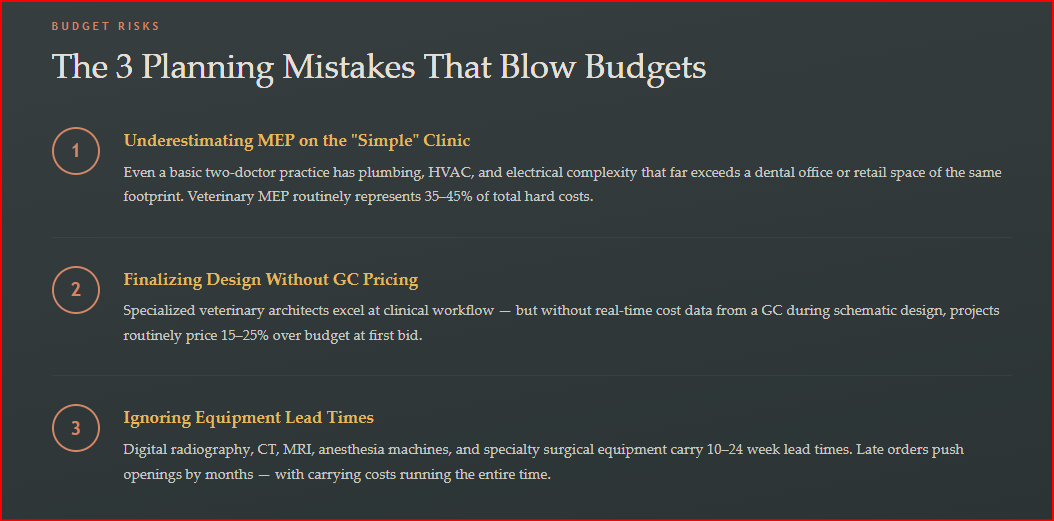
After managing commercial construction projects across the country, including QSR restaurants, cold storage facilities, logistics warehouses, and medical-adjacent facilities, these are the three most consistent planning mistakes we see derail veterinary clinic budgets.
The first is underestimating MEP scope on the "simple" general practice. Practice owners building their first clinic frequently see a 3,000-square-foot building and mentally compare it to a dental office or small retail space. But the plumbing, HVAC, and electrical requirements of even a basic two-doctor veterinary practice are substantially more complex than either of those building types. As Today's Veterinary Business reports, contractors frequently underestimate the price of steel and concrete due to market fluctuations, and veterinary projects are particularly vulnerable because the mechanical systems represent a disproportionate share of total cost. The owners' representative function TCG provides during due diligence is specifically designed to surface these costs before they become surprises.
The second is finalizing design without GC pricing. According to the American Institute of Architects, the majority of commercial projects are delivered to a GC for first pricing with a design that exceeds the owner's budget. Veterinary clinics are particularly vulnerable because specialized veterinary architects — while excellent at clinical workflow and patient care design — may not have real-time pricing data on the MEP and structural systems that drive cost in the current market. Engaging a GC at schematic design through preconstruction services closes the gap between design intent and buildable reality.
The third is ignoring lead times on medical and specialty equipment. Digital radiography systems, CT scanners, MRI units, anesthesia machines, and specialty surgical equipment have lead times of 10 to 24 weeks from major manufacturers. Practice owners who don't specify and order equipment early in the process risk pushing their opening date by months waiting on gear — while carrying construction loan interest and pre-opening overhead. TCG's equipment procurement division helps owners get equipment on order at the right time in the project sequence, coordinated with rough-in and utility installation so nothing sits in a warehouse waiting for the building to catch up.
Is a Pre-Engineered Metal Building Right for a Veterinary Clinic?
A growing number of veterinary practice owners and developers, particularly in suburban and semi-rural markets, are exploring pre-engineered metal buildings as a way to reduce structural costs and compress construction timelines. For general practice clinics in markets where architectural aesthetic standards are less restrictive, pre-engineered metal building systems can save 15–25% on structural costs compared to conventional light-frame or steel-frame construction, with the added benefit of faster fabrication and erection timelines.
The trade-off is architectural flexibility. Pre-engineered metal buildings have design constraints that can conflict with the warm, welcoming aesthetic many veterinarians want for their client-facing spaces. However, hybrid approaches — a pre-engineered structural shell with conventional interior buildout and a finished exterior façade — are increasingly popular and can capture much of the structural cost savings while maintaining the visual character of a conventional building. TCG evaluates PEMB suitability on a project-by-project basis as part of the preconstruction process.
The Veterinary Real Estate Investment Case
For commercial real estate developers and investors reading this article, veterinary clinics represent an attractive net-lease tenant category with several structural advantages. Veterinary practices generate consistent, recession-resistant revenue — even during the 2025 cyclical softening, veterinary practices saw revenue increases of approximately 2.5% as pricing power offset declining visit frequency. Veterinary tenants sign long-term leases (typically 10–15 years) because the cost and disruption of relocating a practice with built-in medical infrastructure is prohibitive. And the specialized nature of the buildout means that veterinary tenants have high switching costs — once they're in a purpose-built facility, they rarely leave.
The development model works well as a build-to-suit: a developer acquires the site, builds the facility to the veterinarian's specification, and leases it back on a long-term triple-net basis. The developer captures development profit and a stabilized NNN investment asset; the veterinarian gets a purpose-built facility without tying up capital in real estate. This structure is particularly effective in markets where veterinarians can't independently finance both a practice startup and a real estate acquisition. For developers interested in exploring veterinary build-to-suit, Terrapin's commercial construction team provides the GC execution on the construction side.
Thinking About a Veterinary Clinic Project? Start the Right Way.

The difference between a veterinary construction project that delivers on its pro forma and one that doesn't almost always traces back to decisions made in the first 60 days of the development process — site selection, practice type definition, GC engagement, and budget validation. That's the window where the most value is created and the most money is saved.
Terrapin Construction Group provides preconstruction services, commercial general contracting, construction management, and design-build delivery for commercial projects nationwide — including medical, healthcare-adjacent, and veterinary facilities. If you're planning a ground-up veterinary clinic or hospital and want a frank, current-market conversation about what it's going to cost to build, we'd welcome a 30-minute call.
Schedule a conversation → calendly.com/will-terrapincg/30min
You can also get a fast, no-obligation project estimate through our AI-powered estimating tools:
Try TCG's Instant AI Estimator →
You may also find the following related reading useful:
Average Cost to Build a QSR Restaurant in the USA
Average Cost to Build a QSR Coffee Shop in the USA
Average Cost to Build an Optometry Office in the USA
Urgent Care Construction Costs in the USA
Cold Storage Construction Costs in the USA
3PL/Logistics Warehouse Construction Costs in the USA
Commercial Construction Delivery Methods: Cost-Plus vs. GMP
Commercial Construction Industry Challenges 2026
AI Advancements in Commercial Construction 2026
High-End Restaurant Construction Cost Per Square Foot
Grocery-Anchored Strip Mall Construction Costs
Commercial Real Estate Developer Pain Points & GC Relationship
IMP Installation Technical Guide
Cannabis Cultivation Facility Value Engineering
Hospital Construction Boom 2026
Sources
American Veterinary Medical Association — 2025 Pet Ownership and Demographics Sourcebook
American Veterinary Medical Association — Veterinary Economics Market Report, 2026
dvm360 — What Does Go Into "Cost Per Square Foot"?
dvm360 — Ballpark Estimates for Your New Veterinary Hospital
Today's Veterinary Business — Small Spaces, Mighty Places, 2026
Today's Veterinary Business — Avoid Costly Surprises When Building a Clinic
Animal Arts / Shor-Line — How Large Should My Hospital Be?
dvm360 — Pick the Perfect Veterinary Hospital Location
OG Analysis — Veterinary Care Market Outlook 2026–2034
IBISWorld — Veterinary Services in the US Industry Analysis, 2026
ProjectionHub — Opening a Profitable Vet Clinic: Numbers You Need to Know
Suveto — The Costs of Starting a Veterinary Practice
American Animal Hospital Association — Corporate Consolidation and Private Equity
Transitions Elite — Veterinary Practice Consolidators and 2026 Market Outlook
AZ New York — Veterinary Clinic Cost Calculator: NYC 2026
HomeGuide — Commercial Construction Cost Per Square Foot, 2026
RSMeans/Gordian — Construction Cost Data
Frequently Asked Questions: Veterinary Clinic Construction Costs
How much does it cost to build a veterinary clinic per square foot?
Ground-up veterinary clinic construction costs $200 to $500+ per square foot depending on practice type and specialty scope, with total project costs ranging from $750,000 for a basic general practice to over $3 million for a full emergency and specialty hospital with surgical suites, diagnostic imaging, and overnight boarding.
Why are veterinary clinics more expensive than standard medical offices?
Veterinary facilities require specialized MEP systems — medical gas, surgical ventilation, isolation ward negative pressure, dental suite infrastructure, radiology shielding, and extensive plumbing for treatment and bathing areas — that create construction complexity comparable to human healthcare facilities. Kennel and boarding areas also require specialized drainage, ventilation, and noise isolation.
What is the cost difference between a general practice and emergency veterinary hospital?
A general veterinary practice (2,500–4,500 SF) typically costs $750,000 to $1.5 million all-in. An emergency and specialty hospital (8,000–15,000+ SF) with surgical suites, CT/MRI imaging, ICU, and 24/7 boarding costs $2.5 to $5+ million. The cost delta is driven by diagnostic imaging infrastructure, surgical suite HVAC, and overnight care systems.
Should I build ground-up or do a tenant improvement for a vet clinic?
TI buildout in existing space costs $150–$350/SF but limits layout flexibility, especially for surgical and imaging suites that have specific structural and shielding requirements. Ground-up construction costs more total but allows optimal workflow design, purpose-built MEP systems, and long-term operational efficiency. The decision depends on budget, timeline, and available real estate.
How long does it take to build a veterinary clinic?
General practice TI buildout: 3–5 months. Ground-up general practice: 6–9 months. Ground-up emergency/specialty hospital: 10–16 months. Equipment lead times for imaging systems (CT, digital X-ray) are 12–20 weeks and must be coordinated with construction.
How do I get a veterinary clinic construction estimate?
TCG's AI construction estimator provides preliminary vet clinic cost estimates. Schedule a call for project-specific preconstruction budgeting.
