
Architectural and Engineering Fees and Soft Costs in Commercial Construction (2026): By Facility Type and Region

Every commercial construction budget has two sides. Hard costs — the materials, labor, equipment, and subcontractor work that physically build the structure — get the most attention because they're tangible, visible, and represent the largest absolute dollar amount. But soft costs — the professional fees, regulatory expenses, financing charges, insurance, and project management that make the project possible — are where budgets quietly expand, where first-time developers get blindsided, and where experienced owners gain their most significant competitive advantages.
Soft costs on commercial projects typically represent 15 to 30% of total development cost, with complex institutional projects like hospitals and government buildings reaching 25 to 35%. Within that soft cost envelope, architectural and engineering fees are almost always the largest single line item. And yet, when developers, operators, and commercial real estate professionals ask "what does an architect cost?" or "what percentage should I budget for soft costs?" — the answers they get are usually either too vague to be useful or too specific to one project type to be applicable.
This article breaks down A/E fees as a percentage of construction cost across ten commercial building types, then maps the complete soft cost picture — permits, plan review, insurance, financing, legal, and project management — by facility type and region. The data reflects Terrapin Construction Group's project experience across all 50 states, benchmarked against current industry data from the American Institute of Architects, RSMeans/Gordian, Monograph's 2026 A/E fee analysis, and Cushman & Wakefield's 2026 market data.
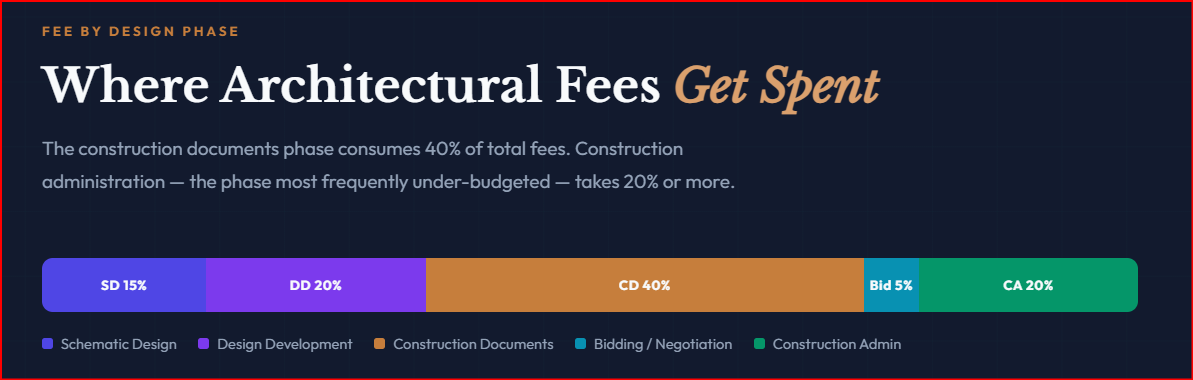
What Soft Costs Actually Include — and Why the Range Is So Wide
Soft costs encompass every project expense that is not a direct hard construction cost. The reason the percentage range spans from 15% to 35% of total project cost is that different building types carry vastly different regulatory, design, and financing complexity — and each of those variables adds soft cost.
The major soft cost categories, in order of typical magnitude, are architectural and engineering design fees (the largest category, typically 8–15% of total project costs according to Revizto's commercial construction cost analysis), regulatory and legal costs including permits, plan review, impact fees, and environmental studies (typically 3–5% of total costs), financing costs including construction loan interest, lender fees, and interest reserves (typically 3–8% depending on project duration and financing structure), insurance including builders risk, general liability, and professional liability (typically 1–4% of construction cost), and project management, construction administration, and owner's representation (typically 2–5% of total costs).
A simple warehouse with a straightforward structural design, minimal permitting complexity, and a short construction timeline hits the low end of all these categories simultaneously — total soft costs of 12 to 18%. A hospital with a multi-discipline design team, specialized engineering consultants, complex code review, extended permitting, construction financing carrying over 18 to 24 months, and multiple layers of insurance and compliance hits the high end of every category — total soft costs of 28 to 35% or more.
Architectural Fees as a Percentage of Construction Cost by Building Type

Architectural fees have evolved significantly from the traditional "6% of construction cost" benchmark that defined the industry for decades. As Siana's 2026 fee analysis documents, commercial architectural fees have moved into the 8 to 12% range for many project types, reflecting increased code complexity, sustainability requirements, technology integration, and expanded construction administration scope. Monograph's current industry benchmarks place private-sector architectural fees at 7 to 10% of construction cost for general commercial work, with residential at 8 to 15% and renovations at 15 to 20% due to added complexity.
But the "general commercial" average masks enormous variation by building type. The architectural profession classifies projects into complexity groups that directly correlate with fee percentages. Simple, utilitarian structures with repetitive elements require less design effort per dollar of construction cost. Complex, highly regulated, MEP-intensive facilities require substantially more. Here is how A/E fees break down across the commercial building types most relevant to commercial real estate development in 2026.
Warehouses, Distribution Centers, and Simple Industrial
This is the lowest-fee category in commercial architecture. Warehouses and distribution centers are structurally repetitive, have minimal interior finish requirements, and carry relatively straightforward code compliance paths. Architectural fees for standard warehouse and industrial buildings typically run 3 to 6% of construction cost, with the lower end for larger facilities where economies of scale reduce the per-dollar design effort. Engineering fees — structural and MEP — add another 1.5 to 3%, bringing total A/E fees to approximately 4.5 to 9% of construction cost. For context, on a 100,000-square-foot distribution center with a construction cost of $6 to $8 million, total A/E fees might run $360,000 to $720,000.
The exception within this category is specialized industrial — cold storage facilities, automated 3PL logistics centers, and food processing plants — where the complexity of the refrigeration system, IMP envelope specification, and regulatory compliance (USDA, FDA/FSMA) pushes A/E fees into the 6 to 10% range.
Retail and QSR
Retail construction sits in the moderate complexity range. A basic retail shell — the kind a developer builds as a strip center or grocery-anchored retail center — carries architectural fees of 4 to 7% of construction cost. The design effort is modest: repetitive bay spacing, standardized MEP, and minimal interior architecture (since tenants do their own TI buildouts).
QSR and restaurant projects command higher fees — 6 to 10% — because of the commercial kitchen design coordination, specialized MEP systems (ventilation, grease, fire suppression), and the increasingly complex brand prototype requirements that franchise operators mandate. As we've documented in our analyses of QSR restaurant construction costs, QSR coffee shop costs, and high-end restaurant construction, the MEP coordination between the kitchen design consultant, the mechanical engineer, the fire protection engineer, and the architect is one of the most coordination-intensive scopes in commercial design — and that coordination drives fees.
Office Buildings
Office construction spans a wide fee range depending on building class, size, and complexity. A single-story Class B office building in a suburban market might carry architectural fees of 5 to 8% of construction cost. A mid-rise Class A office building with a curtain wall facade, complex lobby design, structured parking, and LEED certification runs 7 to 10%. According to ArchitecturalFees.com's complexity analysis, office buildings with tenant improvement coordination fall into the highest complexity group, pushing fees toward the upper end of the range. Engineering fees on office projects — structural, mechanical, electrical, plumbing, fire protection, and potentially civil — add 3 to 5%, bringing total A/E to 8 to 15% of construction cost.
Medical and Healthcare Facilities
Healthcare is the highest-fee category in commercial architecture, and it's not close. The combination of specialized MEP systems, infection control requirements, medical equipment planning, complex code compliance (life safety, accessibility, radiation shielding), and the number of specialized engineering consultants required drives architectural fees to 7 to 12% of construction cost and total A/E fees to 10 to 18%. State-level fee schedules classify hospitals, laboratories, medical office buildings and clinics, and research facilities all in the highest complexity group alongside convention centers and prisons.
For the medical building types TCG most commonly builds — optometry offices, urgent care centers, dental offices, and general medical office — A/E fees typically run 8 to 12% of construction cost. For hospital and surgical center projects, covered in our 2026 hospital construction analysis, fees can reach 10 to 15% or more when specialized consultants for medical equipment planning, acoustics, and infection control are added to the base architectural and engineering team.
Pre-Engineered Metal Buildings
Pre-engineered metal buildings occupy a unique position in the A/E fee landscape. The structural design is largely handled by the PEMB manufacturer's engineering department as part of the building package, which significantly reduces the owner's structural engineering cost. The architect's role on a PEMB project is typically focused on the foundation design, site plan, code compliance documentation, and any interior buildout design — a reduced scope compared to conventional construction. Architectural fees for PEMB projects typically run 3 to 6% of total project cost, with total A/E (including the manufacturer's engineering, which is embedded in the building package price) running 5 to 9%.
Cannabis Facilities
Cannabis cultivation and processing facilities carry A/E fees of 7 to 11% of construction cost due to the specialized environmental control systems, security design requirements, and the evolving regulatory frameworks that differ by state. The design team on a cannabis facility typically includes a mechanical engineer with controlled-environment experience, a security consultant, and often a regulatory compliance specialist in addition to the base architectural team. Our analyses of cannabis cultivation facility value engineering and cannabis emerging markets detail how facility design complexity directly drives both construction cost and A/E fees in this category.
Engineering Fees: The Component That Gets Underestimated
When most people say "architect fees," they're actually talking about the combined cost of architectural and engineering services. But on commercial projects, the engineering consultants — structural, mechanical, electrical, plumbing, fire protection, civil, and potentially specialty disciplines like acoustics, lighting design, or medical equipment planning — are typically separate contracts coordinated through (and sometimes contracted under) the architect. Monograph's industry analysis places MEP engineering at 5 to 15% of construction cost depending on facility complexity — a range that can equal or exceed the architectural fee itself on MEP-intensive building types like hospitals, laboratories, and data centers.
The engineering fee is the component that creates the most budget surprise on first-time development projects. An owner who budgets "8% for the architect" and discovers that the structural engineer, MEP engineer, civil engineer, and fire protection engineer add another 5 to 8% has just found a six-figure gap in their project budget. Terrapin's preconstruction process identifies the full A/E team scope and fee structure during the project budgeting phase — before design begins — so owners have a complete picture of design costs alongside construction costs.
The Complete Soft Cost Picture Beyond A/E Fees
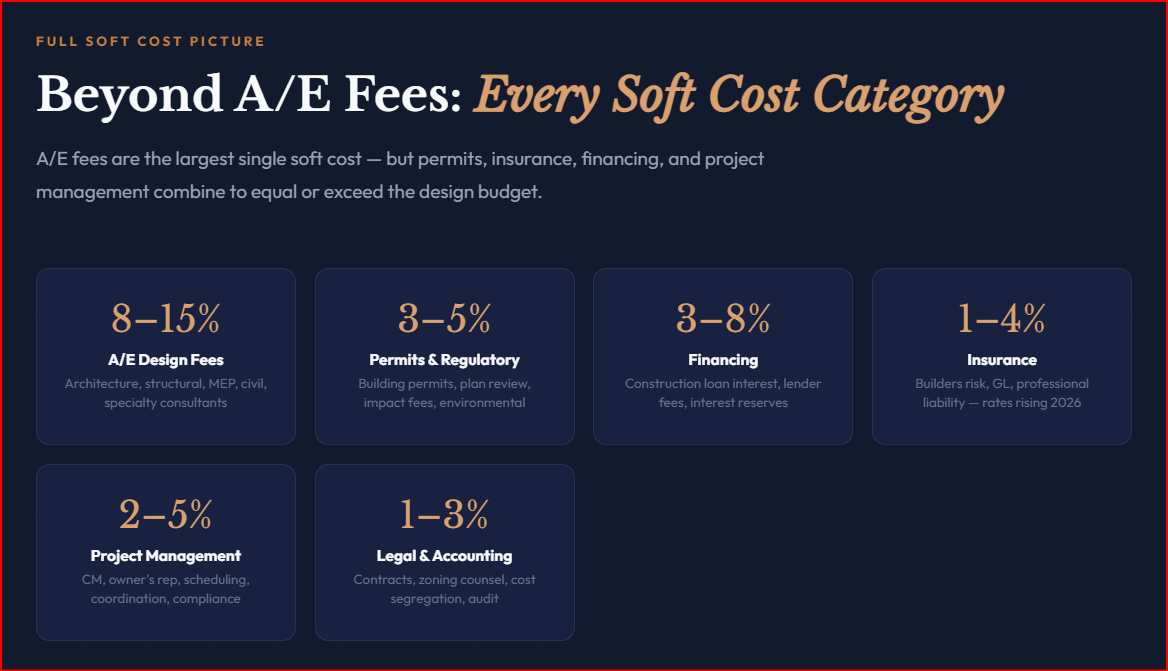
A/E fees are the largest single soft cost category, but they're not the whole picture. Here is where the rest of the soft cost budget goes on a typical commercial project.
Permitting, Plan Review, and Impact Fees
Permitting costs are one of the most variable soft cost categories in commercial construction because they are entirely jurisdiction-dependent. A building permit in a business-friendly Texas municipality might cost $2,000 to $8,000 for a mid-size commercial project. The same project in a California jurisdiction can generate $15,000 to $50,000 or more in permit fees, plan review fees, school impact fees, traffic impact fees, park fees, and other development charges — before accounting for the timeline cost of an entitlement process that can add 4 to 8 months to the project schedule.
As we've noted in our coverage of 2026 industry challenges, permitting timelines have become one of the most significant schedule risks in commercial development, particularly in high-regulation markets on both coasts. The soft cost impact isn't just the fees themselves — it's the carrying costs (construction loan interest, insurance premiums, project management overhead) that accrue during every month of delay. An experienced owner's representative who understands the permitting landscape in a specific jurisdiction can identify these timeline risks during site selection, before the owner is committed to a specific location.
Insurance
Construction insurance on commercial projects includes builders risk insurance (typically 1 to 3% of construction cost), general liability, professional liability, and workers compensation carried by the GC and subcontractors (embedded in their pricing). Ames & Gough's 2026 survey of A/E liability insurers found that 73% plan rate increases in 2026, citing rising claim costs, economic uncertainty, and new risks from artificial intelligence in design. Insurance costs are trending upward across the industry, and owners should budget accordingly.
Construction Financing
For projects that carry construction debt, financing costs — interest during construction, lender fees, draw inspection fees, and interest reserves — typically represent 3 to 8% of total project cost depending on project duration, loan-to-cost ratio, and current interest rates. This is a carrying cost that is directly proportional to the construction timeline: every month of construction extends the interest accrual period. Delivery methods that compress the construction schedule — such as design-build — reduce financing soft costs by getting the project to revenue (or to occupancy for owner-occupied facilities) faster.
Legal and Accounting
Legal fees for commercial construction projects typically include lease review or drafting (for tenant improvement projects), construction contract review and negotiation, zoning and land use counsel, and lien waivers and closeout documentation. Accounting costs include cost segregation studies (for tax depreciation acceleration), construction audit, and project accounting. Combined, legal and accounting typically represent 1 to 3% of total project cost.
Project Management and Construction Administration
Project management — whether provided by an in-house team, a third-party construction manager, or an owner's representative — typically represents 2 to 5% of total project cost. Construction management fees are sometimes structured as a percentage of construction cost and sometimes as a fixed fee or guaranteed maximum price. The value of this cost is measured in what it prevents: scope gaps, coordination failures, schedule delays, and budget overruns that routinely cost multiples of the management fee on projects that try to operate without professional oversight.
Need a complete project budget — hard costs and soft costs?
Terrapin Construction Group provides preconstruction budgeting, construction management, and design-build delivery for commercial projects nationwide. Get a current-market starting estimate with our TCG.ai instant estimator.
Schedule a 30-minute conversation →
Regional Soft Cost Variation: Where Location Adds 10% — or 50%
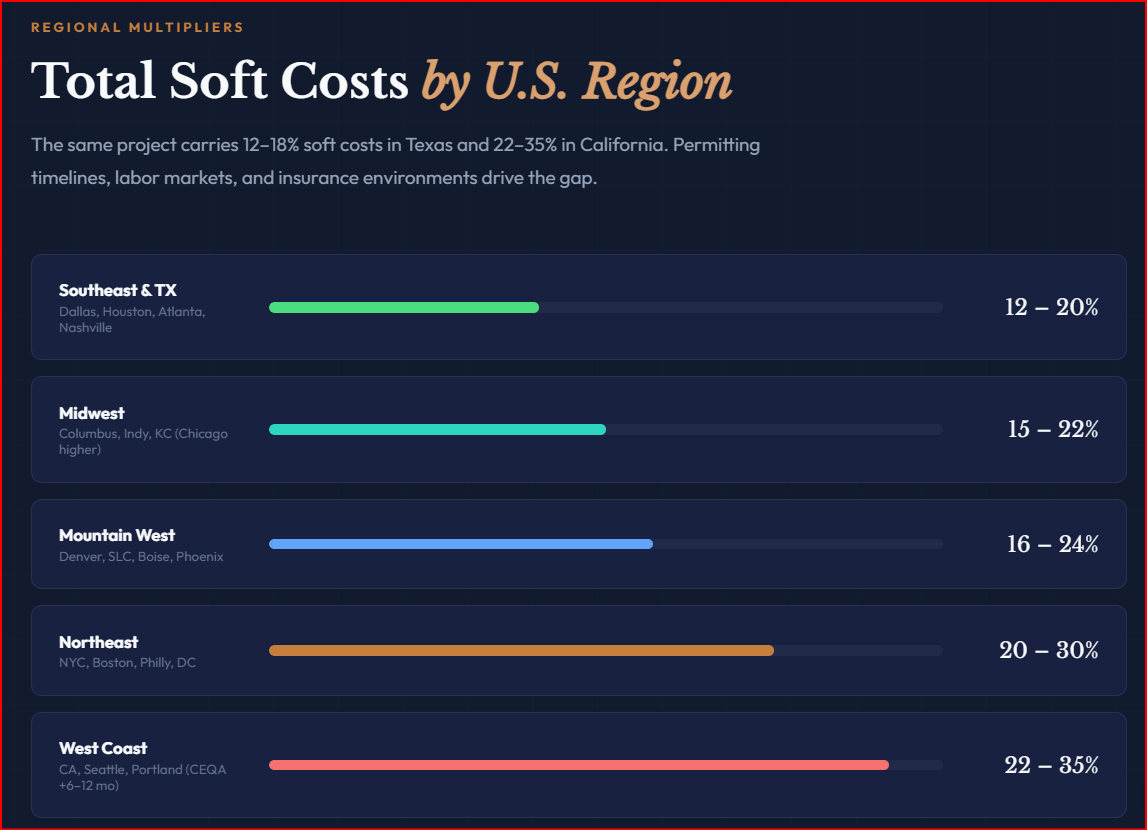
Soft costs are not uniformly distributed across U.S. markets. The same building type with the same design complexity will carry meaningfully different soft costs depending on the jurisdiction's regulatory environment, local A/E market pricing, permitting fees, and insurance requirements.
The Southeast and Texas markets offer the most favorable soft cost environment for commercial development. Streamlined permitting in most jurisdictions, competitive A/E markets with ample firm capacity, lower insurance premiums, and right-to-work labor environments that keep construction timelines shorter (reducing financing carrying costs). Total soft costs in these markets typically run 12 to 20% of total project cost for standard commercial building types. Terrapin's Houston office builds across this market and can quantify these advantages with precision.
The Midwest tracks close to the national average for soft costs. A/E fees are moderate, permitting is generally reasonable outside of Chicago (which carries union labor and more complex regulatory requirements), and insurance costs are in line with national norms. Total soft costs: 15 to 22%.
The Mountain West — including Terrapin's Denver and Sheridan markets — has seen A/E fee inflation driven by high construction activity and strong demand for design services. Permitting varies significantly by jurisdiction within the region. Total soft costs: 16 to 24%.
The Northeast carries elevated soft costs across every category. Higher A/E fees (reflecting the cost of doing business in high-cost-of-living metros), complex permitting with extended timelines, higher insurance premiums, and longer construction durations that increase financing carrying costs. Terrapin's Albany office serves this market. Total soft costs: 20 to 30%.
The West Coast — California in particular — represents the highest soft cost environment in the country. CEQA environmental review can add 6 to 12 months to a project timeline before construction even begins. Design review boards in many California cities add another layer of approval. Title 24 energy compliance adds design and documentation cost. Permit fees and impact fees are among the highest in the nation. Professional liability insurance premiums are elevated due to California's litigation environment. Total soft costs in California: 22 to 35% of total project cost, with complex projects reaching 30%+ routinely.
How Design-Build Reduces Soft Costs
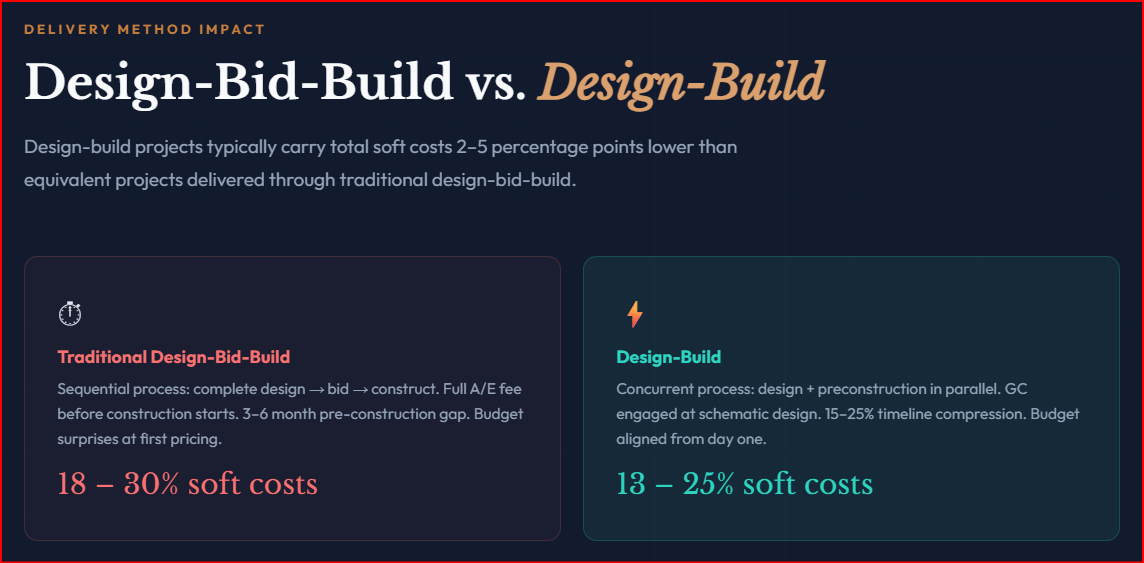
One of the most significant — and least discussed — advantages of design-build project delivery is its impact on soft costs. In a traditional design-bid-build delivery, the architect completes a full set of construction documents before the project goes out to bid. The owner pays for the complete A/E fee (8–15% of construction cost), waits 3 to 6 months for design completion, then goes through a bidding period of 4 to 8 weeks, and finally starts construction. Every month of that pre-construction timeline adds financing carrying costs.
In a design-build delivery, the GC is engaged during design — often at schematic design — and design and preconstruction proceed concurrently. This compresses the overall timeline by 15 to 25% on most projects, directly reducing the financing and insurance carrying costs that represent 4 to 12% of soft costs. It also eliminates the budget gap between design intent and construction reality — the problem we've discussed in detail in our coverage of commercial construction delivery methods and the developer pain points that drive cost overruns.
Design-build also reduces the owner's A/E fee exposure in some cases, because the GC's preconstruction team performs constructability review, value engineering, and cost estimating work that would otherwise require additional consultant fees in a traditional delivery. The net effect is that design-build projects typically carry total soft costs 2 to 5 percentage points lower than equivalent projects delivered through traditional design-bid-build — a meaningful savings on any project over $1 million in construction cost.
The Planning Mistakes That Inflate Soft Costs
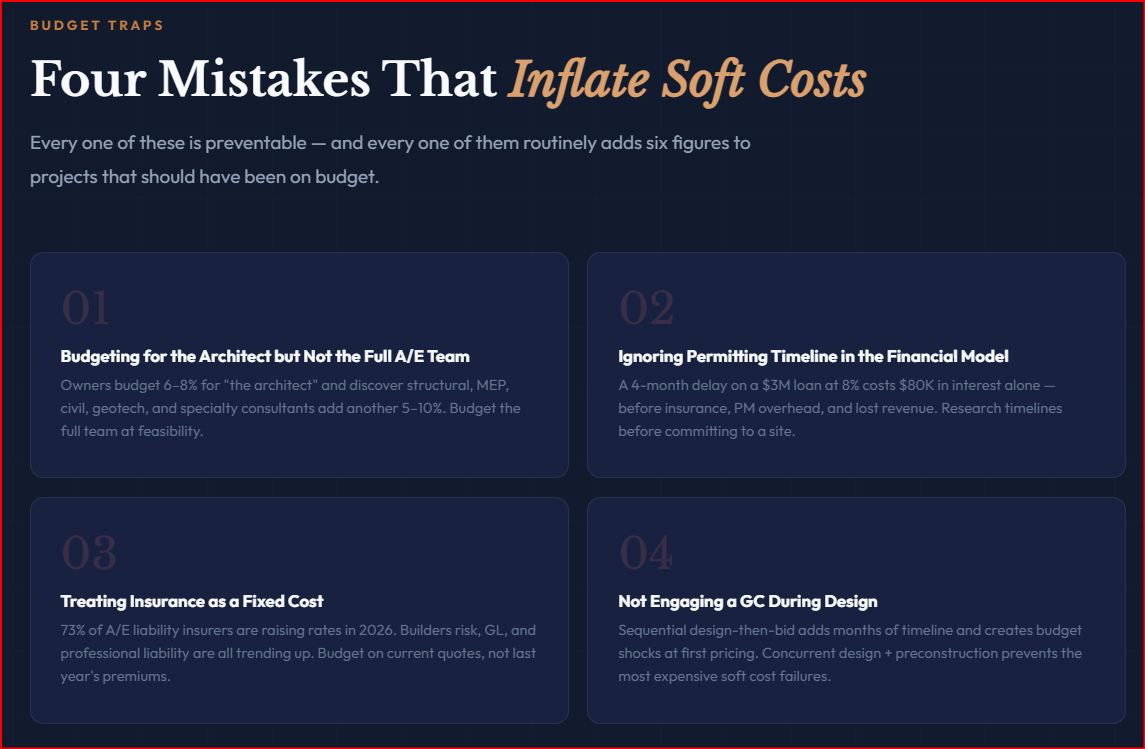
After managing projects across every commercial building type and every U.S. region, these are the most consistent soft cost planning failures we see.
Budgeting for the architect but not the full A/E team. First-time developers routinely budget 6 to 8% for "the architect" and discover that the structural engineer, MEP engineer, civil engineer, geotechnical engineer, surveyor, and specialty consultants add another 5 to 10%. The full A/E team should be budgeted during project feasibility, not discovered during design.
Ignoring permitting timeline in the financial model. A 4-month permitting delay on a project with a $3 million construction loan at 8% interest costs $80,000 in carrying costs alone — before accounting for extended insurance, project management overhead, and lost revenue from delayed occupancy. Owners who don't research permitting timelines in their target jurisdiction before committing to a site are accepting unquantified financial risk.
Treating insurance as a fixed cost. Insurance costs — particularly builders risk and professional liability — are trending upward in 2026. Industry data shows 73% of A/E liability insurers planning rate increases. Owners who budget insurance based on last year's premiums may find a meaningful gap at policy binding.
Not engaging a GC during design. This is the single most impactful soft cost decision any owner can make. Engaging a GC with preconstruction capability during the design phase — not after design is complete — prevents the redesign cycles, bid-phase budget shocks, and scope gaps that inflate both hard costs and soft costs. The construction industry has a well-documented pattern of designs exceeding budgets at first pricing, as the AIA itself acknowledges. The cure is concurrent design and preconstruction, not sequential.
Using AI Estimating Tools for Early-Stage Soft Cost Budgeting
One of the reasons soft costs catch developers off guard is that they're difficult to estimate without project-specific data. TCG.ai — Terrapin's AI-powered construction estimator — provides preliminary project cost estimates that include soft cost ranges calibrated to building type and market, giving developers and operators a realistic total project budget at the feasibility stage, before they've engaged an architect or committed to a site. For projects with insulated metal panel scope, the IMP Install Estimator provides panel-specific cost data that feeds into the broader project budget. These tools don't replace professional preconstruction services, but they close the gap between "I have no idea what this will cost" and "I have a defensible budget range to work from" — which is the gap where most soft cost surprises originate.
Terrapin Construction Group provides preconstruction services, commercial general contracting, construction management, design-build delivery, and owner's representation across all commercial building types nationwide. Our offices in Denver, Houston, Albany, and Sheridan serve projects across all 50 states. If you're planning a commercial project and want a complete budget picture — hard costs and soft costs, with nothing left out — we'd welcome a conversation.
Get a complete project budget — hard costs and soft costs included:
→ Try TCG.ai — Instant Construction Estimator
→ Get an IMP Installation Estimate
→ Schedule a 30-Minute Conversation with Our Team
Related Reading
Tenant Improvement Buildout Costs for Commercial Retail Space (2026)
Commercial Construction Delivery Methods: Cost-Plus vs. GMP
Commercial Real Estate Developer Pain Points
Commercial Construction Industry Challenges 2026
Average Cost to Build a QSR Restaurant in the USA
Average Cost to Build a QSR Coffee Shop in the USA
Average Cost to Build an Optometry Office in the USA
Average Cost to Build a Veterinary Clinic in the USA
Hospital Construction Boom 2026
High-End Restaurant Construction Cost Per Square Foot
Grocery-Anchored Strip Mall Construction Costs
Cold Storage Construction Costs in the USA (2026)
IMP Installation for Cold Storage & Controlled-Environment Facilities
IMP Market Volume and Installation Trends (2026)
IMP Manufacturer Comparison
AI Advancements in Commercial Construction
Strait of Hormuz: Geopolitical Impact on Construction Costs
Cannabis Cultivation Facility Value Engineering
Cannabis Emerging Markets: Minnesota and Kentucky
Urgent Care Construction Costs
3PL/Logistics Construction Costs
Sources
American Institute of Architects — Calculating the Architect's Fee
Monograph — Architectural & Engineering Fee Estimating Guidelines, February 2026
Siana — Architect Fee Percentage by Project Phase: 2026 Report
ArchitecturalFees.com — Commercial Architectural Fees by Complexity Group
HomeGuide — How Much Does an Architect Cost? (2026)
Revizto — Average Commercial Construction Costs Per Square Foot
Cushman & Wakefield — 2026 Office Fit Out Cost Guide
RSMeans/Gordian — Construction Cost Data
Insurance Business / Ames & Gough — A/E Liability Insurers Plan Rate Hikes in 2026
Young Architect — Hard Costs vs. Soft Costs: Making Cents of Construction
TCLI / Estimating Link — Soft Costs in Construction: Contractor Guide
Multifamily Loans — Apartment Construction Costs: Investor Guide 2026
Arrant Construction — Commercial Construction Costs in Texas (2026 Guide)
BuildersRisk.net — Builders Risk Insurance Costs
Leap Architecture — Architecture Services Cost in 2026: Complete Pricing Guide
Architekwiki — Architectural Fee as a Percent of Construction Cost
MMCG Invest — Mixed-Use Development Cost Breakdown 2025
FAQ
-
Total architectural and engineering fees on commercial projects typically range from 4.5% to 18% of construction cost, depending on building type and complexity. Simple, repetitive structures like warehouses and pre-engineered metal buildings fall at the low end — 4.5 to 9% combined for architecture and all engineering disciplines. Mid-complexity building types including QSR restaurants, QSR coffee shops, high-end restaurants, retail centers, and office buildings run 7 to 15%. High-complexity facilities — urgent care centers, optometry offices, dental clinics, hospitals, and laboratory environments — carry the highest A/E fees at 10 to 18% of construction cost. The critical budgeting mistake is allocating 6 to 8% for "the architect" without accounting for the structural engineer, MEP engineer, civil engineer, geotechnical engineer, and specialty consultants that can add another 5 to 10% on top of the architectural fee. Terrapin's preconstruction process identifies the full A/E team scope and fee structure during project budgeting — before design begins — so owners have a complete picture of design costs alongside construction costs.
-
Soft costs are all project expenses that are not direct hard construction costs — they include architectural and engineering design fees, permitting and plan review fees, impact fees, construction financing (loan interest and lender fees), insurance (builders risk, general liability, professional liability), project management, legal counsel, and accounting. On commercial projects, soft costs typically represent 15 to 30% of total development cost, with complex institutional projects like hospitals and government buildings reaching 25 to 35%. The largest single soft cost category is A/E design fees at 8 to 15% of total project costs, followed by construction financing at 3 to 8%, permits and regulatory costs at 3 to 5%, project management at 2 to 5%, insurance at 1 to 4%, and legal and accounting at 1 to 3%. The wide range reflects the enormous variation between a straightforward warehouse or logistics facility in a business-friendly Texas jurisdiction and a cold storage facility with specialized IMP envelope requirements, a cannabis cultivation facility, or a medical building in a high-regulation California market. Understanding soft costs at the feasibility stage — not discovering them during construction — is one of the most important functions of professional construction management.
-
Soft costs vary dramatically by region, driven primarily by differences in permitting complexity, A/E market pricing, labor environments, and insurance requirements. The Southeast and Texas markets offer the most favorable soft cost environment at 12 to 20% of total project cost — Terrapin's Houston office builds across these markets where streamlined permitting, competitive A/E pricing, and right-to-work labor environments keep indirect costs low. The Midwest tracks near the national average at 15 to 22%, with Chicago running higher due to union labor requirements. The Mountain West — including Terrapin's Denver and Sheridan markets — runs 16 to 24% as population growth has driven A/E fee inflation. The Northeast carries 20 to 30% soft costs due to union labor, high permit fees, and extended construction timelines that increase financing carrying costs; Terrapin's Albany office serves this market. The West Coast — California in particular — represents the highest soft cost environment at 22 to 35%, where CEQA environmental review can add 6 to 12 months before construction begins, Title 24 energy compliance adds design cost, and permit and impact fees are among the highest in the nation. An experienced owner's representative who understands the permitting landscape in a target jurisdiction can quantify these soft cost risks during site selection.
-
Design-build project delivery typically reduces total soft costs by 2 to 5 percentage points compared to equivalent projects delivered through traditional design-bid-build. The savings come from three sources. First, design-build compresses the overall project timeline by 15 to 25% because design and preconstruction proceed concurrently rather than sequentially — directly reducing the financing and insurance carrying costs that accrue during every month of pre-construction. Second, design-build eliminates the budget gap between design intent and construction reality by keeping the general contractor's cost estimating aligned with the architect's design from schematic design onward — preventing the redesign cycles that add weeks of A/E fee and schedule cost when a completed design prices 20 to 30% over budget at first bid. Third, the GC's preconstruction team performs constructability review and value engineering work that would otherwise require additional consultant fees in a traditional delivery. As we've detailed in our coverage of commercial construction delivery methods, the most common source of soft cost overruns is the disconnect between what an architect designs and what the construction market will actually build it for — and design-build eliminates that disconnect by definition.
-
Medical and healthcare facilities carry the highest A/E fees of any commercial building type — typically 10 to 18% of construction cost — because they require a depth and breadth of specialized design expertise that no other building type demands. The architectural design must address complex patient flow, infection control zones, accessibility requirements that exceed standard commercial ADA compliance, and room-by-room environmental controls that vary by clinical function. The engineering scope is equally intensive: medical-grade HVAC with enhanced filtration and pressure relationships, specialized plumbing for medical gas systems (vacuum, compressed air, oxygen), radiation shielding for imaging suites, dedicated electrical circuits with isolation transformers, and emergency power systems. Beyond the base architecture and engineering team, healthcare projects frequently require specialty consultants for medical equipment planning, acoustics, lighting design, and regulatory compliance — each adding to the total A/E budget. This is why early preconstruction engagement is especially critical on medical projects: the owner who discovers the full A/E scope after committing to a site or a lease TI allowance — as discussed in our tenant improvement buildout cost analysis — faces the most expensive budget gap in commercial construction.
-
The most impactful soft cost planning mistake is not engaging a general contractor during the design phase. When owners follow a traditional sequential process — complete all architectural and engineering design, then put the project out to bid — two expensive things happen consistently. First, the design almost always exceeds the owner's budget at first pricing, as the American Institute of Architects itself acknowledges is the norm across the industry. This triggers a redesign cycle that adds weeks of additional A/E fees, extends the project timeline, and increases financing carrying costs. Second, the gap between design completion and construction start — typically 3 to 6 months for bidding, contractor selection, permitting, and mobilization — generates carrying costs on every time-dependent soft cost line item: construction loan interest, insurance premiums, project management fees, and lost revenue from delayed occupancy. Engaging a GC with preconstruction capability at schematic design eliminates both problems by keeping budget and design synchronized from day one. TCG.ai and the IMP Install Estimator provide preliminary cost data at the feasibility stage, while Terrapin's full preconstruction services and equipment procurement coordination deliver the detailed budgeting that protects owners from the most common — and most expensive — soft cost failures in today's construction environment.
