
Data Center Chiller Cost and Lead Times in 2026
Real pricing by chiller type, real lead times by frame, what the November 2026 midterms mean for the factory queue, and how TCG engineers, specs, and buys chiller plants faster and for less.
Short answer: In late 2026, packaged air-cooled chillers ship in 16 to 30 weeks, air-cooled screw and magnetic-bearing data center frames in 24 to 40 weeks, air-cooled centrifugal units in 36 to 52 weeks, and water-cooled centrifugal chillers of 1,000 tons and up in 30 to 56+ weeks. JLL puts the U.S. average at about 35 weeks. Chiller equipment runs roughly $550 to $1,700 per ton depending on type, and a complete installed data center chiller plant runs $2,200 to $4,800 per ton, or about $0.6M to $1.4M per megawatt of heat rejected.
Chillers were the quiet bottleneck of the AI build cycle. Switchgear and transformers got the headlines, but a data hall cannot run an IT load test without chilled water, and from 2024 into 2025 major chiller plants were quoting 10 to 16 months. That has eased. In 2026 the market has split in two: standard air-cooled frames are moving, while large custom centrifugal machines are still locked into record manufacturer backlogs.
Then came November 3. Voters rejected data center development in 40 of 41 ballot measures across 10 states, and candidates who campaigned on pausing or regulating data centers won key statewide races in Ohio, Wisconsin, Georgia, and Texas. Projects that lose their entitlements release their place in the factory queue. That is the single biggest new variable in chiller procurement heading into 2027, and we break down exactly where it helps and where it does not below.
This report is written by Terrapin Construction Group, a nationwide design-build commercial general contractor that engineers, specifies, and procures mechanical and electrical equipment for data center and critical infrastructure projects. It is the mechanical companion to our 2026 switchgear, transformer, and generator lead time report.
Need a chiller slot before your CDs are done? TCG selects frames and reserves production slots during schematic design, so the plant arrives when the data hall is ready for it.
Start Procurement PlanningData Center Cooling Equipment Lead Times at a Glance
TCG planning ranges, measured in weeks from released purchase order to shipment, cross-checked against JLL's 2026 Global Data Center Outlook and SourceBlue's Q2 2026 cost index. Filter by category. Gold bars mark the 2024 to 2025 peak for comparison.
Ranges vary by manufacturer, tonnage, refrigerant, voltage, options, and factory testing. Bars are capped at 60 weeks for readability. Lead time is quoted from released PO with approved submittals; add submittal time before it and setting, startup, and commissioning after it.
Do not let a 2024 lead time sit in a 2027 schedule. Standard air-cooled frames have come down by months. If your schedule still carries 60 weeks for a 500-ton air-cooled chiller, you may be paying for float you do not need, or missing a faster frame that fits.
Check My ScheduleWhat a Data Center Chiller Costs in 2026
A chiller is one machine in a thermal chain. The quote for the machine and the cost of a working plant are very different numbers, and confusing them is the fastest way to understate a data center cooling budget. Here is what TCG sees on current procurement, by architecture. All figures are equipment pricing before freight and tax unless noted.
Data center air-cooled frames
- Typical frame350 to 700 tons
- Installed plant$2,200 to $3,600 /ton
- Per MW of heat$0.63M to $1.02M
- Lead time24 to 42 wk
- Water useNear zero
High-temp AI campus frames
- Typical frame1,000 to 2,500 tons
- Installed plant$2,600 to $3,800 /ton
- Per MW of heat$0.74M to $1.08M
- Lead time36 to 52 wk
- Water useNear zero
Central plant with towers
- Typical frame1,000 to 3,000 tons
- Installed plant$2,800 to $4,800 /ton
- Per MW of heat$0.80M to $1.36M
- Lead time30 to 60+ wk
- Water useEvaporative towers
Where the installed plant dollars go
On a typical 5 to 15 MW air-cooled plant, the chillers themselves are well under half the cost. Pumps, piping, power, controls, structure, and commissioning make up the rest, which is why TCG prices the plant, not the machine.
Water-cooled plants shift money from the chiller into cooling towers, condenser pumps, water treatment, and a mechanical room. A cheaper water-cooled machine at a better kW per ton does not automatically win once the condenser side is priced. For the broader mechanical picture, see our commercial HVAC cost guide and our breakdown of ammonia vs CO2 vs glycol refrigeration.
Five things that move chiller price the most in 2026: design leaving water temperature (warmer loops for liquid-cooled AI racks can remove whole machines from the plant), redundancy (N+1 vs 2N can swing installed tonnage 20 to 100 percent), free-cooling coils, refrigerant platform under the EPA's low-GWP transition, and factory witness testing. Tariffs on steel, copper, and imported compressors and drives add another 3 to 8 percent on some packages, and quotes increasingly carry price-adjustment clauses tied to release date.
Chiller Plant Budget and Order-By Calculator
Enter your IT load and target date to size the plant, rough out the budget, and see the latest date the chiller purchase order can be released. It uses TCG's November 2026 planning ranges and the top of each lead time range.
Latest chiller PO release: Pick a date
Planning estimate only. Liquid cooling share assumes warm-water loops that let roughly half of that load reject heat without compressors; actual results depend on climate and supply temperature. Savings figure is potential, based on recent TCG chiller packages up to 20% below competing quotes, and is not a guarantee. Slot reservations during preconstruction can pull delivery 8 to 16 weeks earlier than the range shown.
What the 2026 Midterms Mean for Chiller Lead Times
Direct answer: The midterms did not cut chiller lead times overnight, but they put a new source of supply into the market. When a data center loses its zoning, its ballot measure, or its political support, the chillers it reserved go back into the factory queue. Those released slots are where the first real lead time relief of the cycle is showing up, and owners who are procurement-ready can claim them.
More than 145 data center projects nationwide were delayed or canceled, with public opposition behind most of them, according to S&P Global figures reported by the Washington Post.
Data Center Watch counted at least 45 projects disrupted by local opposition, and anti-data center ad spending topped $173 million across both parties.
Voters rejected data center development in 40 of 41 ballot measures across 10 states. In Ohio, 15 municipalities passed bans or restrictions.
Governors in Texas, Ohio, and Georgia, states that host close to half of the U.S. AI data center buildout, are now on record as skeptical of new data centers. Analysts expect permitted projects to proceed and the friction to land on the next wave.
Here is the mechanism. Large chiller orders on speculative and early-stage campuses are usually placed with a deposit, often 10 to 30 percent, to hold a production slot well before the building is permitted. When a campus is shelved, the developer either cancels, defers release, or tries to resell the slot. Every one of those outcomes moves an earlier delivery date back into the pool. The published lead time sheet is the last thing to change. Slot availability changes first.
That relief is selective. Trane reported a record $12.5 billion backlog in its third quarter, up 73 percent year over year, and said data center demand is not softening. Johnson Controls closed its fiscal year with a $17.8 billion Americas backlog, up 54 percent. The hyperscale programs that already have power and permits are still ordering. So the question for 2027 is not whether lead times fall across the board. It is which frames come loose, and who is positioned to take them.
Where relief shows up first
- Standard air-cooled screw and magnetic-bearing frames in the 350 to 700 ton range, where many speculative campuses standardized
- Released or resold production slots on early-stage campuses in Ohio, Georgia, Texas, Virginia, and Wisconsin
- Cooling towers, dry coolers, and CRAH units that were ordered ahead of permits
- Price: fewer competing buyers for open slots means more room to negotiate
What stays long
- Water-cooled centrifugal machines above 2,000 tons with custom options and witness testing
- Air-cooled centrifugal frames tied to hyperscale reference designs
- Any unit locked to a single manufacturer with no approved alternate
- Projects in markets where permitting just got slower, since a released slot does nothing for a site you cannot build on
How TCG uses it: our procurement desk tracks released and resale slots across manufacturers and matches them to projects that already have power, permits, and a spec that can accept the frame. When a slot comes loose, a procurement-ready owner can take it the same week. One that is still waiting on 100 percent CDs cannot.
Get on the Slot ListFor the broader data center market picture, see our data center construction guide for developers and the data center gold rush.
Why Data Center Chillers Are Still Long-Lead Equipment
AI heat density changed the machine
Liquid-cooled GPU racks run warmer water loops, and manufacturers are redesigning frames around higher leaving water temperatures, free cooling, and zero-water operation. New platforms ramp slowly, and the newest frames carry the longest queues.
Record manufacturer backlogs
Trane is tracking roughly 1,700 mega projects, over 90 percent of them data centers. When a handful of hyperscalers book whole production lines, everyone else waits behind them.
Coils, compressors, and drives
Large heat exchanger coils, centrifugal compressors, and power-semiconductor drives each have their own supply chain. Trane bought a coil supplier this year specifically to secure capacity it could not get from outside vendors.
Refrigerant transition and tariffs
The EPA's AIM Act technology transition is pushing new chillers to low-GWP refrigerants, which means new compressor and safety designs. Tariffs on steel, copper, and imported components add cost volatility and re-sourcing time.
For context on refrigerants, see our guide to low-GWP refrigerants in commercial HVAC. For every other long-lead category, see commercial construction material lead times in 2026.
How TCG Engineers and Specifies Chiller Plants In House
The best way to shorten a chiller lead time is to specify a machine that can actually be built on time. TCG's in-house MEP engineering team designs the plant around the project's real thermal load, site, and schedule, then writes a performance specification that procurement can buy against. Because engineering and procurement sit under one design-build contract, the spec is written with today's factory availability in hand, not discovered after bid day.
Heat balance first
We start from IT load, liquid vs air split, PUE target, and climate, not a rule of thumb. The output is design tons and the hours per year the plant can run on free cooling.
Set the water temperature
Leaving water temperature is the most expensive number in the plant. Warmer loops for direct-to-chip racks can remove whole chillers and open up faster frame options.
Pick the architecture
Air-cooled vs water-cooled is decided on total plant cost, water availability, power, noise limits, and footprint, all priced at the full plant boundary.
Size frames for availability
We compare frame sizes against live factory slots. On one recent data center chiller plant, choosing a faster-shipping frame size pulled roughly 28 weeks off the schedule.
Write a performance spec with alternates
Capacity, IPLV, refrigerant, controls, and footprint are locked; the brand is not. Every spec carries at least two acceptable manufacturers so we can buy the earliest slot at the best price.
Test and commission to the schedule
Factory witness testing, controls simulation, rigging paths, and startup are planned into the procurement schedule, so the milestone is cooling capacity available, not chiller delivered.
Structural pads, dunnage, and roof loads are handled by our structural engineering team, and the building around the plant comes from our architectural design group. That single-team loop is why design-build beats design-bid-build on equipment-driven projects: there is no 12-week gap between final CDs and the first purchase order.
Better Pricing and an Earlier Place in the Factory Queue
Through our Equipment Procurement program, TCG buys chillers and mechanical equipment direct from manufacturers and authorized representatives with no stacked subcontractor markup, competes every package across manufacturers, and locks production slots before the schedule depends on them.
1. Multi-manufacturer competition
We bid chiller packages across Trane, Carrier, Johnson Controls / YORK, Daikin Applied, and other qualified data center manufacturers on the same performance spec, so price and delivery are both competed, not just price.
2. Slot reservations on preliminary specs
We reserve production slots in schematic design with partial deposits, then finalize options as the design firms up. Without a reservation, a finalized order can slip another 8 to 16 weeks.
3. Released-slot tracking
When a campus stalls, its slots come loose. We match released and resale slots to TCG projects that are ready to take them, which matters more after the midterms than at any point in this cycle.
4. Equipment-first estimating
The TCG.ai estimator carries current lead time and pricing intelligence, so your preconstruction budget never assumes 2019 delivery or 2024 pricing.
Chiller procurement red flag
If your GC quotes a single chiller manufacturer, a lead time with no stated start point, or a plant price that is just the chiller quote times quantity, you do not have a plan. You have a number. Ask what the clock starts from, what the approved alternates are, and what the installed plant costs per ton. A plant priced at chiller-only cost will run 2 to 4 times higher by the time it makes chilled water. Our free bid review will check it.
Built for Data Center Schedules
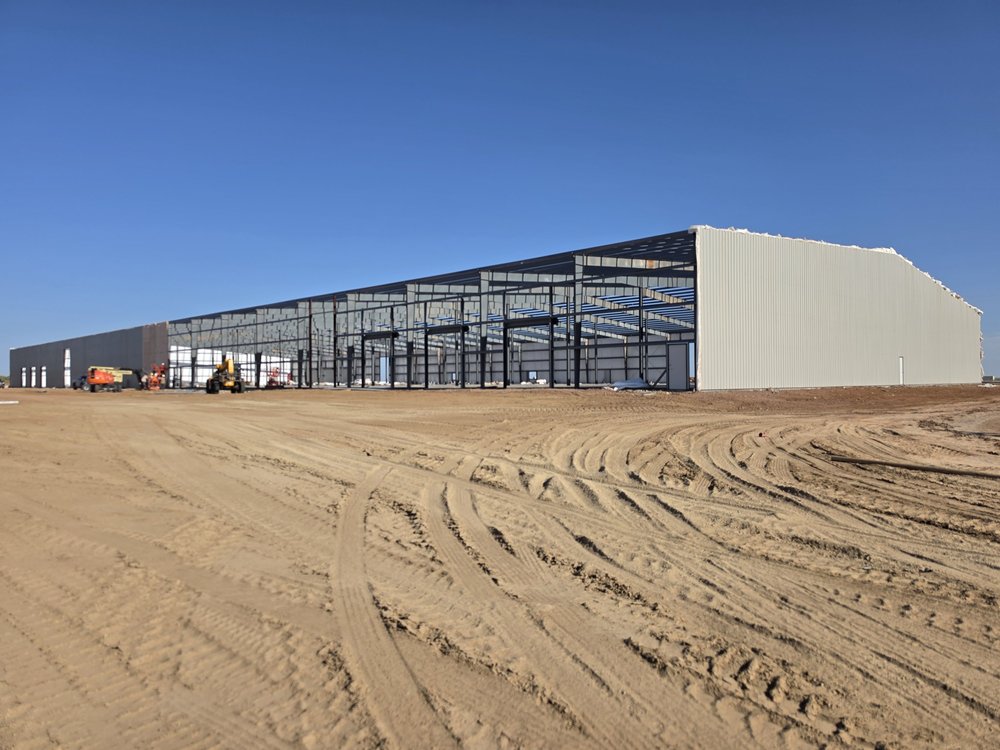
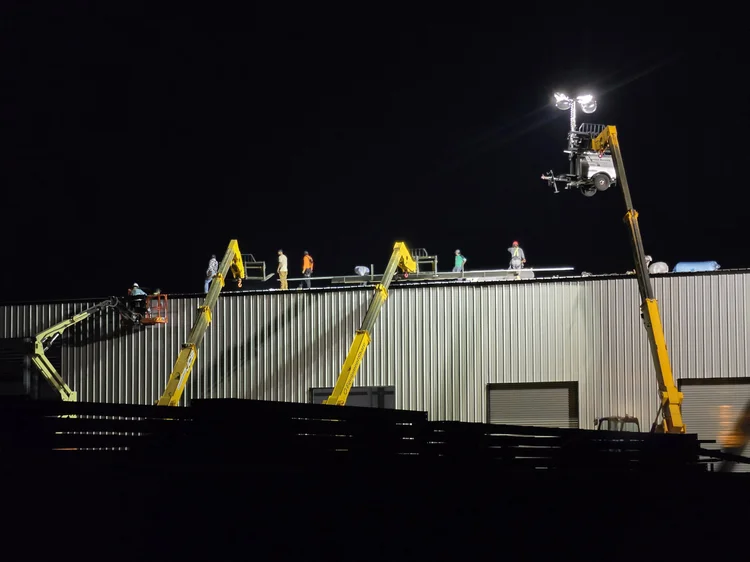
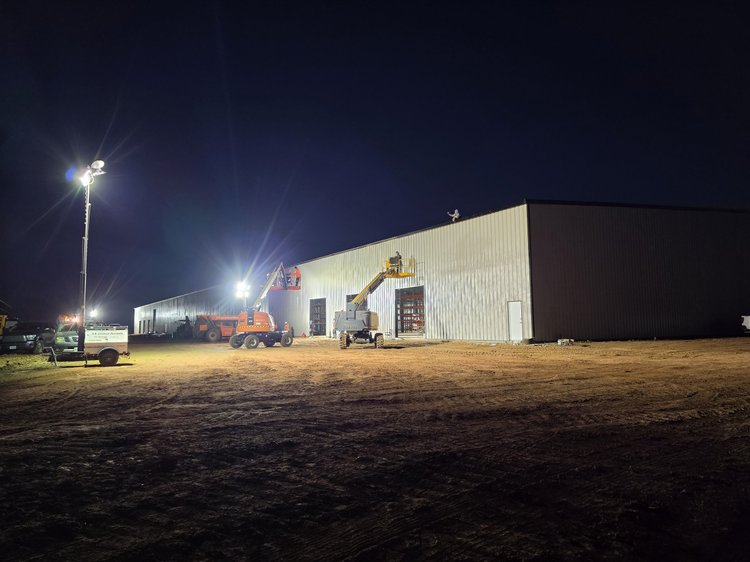
300,000 SF data center support campus, north of Dallas
TCG erected and insulated three 100,000 SF pre-engineered metal buildings for the staging and equipment storage campus of a new data center. Building 1 went from start of steel to sign-off in 41 days, and the full campus finished 30 days ahead of schedule.
On a data center campus the support buildings come first. Chillers, switchgear, and generators that arrive before covered, secure space is ready end up sitting in an open laydown yard. Finishing early meant protected space was ready when long-lead gear shipped.
Beyond Texas, TCG's current data center pipeline spans the Mid-Atlantic, New Jersey, the Carolinas, Ohio, and the Mountain West, from AI-ready design-build to insulated metal panel envelopes for data centers and retrofit work. We do not name clients, but we are glad to walk you through references on a call.
Planning a data center build? Related reading
Start with the average cost to build a data center in the USA, then compare Tier III vs Tier IV data centers, review BESS facility construction cost, and check how long ground-up commercial construction takes and the permitting timeline by state. Cleanroom-grade cooling overlaps heavily with data halls; see cleanroom construction cost by ISO class.
Frequently Asked Questions
Data center chiller lead times in late 2026 run 24 to 40 weeks for air-cooled screw and magnetic-bearing frames, 36 to 52 weeks for air-cooled centrifugal units, and 30 to 56+ weeks for water-cooled centrifugal chillers of 1,000 tons and up. JLL puts the U.S. average at about 35 weeks, down from the 10 to 16 months many projects saw in 2024 and 2025.
Data center chiller equipment costs roughly $900 to $1,400 per ton for air-cooled screw and magnetic-bearing frames, $1,100 to $1,700 per ton for air-cooled centrifugal units, and $550 to $950 per ton for water-cooled centrifugal chillers before towers. A complete installed chiller plant runs about $2,200 to $4,800 per ton.
A data center chiller plant costs about $0.6 million to $1.4 million per megawatt of heat rejected, installed. One megawatt equals about 284 refrigeration tons, so a 10 MW plant with N+1 redundancy typically lands between $7 million and $15 million depending on architecture, redundancy, and site conditions.
The 2026 midterms increased the number of data center projects that are stalled or canceled, which releases reserved chiller production slots back into the market. Voters rejected data center development in 40 of 41 ballot measures. The relief is concentrated in standard air-cooled frames and released slots; large custom centrifugal chillers remain tied to record manufacturer backlogs.
Air-cooled chillers usually win on first cost, water use, and lead time for plants up to roughly 15 to 20 MW and in water-constrained sites. Water-cooled centrifugal plants win on energy efficiency at large scale where water is available. The right answer comes from pricing both at the full plant boundary, including towers, pumps, power, and footprint.
Liquid cooling does not eliminate chillers, but it can reduce how many a data center needs. Direct-to-chip systems move heat into a warm-water loop that can often reject heat through dry coolers for much of the year, with chillers covering peak conditions. Warmer design water temperatures can remove whole machines from the plant.
Chillers for a data center should be ordered, or at least slot-reserved, during schematic design, typically 12 to 15 months before the data hall needs cooling for IT load testing. The order-by date is the commissioning date minus submittals, the factory lead time, and 10 to 14 weeks for setting, piping, startup, and commissioning.
TCG gets better chiller pricing and lead times by engineering the plant in house, writing performance specs with at least two approved manufacturers, buying direct with no stacked subcontractor markup, reserving production slots during preconstruction, and tracking released slots. Recent TCG chiller and HVAC packages came in up to 20 percent below competing quotes.
Spec It Right. Buy It First.
If you have a data center, AI, or critical facility project in the pipeline for 2027, the chiller clock is already running, and post-election slots will not wait. We can model your cooling plant, budget, and order-by date in 48 hours, and tell you which frames are available now. Licensed in all 50 states.
Related Reading
Data center construction by city
Sources and Research Notes
- JLL, 2026 Global Data Center Outlook (U.S. chiller and equipment lead times)
- SourceBlue, Q2 2026 Cost Index Report (air- and water-cooled chiller ranges)
- Data Center Scope, Data Center Chiller Cost and Lead Times in 2026
- The Cooling Report, 2026 Data Center Cooling Supply Chain Guide
- ABC of the Carolinas, North Carolina Data Centers (2024 to 2025 chiller lead times)
- CNBC, Voters rebuff data centers in every ballot measure except one
- Euronews, Data centre backlash in the US midterms
- Al Jazeera, How the US midterms reflected resistance to data centres
- Fast Company, AI data centers in the 2026 midterms
- S&P Global data via Washington Post, as reported November 7, 2026
- S&P Global, Data center opposition gains momentum
- Trane Technologies, Q3 2026 earnings call
- Johnson Controls, Fiscal Q4 2026 results (SEC 8-K)
- Johnson Controls, Air-Cooled Reference Design for Gigawatt-Scale AI Factories
- Carrier, Data Center Thermal Management
- U.S. DOE FEMP, Purchasing Energy-Efficient Electric Chillers
- U.S. EPA, AIM Act Technology Transitions
- ASHRAE TC 9.9, Datacom Series
- Global Market Insights, Data Center Chillers Market
TCG pricing and lead time ranges reflect November 2026 procurement data and published benchmarks; they are planning figures, not quotes. Savings results are from recent TCG procurement packages as published on our Equipment Procurement page and depend on specification, quantity, tariffs, and release timing.
