

Cannabis Facility Construction Requirements (2026): What State Licensing Actually Wants to See
Cannabis Facility Construction Requirements (2026): What State Licensing Actually Wants to See
Most cannabis construction projects don't fail because the GC couldn't build the walls. They fail because the HVAC was sized like an office, the electrical service was 600 amps short, the security plan didn't match the state rule, and the odor exhaust was undersized by 40 percent. Here's what a cultivation, processing, or dispensary facility actually needs to pass licensing — and what we've watched owners redo at 3× the cost when they didn't plan it right.
Cannabis construction is an industrial process build dressed up as commercial tenant improvement. That's the core misread — and it's the one that costs operators the most money. A flower room isn't a warehouse with lights; it's a controlled-environment agriculture space running six to eight times the sensible load of a typical office, pulling 30 to 45 gallons of water per 1,000 SF per day in latent load, under constant RH and temperature setpoints, with regulatory cameras on every plant-touching square foot. Treat it like a TI and you'll end up redoing the mechanical at $85 to $140 per square foot after the first harvest cycle.
What follows isn't a cost guide — we have those in our cannabis value engineering guide and 2026 indoor cultivation cost guide. This is the requirements framework: HVAC, electrical, security, odor, envelope, and state licensing. Build to these and the state inspector doesn't send you back to the architect. Skip them and the best-case outcome is a six-month delay. The worst case is a licensing denial that kills the project.
HVAC: The System Most Owners Underbuild
Cultivation HVAC is not sized by SF alone. It's sized by lighting wattage, plant transpiration load, dehumidification capacity, and the target setpoint for the strain program. A veg room at 75°F and 65 percent RH under 25 W/SF of LED lighting has a fundamentally different load than a flower room at 78°F and 55 percent RH under 60 W/SF of HPS. ASHRAE published the first dedicated cannabis cultivation design guide in 2023, which is now the industry reference for psychrometric modeling.
Here's the rough sizing math we use for early budgets, before the process engineer runs the full psychrometric model. Animated bars below show relative tonnage intensity — more fill means more tons per SF.
Veg Room (LED, 25 W/SF)
Lower light load, smaller plants, less transpiration. Still 2–3x a standard office.
Flower Room (LED, 35–45 W/SF)
Peak sensible load plus dehu pull. Most common room type in modern builds.
Flower Room (HPS, 55–65 W/SF)
Legacy lighting system. 30–40% more tonnage than LED at same canopy SF.
Mother / Clone Room
Small plants, low transpiration. Commonly oversized on first build.
Dry / Cure Room
High dehu demand with low sensible heat ratio. Dedicated desiccant often wins.
Trim / Pack Room
Closer to standard commercial. Labor comfort drives setpoint.
Dehumidification sits on top of the HVAC. Flower rooms typically need 1 pint of water removal per plant per day (USDA ARS CEA data), which translates to 120 to 180 gallons per day on a room with 600 plants. Pulling that out of a standard VRF condenser coil burns compressor hours and energy; a dedicated LGR dehu or desiccant system handles it for less cost per pint removed over a 10-year lifecycle. See our commercial HVAC cost guide for broader sizing context.
Electrical: Size for the Build-Out, Not the First Phase
The most expensive electrical mistake on cannabis facilities is undersized main service. Utility upgrades on 1,200-amp and larger rural service can run $150,000 to $600,000 with 6 to 12 month lead times per Edison Electric Institute utility coordination data. If you land at 800 amps and need 1,600 three harvests in, you're paying for transformer upgrade, wire re-pull, switchgear replacement, and another utility coordination cycle — while the facility runs at partial capacity.
Load allocation for a typical 20,000 SF facility at LED lighting looks roughly like this: HVAC and dehumidification 40 to 50 percent, lighting 30 to 40 percent, irrigation and pumps 5 to 8 percent, CO2 dosing and fans 3 to 5 percent, office and back-of-house 5 to 10 percent. Almost nobody sizes the reserve for expansion into adjacent tenant space or vertical racking — and almost everybody ends up wishing they had. For the current state of skilled electrical trade availability, see our 2026 labor shortage analysis.
On a 24,000 SF cultivation project in the Mountain West, the operator wanted to value-engineer from 1,600-amp to 1,000-amp service to save roughly $85,000 on gear and transformer. We walked them through the expansion math: the second flower-room buildout was already on the board for month 14, and adding that load to 1,000 amps would push service replacement before month 18. They held the 1,600. Eighteen months later they were at 82 percent of service capacity, with the second room running. The $85,000 "saving" would have been a $320,000 utility-coordination loss. This is what our preconstruction services are designed to surface.
Security: Match the State Rule Exactly
Security is where state rules diverge most sharply, and where retrofit fixes are the most disruptive. Every licensed state publishes a technical specification for video, access control, alarm, and log retention. Read the rule before the MEP engineer specs the system, not after.
The common denominators across most states include continuous video coverage of all plant-touching areas, storage vaults, loading docks, and entry/exit points at 720p or higher with 30 to 120 days of retention. Access control at all licensed-area doors with unique credentials and 3 to 5 years of log retention. Monitored intrusion alarm on all exterior openings. Backup power for security infrastructure sized for 72+ hours on generator or 4+ hours on UPS. The ASIS International physical security standards are the closest thing to a baseline the industry recognizes.
Colorado MED
HD video; all licensed areas; 5-year badge logs; R-682 rule set. Denver facilities in Denver and Fort Collins.
Massachusetts CCC
720p minimum; motion-triggered acceptable on some zones; 935 CMR 500. Licensed-area facilities near Boston.
New York OCM
Cannabis Law §129; retention longer for product-handling zones. NY facilities across NYC and Albany.
Illinois IDFPR
410 ILCS 705; dual-authentication vault access. Chicago market.
Michigan CRA
R 420; high-definition; 72-hour backup power for security. Detroit and Ann Arbor.
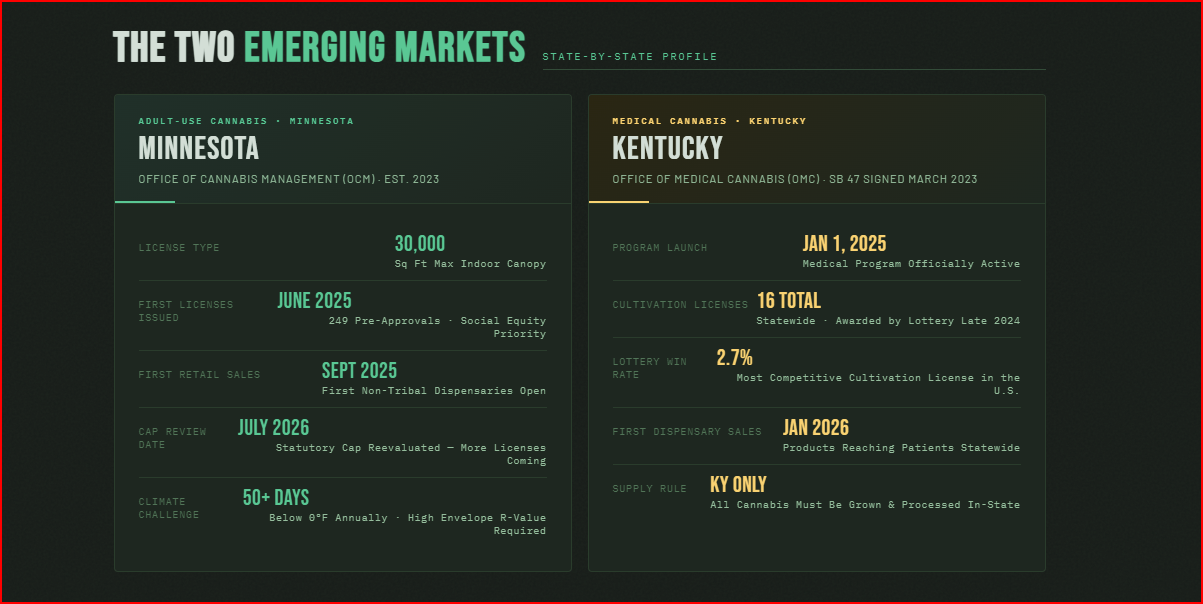
Minnesota OCM
Emerging 2026 market; spec aligned with MED model. Minneapolis and Rochester.
Planning a cannabis facility? Get a licensing-ready construction review.
TCG has built cultivation, processing, and dispensary facilities across 38 states. Upload your program and we'll map state-specific requirements to a buildable scope before you sign the lease.
Single-Source Cannabis Design-Build — IMP, MEP, Security, Licensing
Cannabis construction is coordination-heavy. Envelope, refrigeration-grade HVAC, high-ampacity electrical, security infrastructure, and licensing drawings all land on the same schedule. TCG self-performs critical trades and integrates design, MEP, and construction under one contract.
Odor Control: Size Carbon for Cannabis, Not Industrial Generic
Odor is a permitting lever, a good-neighbor issue, and — in some jurisdictions — a hard regulatory threshold. Municipal nuisance ordinances and zoning conditions are often the real teeth behind odor requirements, more than any state cannabis rule. Denver's odor enforcement, for example, is driven by a dedicated inspector program and measurable complaint triggers, not a prescriptive standard.
Carbon filtration on exhaust is the baseline for every cultivation facility we've built. The sizing rule most published charts use — around 300 to 400 CFM per cubic foot of carbon — is generic industrial. For cannabis terpene adsorption, real-world carbon life drops by 40 to 60 percent at that CFM rate. Size closer to 150 to 200 CFM per cubic foot for realistic life, and plan on media replacement every 6 to 18 months depending on strain mix and exhaust volume. The American Industrial Hygiene Association has published guidance on carbon adsorption for VOC control that maps reasonably well to cannabis terpenes.
Other odor controls that show up in facility design: negative pressure in flower rooms (0.02 to 0.05 inches water column relative to surrounding corridor), HEPA on supply where process ventilation requires it, atomizing or neutralizing systems at exhaust stacks where jurisdictions require redundant control, and sealed envelope construction — which is where IMP walls with taped joints earn their keep.
Envelope: IMP, Vapor Control, and FM Ratings
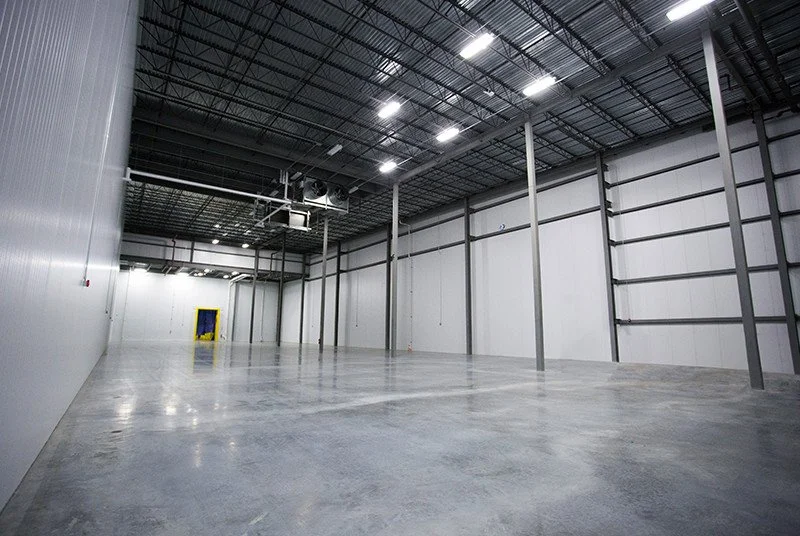
Cultivation envelope has to handle high interior RH, large temperature differentials to exterior in winter, and — increasingly — insurance-driven fire rating. Insulated metal panel walls are the most common envelope system for new-build cultivation because they deliver continuous insulation, a hard vapor barrier, and a single-source wall-ceiling system that installs faster than CMU + insulation + finish.
FM Global's 4880 rating is increasingly required by insurance carriers on cannabis facilities. Class 1 panels with mineral wool or PIR cores meet the standard; a cheaper EPS-core panel may not. The insurance-driven spec usually wins over the value-engineered spec — retroactive panel swaps are five to seven times the cost of installing the right panel the first time. See our best IMP manufacturers guide for the comparison matrix.
| Envelope System | Typical Use | FM 4880 Class 1 | Vapor Barrier |
|---|---|---|---|
| IMP (mineral wool core) | Flower rooms, vaults, corridors | Yes | Integral |
| IMP (PIR core) | Dry rooms, trim, office | Yes (with spec) | Integral |
| IMP (EPS core) | Limited — check with carrier | Varies | Integral |
| CMU + spray foam + finish | Budget retrofit | No (masonry) | Requires membrane |
| Tilt-up + stud + insulation | Large ground-up | No (masonry) | Requires membrane |
Six Drivers That Push Cannabis Construction Scope Higher
Vertical Racking
Multi-tier cultivation doubles canopy SF per floor SF — but multiplies HVAC tonnage, lighting load, and structural demand. Design for it up front.
CO2 Dosing
Bulk CO2 storage, piping, solenoid dosing. Typical 1,200–1,800 ppm target. Leak detection and egress alarms are code-required per OSHA.
Water Treatment
RO + UV + remineralization for fertigation. 30–50 gal/1,000 SF/day typical draw; waste stream reclaim adds $40–80k capital.
Ethanol or CO2 Extraction
Class 1 Div 2 hazardous zones, explosion-proof fixtures, dedicated mechanical, NFPA 70 compliance. Not a TI-scale upgrade.
Secure Product Storage
Vault construction, dual-factor access, isolated video, GSA Class 5 on some state programs. Plan early; retrofit doubles the cost.
Backup Power
Generator sizing to cover HVAC, dehu, and security for regulated duration. 500–1,200 kW typical on 20–30k SF facilities.
A cultivation operator in the Great Lakes region asked us to price a 28,000 SF tenant improvement into an older industrial shell. The roof was TPO, the service was 800 amps, and the clear height was 14 feet. We walked them through three issues before the LOI: the roof deck wasn't rated for the interior RH and would sweat the first winter, the service needed to jump to 1,600 amps with a transformer upgrade the utility quoted at 22 weeks, and the ceiling height killed any vertical racking economics. They walked from the deal and found a clear-span shell built post-2015 with 28-foot heights and adjacent 480V capacity. The second building cost roughly $38 more per rentable SF — but the total program came in $1.1M under the first plan, because the MEP and envelope scope matched the shell. This is what our owner's rep services deliver.
State Licensing: Build the Drawings for the Inspector
A CO from the building department isn't the same thing as a state cannabis license. Licensing narratives typically require a separate set of facility diagrams: plant-touching zones, security camera coverage, HVAC zoning with tonnage and dehu, electrical one-line with service size, waste disposal flow, sanitation plan. Some states publish explicit templates; others require the applicant to propose a format.
Build the construction drawings with an eye toward the licensing narrative, not the other way around. We've watched owners deliver a building to CO on schedule, then spend 60 to 90 days reformatting drawings and running supplementary inspections to satisfy a state reviewer who asked for information that should have been in the original package. That delay costs real revenue: a cultivation facility held off-license for 60 days is typically looking at $180,000 to $400,000 in deferred harvest revenue. For broader permitting timelines, see our state-by-state permitting guide.
Building in a New Cannabis Market?
TCG.ai delivers early cost estimates calibrated to your state's cannabis code. Upload concept drawings and receive a licensing-aware budget range in minutes.
Cannabis is an industrial process build. Stop pricing it like TI.
We get asked to "value-engineer" cannabis scope probably twice a month. Some of it is fair — there are real trade-offs between EPS and PIR panel cores, between LGR and desiccant dehu, between single-source and modular HVAC. But most of what operators try to VE out is actually the difference between a facility that runs clean for ten years and one that needs $400,000 of rework after the first harvest cycle. For a structured approach to where VE actually helps, see our cannabis value engineering guide.
The honest version is this: the system costs on a 20,000 SF cultivation facility typically run $220 to $340 per square foot in 2026 (TCG project data across 38 states), and the bottom of that range only lands when you hit every sizing rule on the first pass. Skip the process engineer, spec retail-grade HVAC, and use 800-amp service because it's already on-site — and you'll end up at the top of the range anyway, just with 18 months of delay and a licensing headache mixed in.
Planning a Cannabis Cultivation or Processing Facility?
TCG runs design-build cannabis projects across all 50 states. We've delivered cultivation, processing, and dispensary facilities in 38 operating states through our cannabis facility construction service line. Send us your state, program, and site — we'll send back a licensing-aware budget and schedule you can underwrite against.
Indoor Cannabis Cultivation Facility, Minneapolis, MN
TCG supplied and installed 50,000 SF of insulated metal panel, with doors and hardware, to build out the cultivation rooms of an indoor cannabis facility in Minneapolis, then supplied and installed urethane cement flooring. One contractor, one schedule, envelope to floor.
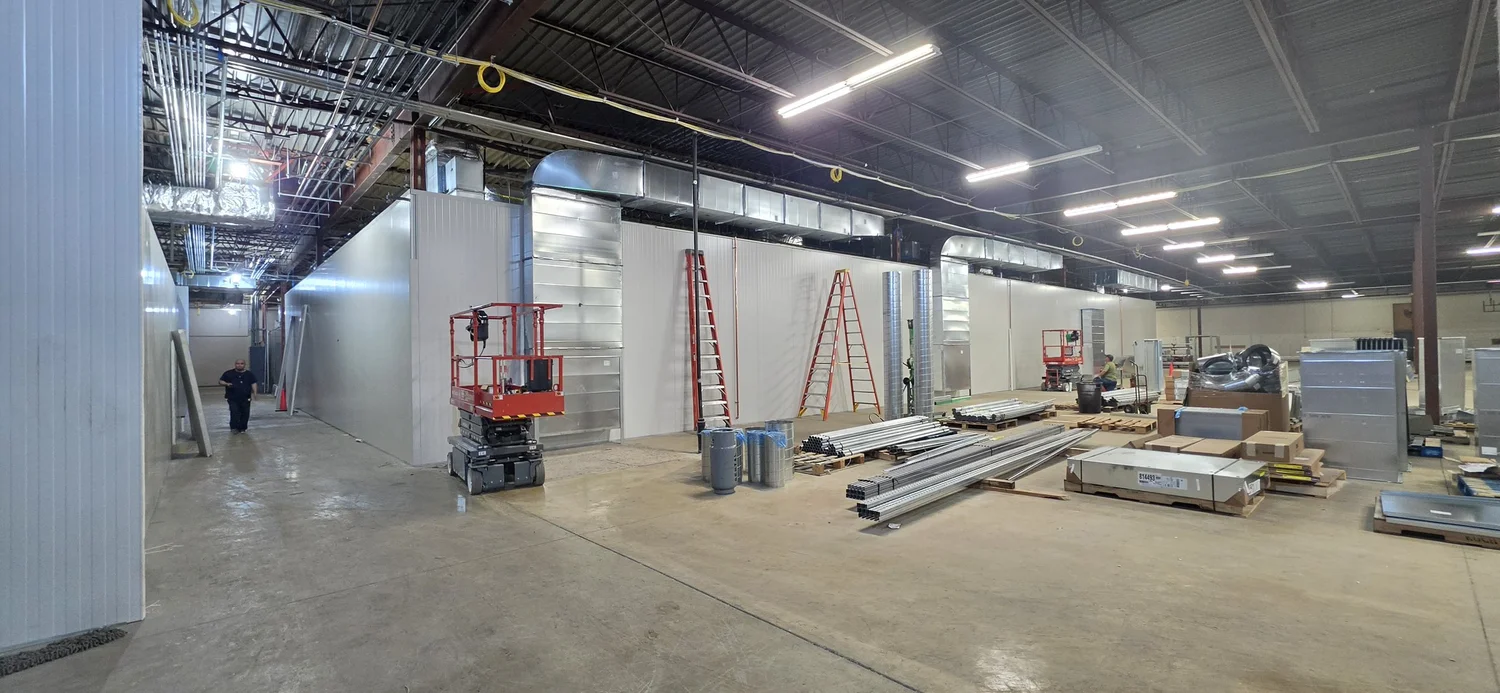
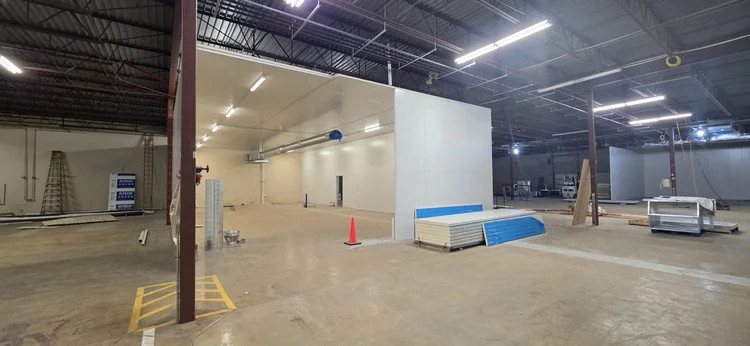
Cultivation rooms hold tight temperature and humidity setpoints around the clock. A sealed, thermally continuous IMP envelope with an integrated vapor barrier keeps moisture out of the assembly, and urethane cement floors stand up to washdown, nutrients, and constant traffic.
How the requirements show up in the build: the sealed rooms, washable surfaces, and controlled environments that regulators and operators expect are delivered through the envelope and the floor. On this project that meant an IMP room system and urethane cement flooring from one self-performing contractor. See TCG’s cannabis facility construction services.
- Envelope: 50,000 SF of IMP wall and ceiling panel forming the cultivation rooms
- Openings: IMP doors and hardware supplied and installed
- Flooring: urethane cement supplied and installed
- Delivery: turnkey supply and install, self-performed
Full photo gallery on the project spotlight.
Cannabis Facility Construction FAQ (2026)
How much HVAC tonnage does a cannabis grow room actually need?
What electrical service size does a 20,000 SF cultivation facility need?
What security cameras and systems does a state licensing application require?
How do you actually control cannabis odor at a commercial facility?
Do cannabis facilities need FM or UL-rated wall systems?
How long does it take to build a 20,000 SF cannabis cultivation facility?
What does state licensing expect to see in construction drawings?
Can you convert a warehouse into a cannabis facility without tearing it apart?
What's the biggest mistake operators make on cannabis construction?
What occupancy classification does a cannabis facility fall under in the IBC?
What dehumidification equipment works best for cannabis cultivation?
Does a cannabis facility need a fire sprinkler system?
- International Code Council — IBC 2024, Occupancy Classification Groups F-1, S-1, H-2/H-3
- Colorado Marijuana Enforcement Division (MED) — Regulation R-682
- Massachusetts Cannabis Control Commission (CCC) — 935 CMR 500
- New York Office of Cannabis Management (OCM) — Cannabis Law §129
- Illinois Department of Financial and Professional Regulation (IDFPR) — 410 ILCS 705
- Michigan Cannabis Regulatory Agency (CRA) — R 420
- Minnesota Office of Cannabis Management (OCM) — 2026 regulatory framework
- FM Global Property Loss Prevention Data Sheet 1-57 and Test Standard 4880
- ASHRAE — Design Guide for Cannabis Facilities, 2023 edition
- USDA Agricultural Research Service — Controlled Environment Agriculture transpiration data
- NFPA 70 — National Electrical Code, 2023 edition (hazardous locations for extraction)
- NFPA 13 — Standard for the Installation of Sprinkler Systems
- Associated General Contractors of America (AGC) — Construction Inflation Alert, March 2026
- International Energy Conservation Code (IECC) — Envelope and MEP energy standards
- ASIS International — Physical security standards for controlled-access facilities
- OSHA — CO2 exposure limits and leak detection requirements
- American Industrial Hygiene Association (AIHA) — Carbon adsorption and VOC control
- Edison Electric Institute — Utility service coordination benchmarks
- TCG project data across cannabis cultivation, processing, and dispensary facilities in 38 operating states (2019–2026)
