
Commercial Roofing Cost Per Square Foot in the USA (2026)
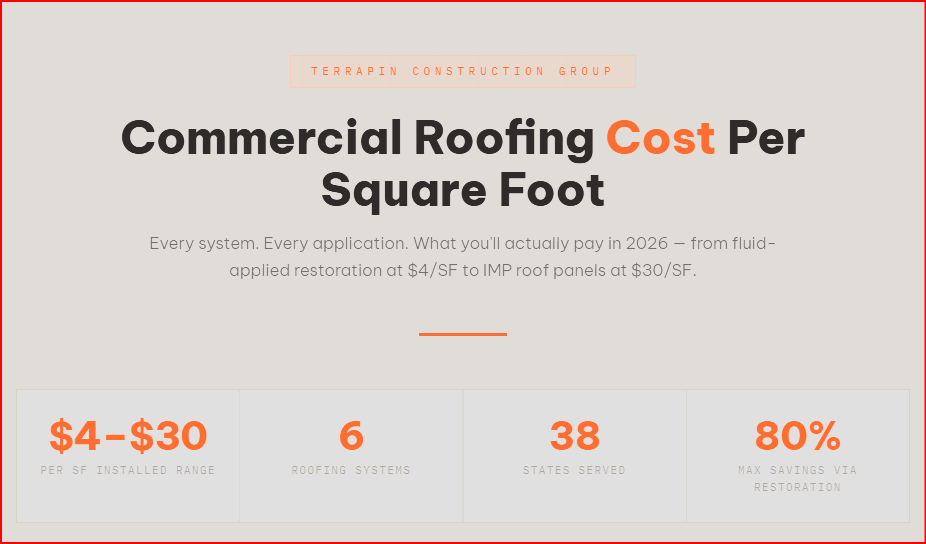
Commercial roofing is one of the largest single-scope line items on any commercial construction or capital improvement project. On a new 100,000-square-foot warehouse, the roof can represent $600,000 to $1.5 million or more depending on system type and insulation requirements. On a multi-story self-storage facility, the roof is both the primary weather barrier and a critical component of the building's thermal envelope. On a cold storage facility, the roof system directly impacts energy costs, refrigeration load, and product integrity.
Yet most building owners and developers make roofing decisions with surprisingly little cost transparency. Roofing contractors quote projects as lump sums, making it difficult to compare system-to-system on an apples-to-apples basis. The range of available commercial roofing systems — from low-cost single-ply membranes to premium insulated metal panel roof systems — creates a spectrum so wide that an uninformed buyer can easily over-specify or under-specify for the application. And the decision between full roof replacement and roof restoration is one of the highest-stakes choices in facility management, with the wrong call costing hundreds of thousands of dollars in unnecessary construction.
At Terrapin Construction Group, commercial roofing is a self-performed specialty that we deliver as part of our integrated building envelope services — alongside insulated metal panel installation, pre-engineered metal building erection, and commercial flooring. This article provides an honest, detailed breakdown of what every major commercial roofing system costs in 2026, which applications each system serves best, how regional markets affect pricing, and when restoration makes more financial sense than replacement.
Commercial Roofing Systems: What Each One Costs and Where It Belongs

The commercial roofing market in 2026 is dominated by six primary system types, each with a distinct cost profile, performance envelope, and optimal application range. The costs below reflect fully installed pricing — materials, labor, insulation, flashings, and typical accessories — at national average rates. Regional adjustments are discussed in a subsequent section.
TPO (Thermoplastic Polyolefin) — $6 to $12 Per Square Foot Installed
TPO is the most widely specified single-ply commercial roofing membrane in the United States. Its popularity is driven by a combination of competitive installed cost, energy-efficient reflective surface, and hot-air welded seams that provide excellent long-term waterproofing integrity. TPO membranes are available in 45-mil, 60-mil, and 80-mil thicknesses, with 60-mil being the most common specification for new commercial construction. Expected service life is 20 to 30 years with proper maintenance.
TPO is the standard specification for office and retail tenant improvement buildings, grocery-anchored strip malls, medical office buildings, and institutional facilities where energy efficiency and moderate installed cost are the primary drivers. The reflective white surface reduces cooling loads by 10–30% in hot climates — a meaningful operating cost advantage in markets like Phoenix, Houston, and Atlanta.
According to the National Roofing Contractors Association (NRCA), TPO accounts for the largest share of new commercial roofing installations nationally. Its combination of cost-effectiveness, energy performance, and welded-seam durability has made it the default choice for low-slope commercial roofs in most U.S. markets.
EPDM (Ethylene Propylene Diene Monomer) — $6 to $11 Per Square Foot Installed
EPDM is a synthetic rubber single-ply membrane with over 50 years of proven performance in the commercial roofing market. It is the most flexible commercial membrane — critical in cold climates where thermal contraction at below-zero temperatures can stress rigid membranes — and it is among the easiest to repair in the field. Available in black or white, in 45-mil and 60-mil thicknesses, EPDM is mechanically fastened or fully adhered depending on wind uplift requirements and substrate conditions. Expected service life is 25 to 35 years.
EPDM is particularly well-suited for large warehouse and industrial roofs where installed cost per square foot is the dominant specification driver. Its flexibility makes it the preferred membrane in Northern markets like Albany, Chicago, and Sheridan where freeze-thaw cycling is a primary durability concern. The trade-off versus TPO is that EPDM seams are adhesive-bonded rather than heat-welded, which requires more careful quality control during installation.
PVC (Polyvinyl Chloride) — $8 to $14 Per Square Foot Installed
PVC is a premium single-ply membrane with superior chemical resistance — the critical differentiator that drives its specification in restaurant, food processing, and manufacturing applications where grease-laden exhaust, chemical fumes, or industrial effluent come into contact with the roof surface. Like TPO, PVC seams are hot-air welded for long-term integrity. Expected service life is 25 to 35 years.
PVC carries a price premium over TPO and EPDM, but for applications where chemical resistance is required, it is the only appropriate single-ply specification. QSR restaurants and high-end restaurants with rooftop grease exhaust should always specify PVC rather than TPO to prevent membrane degradation from animal fats and cooking oils.
Standing Seam Metal — $10 to $25 Per Square Foot Installed
Standing seam metal roofing is the longest-lasting commercially available roof system for sloped applications, with expected service life of 40 to 60+ years. Concealed fasteners, raised seam profiles, and factory-applied finishes provide superior weather resistance, wind uplift performance, and aesthetic versatility. Standing seam pairs naturally with pre-engineered metal building structural systems — and TCG's ability to procure and install both the PEMB structure and the standing seam roof as an integrated scope eliminates the coordination risk that commonly occurs when the steel erector and the roofer are separate firms.
Standing seam metal is the standard roof system for self-storage facilities, distribution warehouses, agricultural buildings, vehicle maintenance facilities, and any PEMB application. In hurricane-prone markets like the Texas Gulf Coast, standing seam metal's superior wind uplift ratings (routinely tested to 150+ mph) make it the preferred system for high-wind zones.
Insulated Metal Panel (IMP) Roof Systems — $12 to $30 Per Square Foot Installed
IMP roof panels combine structure, insulation, and waterproofing in a single prefabricated component — delivering the highest R-value per inch of any roof system available for commercial construction. IMP roof panels are the default specification for cold storage facilities, controlled-environment agriculture, cannabis cultivation facilities, and any building where thermal performance is the dominant roof specification driver.
As detailed in our IMP manufacturer comparison guide, TCG procures IMP roof panels from Kingspan, PermaTherm, FALK, and other leading manufacturers through direct factory relationships that deliver volume pricing single-project buyers cannot access. The IMP Install Estimator on our website provides preliminary supply-and-install pricing for IMP roof and wall scopes.
FlexRock Fluid-Applied Restoration — $4 to $8 Per Square Foot Installed
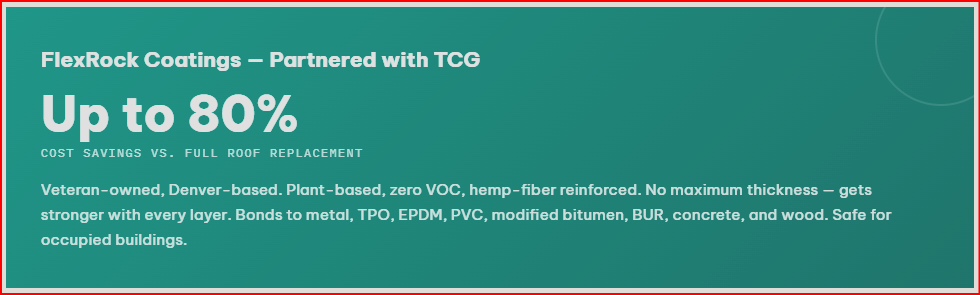
Fluid-applied roof restoration is not a new roof — it is a technology that extends the life of an existing commercial roof by 15 to 25+ years at a fraction of the cost of full tear-off and replacement. TCG partners with FlexRock Coatings — a veteran-owned, Denver-based manufacturer of plant-based, zero-VOC fluid-applied reinforcement systems — to deliver roof restorations that save building owners up to 80% compared to full replacement.
FlexRock's proprietary FX-100 system is fundamentally different from traditional roof coatings. It chemically bonds to virtually any existing substrate — metal, TPO, EPDM, PVC, modified bitumen, built-up roofing, fiberglass, concrete, and wood — fills cracks and defects, and creates a monolithic waterproof membrane with no maximum thickness limitation. Where traditional coatings crack and delaminate when applied too thickly, FlexRock gets stronger with every layer, allowing targeted buildup at ponding areas, flashings, and penetrations.
For owners of large commercial roofs — 50,000, 100,000, 200,000+ square feet — where a full tear-off would cost millions and disrupt operations for weeks, FlexRock restoration changes the economics entirely. A 100,000-square-foot warehouse roof that would cost $800,000 to $1.2 million for full TPO replacement can often be restored with FlexRock for $400,000 to $600,000 — with zero tear-off, zero landfill waste, and minimal operational disruption.
Get a Commercial Roofing Estimate for Your Building
TCG's commercial roofing cost estimator provides preliminary pricing for new roof installation and FlexRock restoration projects. For buildings requiring a roof condition assessment and formal proposal, schedule a 30-minute call with our roofing team.
The Six Factors That Drive Commercial Roofing Costs
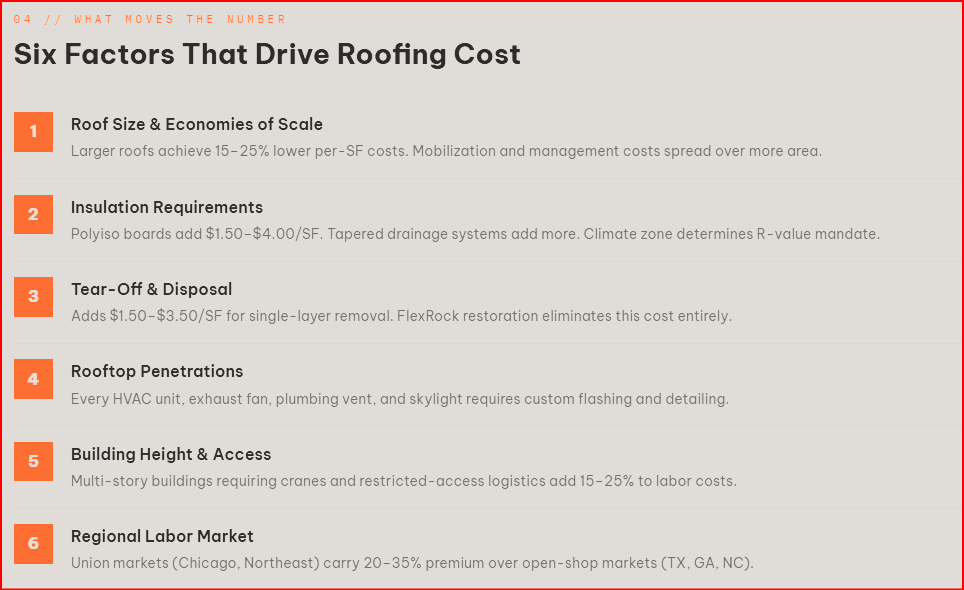
Within any system type, the actual installed cost on a specific project is determined by six variables that create meaningful cost variance between the low and high end of the range.
Roof size and economies of scale are the most straightforward cost variable. Mobilization, equipment setup, and project management costs are relatively fixed regardless of whether the roof is 10,000 or 100,000 square feet. As a result, larger roofs generally achieve lower per-square-foot installed costs — sometimes 15–25% lower than small-roof pricing for the same system on the same building type. This is one reason TCG's national volume across multiple markets delivers pricing advantages that local roofing contractors cannot match.
Insulation requirements significantly affect total installed cost. Modern energy codes — IECC and ASHRAE 90.1 — require specific R-value insulation levels that vary by climate zone. In Denver (Climate Zone 5B) or Albany (Climate Zone 5A), roof insulation requirements are substantially more stringent than in Phoenix (Climate Zone 2B) or Houston (Climate Zone 2A). Polyisocyanurate insulation boards add $1.50 to $4.00 per square foot to the roof assembly depending on thickness and R-value target. Tapered insulation systems — which provide positive drainage slope on flat roofs — add additional cost but eliminate ponding water, which is the single most common cause of premature roof membrane failure.
Tear-off and disposal costs apply only to reroofing projects where the existing membrane must be removed. Tear-off adds $1.50 to $3.50 per square foot in most markets for single-layer removal and disposal, with multi-layer tear-offs running higher. This is the cost that FlexRock restoration eliminates entirely — and on a large roof, the tear-off savings alone can represent $100,000 or more.
Rooftop penetrations and equipment curbs add labor and material cost proportional to their quantity and complexity. A warehouse roof with minimal penetrations is a simpler (and cheaper) installation than a veterinary clinic or urgent care center with dozens of HVAC units, exhaust fans, plumbing vents, and skylight curbs that each require custom flashing and sealant detailing. TCG coordinates rooftop equipment placement with our 9BA MEP engineering partner during preconstruction to minimize unnecessary penetrations and optimize HVAC placement for both roof integrity and mechanical efficiency.
Building height and access complexity affect labor productivity and safety costs. A single-story warehouse with ground-level material staging is a lower-cost installation per square foot than a multi-story building requiring crane lifts, safety hoarding, and restricted-access logistics. In dense urban markets like Chicago and Albany/New York metro, access constraints can add 15–25% to roofing labor costs versus suburban single-story installations.
Regional labor markets create structural cost differences. As with all commercial construction, union-heavy markets in the Northeast and Midwest carry labor premiums of 20–35% over open-shop markets in the South and Mountain West. This geographic cost spread is consistent with the regional patterns we've documented across QSR, healthcare, and industrial construction verticals.
Commercial Roofing by Market: What You'll Pay Across TCG's National Footprint
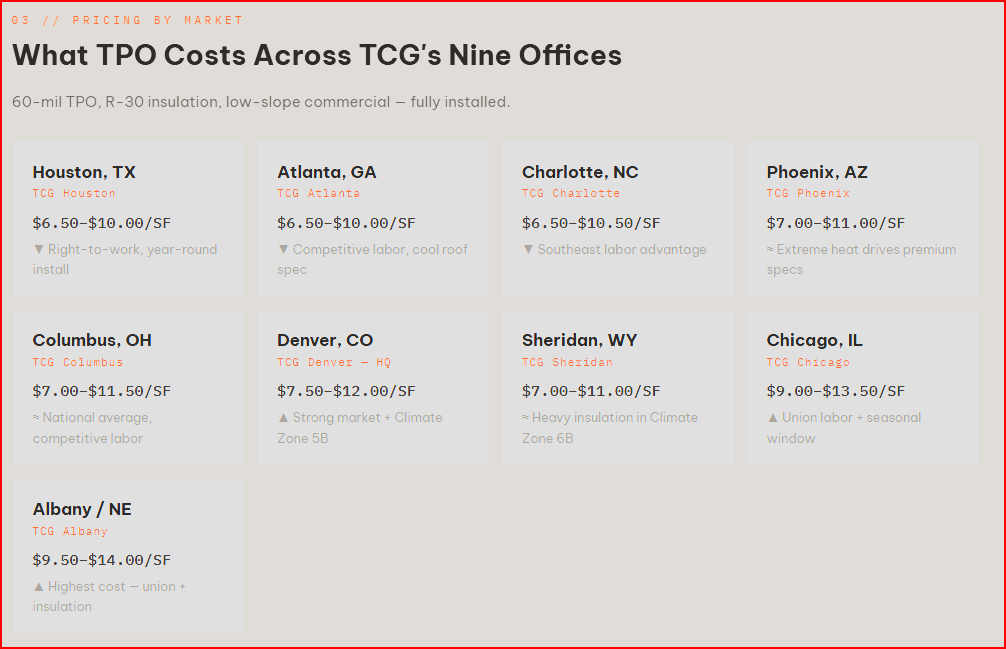
TCG builds across all of these markets, and roofing costs vary meaningfully across them. Here's what the regional cost environment looks like for the most common commercial roofing system — a 60-mil TPO single-ply membrane with R-30 insulation on a low-slope commercial building — as a representative benchmark.
In the Houston and Atlanta markets, TPO roofing runs approximately $6.50 to $10.00 per square foot installed. These right-to-work markets offer competitive labor pricing and year-round installation windows, making them among the most favorable roofing cost environments in the country. Cool roof specifications (high-SRI white TPO) are especially common in these hot-climate markets where energy code compliance drives reflective membrane selection.
In Charlotte, pricing tracks similarly to Atlanta — $6.50 to $10.50 per square foot — with the Southeast's favorable labor market and moderate insulation requirements keeping installed costs below the national average.
In Phoenix, TPO runs $7.00 to $11.00 per square foot. The desert climate creates extreme thermal cycling that demands premium membrane specifications and enhanced attachment methods, but lower insulation requirements (Climate Zone 2B) offset some of that premium.
In Columbus and the broader Ohio market, pricing tracks to the national average at $7.00 to $11.50 per square foot. Midwest climate zone insulation requirements add cost, but the labor market is competitive.
In Denver, TPO runs $7.50 to $12.00 per square foot. Colorado's strong construction market creates competitive labor demand, and Climate Zone 5B insulation requirements (R-30 minimum for low-slope commercial roofs under most code interpretations) add to the installed assembly cost.
In Chicago, union labor requirements push TPO installed costs to $9.00 to $13.50 per square foot — 20–30% above the national average. The shortened construction season (roofing installations are weather-dependent, and Chicago's winter limits the installation window to roughly April through November) concentrates demand into fewer months, which further tightens labor pricing during peak season.
In the Albany/Northeast market, commercial roofing runs $9.50 to $14.00 per square foot for TPO — the highest in TCG's footprint. Union labor, aggressive insulation requirements (Climate Zone 5A/6A), and shorter installation seasons all contribute to the premium.
In Sheridan and the broader Wyoming market, installed costs are moderate at $7.00 to $11.00 per square foot, though extreme cold climate insulation requirements (Climate Zone 6B) can push total roof assembly costs higher when high-R insulation packages are specified.
Replacement vs. Restoration: The Highest-Stakes Decision in Commercial Roofing
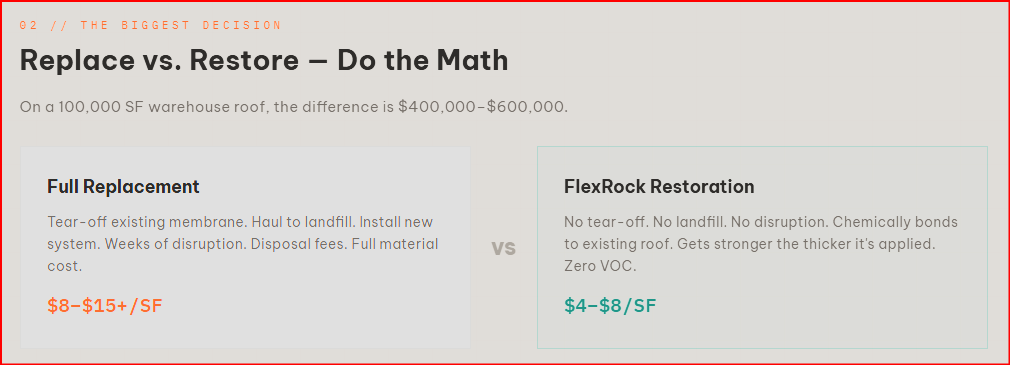
For building owners facing a roof that is beyond its serviceable life — leaking, losing insulation value, or approaching warranty expiration — the decision between full replacement and fluid-applied restoration is the single most consequential financial decision in the project. Getting it wrong in either direction costs real money.
Full replacement is the right answer when the existing roof deck is structurally compromised, when insulation is widely saturated (more than 25% of the roof area shows moisture infiltration on infrared scan or core sampling), or when the building use has changed in a way that requires a fundamentally different roof system — for example, converting a dry warehouse to cold storage where the roof insulation package must be completely redesigned.
Restoration with FlexRock is the right answer when the existing membrane has structural integrity, when moisture infiltration is localized rather than widespread, and when the owner's goal is to extend the roof's service life by 15–25 years at a fraction of replacement cost. FlexRock's fluid-applied reinforcement system is especially advantageous on large commercial roofs — 50,000 square feet and above — where the economics of full tear-off are punishing. The tear-off labor, dumpster and disposal fees, and operational disruption that accompany a full replacement on a 100,000+ square foot occupied building can easily add $200,000 to $400,000 to the project cost that restoration avoids entirely.
FlexRock's zero-VOC, plant-based formulation is also a critical advantage for occupied buildings. Medical facilities, hotels, retail centers, and food production environments cannot tolerate the odor, debris, and disruption of a full roof tear-off. FlexRock restoration is virtually odorless and generates zero construction waste — the existing roof stays in place and the FlexRock system is applied directly over it.
TCG provides free roof condition assessments with core sampling and infrared moisture scanning to make a data-driven recommendation — replacement or restoration — based on actual roof conditions rather than contractor preference. Our owner's representative services include independent roof condition evaluation for owners who want third-party validation before committing to a seven-figure roofing decision.
Why TCG's Integrated Approach to Commercial Roofing Matters
Most commercial roofing contractors are roofing-only firms. They install the membrane — and that's the extent of their scope and expertise. When the roof interfaces with the wall system, the structural frame, the HVAC equipment, or the building's thermal envelope, the roofing contractor's scope ends and coordination gaps begin.
TCG is not a roofing-only contractor. We are a full-service general contractor and design-build firm that self-performs roofing as one component of an integrated building envelope service. Our teams also self-perform IMP wall and roof panel installation, PEMB erection, and commercial flooring. When we install a roof on a new commercial building, the roof is coordinated with the wall system, the structural connections, the MEP penetrations, and the insulation continuity from the earliest design phase — not as a standalone subcontract awarded to the lowest bidder after design is complete.
This integration produces measurably better outcomes on every project type we build. On cold storage projects, where thermal bridging at the roof-to-wall connection can cause ice accumulation and energy loss, our crews install both the roof IMP panels and the wall IMP panels, ensuring continuous insulation and vapor barrier performance at the transition. On self-storage projects, where the standing seam roof sits on a PEMB structural system, our crews erect the steel and install the roof as one continuous sequence — eliminating the scheduling gap and finger-pointing that commonly occur when the steel erector and the roofer are separate firms. On tenant improvement projects where an existing roof must be restored before interior buildout begins, our FlexRock restoration team works in sequence with our interior construction crews to deliver the complete scope under one contract.
Our partner 3rd Act Architecture & Consulting provides the architectural design framework for new construction roofing, and 9BA MEP coordinates mechanical system placement and rooftop equipment specification to ensure the roof design accommodates every penetration, curb, and equipment pad from the start.
Need a Roof Assessment, Restoration Quote, or New Roof Estimate?
TCG provides commercial roofing services — new installation, reroofing, and FlexRock restoration — nationwide from our Denver headquarters. Use our AI construction estimator for preliminary project-level cost estimates, or schedule a 30-minute conversation →
Frequently Asked Questions: Commercial Roofing Costs in 2026
How much does commercial roofing cost per square foot in 2026?
Commercial roofing costs $4 to $30 per square foot installed in 2026, depending on system type, insulation requirements, and market. Fluid-applied restoration with FlexRock runs $4–$8 per square foot. TPO single-ply membrane runs $6–$12 per square foot. EPDM runs $6–$11. PVC runs $8–$14. Standing seam metal runs $10–$25. IMP roof panels for cold storage and controlled-environment applications run $12–$30. All figures include materials, labor, insulation, and standard accessories at national average rates. Regional labor markets adjust these figures by ±20–35% depending on location.
What is the cheapest commercial roofing system?
Fluid-applied restoration with FlexRock is the lowest-cost option at $4–$8 per square foot — but it is only appropriate for existing roofs with structural integrity that need life extension rather than full replacement. For new roof installations, EPDM and TPO are the most cost-effective systems at $6–$12 per square foot installed. EPDM is generally the lowest-cost option for large warehouse and industrial roofs, while TPO offers better energy efficiency through its reflective surface. The TCG roofing estimator provides project-specific pricing based on your building type and location.
How long does a commercial roof last?
Commercial roof lifespan varies by system: TPO lasts 20–30 years, EPDM lasts 25–35 years, PVC lasts 25–35 years, standing seam metal lasts 40–60+ years, and IMP roof panels last 30–50 years. FlexRock restoration extends an existing roof's life by 15–25+ years depending on substrate condition and application thickness. Proper maintenance — including bi-annual inspections, sealant replacement, and drainage management — significantly extends all roof lifespans. TCG recommends establishing a maintenance program immediately after installation or restoration.
What is FlexRock and how does it save up to 80% on commercial reroofing?
FlexRock Coatings is a fluid-applied reinforcement roofing system that restores existing commercial roofs in place — without tear-off, landfill disposal, or full membrane replacement. Unlike single-component coatings that merely bridge over surface defects, FlexRock's FX-100 system chemically bonds to the existing substrate, fills deep cracks and imperfections, and creates a monolithic waterproof membrane with no maximum thickness limitation. By eliminating tear-off labor ($1.50–$3.50/SF), disposal costs, and new membrane material, owners save up to 80% compared to full replacement. FlexRock is zero-VOC, plant-based, and virtually odorless — making it safe for application on occupied buildings including medical facilities and hotels.
Should I replace my commercial roof or restore it?
Restoration is the right choice when the existing membrane has structural integrity, when moisture infiltration affects less than 25% of the roof area, and when the goal is to extend roof life by 15–25 years at a fraction of replacement cost. Full replacement is necessary when insulation is widely saturated, when the roof deck is structurally compromised, or when the building use has changed in a way that requires a fundamentally different roof system. TCG provides free roof condition assessments with core sampling and infrared moisture scanning to make a data-driven recommendation. Schedule an assessment.
Which commercial roofing system is best for restaurants?
PVC (polyvinyl chloride) membrane is the recommended roofing system for QSR restaurants, high-end restaurants, and any commercial kitchen application. PVC's chemical resistance to animal fats, cooking oils, and grease-laden exhaust makes it the only single-ply membrane appropriate for food service buildings. TPO and EPDM will degrade when exposed to these chemicals. PVC costs $8–$14 per square foot installed — a modest premium over TPO that is essential for long-term roof performance in restaurant applications.
What is the best roofing system for cold storage and warehouse buildings?
For cold storage facilities requiring maximum thermal performance, IMP roof panels are the standard specification — delivering the highest R-value per inch of any roof system while integrating structure, insulation, and waterproofing into a single component. For standard dry warehouses and distribution centers, standing seam metal on a PEMB structure provides 40–60+ year service life at competitive installed cost. For large existing warehouse roofs needing life extension, FlexRock restoration at $4–$8 per square foot can save hundreds of thousands of dollars versus full replacement.
Where does TCG install commercial roofing?
TCG provides commercial roofing services across 38 states, including key markets like Denver, Colorado, Houston, Texas, Atlanta, Georgia, Columbus, Ohio, Phoenix, Arizona, Charlotte, North Carolina, Chicago, Illinois, Albany, New York, and Sheridan, Wyoming. Each office provides local project management, crew mobilization, and regional subcontractor relationships for both new roof installation and FlexRock restoration projects.
Does TCG coordinate roofing with other building envelope work?
Yes — TCG is one of the few commercial contractors that self-performs roofing, IMP wall and roof panels, PEMB erection, and commercial flooring under one contract. This eliminates the coordination gaps between roof, wall, and structure that cause leaks and warranty disputes on conventionally bid projects. On cold storage and controlled-environment projects, this integrated approach ensures continuous insulation and vapor barrier performance at every roof-to-wall transition. Our partners 3rd Act Architecture and 9BA MEP provide design coordination for the complete building envelope.
How do I get a commercial roofing estimate from TCG?
The fastest way to get preliminary commercial roofing pricing is through TCG's roofing cost estimator on our commercial roofing services page — describe your project and get AI-powered preliminary pricing. For general construction estimates across all building types, use the TCG.ai construction estimator. For projects requiring a formal roof condition assessment, core sampling, or detailed proposal, schedule a call with our roofing team.
Related Reading
Equipment Procurement for Commercial Construction
IMP Supply & Install: State-by-State Guide
Best IMP Manufacturers in the USA
IMP Installation Technical Guide
IMP Installation for Cold Storage Facilities
Pre-Engineered Metal Building Cost Per Square Foot
Average Cost to Build a Cold Storage Facility
Average Cost to Build a Self-Storage Facility
Average Cost to Build a 3PL Logistics Warehouse
Average Cost to Build a QSR Restaurant
Average Cost to Build a QSR Coffee Shop
Average Cost to Build a Veterinary Clinic
Average Cost to Build an Urgent Care Center
Average Cost to Build an Optometry Office
High-End Restaurant Construction Cost
Cost to Build a Grocery-Anchored Strip Mall
Tenant Improvement Buildout Costs
Commercial Architectural Services: Costs and Value
Architectural and Engineering Fees and Soft Costs
Commercial Construction Delivery Methods: Cost-Plus vs. GMP
Commercial Construction in 2026: The Five Forces
Developer GC Pain Points
Cannabis Cultivation Facility Value Engineering
Emerging Cannabis Markets 2026
AI-Powered Construction Estimator
AI in Commercial Construction
Hospital Construction Boom 2026
Sources
National Roofing Contractors Association (NRCA)Veteran Roofing Systems — 2026 Commercial Roof Replacement Cost GuideAAA Roofing — Commercial Roof Replacement Cost 2025Greater Midwest Exteriors — 2026 Commercial Roof Repair & Replacement CostJTech Construction — Commercial Roofing Cost 2026FoxHaven Roofing — Flat Roof Replacement Cost 2026Schrock Commercial Roofing — Flat Roof Cost Per Square FootFlexRock Coatings — Fluid-Applied Reinforcement Roofing SystemsU.S. Department of Energy — Commercial Building Energy CodesRSMeans/Gordian — Construction Cost DataAssociated General Contractors of America (AGC)NAIOP — Commercial Real Estate Development AssociationCBRE — Commercial Real Estate ResearchJLL — Commercial Real Estate ServicesConstruction Dive — Industry NewsProcore — Construction Management PlatformKingspan — Insulated Metal Panel SystemsDeloitte — Engineering & Construction Outlook
