
IMP Supply and Installation for Cold Storage, Food Processing, and Cannabis Facilities: A State-by-State Guide

Insulated metal panels are the single most important building envelope specification on any temperature-controlled commercial project. Whether the application is a 200,000-square-foot cold storage distribution center operating at -20°F, a USDA-inspected food processing facility maintaining strict hygiene and thermal performance standards, or a cannabis cultivation facility requiring precise environmental control for year-round production, IMP panels are the system that makes the building work. The panel selection, procurement, and installation quality determine whether the envelope performs for decades or fails within years — and the cost difference between getting it right and getting it wrong is measured in hundreds of thousands of dollars.
At Terrapin Construction Group, IMP supply and installation is a core competency — not a subcontracted afterthought. We maintain direct procurement relationships with Kingspan, Metl-Span, CENTRIA, PermaTherm, FALK, UPI, Arch Solar, AWIP, and MBCI, and we deploy our own installation crews and vetted specialty partners to projects across the country. As detailed in our IMP manufacturer comparison guide, each of these manufacturers serves different performance niches, and the specification that's right for a blast-freeze warehouse in Atlanta is not the same specification that's right for a cannabis grow room in Denver or a food processing plant in Columbus.
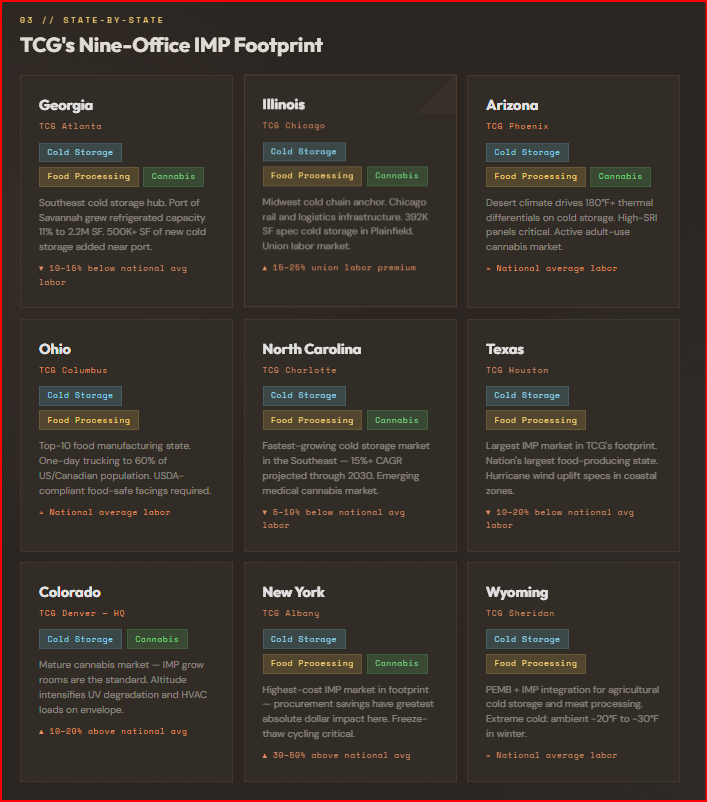
This article covers the IMP supply-and-install landscape across nine key states where TCG is active — Georgia, Illinois, Arizona, Ohio, North Carolina, Texas, Colorado, New York, and Wyoming — with a focus on the three project verticals driving the greatest IMP demand in 2026: cold storage, food processing, and cannabis cultivation. For each state, we cover the market demand drivers, the construction cost environment, the IMP specification considerations specific to the regional climate and regulatory landscape, and how TCG's local office presence translates into better pricing, faster mobilization, and tighter project execution.
Why Single-Source IMP Supply and Install Changes the Project Economics
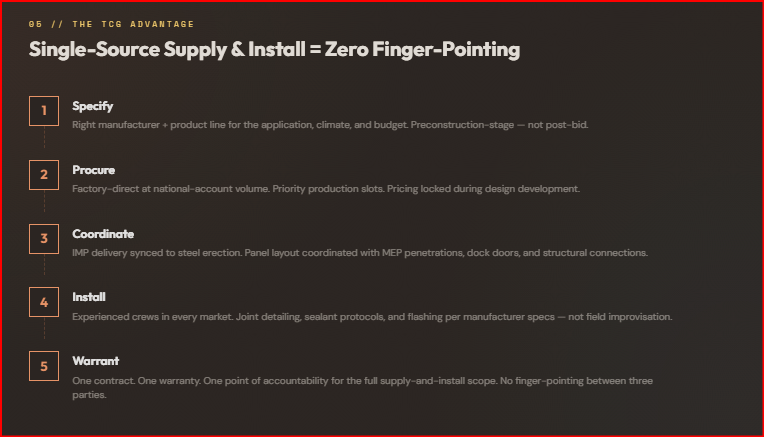
Before the state-by-state breakdown, it's worth understanding why a single-source supply-and-install model — where the same firm procures the panels and installs them — creates a fundamentally better outcome than the fragmented approach most projects use.
The traditional model separates procurement and installation into different contracts with different parties. The architect specifies the panel. The owner or GC buys the panel from the manufacturer or a distributor. A separate specialty subcontractor installs the panel. When something goes wrong — and on IMP projects, the failure mode is almost always at the joints, transitions, and penetrations, not in the panel itself — three parties point at each other. The manufacturer says the panel was installed incorrectly. The installer says the panel was specified incorrectly. The GC says both parties should have flagged the issue in submittals. The owner pays for the remediation.
TCG's model eliminates that fragmentation. As detailed in our complete IMP installation guide, we control the full chain from specification through procurement through installation through commissioning. We select the right manufacturer and product line for the application. We procure at volume pricing through our direct manufacturer relationships. We install with crews that have demonstrated proficiency with the specific panel system and joint configuration required by the project. And we warrant the installed system as a single scope of work — not as a collection of disconnected material and labor contracts.
On cold storage and food processing projects in particular, this model produces measurably better outcomes. According to Cushman & Wakefield's cold storage research, modern cold storage facilities are designed with up to 100-foot clear heights, glycol-piped floor systems, vapor barriers, and specialized racking — all of which must be coordinated with the IMP envelope to prevent thermal bridging, condensation, and ice accumulation at panel joints. An IMP installer who is not integrated with the structural and MEP trades — who shows up after the steel is erected and the roof deck is down — is working without the coordination that prevents the most expensive field failures. TCG's construction management model integrates IMP installation into the master schedule from day one.
Georgia: Southeast Cold Storage Hub with Explosive IMP Demand
Georgia is one of the fastest-growing cold storage and food processing markets in the United States, driven by the Port of Savannah's continued expansion and Atlanta's position as a major food distribution hub for the entire Southeast. According to Persistence Market Research, Georgia is a Southeast cold storage hotspot, with over 500,000 square feet of new cold storage capacity added near Savannah's port in recent years. The port itself grew refrigerated capacity by 11% to 2.2 million square feet, and major operators including Americold and Lineage Logistics are building new facilities in the Atlanta-to-Savannah corridor.
For IMP projects in Georgia, the specification considerations center on humidity management. The Southeast climate — hot, humid summers with dew points regularly exceeding 70°F — creates extreme vapor drive conditions on cold storage envelopes. IMP panel selection must prioritize vapor barrier integrity at joints and transitions. Foil-faced polyurethane core panels from manufacturers like Kingspan and PermaTherm are the standard specification for sub-zero cold storage in this climate zone. Joint sealant protocols are especially critical in humid environments, and TCG's installation crews in the Southeast follow the enhanced joint treatment details outlined in our IMP cold storage installation guide.
Georgia's construction cost environment is favorable — labor rates run 10–15% below the national average in most markets outside central Atlanta, and the state's right-to-work status supports competitive subcontractor pricing. TCG's Atlanta office serves cold storage, food processing, and cannabis-adjacent projects (Georgia's medical cannabis program continues to expand) across the state and the broader Southeast region.
Illinois: Midwest Cold Chain Infrastructure and Food Processing Corridor
Illinois anchors the Midwest cold chain — Chicago's logistics infrastructure, rail connectivity, and food processing industry make it one of the largest IMP markets in the country for temperature-controlled facilities. Colliers' cold storage analysis notes that speculative cold storage development in the Chicago market has included major projects such as the 392,000-square-foot facility in Plainfield, reflecting the region's ongoing demand for modern cold storage capacity.
The IMP specification environment in Illinois is defined by extreme temperature differentials. A blast-freeze facility in Chicago operating at -20°F experiences a temperature differential of over 110°F across the envelope during a July heat wave. That differential drives aggressive thermal expansion and contraction at panel joints, and it creates the conditions for condensation and ice formation at any point where the vapor barrier is compromised. IMP panel thickness in Illinois cold storage projects is typically 4 to 6 inches for refrigerated applications and 5 to 8 inches for frozen and blast-freeze, depending on the R-value targets established during preconstruction.
Chicago is a union labor market, which adds 15–25% to installation labor costs relative to open-shop markets. This makes procurement pricing even more critical — on a project where labor rates are structurally higher, the ability to secure factory-direct panel pricing through volume relationships has an outsized impact on total installed cost. TCG's Chicago office manages IMP projects across Illinois and the broader Midwest, leveraging our manufacturer relationships to offset the labor premium with material savings.
Cannabis cultivation in Illinois is also a growing IMP market. Illinois was one of the first Midwest states to legalize adult-use cannabis, and cultivation facility construction continues to expand as operators build out capacity to meet rising demand. IMP-enclosed grow rooms provide the thermal and vapor performance required for controlled-environment agriculture — and Arch Solar panels are particularly well-suited for cannabis and food processing applications where food-safe interior surfaces and rapid lead times (8–14 weeks) are critical.
Arizona: Desert Climate Creates Unique IMP Performance Requirements
Arizona's cold storage and food processing market is driven by population growth in the Phoenix metro and the state's position as a distribution hub for the broader Southwest. The desert climate creates a unique IMP performance environment — exterior surface temperatures on a south-facing panel in Phoenix can exceed 160°F during summer months, creating a temperature differential of 180°F or more on a blast-freeze facility. Panel color selection, solar reflectance, and thermal shock resistance at joints become critical specification considerations that are less consequential in temperate climates.
Metl-Span and CENTRIA panels with high-SRI (solar reflectance index) exterior facings are commonly specified for Arizona cold storage projects to reduce the thermal load on the envelope and minimize the cooling energy required to maintain target temperatures. The arid climate does simplify one aspect of IMP installation — humidity-driven vapor migration is less aggressive than in the Southeast — but the extreme heat creates its own challenges for installation scheduling, sealant curing, and worker productivity.
Arizona's cannabis market is also driving IMP demand. The state's adult-use cannabis program is one of the most active in the West, and cultivation operators are building purpose-built IMP-enclosed facilities to achieve the environmental control required for year-round production in a climate where ambient conditions make conventional grow facilities impractical. TCG's Phoenix office serves cold storage, food processing, and cannabis IMP projects across Arizona and the broader Southwest.
Ohio: Food Processing Heartland with Growing Cold Storage Investment
Ohio sits at the center of the Midwest food processing industry — the state ranks among the top ten nationally in food manufacturing output, and its location provides one-day trucking access to roughly 60% of the U.S. and Canadian population. Cold storage demand in Ohio is driven by the intersection of food processing capacity and distribution logistics, with major projects concentrated in the Columbus, Cincinnati, and Cleveland corridors.
IMP specification for Ohio food processing facilities must address USDA and FDA regulatory requirements for interior panel surfaces. Panels with food-safe interior facings — smooth, cleanable, non-porous surfaces that meet USDA wash-down standards — are required in any facility where exposed food products are processed or stored. Manufacturers like PermaTherm and Arch Solar offer panels specifically engineered for food processing environments, and TCG's specification team works with food processing operators to select panels that meet both thermal performance and regulatory compliance requirements.
Ohio's construction cost environment tracks closely to the national average, with some urban premium in Cleveland and Columbus. TCG's Columbus office builds cold storage, food processing, and industrial projects across Ohio and serves as our central Midwest operations hub for IMP installation in the region.
North Carolina: Fastest-Growing Cold Storage Market in the Southeast
North Carolina is projected to be one of the fastest-growing cold storage construction markets in the country through 2030, according to SkyQuest's U.S. cold storage market analysis, which projects the state's cold storage market to grow at a CAGR exceeding 15% through the end of the decade. The growth is driven by a combination of factors: a rapidly growing population, expanding food distribution infrastructure along the I-85 and I-40 corridors, favorable business climate with low taxes and streamlined permitting, and increasing demand from the pharmaceutical cold chain sector anchored by the Research Triangle.
The climate in North Carolina presents moderate IMP specification challenges — humid summers require attention to vapor management, though not at the extreme levels seen in Georgia and the Gulf Coast. The state's construction cost environment is favorable, running 5–10% below the national average in most markets, and the right-to-work labor environment supports competitive installation pricing.
North Carolina is also an emerging cannabis market. The state passed medical cannabis legislation in recent years, and cultivation operators are beginning to build licensed facilities that require IMP-enclosed grow rooms for environmental control. TCG's Charlotte office serves IMP installation projects across North Carolina and the broader mid-Atlantic Southeast region.
Texas: Largest and Most Active IMP Market in TCG's Footprint
Texas is the single largest market for IMP installation across cold storage, food processing, and cannabis-adjacent projects in TCG's nine-state office footprint. The state's population growth, its position as the nation's largest food-producing state, and the explosive expansion of cold chain infrastructure along the Houston–San Antonio–Dallas–Fort Worth corridor are driving IMP demand at a scale that exceeds any other individual state in our portfolio.
According to Persistence Market Research, Texas is one of the leading states for cold storage expansion, benefiting from port proximity (Houston and Corpus Christi), rising consumer demand, and robust transportation infrastructure. The state's right-to-work status, low regulatory burden, and competitive labor market make it one of the most favorable construction cost environments in the country for large-format cold storage and food processing projects.
IMP specification in Texas must account for hurricane and severe weather exposure in coastal markets, and for the extreme heat in South and West Texas that creates aggressive thermal differentials on cold storage envelopes. Wind uplift ratings on roof IMP panels in coastal Texas markets must comply with the Texas Windstorm Insurance Association (TWIA) requirements, which can drive specification to heavier-gauge facings and enhanced fastener patterns.
Texas's hemp and cannabis-adjacent markets are also growing, and food processing facility construction remains one of the most active IMP sectors in the state. TCG's Houston office serves as our primary Texas and Gulf Coast hub for IMP supply-and-install projects.
Colorado: Cannabis IMP Leader and Mountain West Cold Chain Growth
Colorado's IMP market is defined by two intersecting demand drivers: the state's mature cannabis cultivation industry and the growing cold storage and food processing infrastructure supporting the Mountain West's population growth. As one of the first states to legalize adult-use cannabis, Colorado has one of the most developed cultivation facility construction markets in the country, and IMP-enclosed grow rooms are the standard building envelope for commercial-scale cannabis operations. Our cannabis cultivation value engineering guide details how IMP wall systems deliver 25–40% cost savings over conventional construction for controlled-environment growing facilities.
Colorado's altitude and arid climate create a unique IMP performance environment. The thin air at 5,000+ feet elevation means HVAC systems work harder, which makes the thermal performance of the IMP envelope even more consequential for energy costs. UV exposure at altitude accelerates exterior facing degradation, making panel color and coating specification important considerations for long-term durability. TCG's Denver office — our company headquarters — serves as the central operations hub for IMP projects across Colorado and the Mountain West.
Cold storage demand in the Denver metro is growing as the region's population expands and food distribution infrastructure builds out to serve the broader Mountain West market. The construction cost environment in Colorado runs 10–20% above the national average, driven by strong demand across all commercial sectors and a competitive labor market. Our partner 9BA MEP provides the mechanical engineering coordination that ensures the HVAC and refrigeration systems are designed in concert with the IMP envelope — a coordination step that is essential on every cold storage and cannabis project.
New York: High-Cost Market Where IMP Procurement Advantage Matters Most
New York State represents the highest-cost IMP installation market in TCG's footprint — and accordingly, the market where our procurement advantage creates the largest absolute dollar savings. Union labor requirements, elevated material costs, complex permitting, and limited site availability in urban and suburban markets drive IMP installation costs to levels that are 30–50% above the national average.
Cold storage demand in the New York metro and broader Northeast is driven by the region's enormous consumer population, the shift toward online grocery fulfillment requiring distributed cold chain nodes, and pharmaceutical cold storage supporting the biotech corridor. Colliers' research notes cold storage projects in Long Island and the broader New York region among active speculative development. The climate — cold winters and humid summers — creates year-round challenges for IMP envelope performance, and freeze-thaw cycling at panel joints is a primary durability concern in the Northeast.
New York's cannabis market is also ramping. The state's adult-use program has been issuing cultivation licenses, and operators are building IMP-enclosed facilities across the state. TCG's Albany office serves cold storage, food processing, cannabis, and industrial IMP projects across New York and the greater Northeast. In this high-cost market, the pricing advantage from our direct manufacturer relationships — where we are buying at volume across our national project portfolio and passing those savings to the project — can represent $100,000 or more on a mid-size IMP scope compared to a local GC buying through a distributor.
Wyoming: PEMB + IMP Integration for Agricultural and Industrial Projects
Wyoming is the smallest market in TCG's nine-state footprint by IMP volume, but it represents an important project type: the integrated pre-engineered metal building and IMP installation for agricultural cold storage, food processing, and industrial applications. Wyoming's agricultural economy generates demand for cold storage and food processing facilities — particularly for meat processing, grain storage, and agricultural products that require temperature-controlled environments for USDA compliance.
The IMP specification environment in Wyoming is dominated by extreme cold. Winter temperatures routinely reach -20°F to -30°F in many parts of the state, which means that even dry storage and processing facilities require significant envelope thermal performance to maintain interior temperatures without excessive heating costs. For cold storage applications, the exterior-to-interior temperature differential can actually be smaller in winter (when ambient temperatures are already near target) and larger in summer — the opposite pattern from Southern states. This year-round thermal cycling drives specification toward panels with the highest joint integrity and the most robust sealant systems.
TCG — a Wyoming-registered company — serves IMP projects across the state and the broader Northern Mountain West region. Many Wyoming projects combine PEMB structural systems with IMP envelope systems, and TCG's ability to procure and install both the steel structure and the insulated panel system as a single integrated scope eliminates the coordination risk that plagues projects where the steel erector and the panel installer are separate firms working from separate schedules.
Get an IMP Supply-and-Install Estimate for Your Project
Whether you're building a cold storage facility in Georgia, a food processing plant in Ohio, or a cannabis cultivation operation in Colorado, TCG's IMP Install Estimator provides preliminary supply-and-install pricing for your specific project. Upload your plans and get an instant Good / Better / Best estimate backed by over one million square feet of direct IMP installation experience.
For complex projects requiring detailed specification consultation, schedule a 30-minute call with our IMP team.
How TCG Selects the Right IMP Manufacturer for Each Project
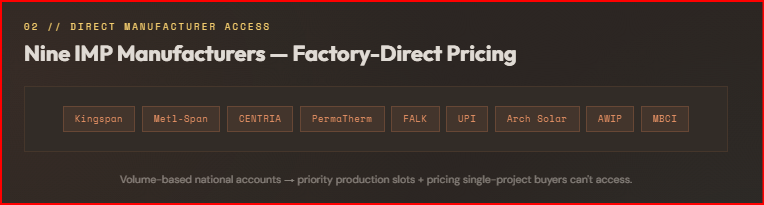
One of the most consequential decisions on any IMP project is manufacturer and product selection. As we detail in our comprehensive IMP manufacturer comparison, the nine manufacturers we work with — Kingspan, Metl-Span, CENTRIA, PermaTherm, FALK, UPI, Arch Solar, AWIP, and MBCI — each have distinct strengths across performance, pricing, lead time, and application suitability.
For cold storage projects requiring the highest R-value per inch and the most robust vapor barrier performance, Kingspan and PermaTherm are typically the specification starting point. For food processing facilities where USDA-compliant interior facings and competitive pricing are the primary drivers, PermaTherm and Arch Solar are strong options — and Arch Solar's 8–14 week lead times (versus 16–24+ weeks for some competitors) make it particularly attractive for schedule-driven projects. For architectural wall applications where aesthetic flexibility matters alongside thermal performance, CENTRIA and Metl-Span offer broader design options. For projects where cost is the dominant constraint and the application is standard commercial or light industrial, AWIP and MBCI provide excellent value.
TCG's preconstruction team makes these manufacturer recommendations during the design phase — not after construction documents are issued — so the specification reflects both the performance requirements of the application and the real-world pricing and lead-time conditions of the market at the time of procurement. This is the kind of decision that a design-build delivery method enables and that traditional design-bid-build frequently misses.
The 2026 IMP Market: Demand, Lead Times, and Pricing
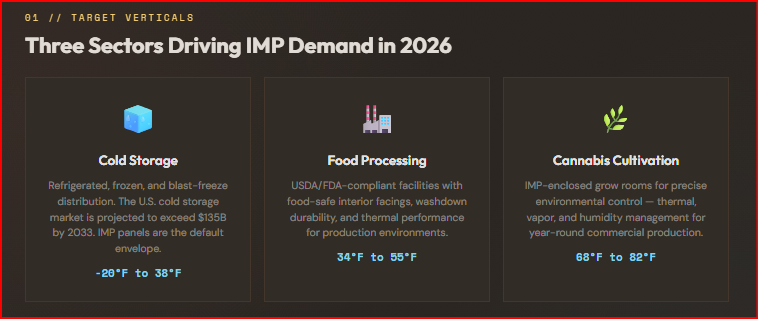
The U.S. IMP market in 2026 is defined by strong demand and tightening capacity. As we projected in our IMP installation volume analysis, the country is on track to install more than 550 million square feet of insulated metal panels this year across cold storage, industrial, commercial, and data center applications. The cold storage construction market alone is projected to grow at a compound annual rate exceeding 12% through 2030, according to Grand View Research, reaching over $135 billion in total market value by 2033.
For project owners, the practical implications are straightforward: popular IMP product lines are running extended lead times, and manufacturers are prioritizing their highest-volume customers for production slots. Owners who wait until construction documents are complete to begin IMP procurement are finding themselves at the back of the queue — and the schedule delay from a 20-week or 24-week panel lead time can cascade into months of downstream impact on the overall project timeline.
TCG's volume across our nine-state footprint gives us priority access to production capacity at every manufacturer we work with. When we place an order for a cold storage project in Texas or a cannabis facility in Colorado, that order carries the weight of our annual aggregate volume — not just the square footage of the individual project. In a constrained market, that priority is worth more than the material pricing advantage alone.
The tariff environment adds additional urgency. Steel facing on IMP panels is subject to the same Section 232 tariff structure affecting all steel products, and manufacturers have implemented price increases accordingly. Owners who lock in IMP pricing early — during preconstruction, before construction documents are finalized — protect their project budget against further increases.
Building a Cold Storage, Food Processing, or Cannabis Facility?
TCG provides IMP supply and installation, commercial general contracting, design-build delivery, and construction management for temperature-controlled and environmentally controlled facilities nationwide. With active projects in Atlanta, Chicago, Phoenix, Columbus, Charlotte, Houston, Denver, Albany, and Sheridan, we're the IMP supply-and-install partner that's actually in your market — not flying crews in from three states away.
Get an AI construction estimate or schedule a 30-minute conversation →
Frequently Asked Questions: IMP Supply and Install for Cold Storage, Food Processing, and Cannabis
What is an insulated metal panel (IMP) and why is it the default envelope for cold storage and food processing?
An insulated metal panel is a prefabricated building envelope component consisting of an insulating foam core — typically polyurethane, polyisocyanurate, or mineral wool — bonded between two metal facings. IMPs are the default envelope system for cold storage and food processing facilities because they deliver the highest R-value per inch of any commercially available wall and roof system, they provide a continuous vapor barrier when properly installed, they offer smooth and cleanable interior surfaces that meet USDA and FDA sanitation requirements, and they can be installed significantly faster than conventional insulated wall assemblies. TCG's IMP division has installed over one million square feet of panels across cold storage, food processing, cannabis, industrial, and commercial projects nationwide.
What IMP manufacturers does TCG work with?
TCG maintains direct procurement relationships with nine leading IMP manufacturers: Kingspan, Metl-Span, CENTRIA, PermaTherm, FALK, UPI, Arch Solar, AWIP, and MBCI. Each manufacturer serves different performance niches — Kingspan and PermaTherm for high-R-value cold storage, Arch Solar for food-safe and cannabis applications with fast lead times, CENTRIA and Metl-Span for architectural applications, and AWIP and MBCI for cost-effective standard commercial and industrial envelopes. Our preconstruction team recommends the right manufacturer and product line based on the specific performance requirements, budget, and schedule of each project.
In which states is TCG most active on IMP installation projects?
TCG is most active in nine states: Georgia (Atlanta), Illinois (Chicago), Arizona (Phoenix), Ohio (Columbus), North Carolina (Charlotte), Texas (Houston), Colorado (Denver), New York (Albany), and Wyoming (Sheridan). While we install IMP panels across all 50 states, these markets benefit from established project management, faster crew mobilization, and direct relationships with regional subcontractor networks that improve both pricing and execution quality on IMP projects in those markets.
How much does IMP installation cost per square foot in 2026?
IMP supply-and-install costs vary significantly by panel type, thickness, manufacturer, and market — ranging from approximately $8 to $25+ per square foot installed for wall panels and $10 to $30+ per square foot installed for roof panels, depending on specification and project complexity. Cold storage applications requiring thicker panels (5–8 inches) with enhanced joint treatment and vapor barrier detailing fall at the upper end of these ranges. Standard commercial and industrial applications with 2–4 inch panels fall at the lower end. The TCG IMP Install Estimator provides project-specific preliminary pricing based on your plans and specifications.
Why does climate zone matter for IMP specification on cold storage projects?
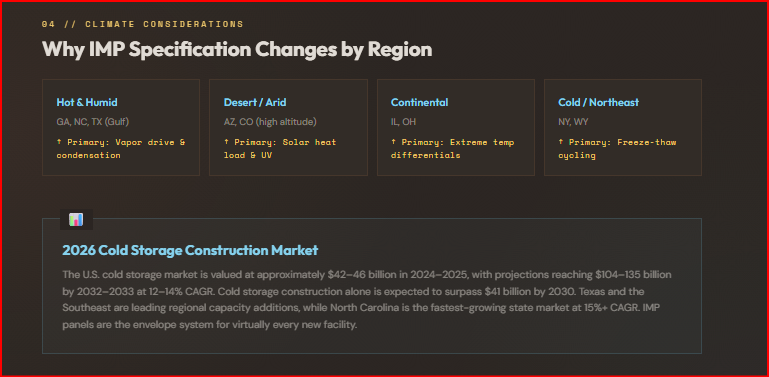
Climate zone determines the severity of the thermal and moisture challenges the IMP envelope must manage. In humid climates like Georgia and North Carolina, vapor drive from warm, moist exterior air into the cold interior is the primary concern — requiring panels with robust vapor barriers and meticulous joint sealant protocols. In desert climates like Arizona, extreme solar heat load drives specification toward high-SRI exterior facings and thermal shock-resistant joint systems. In cold climates like New York and Wyoming, freeze-thaw cycling at panel joints and the reduced temperature differential in winter (when ambient temperatures are already near target) create different durability considerations. TCG's specification team accounts for these regional variables during preconstruction to ensure the panel system is matched to the site conditions.
Can TCG supply and install IMP panels for cannabis cultivation facilities?
Yes — cannabis cultivation is one of TCG's deepest IMP specialties. IMP-enclosed grow rooms provide the thermal performance, vapor management, and environmental control precision required for commercial-scale cannabis production. We have completed IMP installations for cannabis facilities in Colorado and other active cannabis states, and our cannabis value engineering guide details how IMP wall systems deliver 25–40% cost savings over conventional construction for grow rooms while improving environmental control and energy efficiency. Our partner 3rd Act Architecture & Consulting provides the design framework for cannabis facilities, and our IMP team handles supply and installation as part of the integrated project delivery.
How does TCG's volume purchasing affect IMP panel pricing?
TCG installs IMP panels on dozens of projects annually across our nine-state footprint. That aggregate annual volume gives us pricing leverage with every manufacturer we work with — we are buying at national-account volume, not individual-project quantities. The pricing differential between our volume-based procurement and single-project purchasing through a distributor typically represents 15–30% savings on material cost, depending on the manufacturer and product line. On a 50,000-square-foot cold storage envelope, that pricing advantage can represent $75,000 to $200,000 in material savings alone — before accounting for the schedule and coordination advantages of our integrated supply-and-install model. See our equipment procurement guide for more on how GC-led procurement creates structural cost advantages.
What is the typical lead time for IMP panels in 2026?
Lead times vary by manufacturer and product line. Standard commercial panels from manufacturers like AWIP and MBCI are typically available in 8–12 weeks. Specialty cold storage and food processing panels from Kingspan and PermaTherm run 12–20 weeks depending on thickness and facing specifications. Arch Solar — which TCG recommends for cold storage, food processing, and cannabis applications where schedule is critical — delivers in 8–14 weeks, meaningfully faster than several competitors in the same performance tier. In the current market, where IMP installation volumes are at record levels, ordering early during design development rather than after construction documents are complete can save 4–8 weeks on the project schedule.
Does TCG provide IMP installation only, or full design-build services for cold storage and food processing?
TCG provides both. For owners and GCs who need IMP supply-and-install as a specialty subcontract scope, our IMP installation division delivers that service as a standalone package. For owners developing cold storage, food processing, or cannabis facilities who want a single point of accountability for the entire project — from architectural design through structural engineering through MEP engineering through IMP installation through equipment procurement through final commissioning — our design-build delivery and construction management services integrate IMP into the total project scope.
How do I get an IMP estimate for my specific project?
The fastest way to get preliminary IMP supply-and-install pricing is through TCG's IMP Install Estimator — upload your plans (floor plans, elevations, or panel layouts) and receive an instant Good / Better / Best cost estimate. As described in our IMP estimator guide, the tool is powered by our database of over one million square feet of completed IMP installations and provides budget-level pricing you can use for feasibility analysis and project underwriting. For projects requiring detailed specification consultation and formal proposals, schedule a call with our team.
Related Reading
Best IMP Manufacturers in the USA (2026) — Kingspan, Metl-Span, CENTRIA, and More Compared
The Complete Guide to Insulated Metal Panel Installation
IMP Installation for Cold Storage and Controlled-Environment Facilities
How Many Square Feet of IMP Will Be Installed in the USA in 2026?
IMP Cost Estimator: Upload Your Plans for Instant Pricing
Nationwide Reach: Active IMP Projects Underway in 2026
Average Cost to Build a Cold Storage Facility in the USA
How Much Does Cold Storage Construction Cost in 2026?
How to Value-Engineer a Cannabis Cultivation Facility
Emerging Cannabis Markets: Minnesota, Kentucky, and Beyond
Equipment Procurement for Commercial Construction
Pre-Engineered Metal Building Cost Per Square Foot
Average Cost to Build a Self-Storage Facility
Average Cost to Build a 3PL Logistics Warehouse
Commercial Construction in 2026: The Five Forces
Commercial Architectural Services: Costs and Value
Architectural and Engineering Fees and Soft Costs
Developer GC Pain Points
AI-Powered Commercial Construction Estimator
Average Cost to Build a QSR Restaurant
Average Cost to Build a QSR Coffee Shop
Average Cost to Build a Veterinary Clinic
Average Cost to Build an Urgent Care Center
Average Cost to Build an Optometry Office
High-End Restaurant Construction Cost Per Square Foot
Cost to Build a Grocery-Anchored Strip Mall
Tenant Improvement Buildout Costs
AI in Commercial Construction
Iran War & Strait of Hormuz Construction Cost Impact
Hospital Construction Boom 2026
Commercial Construction News Roundup
Sources
Grand View Research — U.S. Cold Storage Market Size & Share Report, 2033Coherent Market Insights — U.S. Cold Storage Market Analysis 2026–2032Persistence Market Research — U.S. Cold Storage Market Size and Trends to 2032SkyQuest — U.S. Cold Storage Market Size and Regional Growth 2026–2033Cushman & Wakefield — Exploring the Future of Cold StorageColliers — The Future of Speculative Cold Storage DevelopmentCold Summit — Cold Storage Industry Outlook 2026Business Research Company — Cold Storage Construction Market 2026Future Market Insights — Global Cold Storage Market Analysis 2036Kingspan — Insulated Metal Panel SystemsMetl-Span — Insulated Metal PanelsCENTRIA — Architectural Metal Wall and Roof SystemsPermaTherm — Cold Storage and Food Processing IMPArch Solar — Insulated Metal PanelsAWIP — Insulated Metal PanelsMBCI — Metal Building ComponentsAssociated General Contractors of America (AGC)CBRE — Commercial Real Estate ResearchNAIOP — Commercial Real Estate Development AssociationProcore — Construction Management PlatformRSMeans/Gordian — Construction Cost Data
