

How Much Does Cold Storage Construction Cost in 2026?
How Much Does Cold Storage Construction Cost in 2026?
A nationwide guide to warehouse and cold storage construction costs by temperature zone — including IMP installation, PEMB structures, refrigeration systems, and how to benchmark your project with TCG's free AI-powered cost estimator.
Cold storage construction is one of the fastest-growing segments of commercial construction in the United States. Driven by e-commerce grocery delivery, pharmaceutical cold chain expansion, reshoring of food processing, and tightening FDA/USDA regulations, demand for temperature-controlled facilities has surged — and so has the complexity of building them.
Whether you are a developer evaluating a speculative freezer warehouse, a food manufacturer expanding production, or a pharmaceutical company building cGMP cold chain capacity, understanding the real cost of cold storage construction is the first step toward a successful project. This guide breaks down costs by temperature zone, explains why insulated metal panels (IMPs) are the standard building envelope, and introduces a free tool that gives you a preliminary estimate in under two minutes.
Cold Storage Costs by Temperature Zone
The single largest variable in cold storage construction cost is temperature. Lower operating temperatures require thicker insulated metal panels, more robust vapor barrier assemblies, heated sub-slab systems to prevent frost heave, and higher-capacity refrigeration — all of which compound costs significantly as you move from cooler to freezer to blast freeze.
Standard distribution, 3PL, general storage. PEMB + minimal insulation.
Produce, dairy, beverage. 2"–4" IMP, light-duty refrigeration.
Ice cream, frozen foods, pharma. 5"–6" IMP, heated sub-slab.
Rapid freezing for meat, seafood, prepared foods. 6"–8" IMP.
Biologics, vaccines, cGMP cold chain. 8"+ IMP, redundant refrigeration.
These ranges reflect total construction cost including site work, structure, envelope, mechanical systems, and general contractor fees. Regional cost multipliers can shift these ranges by 15–45%.
Regional Cost Adjustments
Benchmark Your Cold Storage Project in Under 2 Minutes
Describe your project and get a preliminary cost estimate calibrated to your temperature zone, region, and facility type — free, instant, no sales call required.
Why Insulated Metal Panels Are the Cold Storage Standard
Insulated metal panels — commonly called IMPs — are the envelope system of choice for virtually every cold storage facility built in the United States today. An IMP consists of a rigid foam core (polyurethane, polyisocyanurate, or mineral wool) bonded between two metal face sheets. The result is a continuous, thermally efficient, vapor-tight, and structurally rigid panel that installs in a fraction of the time required by traditional insulation methods.
TCG has installed over 1,000,000 square feet of IMP across 38 states — making it one of the most experienced IMP installation contractors in the country. We self-perform all IMP work with our own crews and partner with every major manufacturer including PermaTherm, Falk, Metl-Span, Kingspan, and UPI.
- Continuous insulation without thermal bridging. Unlike stud-framed walls with batt insulation, IMPs eliminate the thermal short circuits that cause condensation, ice formation, and energy loss.
- Integrated vapor barrier. Metal face sheets and factory-sealed joints create a continuous vapor barrier — essential for preventing moisture migration that destroys R-value over time.
- Food-safe interior surfaces. Smooth, washable, USDA/FDA-compliant finishes that meet cGMP and FSMA sanitation requirements without additional interior finishing.
- 3–5× faster installation. Factory-fabricated panels install in a fraction of the time of traditional framed walls. On 100,000 SF projects this can save 4–8 weeks of schedule.
- Scalable for any temperature. Panels available from 2" (cooler) to 8"+ (blast freeze/ultra-low), so one envelope system can serve every temperature zone in a multi-temp facility.
IMP typically costs $12–$35 per square foot of wall and ceiling area, depending on panel thickness, manufacturer, and finish. For a 75,000 SF freezer warehouse, the IMP envelope alone represents $800,000–$1,500,000 of the total budget — making manufacturer selection and installation quality among the most consequential decisions in the project.
The Role of PEMB Structures in Warehouse Construction
Most single-story warehouses and cold storage facilities in the U.S. are built on pre-engineered metal building (PEMB) structural frames. A PEMB uses factory-manufactured rigid steel frames custom-engineered to site-specific loads — snow, wind, seismic, and collateral — per MBMA and AISC standards.
| Attribute | PEMB | Conventional Steel |
|---|---|---|
| Cost per SF (structure) | $18–$32 | $28–$48 |
| Clear span capability | 200+ ft without columns | Typically 60–120 ft |
| Erection time (100K SF) | 6–10 weeks | 12–18 weeks |
| IMP compatibility | Native — Z-girts sized for IMP | Requires secondary framing |
| Design lead time | 6–10 weeks | 12–20 weeks |
TCG self-performs both PEMB erection and IMP installation — an unusual combination that eliminates coordination gaps between structural and envelope subcontractors and gets buildings weathertight faster.
What Drives Cold Storage Construction Costs?
Beyond temperature zone and regional labor rates, several major systems determine the final cost of a cold storage facility. Each of these scopes is quality-sensitive — corners cut here surface years later as operational failures.
Refrigeration Systems
Ammonia (NH₃) remains the most efficient refrigerant for large facilities but requires IIAR and OSHA PSM compliance. CO₂ cascade is growing for food-contact applications. HFCs/HFOs serve smaller projects.
$15–$60/SFFoundation & Heated Slab
Freezer areas require heated sub-slab systems (glycol loops or electric resistance) to prevent frost heave. Racking-rated slabs need thickened sections and ACI 360 flatness tolerances.
+$8–$18/SF for heated slabDock Equipment
Dock levelers, insulated overhead doors, dock seals or shelters, and temperature-controlled vestibules. Each dock position is $15K–$35K depending on configuration.
$15K–$35K per dockVapor Barrier Systems
The difference between a facility that performs for 30 years and one that fails in 5. Every joint, penetration, and temperature-zone transition must be sealed against moisture migration.
$2–$6/SF envelopeMEP Engineering
MEP systems — electrical, plumbing, fire protection, controls — must coordinate with refrigeration, envelope, and operational layout.
$25–$60/SFSite Work & Utilities
Site prep, utilities, stormwater, and heavy power service (cold storage is power-intensive). Cold storage facilities typically need 2–4× the electrical service of a dry warehouse.
$12–$35/SFWhy Design-Build Delivery Matters for Cold Storage
Cold storage construction involves more interdependent systems than almost any other commercial building type. The structural frame must support both the IMP envelope and refrigeration equipment. The floor slab must accommodate racking loads, heated sub-slab systems, and process drainage. The IMP envelope must be installed before refrigeration can be commissioned.
In traditional design-bid-build delivery, the owner hires an architect, then separately bids construction. The result is often a 6–12 month design phase followed by a competitive bid that rarely accounts for constructability issues that drive cold storage costs. Change orders are common. Schedules slip.
Design-build consolidates architecture, engineering, and construction under a single contract and a single point of accountability. At TCG, our architects and engineers design the building in real-time coordination with our preconstruction estimators and construction managers. The result: facilities designed to be built efficiently, priced accurately from day one, and delivered 15–30% faster than traditional methods.
Ready to Estimate Your Cold Storage Project?
Use TCG's free AI-powered estimator to benchmark construction costs for any cooler, freezer, or cold storage facility — anywhere in the U.S.
Codes, Certifications & Regulatory Compliance
Cold storage construction is among the most heavily regulated segments of commercial building. Depending on stored product, facilities may need to comply with FDA cGMP (21 CFR 110), USDA FSIS, SQF and FSMA for food safety, IIAR for ammonia refrigeration safety, NFPA 13 for fire protection in high-piled storage, and ASHRAE standards for refrigerated facility design.
TCG's design-build model ensures regulatory requirements are designed into the facility from schematic design — not discovered as change orders during construction. Our track record includes first-inspection FDA and USDA certifications on multiple food processing and cold storage facilities.
Indoor Cannabis Cultivation Facility, Minneapolis, MN
TCG supplied and installed 50,000 SF of insulated metal panel, with doors and hardware, to build out the cultivation rooms of an indoor cannabis facility in Minneapolis, then supplied and installed urethane cement flooring. One contractor, one schedule, envelope to floor.
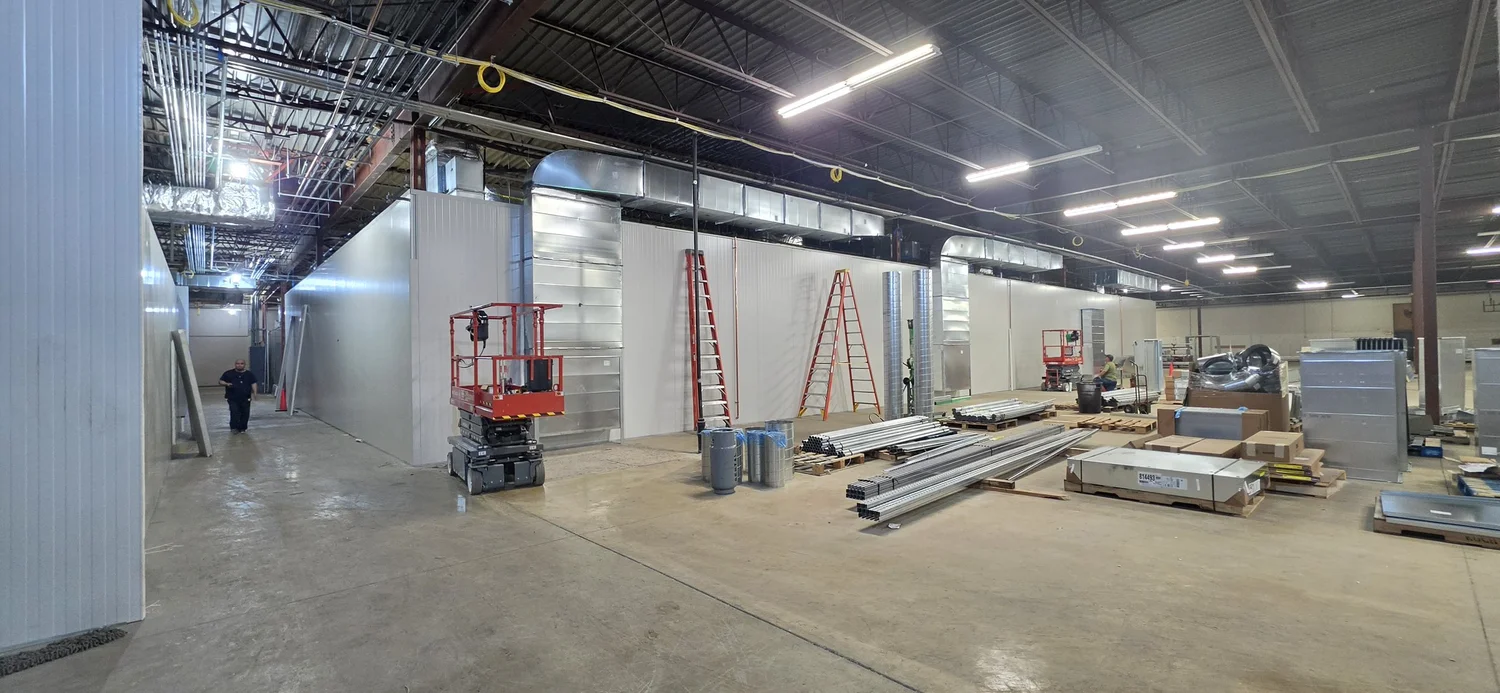
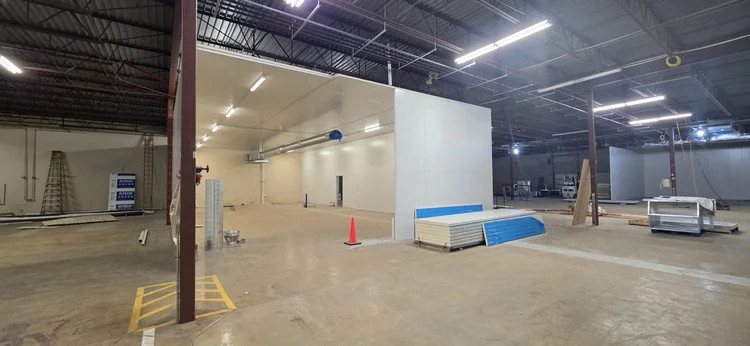
Cultivation rooms hold tight temperature and humidity setpoints around the clock. A sealed, thermally continuous IMP envelope with an integrated vapor barrier keeps moisture out of the assembly, and urethane cement floors stand up to washdown, nutrients, and constant traffic.
From cultivation rooms to cold rooms: controlled-environment rooms of every kind live or die on panel joints, door seals, and penetration details. TCG self-performs IMP supply and install on cold storage, food, and cultivation projects nationwide; see cold storage construction or price your project with the IMP install estimator.
- Envelope: 50,000 SF of IMP wall and ceiling panel forming the cultivation rooms
- Openings: IMP doors and hardware supplied and installed
- Flooring: urethane cement supplied and installed
- Delivery: turnkey supply and install, self-performed
Full photo gallery on the project spotlight.
Cold Storage Construction FAQ
How much does it cost to build a cold storage warehouse?
Costs depend on temperature zone: dry warehouse $60–$150/SF, cooler (35°F) $150–$250/SF, freezer (0°F) $200–$350/SF, blast freeze (–40°F) $280–$450/SF, ultra-low (–150°F) $350–$550/SF. Regional multipliers shift these 15–45%.
What are insulated metal panels (IMPs) and why are they used in cold storage?
IMPs are prefabricated panels with rigid foam insulation bonded between two metal face sheets. They are the industry standard because they provide continuous thermal insulation without bridging, integrated vapor barriers, food-safe surfaces, and install 3–5× faster than framed walls. TCG has installed over 1,000,000 SF with panels from PermaTherm, Falk, Metl-Span, Kingspan, and UPI.
How much does IMP installation cost?
$12–$35 per SF of wall and ceiling area depending on panel thickness (2" for coolers up to 8"+ for ultra-low), manufacturer, finish, and complexity. For a 75,000 SF freezer warehouse, the IMP envelope typically represents $800,000–$1,500,000.
What is a PEMB and why is it used for warehouse construction?
A Pre-Engineered Metal Building uses factory-manufactured rigid steel frames custom-engineered to site-specific loads. PEMBs are 15–30% less expensive than conventional steel for single-story clear-span buildings, can span 200+ feet without interior columns, and erect faster. TCG self-performs both PEMB erection and IMP installation.
How can I estimate the cost of my cold storage project?
Use TCG's free AI-powered cold storage estimator. Describe your project — square footage, temperature zones, location, refrigeration type — and receive a preliminary estimate with a system-by-system breakdown in under two minutes. For a formal proposal, schedule a call with preconstruction.
What refrigeration system is best for cold storage?
Ammonia (NH₃) is most efficient for large facilities but requires IIAR and OSHA PSM compliance. CO₂ cascade is growing for food-contact where ammonia is restricted. Synthetic refrigerants (HFCs/HFOs) are used in smaller facilities. Refrigeration runs $15–$60/SF.
Does TCG handle FDA and USDA certification?
Yes. TCG designs and builds to pass FDA cGMP (21 CFR 110) and USDA FSIS inspections on the first attempt — sanitary finishes, cove bases, floor slopes, drainage, temperature monitoring, and pest control. We also support SQF and FSMA.
Why is heated floor slab required in freezer construction?
Freezer temperatures cause soil moisture to freeze and expand — frost heave — which lifts and cracks the slab, damaging racking and structure. A heated sub-slab system (glycol loops or electric resistance) prevents this. Heated slabs add $8–$18/SF.
How long does cold storage construction take?
Dry warehouses: 6–12 months. Single-temp cold storage: 8–14 months. Multi-temp with complex refrigeration: 12–16 months. PEMB and IMP procurement (8–14 week lead time) is usually the critical path. Design-build compresses schedules 15–30%.
Can TCG build cold storage facilities anywhere in the U.S.?
Yes. TCG operates across 38 states, headquartered in Denver, CO. Regional subcontractor networks, local cost data, and jurisdiction-specific code knowledge are applied to every project.
