
Commercial Architectural Services: What They Cost, How They Work, and Why They Pay for Themselves (2026)
One of the most persistent conversations in commercial real estate development goes something like this: "Do we really need an architect? Can't we just give the contractor a budget and some napkin sketches and let them figure it out?"
The honest answer: you'll pay for architecture one way or another. The question is whether you pay an architect upfront to prevent problems, or pay a contractor mid-project to solve them through change orders, schedule delays, and rework.
A 2023 AIA study found that commercial projects delivered without architect involvement during preconstruction averaged 12% cost overruns. Projects with design-build delivery — architect and GC engaged together from the start — averaged only 2% cost variance. That 10-point difference is not theoretical. On a $5 million project, it's half a million dollars.
This guide breaks down what commercial architectural services actually include at each phase, how architects price their work, what you should look for when hiring one, and the data showing why the investment returns 3 to 5 times its cost through reduced rework, code compliance, and on-time delivery. For a comprehensive breakdown of A/E fee percentages by building type and the full soft cost picture across U.S. regions, see our companion article on architectural and engineering fees and soft costs in commercial construction.
What Commercial Architectural Services Actually Include
Before any cost conversation makes sense, you need to understand what architectural services actually encompass. A lot of developers think "architecture" means drawing pretty pictures. It's not. Modern commercial architecture is a specific sequence of services, each with a distinct deliverable, timeline, and cost.
The AIA B101 Standard Form of Agreement defines architectural services across five core phases:
Phase 1: Programming and Site Analysis
The architect works with the owner, operator, and — ideally — the future GC to understand the project's functional requirements, code constraints, site conditions, budget, and schedule. This phase typically lasts 4 to 8 weeks and results in a detailed program document and site analysis report. Many owners skip this phase. They shouldn't. Programming misalignment is the number-one driver of design rework and cost overruns. A $25,000 to $50,000 programming study routinely prevents $300,000 or more in redesign costs downstream.
Phase 2: Schematic Design
The architect translates the program into initial design concepts — building massing, floor plans, preliminary systems, and design direction. Schematics are typically 30 to 40% complete in terms of detail. This phase lasts 6 to 10 weeks and produces sketches, 3D models, and preliminary cost estimates. This is where preconstruction cost validation from a GC is most valuable. Design decisions made at schematic design determine roughly 80% of the final project cost — and they're still cheap to change at this stage.
Phase 3: Design Development
The architect refines the schematic design into a more complete set of documents showing structural systems, MEP coordination, exterior materials, and interior details. Design Development typically represents 60 to 70% design completion and lasts 8 to 12 weeks. This is the critical phase where buildability conflicts become visible — and fixable — before they become expensive change orders. For owners building MEP-intensive projects like medical offices, QSR coffee shops, or cold storage facilities, the coordination work in this phase is where the most money is saved or lost.
Phase 4: Construction Documents
The architect produces the final, bid-ready set of drawings and specifications — the legal contract documents that contractors use to price the work and construct the building. These typically run 100 to 200-plus pages and represent 100% design completion. This phase lasts 10 to 16 weeks depending on complexity. General contractors use these documents to generate accurate bids and protect themselves legally during construction. Incomplete or ambiguous construction documents lead directly to change orders — the single most common source of budget overruns on commercial projects.
Phase 5: Construction Administration
The architect provides site observation, interprets drawing questions, reviews shop drawings and submittals, and certifies that the work is proceeding in substantial conformance with the contract documents. Construction administration lasts the full construction period — typically 12 to 24 months for commercial projects — and is billed on a time-and-materials basis or as a fixed percentage of hard costs. This is the phase most owners try to cut when budgets get tight, and it's almost always the wrong place to save money. An architect who isn't reviewing submittals and answering RFIs during construction is an architect who isn't protecting the owner from field-level mistakes.
The Four Fee Structures: How Architects Price Their Work
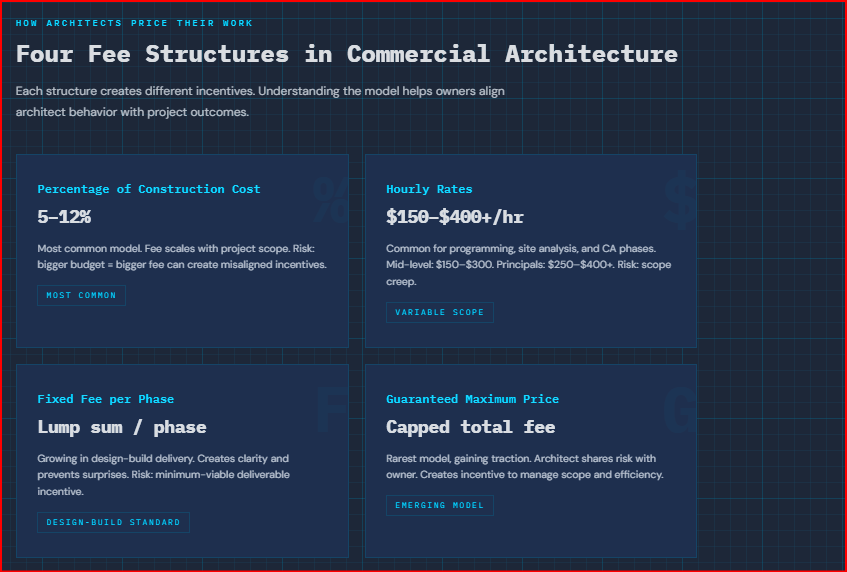
There are four primary fee structures in commercial architecture. Understanding each one helps owners align incentives with project outcomes — and avoid the misaligned incentive traps that drive cost overruns on projects of every size.
Percentage of Construction Cost is the most common structure. The architect charges a percentage of total hard construction cost, typically 5 to 12% depending on project type and complexity, per 2023 AIA fee survey data. This structure aligns the architect's compensation with project scope, but it can create a perverse incentive: a bigger budget means a bigger fee. Sophisticated owners negotiate caps or hybrid structures to manage this dynamic.
Hourly Rates are common for programming, site analysis, and construction administration phases where scope is less predictable. Mid-level designers typically bill $150 to $300 per hour, with senior architects and principals at $250 to $400 or more. The risk to the owner is scope creep; the risk to the architect is underestimating hours. Clear scope definitions and regular budget check-ins manage both risks.
Fixed Fee per Phase is increasingly common in design-build projects where scope is tightly defined upfront. The architect charges a lump sum for each service phase — for example, $25,000 for Programming, $75,000 for Schematic Design, $85,000 for Design Development. Fixed fees create clarity and prevent surprises, but they can incentivize architects to deliver the minimum scope required rather than the optimal scope. The antidote is selecting an architect whose reputation and repeat-client relationships create a stronger incentive than the fee structure alone.
Guaranteed Maximum Price is the rarest model but gaining traction among sophisticated developers and GCs who want predictability and shared risk. The architect commits to a maximum total fee for all services, with incentives for finishing under budget. This works similarly to construction GMPs — the architect has a margin target and a ceiling, creating an incentive to manage scope and efficiency without sacrificing quality.
For a detailed breakdown of how these fee structures play out across specific building types — warehouses, QSR, healthcare, office, cannabis, and more — and how fees vary by U.S. region, see our complete guide to A/E fees and soft costs by facility type and region.
What Drives Architectural Fees Up and Down
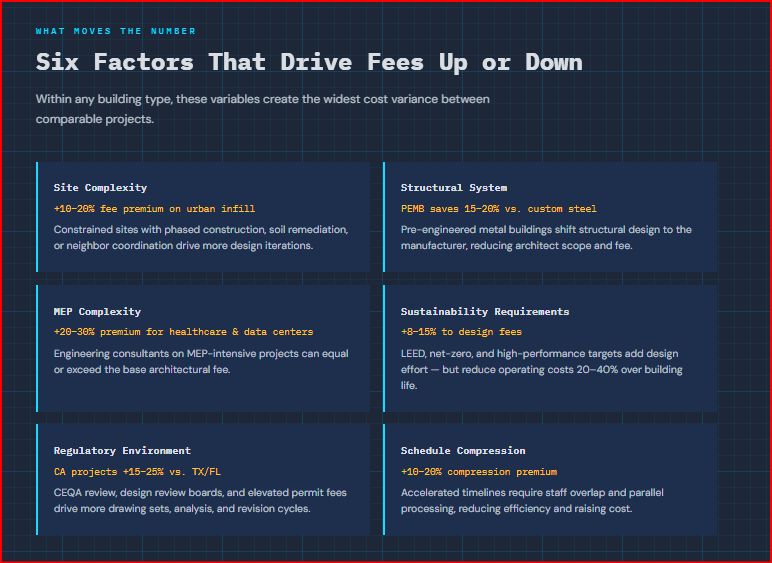
Within any building type or fee structure, six factors create the most significant variation in what you'll actually pay for architectural services.
Site Complexity. A straightforward rectangular site with simple constraints carries lower architectural fees than a constrained urban infill site requiring phased construction, soil remediation analysis, complex utility coordination, or sensitive neighbor interface. Urban infill projects often carry 10 to 20% fee premiums due to increased design iterations and code coordination. This is one of the reasons an experienced owner's representative conducting site due diligence before design begins can prevent budget surprises — the site drives the fee before a single line is drawn.
Structural System Selection. A simple post-and-beam building on grade with clear spans is cheaper to design than a building requiring complex transfer structures, seismic design, or deep foundation systems. Pre-engineered metal buildings can reduce architectural fees 15 to 20% relative to custom steel or concrete frame design because the manufacturer's engineering department handles the structural design as part of the building package.
MEP Complexity. A building with minimal mechanical systems is less expensive to design than a facility requiring sophisticated MEP coordination, building-wide automation, or specialized equipment integration. Healthcare facilities, data centers, and cannabis cultivation facilities carry MEP design premiums of 20 to 30% relative to standard commercial buildings. The engineering consultant team on these projects — mechanical, electrical, plumbing, fire protection, and often specialty disciplines — can equal or exceed the base architectural fee. Our A/E fees and soft costs guide breaks down the engineering component in detail by building type.
Sustainability and Code Requirements. Buildings targeting LEED certification, net-zero energy, or high-performance standards require additional design effort for systems integration, commissioning, and performance modeling. Sustainable design adds 8 to 15% to architectural fees but often reduces operational costs by 20 to 40% over the building's life — making it one of the highest-ROI investments available in the design phase.
Regulatory and Permitting Environment. States and cities with aggressive code enforcement, design review boards, or environmental review requirements drive higher architectural fees due to increased drawing sets, analysis, and revision cycles. California projects often carry 15 to 25% fee premiums relative to Texas or Florida due to CEQA requirements and permitting complexity. As we've covered in our analysis of commercial construction challenges in 2026, permitting timelines have become one of the most significant schedule and cost risks in commercial development.
Schedule Compression. Architects asked to accelerate their standard timeline — moving from 20-week design development to 12 weeks — charge a schedule compression premium, typically 10 to 20%, due to increased staff overlap and reduced efficiency. Design-build delivery often compresses the overall project schedule, but architectural parallel processing must be managed carefully to avoid unnecessary fee premiums.
Need a current-market construction cost estimate?
Terrapin's AI-powered construction estimator generates detailed cost projections by building type, location, and scope — including soft cost ranges — in seconds. Use it for early feasibility before you've engaged an architect or committed to a site.
The Five Architectural Planning Mistakes That Cost Real Money
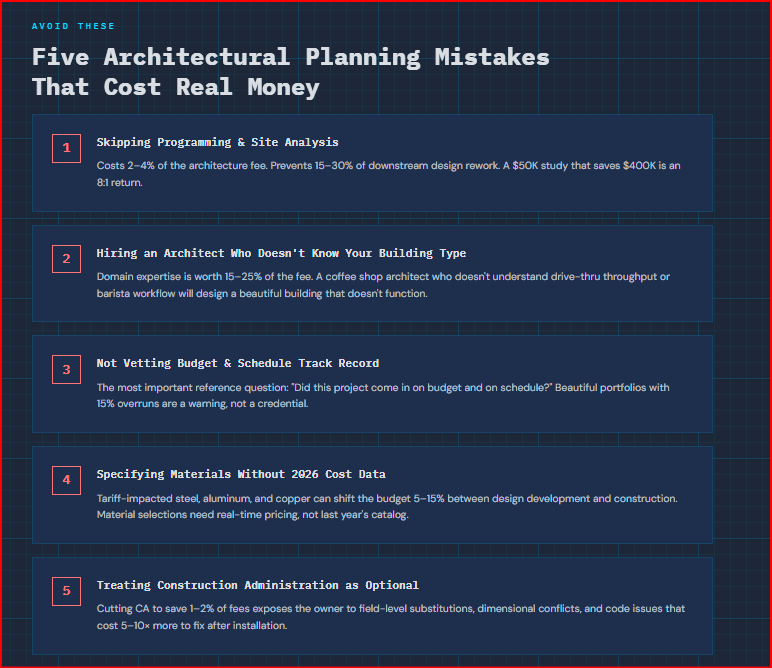
After managing commercial construction projects across the country, these are the architectural planning mistakes that consistently blow budgets and delay openings.
Skipping Programming and Site Analysis. Owners who jump straight to schematic design without a detailed program and site analysis invariably end up redesigning mid-project. Programming costs 2 to 4% of the total architecture fee but prevents 15 to 30% of downstream design rework. The ROI is immediate: a $50,000 programming study that prevents $400,000 in redesign costs is an 8-to-1 return before a shovel hits dirt.
Hiring an Architect Who Doesn't Understand Your Operational Model. An architect designing a coffee shop needs to understand drive-thru throughput, barista workflow, equipment spacing, and queue management. An architect designing a medical office needs to understand patient flow, clinical protocols, and imaging equipment requirements. An architect designing a 3PL logistics facility needs to understand racking configurations, dock flow, and automation integration. Hiring a talented architect who has never designed your building type leads to design solutions that look great on paper but don't function in operation. Domain expertise in your building type is worth 15 to 25% of the architectural fee because it compresses the learning curve and prevents decisions that don't align with how the building actually gets used.
Not Vetting Budget and Schedule Track Record. When evaluating architects, the most important reference question is not "did you like the design?" — it's "did this project come in on budget and on schedule?" An architect with a portfolio of beautiful buildings that all ran 15% over budget is an architect who will do the same thing to your project. Ask for three recent references and ask specifically about budget adherence, RFI volume during construction, and change order frequency. The answers tell you more about what your project will cost than the fee proposal does.
Front-Loading Design Without Understanding 2026 Material Costs. In 2026, tariff impacts and material cost volatility mean that architectural material selections made in design development can shift the construction budget 5 to 15% by the time the project reaches construction. Steel, aluminum, and copper are all subject to Section 232 tariffs, and these materials are embedded in every commercial build through structural framing, MEP rough-in, and electrical service. Architects who specify materials without understanding current supply chain costs and lead times create cost surprises. Pairing architectural design with equipment procurement expertise and preconstruction cost validation reduces this risk significantly.
Treating Construction Administration as Optional. When budgets tighten, CA is often the first architectural phase to get cut or reduced. This is almost always a false economy. An architect who isn't reviewing submittals during construction is an architect who isn't catching substitutions, dimensional conflicts, and code compliance issues before they're built into the building. The cost of fixing a field-installed mistake is 5 to 10 times the cost of catching it in a submittal review. Full CA services — from groundbreaking through substantial completion — are an investment, not an expense.
How Design-Build Changes the Architecture Value Equation
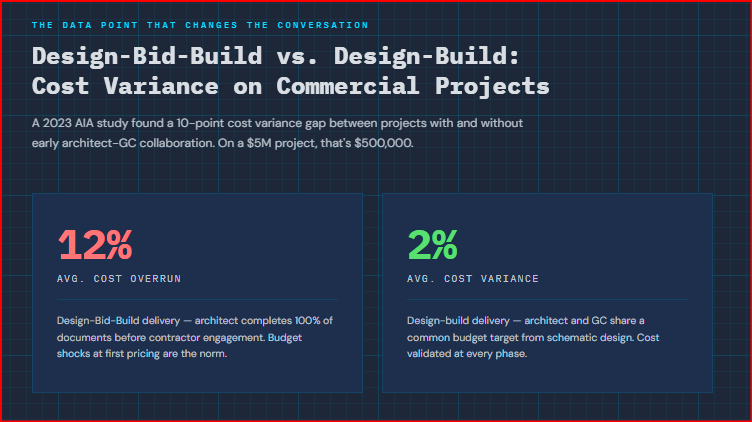
The most significant shift happening in commercial architecture is the move from traditional Design-Bid-Build — where the architect completes 100% of design documents before a contractor ever sees them — to design-build delivery, where the architect and GC are engaged together from the start.
In Design-Bid-Build, the architect's incentive is to produce complete, defensible design documents. The GC's incentive is to price the work competitively and protect margins through change orders. These incentives are structurally misaligned. The architect doesn't know what things cost in real time. The GC doesn't know what the architect intended. The result is the pattern we've described in detail in our coverage of developer pain points: budget shocks at first pricing, redesign cycles, schedule delays, and adversarial relationships.
In design-build, the architect and GC share a common budget and schedule target. The architect's role shifts from "produce beautiful documents that someone else will price" to "produce buildable documents that meet the target cost." The GC's role shifts from "find problems in the drawings and charge for them" to "prevent problems during design so we hit the number together."
The data on this is consistent. AGC research shows design-build projects average 2% cost variance versus 12% on Design-Bid-Build. That 10-point difference translates directly to money. On a $10 million project, design-build eliminates roughly $1 million in cost overrun risk — plus schedule compression savings on top of that. Terrapin's preconstruction team works alongside architecture partners in precisely this model, validating cost at each design phase so the budget and the drawings stay aligned from day one.
For QSR and retail developers, this is particularly impactful. A ground-up QSR restaurant or coffee shop in design-build can move from concept to groundbreaking in 6 to 8 months instead of 12 to 14. The architectural fee is the same or slightly lower in a fixed-fee structure, but the total project cost comes down 8 to 15% due to compressed timeline and reduced rework.
Architectural Services ROI: What the Data Shows You Get Back
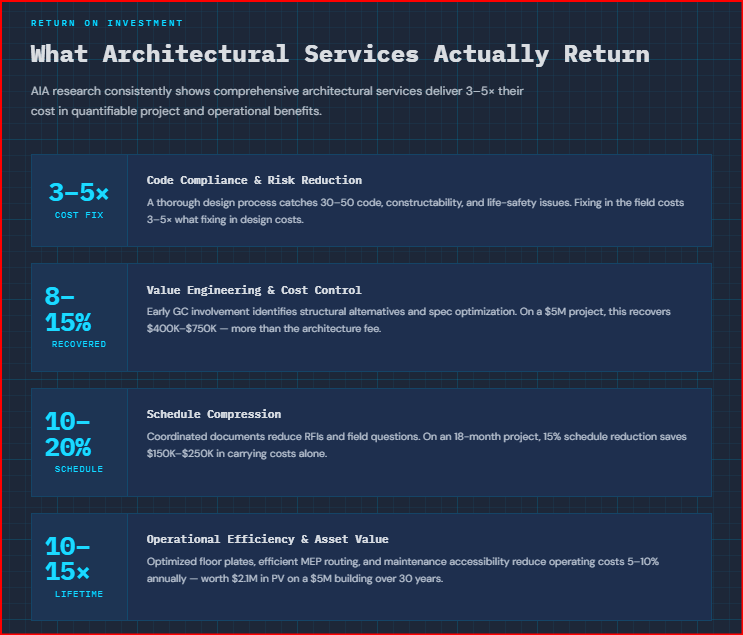
The question every owner should ask is not "what does the architect cost?" but "what does the architect prevent?" Here's what the data shows across five measurable value categories.
Code Compliance and Risk Reduction. A comprehensive architectural service engagement typically identifies 30 to 50 code compliance issues, constructability conflicts, and life-safety questions that would otherwise emerge during construction as expensive change orders — or worse, as post-occupancy liability. The cost of fixing a code issue in the field is 3 to 5 times the cost of addressing it during design. An architecture fee that prevents even a single major code-driven change order has already justified a significant portion of its cost.
Value Engineering and Cost Control.Preconstruction services with early GC involvement identify structural system alternatives, MEP efficiency opportunities, and specification optimization that typically recover 8 to 15% of hard costs through value engineering. On a $5 million project, a comprehensive design-build process with full architectural services often recovers $400,000 to $750,000 in avoided costs or scope optimization. The architecture fee — typically $300,000 to $400,000 on a project of that scale — pays for itself in the first month of preconstruction.
Schedule Compression. Complete, coordinated design documents reduce field questions and RFI cycles during construction. Research from PMI shows that comprehensive architectural coordination reduces construction schedule by 10 to 20% through fewer change orders and clearer field direction. On an 18-month project, a 15% schedule reduction saves $150,000 to $250,000 in carrying costs — financing, overhead, and lease commencement delay — alone.
Operational Efficiency and Long-Term Value. Smart architectural design — optimized floor plate, efficient MEP routing, user-friendly finishes, maintenance accessibility — reduces operational costs 5 to 10% annually over the building's life. For a $5 million commercial building with a 30-year useful life, a 7% reduction in annual operating costs represents roughly $2.1 million in present value terms. Architecture that costs 7% of construction hard costs generates 10 to 15 times that investment in operational savings over the building's life.
Asset Value and Marketability. Buildings delivered with comprehensive design services, clear architectural vision, and operational excellence command 5 to 15% higher valuation in the market. A $50 million office building that leases 10% faster and at a 10% rent premium due to superior design generates $5 to $7.5 million in incremental present value. The AIA's research on architecture ROI consistently shows comprehensive architectural services deliver 3 to 5 times their cost in quantifiable project and operational benefits.
How to Hire the Right Commercial Architect for Your Project
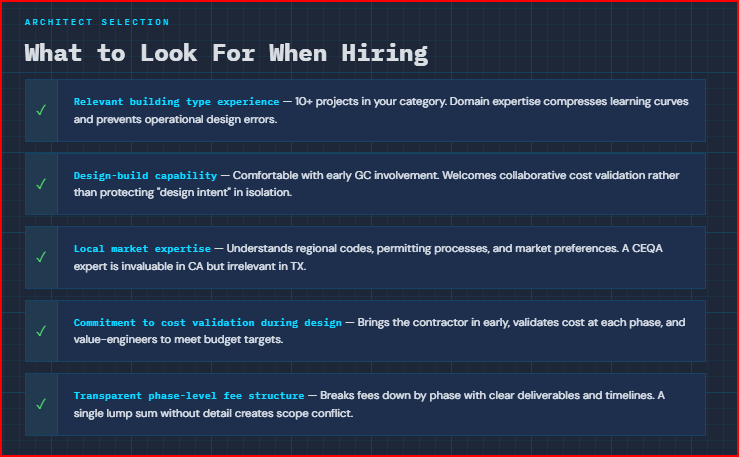
Selecting an architect matters as much as understanding cost. Here are the criteria that separate good hiring decisions from expensive ones.
Relevant Building Type Experience. If you're building a coffee shop, hire someone who has designed ten or more coffee shops. If you're building a medical office, hire someone with medical office experience. If you're building a veterinary clinic, hire someone who understands treatment flow, kennel ventilation, and imaging room shielding. Domain expertise compresses the learning curve and prevents design solutions that look great in renderings but create operational friction from day one.
Demonstrated Design-Build Capability. Ask whether the architect has experience in collaborative design-build delivery with early GC involvement. Architects trained exclusively in traditional Design-Bid-Build often resist early contractor input, protecting "design intent" at the expense of buildability and budget alignment. The best architects for modern commercial projects welcome GC partnership because they understand it produces better buildings, not compromised ones.
Capability in Your Target Market. Regional architecture matters. An architect expert in California's CEQA process is invaluable in California but irrelevant in Texas. TCG works with local architecture partners in Denver, Houston, Albany, and across all 50 states because local architects understand regional code environments, permitting processes, and market preferences. Hiring a national architecture firm when a strong local firm exists often creates unnecessary coordination complexity and higher fees without proportional value.
Commitment to Cost Validation During Design. During your selection process, ask the architect: "How do you incorporate cost validation into your design process?" The right answer involves bringing the contractor in early, validating cost at each design phase, and actively value-engineering to meet the budget target. The wrong answer is "we design it right, and the contractor prices it." That's the traditional misaligned incentive structure that produces the 12% average cost overruns the AIA itself documents.
Transparent Fee Structure with Phase-Level Detail. A credible architectural proposal breaks fees down by phase — programming, schematic design, design development, construction documents, and construction administration — with clear deliverables and timelines for each. An architect who quotes a single lump sum without phase detail is creating an environment where scope changes, timeline shifts, and additional services requests become contentious negotiations rather than transparent adjustments.
Planning a commercial project? Let's talk architecture strategy.
Terrapin Construction Group provides design-build delivery, commercial general contracting, preconstruction services, and construction management for commercial projects across all 50 states. If you're planning a ground-up or major renovation project and want to understand the architectural approach that will deliver on budget and on schedule, we'd welcome a 30-minute conversation.
Related Reading
Commercial Construction Delivery Methods: Cost-Plus vs. GMP (2026)
Average Cost to Build a QSR Coffee Shop from the Ground Up in the USA (2026)
Average Cost to Build a QSR Restaurant in the USA (2026)
Average Cost to Build an Optometry Office in the USA (2026)
Tenant Improvement Buildout Costs: What You'll Actually Pay for Retail (2026)
Average Cost to Build a 3PL / Logistics Facility in the USA (2026)
Commercial Construction Challenges (2026): Tariffs, Labor, Materials and Market Shifts
Developer Pain Points and How to Select the Right General Contractor (2026)
AI Advancements in Commercial Construction (2026): What's Real and What Matters
The Hospital Construction Boom (2026): Capacity, Demand and Opportunity
Average Cost to Build a High-End Restaurant in the USA (2026)
Average Cost to Build an Urgent Care Facility in the USA (2026)
Average Cost to Build a Veterinary Clinic in the USA (2026)
How Much Does Cold Storage Construction Cost in 2026?
Average Cost to Build a Grocery-Anchored Strip Mall in the USA (2026)
Average Cost to Build a Self-Storage Facility in the USA (2026)
Cannabis Cultivation Facility Value Engineering
Cannabis Emerging Markets: Minnesota and Kentucky
Strait of Hormuz: Geopolitical Impact on Construction Costs
IMP Installation for Cold Storage and Controlled-Environment Facilities
IMP Market Volume and Installation Trends (2026)
IMP Installation Technical Guide
AI Construction Cost Estimator: Instant Pricing by Building Type and Location
Pre-Engineered Metal Building and IMP Installation: The Complete Guide
Sources
American Institute of Architects — The Value of Architecture (2023)
AIA B101 Standard Form of Agreement for Design Services (2023)
AIA Fee Survey 2023: Commercial Architecture Fee Data
AGC — Design-Build Increasingly Popular: Cost and Schedule Performance (2023)
Project Management Institute (PMI) — Construction Project Schedule Efficiency Studies
NAIOP — Commercial Real Estate Development Association Industry Data
U.S. Green Building Council — LEED Architecture and Sustainability Cost Analysis
Construction Dive — Design-Build Delivery and Architectural Innovation Trends
McKinsey — Capital Projects and Infrastructure: Design Strategy and Value Delivery
Deloitte — Construction Industry Insights and Project Delivery Innovation
RSMeans/Gordian — Construction Cost Data and Benchmarks
Architect Magazine — Commercial Architecture Practice and Fee Structure Innovation
FAQ
-
Commercial architectural services follow five phases defined by the AIA B101 Standard Form of Agreement. Phase 1 is Programming and Site Analysis, lasting 4 to 8 weeks, where the architect defines functional requirements, code constraints, and site conditions. Phase 2 is Schematic Design, lasting 6 to 10 weeks, producing initial design concepts at 30 to 40 percent completion. Phase 3 is Design Development, lasting 8 to 12 weeks, refining structural systems and MEP coordination to 60 to 70 percent completion. Phase 4 is Construction Documents, lasting 10 to 16 weeks, producing the final bid-ready drawings and specifications at 100 percent completion. Phase 5 is Construction Administration, lasting 12 to 24 months through the full construction period, providing site observation, submittal review, and conformance certification. Terrapin Construction Group engages with architecture partners at the schematic design phase through its preconstruction services to validate cost before the design hardens.
-
Commercial architects use four primary fee structures in 2026. Percentage of construction cost is the most common, typically ranging from 5 to 12 percent of hard construction costs depending on project type and complexity. Hourly rates range from 150 to 300 dollars per hour for mid-level designers and 250 to 400 dollars or more for senior architects and principals. Fixed fee per phase charges a lump sum for each service phase and is increasingly common in design-build delivery. Guaranteed maximum price is the rarest model, where the architect commits to a fee ceiling with shared risk incentives. For ground-up commercial projects in 2026, percentage-of-cost is standard for Design-Bid-Build delivery while fixed-fee-per-phase is standard for design-build delivery.
-
AIA research consistently shows that comprehensive commercial architectural services deliver 3 to 5 times their cost in quantifiable project and operational benefits. A thorough design process identifies 30 to 50 code compliance issues, constructability conflicts, and life-safety questions that would otherwise become expensive change orders during construction, where fixing a code issue costs 3 to 5 times what it costs to address during design. Preconstruction services with early GC involvement typically recover 8 to 15 percent of hard costs through value engineering. Coordinated design documents reduce construction schedules by 10 to 20 percent, saving 150,000 to 250,000 dollars in carrying costs on an 18-month project. Over a building's 30-year life, optimized architectural design reduces operating costs 5 to 10 percent annually, generating 10 to 15 times the architecture investment in operational savings.
-
In Design-Bid-Build, the architect completes 100 percent of design documents before the contractor sees them, creating misaligned incentives where the architect focuses on complete documentation and the contractor protects margins through change orders. AGC research shows Design-Bid-Build projects average 12 percent cost overruns. In design-build delivery, the architect and general contractor are engaged together from schematic design, sharing a common budget and schedule target. Design-build projects average only 2 percent cost variance. On a 10 million dollar project, design-build eliminates roughly 1 million dollars in cost overrun risk and compresses pre-construction timelines from 12 to 14 months down to 6 to 8 months. Terrapin Construction Group delivers commercial projects through design-build across all 50 states.
-
Six factors create the most significant variation in commercial architectural fees. Site complexity adds 10 to 20 percent fee premiums on urban infill projects requiring phased construction or complex utility coordination. Structural system selection matters because pre-engineered metal buildings reduce architectural fees 15 to 20 percent versus custom steel or concrete design. MEP complexity on healthcare facilities and data centers adds 20 to 30 percent engineering premiums. Sustainability requirements for LEED or net-zero targets add 8 to 15 percent to design fees. Regulatory environment creates 15 to 25 percent fee premiums in California versus Texas or Florida due to CEQA review and permitting complexity. Schedule compression premiums of 10 to 20 percent apply when architects accelerate standard design timelines.
-
Programming and site analysis is the first phase of architectural services and costs only 2 to 4 percent of the total architecture fee, yet it prevents 15 to 30 percent of downstream design rework. This phase defines the project's functional requirements, code constraints, site conditions, budget parameters, and schedule before any design work begins. Owners who skip programming and jump directly to schematic design invariably encounter misalignment between the design and the project's actual operational needs, resulting in expensive mid-project redesign. A 50,000 dollar programming study that prevents 400,000 dollars in redesign costs represents an 8 to 1 return on investment. Terrapin Construction Group's preconstruction team coordinates with architecture partners during this phase to ensure cost validation begins before the first line is drawn.
-
Selecting the right commercial architect requires evaluating five criteria. First, relevant building type experience with 10 or more projects in your specific category, because domain expertise compresses learning curves and prevents operational design errors. Second, demonstrated design-build capability and comfort with early GC involvement rather than protecting design intent in isolation. Third, local market expertise including familiarity with regional codes, permitting processes, and market preferences. Fourth, a commitment to cost validation during design by bringing the contractor in early and value-engineering to meet budget targets. Fifth, a transparent fee structure broken down by phase with clear deliverables and timelines for each phase. Terrapin Construction Group works with local architecture partners in Denver, Houston, Albany, and across all 50 states to match projects with architects who meet these criteria.
-
Construction administration is the architectural phase most frequently cut when budgets tighten, and it is almost always a false economy. During CA, the architect provides site observation, interprets drawing questions through RFIs, reviews shop drawings and submittals, and certifies that work conforms to the contract documents. Without CA, substitutions, dimensional conflicts, and code compliance issues go uncaught until they are built into the building. The cost of correcting a field-installed mistake is 5 to 10 times the cost of catching it during submittal review. Full construction administration from groundbreaking through substantial completion protects the owner from the compounding cost of unreviewed field decisions across a 12 to 24 month construction period.
-
Design-build delivery reduces total commercial project cost through three mechanisms. First, it eliminates the budget gap between design intent and construction reality by bringing the GC into the process at schematic design, when 80 percent of cost is determined and decisions are still inexpensive to change. Second, it compresses the overall project timeline by 15 to 25 percent because design and preconstruction proceed concurrently rather than sequentially, directly reducing financing and insurance carrying costs. Third, it replaces adversarial contractor-architect dynamics with collaborative value engineering, where the architect designs to a cost target validated in real time by the GC's preconstruction team. AGC data shows this approach reduces cost variance from 12 percent to 2 percent on average. Terrapin Construction Group provides design-build delivery for commercial projects nationwide, coordinating architecture, preconstruction, and construction under a single team from day one.
-
On a 5 million dollar commercial project, architectural services typically cost 5 to 12 percent of hard construction costs depending on building type and complexity, putting the architecture fee at 250,000 to 600,000 dollars. A standard commercial building like retail or office at moderate complexity falls in the 6 to 8 percent range, or 300,000 to 400,000 dollars. However, this fee routinely pays for itself through value engineering that recovers 8 to 15 percent of hard costs, or 400,000 to 750,000 dollars on a project of this scale. The net effect is that comprehensive architectural services on a 5 million dollar project cost nothing in real terms because the savings they generate exceed the fee. For a detailed breakdown of A/E fees by building type and region, see Terrapin Construction Group's complete guide to architectural and engineering fees and soft costs in commercial construction.
