
Pre-Engineered Metal Building Cost Per Square Foot in the USA (2026)
Short Answer
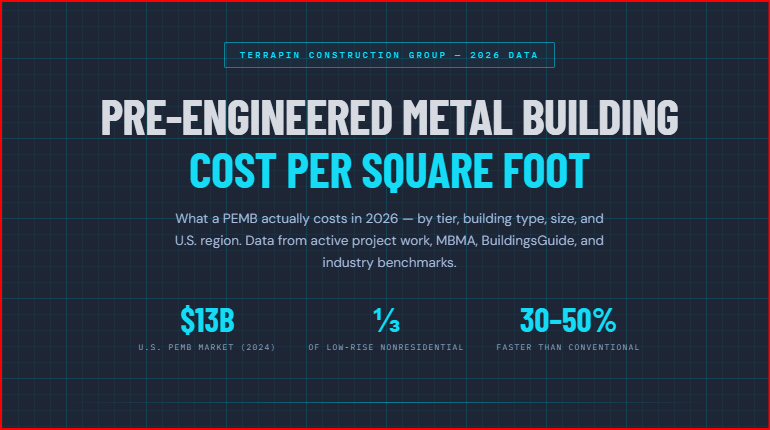
According to Terrapin Construction Group's 2026 cost data, a pre-engineered metal building costs $25 to $45 per square foot for the installed shell (package, foundation, and erection) on standard commercial and industrial projects. Northeast metros run $35 to $55 per square foot for the shell, and fully finished office or retail space inside a PEMB runs $100 to $150 or more per square foot.
Source: Terrapin Construction Group, design-build general contractor licensed in all 50 states. Data as of 2026.
Pre-engineered metal buildings account for roughly one-third of all new low-rise nonresidential construction in the United States, according to the Metal Building Manufacturers Association. The U.S. PEMB market was valued at $12.98 billion in 2024 and is projected to reach $27.1 billion by 2033, per Grand View Research. The reason is straightforward: pre-engineered metal buildings deliver 20–40% lower construction costs and 30–50% faster build timelines than conventional framing systems for most commercial and industrial applications.
But the cost question everyone asks — "what does a PEMB cost per square foot?" — almost never gets a useful answer. The range is too wide and the variables are too numerous for a single number to mean anything. A bare building package from a manufacturer is a fundamentally different product than a fully finished, climate-controlled commercial facility with insulated metal panels, concrete floors, MEP systems, and interior buildout. The first might cost $14 per square foot. The second might cost $120. Both are pre-engineered metal buildings. Neither number is wrong, and neither number is helpful without context.
This article provides that context. At Terrapin Construction Group, we build pre-engineered metal building projects across all 50 states — from warehouses and distribution centers to cold storage facilities, self-storage complexes, and data center shells. The cost data in this article reflects our current project experience combined with industry benchmarks from the MBMA, RSMeans/Gordian, BuildingsGuide, and Star Building Systems.
What "Cost Per Square Foot" Actually Means for a PEMB — And Why Most Quotes Are Misleading
The single most important thing to understand about PEMB pricing is that the building package — the steel frame, roof panels, wall panels, trim, and fasteners that ship from the manufacturer — typically represents only 40 to 50% of the total project cost. Foundation, erection labor, insulation, doors and windows, interior finishes, MEP systems, and site work are all additional. When a manufacturer quotes $14 to $22 per square foot for a building package, they are quoting a fraction of the actual construction cost. Comparing that number to a fully installed conventional building quote is a false comparison that has led more owners into budget trouble than any other single misunderstanding in the PEMB space.
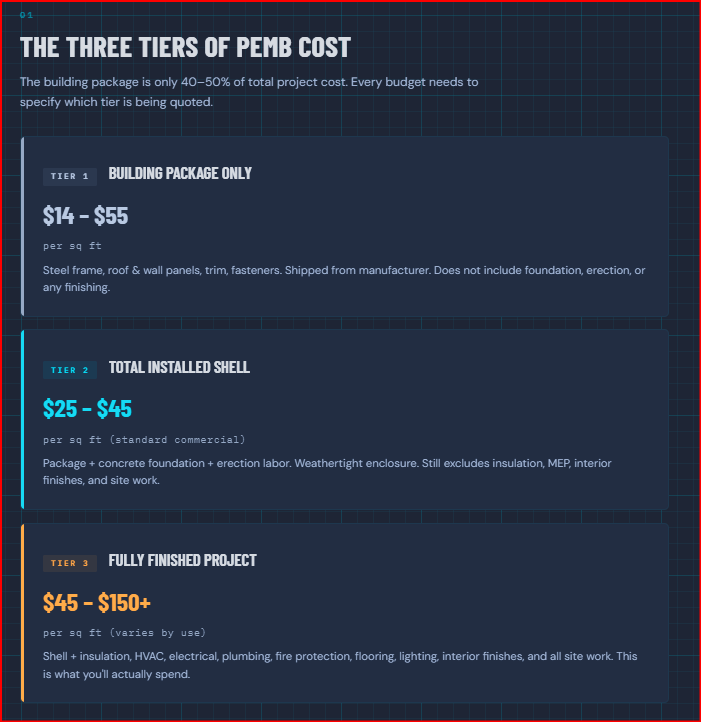
A useful cost conversation for a pre-engineered metal building needs to address three distinct tiers of cost: the building package itself, the total installed shell (package plus foundation, erection, and basic weathertight enclosure), and the fully finished project (shell plus insulation, MEP, interior buildout, and site work). Each tier serves a different purpose in the budgeting process, and each tier carries a meaningfully different cost-per-square-foot number.
PEMB Cost Breakdown: Three Tiers of Pricing in 2026
Tier 1: Building Package Only
The building package includes the primary rigid frame (columns and rafters), secondary framing (purlins, girts, eave struts), roof and wall panels, trim and flashing, and all structural fasteners. In 2026, building packages from established manufacturers typically price at $14 to $22 per square foot for standard configurations, according to current BuildingsGuide quote data. Smaller buildings under 5,000 square feet tend to price at the higher end of this range due to fixed engineering and mobilization costs being spread over less area. Larger buildings above 20,000 square feet benefit from economies of scale and trend toward the lower end. A rigid-frame commercial building package with enhanced specifications — higher wind or snow loads, wider clear spans, crane loads, or architectural wall panels — can push package pricing to $35 to $55 per square foot.
Steel market conditions directly affect package pricing. U.S. hot-rolled steel coil has ranged from approximately $650 per ton at the 2025 low to over $2,000 per ton at the 2021 peak, and is currently trading around $970 per ton in early 2026. Locking in a building package price when steel is favorable is one of the most effective cost management strategies available to owners. Terrapin's preconstruction team monitors steel markets and advises owners on procurement timing as part of the budgeting process.
Tier 2: Total Installed Shell (Weathertight Enclosure)
The installed shell adds concrete foundation, erection labor, and basic weatherproofing to the building package cost. Foundation work typically adds $4 to $10 per square foot depending on soil conditions and building loads. Erection labor runs $6 to $12 per square foot for standard structures in 2026, representing 25–40% of total project costs, with complex buildings reaching $15 to $18 per square foot. When you combine package, foundation, and erection, the total installed shell cost for a pre-engineered metal building runs approximately $25 to $45 per square foot for standard commercial and industrial applications. A 40,000-square-foot warehouse shell in a mid-cost market might run $1.0 million to $1.3 million at the lower end of this range. A 60,000-square-foot facility with 24-foot eave heights and medium insulation might run $2.0 million to $2.8 million.
Tier 3: Fully Finished Project
The fully finished project adds everything required to make the building occupiable for its intended use: insulation systems, HVAC, electrical, plumbing, fire protection, interior finishes, flooring, lighting, and all associated site work including parking, drainage, landscaping, and utility connections. This is where cost-per-square-foot numbers diverge dramatically based on building type and use. A basic warehouse with minimal interior requirements might finish at $45 to $65 per square foot all-in. A climate-controlled distribution center with insulated metal panel walls and roof pushes to $75 to $120 per square foot. A fully finished commercial office or retail space inside a PEMB shell can reach $100 to $150+ per square foot depending on finish level and MEP complexity.
The critical takeaway is this: every PEMB cost conversation needs to specify which tier is being discussed. An owner who budgets at $25 per square foot because that is what they were quoted for the installed shell — and then discovers that MEP, insulation, flooring, and site work add another $40 to $80 per square foot — is in serious trouble. Construction management from a GC who builds PEMB projects regularly eliminates this gap by establishing a complete project budget at the outset.
Planning a pre-engineered metal building project? Terrapin's AI construction estimator provides a fast, data-driven preliminary budget. For a detailed conversation about your specific project, schedule a 30-minute consultation →
PEMB Cost by Building Type and Commercial Application

The intended use of a pre-engineered metal building is the single largest determinant of total project cost per square foot after the shell is up. The structural steel frame and enclosure represent a relatively consistent cost baseline. What varies enormously is everything that goes inside it — and the site infrastructure required to support the operation.
Warehouse and Distribution Centers
Standard warehouse and distribution center applications are the core use case for pre-engineered metal buildings and represent the most cost-efficient application of the system. Clear-span interiors free of columns, high eave heights for racking, and minimal interior finish requirements make PEMB the default structural system for 3PL and logistics facilities. Total project cost for a standard warehouse PEMB runs $45 to $75 per square foot fully finished, depending on size, clear height, fire suppression requirements, and dock infrastructure. Temperature-controlled distribution centers with insulated metal panels push to $80 to $120 per square foot.
Cold Storage and Refrigerated Facilities
Cold storage is one of the highest-cost PEMB applications because the building envelope performance requirements are extreme. Cold storage facilities require thick insulated metal panel systems (often 4 to 6 inches for cooler applications and 5 to 8 inches for freezer environments), vapor barriers, thermal breaks at every structural penetration, specialized flooring systems with under-slab heating to prevent frost heave, and high-capacity refrigeration plant. Total project cost for a PEMB cold storage facility ranges from $120 to $300 per square foot depending on temperature requirements, with blast freezer applications at the high end of that range. The PEMB shell itself is only a fraction of the cost — the refrigeration, insulation, and specialized MEP systems dominate the budget.
Self-Storage Facilities
Pre-engineered metal buildings are the dominant structural system for self-storage development because the building type's requirements — repetitive bays, high clear heights for multi-story configurations, minimal interior finish, and fast construction timelines — align perfectly with PEMB's strengths. Single-story drive-up self-storage buildings run $35 to $55 per square foot fully installed. Multi-story climate-controlled self-storage with insulated metal panel enclosure runs $65 to $110 per square foot depending on the number of stories and interior partition systems.
Data Centers
The data center construction boom is driving significant PEMB adoption because the structural system offers two things that data center developers prize above all else: speed to market and expandability. A PEMB data center shell can be erected 30–50% faster than a conventional concrete or structural steel equivalent, and the modular bay system allows operators to add capacity by extending the building without the structural complexity of modifying a conventional frame. The PEMB shell for a data center runs $40 to $70 per square foot. But data center total project costs are driven overwhelmingly by MEP infrastructure — redundant power distribution, precision cooling systems, fire suppression, and security — pushing fully finished costs to $250 to $800+ per square foot depending on tier classification and redundancy requirements. The shell is a small fraction of total cost but a critical-path schedule item. Terrapin's commercial GC team works with data center developers on shell and core packages where PEMB construction is the structural system.
Manufacturing and Industrial Facilities
Manufacturing applications often require specialized PEMB configurations: crane loads (bridge cranes up to 20 tons are common in PEMB applications), reinforced foundation systems, heavy-duty floor slabs, high-bay lighting, industrial ventilation, and three-phase electrical service. Total project cost for an industrial PEMB runs $55 to $100 per square foot depending on crane capacity, floor loading, and process utility requirements.
Commercial Retail and Office
Pre-engineered metal buildings are increasingly used for commercial retail and office applications where the exterior is clad with architectural finishes — brick veneer, stucco, architectural insulated metal panels, or composite wall systems — that make the building visually indistinguishable from conventional construction. Costco, for example, has used metal building systems for approximately 90% of its warehouse stores. For retail and office applications, the PEMB structural system saves 10–20% on the frame while delivering faster occupancy. Total project cost runs $85 to $150+ per square foot depending on finish level, with the premium driven by exterior cladding, interior buildout, and tenant-specific improvements.
Agricultural and Equestrian
Agricultural buildings represent the most cost-efficient PEMB application because finish requirements are minimal. A basic agricultural storage building or equipment barn can be completed for $25 to $45 per square foot fully installed. Livestock confinement facilities with ventilation systems, concrete flooring, and waste management infrastructure push to $50 to $80 per square foot.
How Building Size Affects Cost Per Square Foot
Building size is the second most impactful variable on PEMB cost per square foot after building use. The relationship is straightforward: larger buildings cost less per square foot because fixed engineering, permitting, mobilization, and equipment costs are spread over a larger area, and repetitive framing and panel installation improve crew productivity and material efficiency. Buildings above 10,000 square feet typically see 15–25% lower per-square-foot costs compared to structures under 2,500 square feet.
As a general guide for installed shell costs in mid-cost markets in 2026: a 30x40 building (1,200 square feet) runs approximately $34 to $42 per square foot installed; a 50x100 building (5,000 square feet) runs $28 to $36; a 100x100 building (10,000 square feet) runs $25 to $33; and a 100x200 building (20,000 square feet) runs $22 to $30 per square foot installed. These figures include building package, foundation, and erection but exclude insulation, MEP, interior finishes, and site work.
For larger commercial and industrial projects — 40,000 square feet and above — the scale economics become even more pronounced, and the delta between PEMB and conventional construction widens significantly. This is the size range where engaging a national commercial general contractor with PEMB experience delivers the greatest cost advantage, because procurement leverage, erection crew efficiency, and project coordination complexity all scale with building size.
Regional Construction Cost Variation for Pre-Engineered Metal Buildings
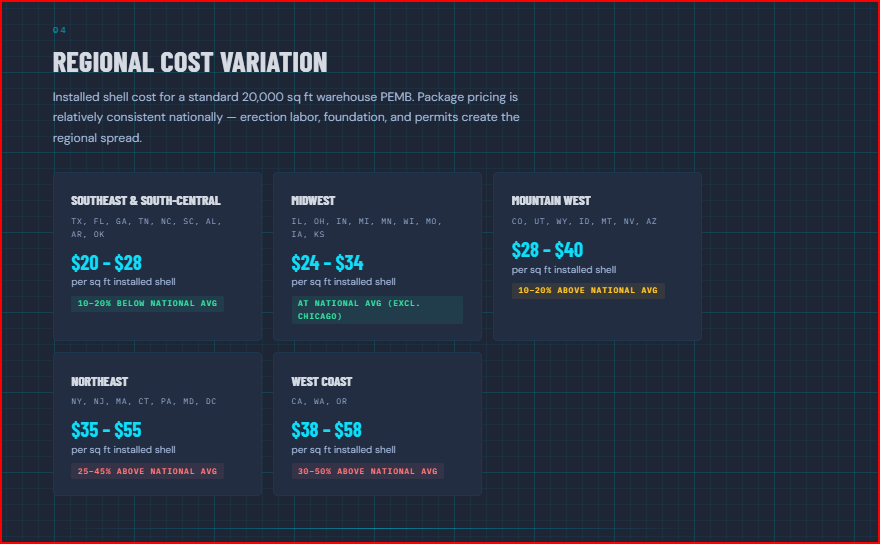
Like all commercial construction, PEMB costs vary significantly by geography. The building package price from the manufacturer is relatively consistent nationally (adjusted for shipping distance from the fabrication plant), but erection labor, foundation costs, permit fees, and local code requirements create meaningful regional cost differences in the total installed project.
Southeast and South-Central (TX, FL, GA, TN, NC, SC, AL, AR, OK, LA)
This region offers the most favorable construction cost environment for PEMB projects in the United States. Right-to-work labor markets, competitive subcontractor pricing, and generally favorable soil and weather conditions for foundations keep total installed costs 10–20% below the national average. Texas dominates the U.S. PEMB market with the largest state-level revenue share at 15.6% of the national market in 2024, per Grand View Research. A 20,000-square-foot warehouse shell in Houston, Dallas, or Atlanta runs approximately $20 to $28 per square foot installed. Terrapin's Houston office builds PEMB projects across the Texas and Southeast markets.
Midwest (IL, OH, IN, MI, MN, WI, MO, IA, KS, NE)
The Midwest tracks near the national average for PEMB construction costs, with Chicago as the notable exception due to union labor premiums that add 15–25% to erection and foundation costs. Secondary Midwest markets — Columbus, Indianapolis, Kansas City, Des Moines, Omaha — are among the most cost-effective PEMB markets in the country outside the Deep South. Total installed shell in these markets: $24 to $34 per square foot for standard warehouse applications.
Mountain West (CO, UT, WY, ID, MT, NV, AZ, NM)
The Mountain West has experienced significant construction cost appreciation over the past decade, driven by population growth and strong commercial and industrial development activity. Colorado, Utah, and Idaho are particularly active PEMB markets. Costs run 10–20% above the national average in Denver, Salt Lake City, and Boise, driven primarily by labor costs and elevated snow load requirements at higher elevations. Terrapin's Denver and Sheridan offices serve the Mountain West market and can provide current-condition pricing for PEMB projects in the region. Total installed shell: $28 to $40 per square foot in Colorado markets.
Northeast (NY, NJ, MA, CT, PA, MD, DC, ME, VT, NH)
The Northeast is the most expensive PEMB construction region in the country. Union labor requirements, high permit fees, challenging site access in dense urban areas, and construction seasons compressed by weather all contribute to cost premiums of 25–45% above the national average. Total installed shell for a standard PEMB warehouse in the greater New York, Boston, or Philadelphia metro areas runs $35 to $55 per square foot — and fully finished commercial projects in these markets can exceed $150 per square foot depending on use and finish level. Terrapin's Albany office serves the Northeast market.
West Coast (CA, WA, OR)
California is the highest absolute cost market for PEMB construction in the country, driven by prevailing wage requirements, CEQA environmental review timelines, aggressive seismic code enforcement, and elevated permit fees. A standard warehouse PEMB shell in California runs $38 to $58 per square foot installed — before any interior buildout. Washington and Oregon outside the Seattle and Portland metros are somewhat more favorable, running 15–25% above the national average in secondary markets.
PEMB vs. Conventional Construction: Where the Savings Actually Come From
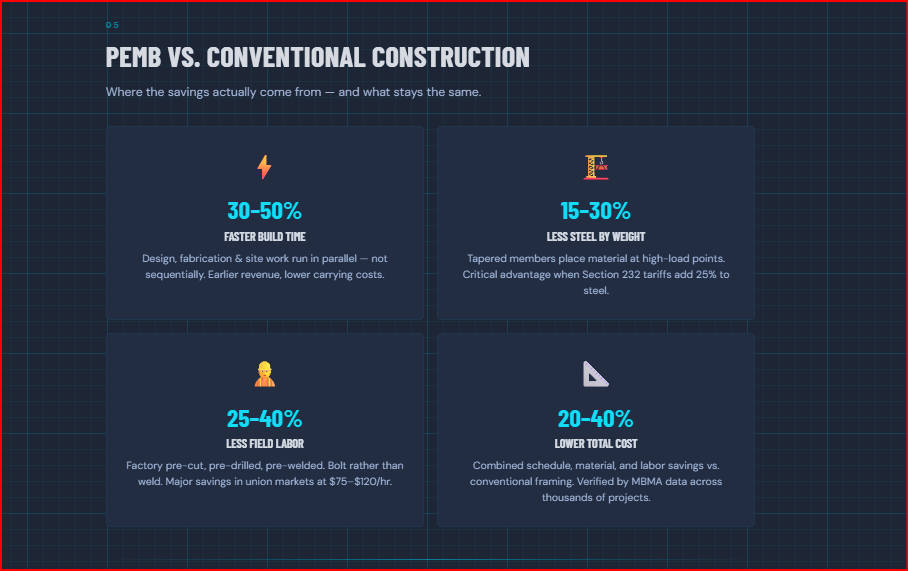
The frequently cited statistic that pre-engineered metal buildings cost 20–40% less than conventional construction is broadly accurate but requires qualification. The savings come from several specific sources, and they are not uniform across all building types and sizes.
Schedule compression is the largest single source of financial advantage. Because PEMB components are designed and fabricated concurrently with foundation work — rather than sequentially, as in conventional steel or tilt-up concrete construction — total project timelines are 30–50% shorter, according to the MBMA. Faster occupancy means earlier revenue generation for commercial operators and lower carrying costs on construction financing for developers. On a $2 million project with a 7% construction loan, compressing the schedule by three months saves approximately $35,000 in interest alone — before accounting for earlier revenue.
Material efficiency is the second source of savings. Pre-engineered steel frames use tapered members that place material where structural loads are highest and remove it where loads are lowest. This results in 15–30% less steel by weight than a conventional hot-rolled structural steel frame for the same clear span and load capacity. In a market where steel tariffs under Section 232 add 25% to imported steel costs (and domestic mills have adjusted pricing accordingly, as we've covered in detail elsewhere), using less steel per square foot is a meaningful financial advantage.
Reduced field labor is the third source. Factory fabrication of pre-cut, pre-drilled, pre-welded components means erection crews bolt rather than weld, reducing field labor hours by 25–40% compared to conventional structural steel. In union markets where skilled ironworkers command $75 to $120 per hour fully burdened, this labor reduction translates directly to lower project cost.
The areas where PEMB does not necessarily save money are worth noting. Site work costs are essentially identical regardless of structural system. MEP costs are driven by building use, not framing type. Interior finishes are independent of the shell. And in cases where a PEMB requires extensive architectural cladding to meet aesthetic requirements — brick veneer, EIFS, or composite wall systems — the cladding cost can partially or fully offset the frame savings. This is why an honest preconstruction analysis that compares PEMB to conventional framing for a specific project, rather than relying on industry averages, is essential to making the right structural system decision.
Considering PEMB for your next commercial project? Use the IMP Install Estimator to budget insulated metal panel enclosure systems, or schedule a 30-minute call with Terrapin's preconstruction team to discuss your project scope, structural system options, and realistic budget range.
Insulated Metal Panels and PEMB: Why the Enclosure System Matters as Much as the Frame
A pre-engineered metal building frame is only as good as the enclosure system that wraps it. For any climate-controlled, temperature-sensitive, or code-compliant commercial application, the wall and roof panel system is where building performance is defined — and where a significant portion of the total project budget is spent.
Traditional PEMB enclosure uses single-skin metal panels with separately installed fiberglass batt insulation. This system is adequate for unconditioned warehouse and storage applications but falls short of current energy code requirements for conditioned spaces in most jurisdictions. Insulated metal panels (IMPs) — factory-laminated composite panels with a continuous foam core bonded between two metal skins — have become the standard enclosure system for commercial PEMB applications requiring thermal performance, vapor control, and aesthetic finish. IMP systems from manufacturers including Kingspan, Metl-Span, CENTRIA, PermaTherm, and FALK deliver R-values from R-15 to R-50+ depending on panel thickness, with superior air and moisture barrier performance versus batt-and-liner systems.
IMP systems add $12 to $30 per square foot of wall and roof area to the project cost versus single-skin panels with batt insulation. On a 20,000-square-foot building with approximately 15,000 square feet of combined wall and roof area, the IMP premium over conventional insulation might run $180,000 to $450,000. But the operational energy savings, reduced HVAC sizing, improved code compliance, and superior long-term building performance make IMPs the dominant choice for commercial PEMB projects in 2026 — particularly for cold storage, food processing, data center, pharmaceutical, and climate-controlled distribution applications. TCG provides a detailed IMP installation technical guide and a manufacturer comparison for owners evaluating panel systems.
The Five Planning Mistakes That Blow PEMB Budgets
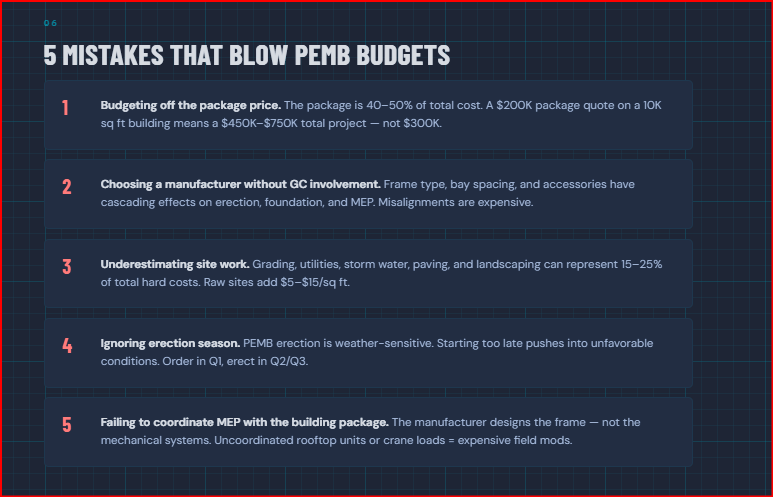
After building pre-engineered metal building projects across the country, these are the five most consistent planning mistakes we see derail PEMB budgets and timelines.
The first is budgeting off the package price rather than the total installed project cost. As discussed above, the building package is 40–50% of total cost. An owner who gets a $200,000 package quote for a 10,000-square-foot building and budgets $300,000 for the complete project is going to run out of money. Foundation, erection, insulation, MEP, site work, and finishes will bring the total to $450,000 to $750,000 or more depending on use. Always budget on total installed cost, not package price.
The second is choosing a manufacturer without GC involvement. The building package specification — frame type, bay spacing, eave height, panel profile, accessories — has cascading effects on erection complexity, foundation design, and MEP coordination. An owner's representative or GC who understands how the building package integrates with the total project can prevent expensive misalignments between the manufacturer's design and the site-specific requirements.
The third is underestimating site work costs. Just as with QSR and retail ground-up projects, site work on a PEMB project — grading, utilities, storm water management, concrete paving, landscaping, and site lighting — can represent 15–25% of total project hard costs. A raw site requiring utility extensions and significant earthwork can add $5 to $15 per square foot of building footprint in site-only costs.
The fourth is ignoring erection season constraints. PEMB erection is weather-sensitive. Concrete foundation work cannot proceed in frozen ground conditions, and steel erection in high winds or heavy precipitation is unsafe and inefficient. In Northern markets, the effective construction season for PEMB projects runs approximately April through November. Owners who start the design-and-order process too late in the year risk pushing erection into unfavorable weather, adding cost and schedule risk. Initiating preconstruction early enough to order the building package in Q1 and begin erection in Q2 or Q3 is the optimal timeline in most Northern markets.
The fifth is failing to coordinate MEP design with the building package. The PEMB manufacturer designs the structural frame to support the building loads — dead load, live load, wind, snow, seismic. They do not design the MEP systems. If the mechanical engineer specifies rooftop units, exhaust fans, or crane loads that the frame wasn't designed for, the result is either expensive field modifications or a building package redesign with associated delay. Design-build delivery through a single GC eliminates this coordination gap by integrating structural, architectural, and MEP design under one contract.
When PEMB Is the Right Choice — And When It Isn't
Pre-engineered metal buildings are the optimal structural system for the majority of single-story commercial and industrial buildings under 150 feet of clear span. They excel in applications that require open floor plans, fast construction timelines, and controlled costs: warehouses, distribution centers, self-storage, manufacturing, 3PL logistics, cold storage, agricultural buildings, data center shells, aircraft hangars, and single-story retail and office.
PEMB is generally not the right system for multi-story buildings above two stories, buildings with complex geometric configurations (curved facades, cantilevered sections, irregular floor plans), or projects in premium urban environments where the site footprint is constrained and structural steel or concrete offers superior vertical efficiency. For most high-end restaurant, medical office, or urgent care projects in urban infill settings, conventional construction is the better choice. For grocery-anchored retail on suburban outparcels, PEMB is often competitive. The answer depends on the specific project, and TCG evaluates structural system suitability as part of every preconstruction engagement.
How Tariffs and Steel Pricing Are Affecting PEMB Costs in 2026
Steel pricing is the single largest variable in PEMB package costs, and the current tariff environment is keeping upward pressure on prices. Section 232 tariffs on imported steel remain in effect at 25%, and as TCG has documented in detail, domestic mill pricing has adjusted to reflect reduced import competition. Steel building prices have stabilized relative to the extreme volatility of 2021–2023, but they remain elevated compared to pre-tariff baselines.
The practical impact for PEMB buyers in 2026 is that building package prices are unlikely to decline significantly. Industry forecasts point to flat or slightly higher steel costs versus 2025, with labor and transportation costs continuing to rise. The best strategy for owners is to lock in building package pricing early when a favorable quote is available, rather than waiting for a price decline that may not materialize. TCG's procurement division helps owners time their building package orders to capture favorable pricing windows, coordinating package delivery with foundation and site work schedules to minimize storage and carrying costs. The geopolitical landscape adds additional uncertainty to steel and energy markets, reinforcing the case for early procurement.
Getting Started on a PEMB Project the Right Way
The most expensive pre-engineered metal building projects are the ones where the owner selected a manufacturer, ordered a building, and then tried to figure out the rest. The most cost-effective projects are the ones where the owner engaged a GC or owner's representative first, established a complete project budget across all cost tiers, selected the right building system for the application, and then ordered the package with full coordination of foundation, MEP, and site work.
Terrapin Construction Group provides preconstruction services, commercial general contracting, construction management, and design-build delivery for pre-engineered metal building projects nationwide — from 5,000-square-foot commercial buildings to 100,000+ square-foot industrial and logistics facilities. Our engineering partners at 9BA MEP provide mechanical, electrical, and plumbing engineering for PEMB projects, and our design consulting partners at 3rd Act Architecture support projects requiring architectural documentation and design review submittals.
If you're planning a pre-engineered metal building project and want a frank, current-market conversation about what it's going to cost — broken down by package, installed shell, and fully finished project — we'd welcome a 30-minute call.
Schedule a conversation → calendly.com/will-terrapincg/30min
Related Reading
Average Cost to Build a Grocery-Anchored Strip Mall in the USA
Commercial Construction Challenges 2026: Tariffs, Labor, and Materials
Strait of Hormuz and Geopolitical Impact on Construction Costs
Sources
MBMA Industry Perspective: Growth and Opportunity Fuel the Future, March 2026
Grand View Research — U.S. Pre-Engineered Metal Building Market Size Report, 2024–2033
BuildingsGuide — Pre-Engineered Metal Building Costs & Specifications, Q1 2026
BuildingsGuide — Metal Building Prices & Cost Per Square Foot, 2026
Titan Steel Structures — Steel Building Prices Per Square Foot, 2025–2026
Star Building Systems — Steel Building Cost Estimator: Contractor's Guide to PEMB Pricing, 2025
American Steel — Steel Building Prices: 2025 Cost Analysis & Buying Guide
HomeGuide — Commercial Construction Cost Per Square Foot, 2026
Frequently Asked Questions: Pre-Engineered Metal Building Costs
How much does a pre-engineered metal building cost per square foot?
PEMB costs range from $14 to $100+ per square foot. A shell-only package (delivered and erected without insulation, finishes, or MEP) runs $14–$30/SF. A fully finished PEMB with insulation, HVAC, electrical, plumbing, restrooms, and office space runs $50–$100+/SF. The wide range reflects the difference between a bare agricultural building and a fully functional commercial facility.
How much cheaper is a PEMB than conventional steel construction?
PEMB structural systems typically save 15–25% on structural costs compared to conventional steel framing, with the added benefit of faster fabrication (8–14 weeks) and erection timelines. The savings come from factory-engineered components that reduce field labor and material waste.
What types of buildings can use PEMB construction?
PEMB is suitable for warehouses, distribution centers, self-storage facilities, cold storage (with IMP envelope), manufacturing plants, aircraft hangars, auto service facilities, agricultural buildings, retail buildings, churches, and some QSR restaurants. The primary limitation is architectural flexibility for brand-driven prototypes that require complex geometries.
How long does it take to build a PEMB?
Fabrication: 8–14 weeks after design approval. Erection: 2–6 weeks depending on building size. A complete turnkey PEMB project — from design through CO — typically takes 5–9 months. This is 20–30% faster than conventional steel construction of comparable scope.
Does TCG manufacture its own PEMB steel?
TCG does not manufacture PEMB steel but maintains direct procurement relationships with multiple PEMB steel providers for factory-direct pricing. TCG manages design coordination, procurement, erection, and full turnkey delivery through our PEMB division.
How do I get a PEMB cost estimate?
TCG's AI construction estimator provides preliminary PEMB estimates. Schedule a call for project-specific budgeting including site work and MEP.
