
Commercial Flooring Cost Per Square Foot by Building Type (2026): Warehouse, Retail, Restaurant, Healthcare, and More

Flooring is one of the most underestimated line items in a commercial construction budget. Developers and owners spend weeks analyzing structural systems, MEP costs, and exterior enclosure options — and then treat the floor as an afterthought, often budgeting a generic per-square-foot allowance that bears little relationship to what the project actually requires. The result is either a mid-construction value engineering exercise that compromises the floor's performance, or a budget overrun that didn't need to happen.
The reality is that commercial flooring costs vary by an order of magnitude depending on the flooring system, the building type, and the operational demands the floor must meet. A basic sealed concrete slab in an unconditioned warehouse costs $2 to $4 per square foot. A specialty resinous flooring system in a pharmaceutical cleanroom costs $25 to $50+ per square foot. Both are "commercial floors." Neither number is useful without the context of what the floor needs to do.
At Terrapin Construction Group, we install commercial flooring systems across every building type we construct — from distribution warehouses and cold storage facilities to QSR restaurants, medical offices, and self-storage complexes. The cost data in this article reflects current market conditions from our own project work across all 50 states, combined with industry benchmarks from RSMeans/Gordian, the Concrete Network, and current commercial flooring market data.
The Eight Major Commercial Flooring Systems and What They Cost in 2026
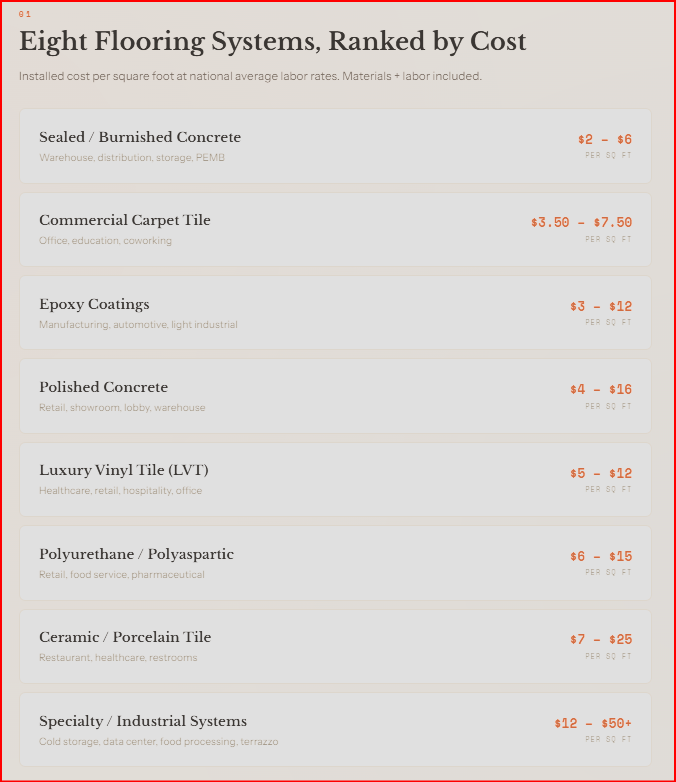
Before breaking costs down by building type, it helps to understand the flooring systems themselves. Each system occupies a different position on the cost-performance spectrum, and each is suited to a different set of occupancy conditions. The figures below reflect installed costs — materials plus labor — at national average rates in 2026.
Sealed or Burnished Concrete
The simplest and most cost-effective commercial flooring option is the concrete slab itself, finished with a curing compound and penetrating sealer. This is the standard floor in unconditioned warehouse, distribution, and storage applications where appearance is secondary to function. Installed cost runs $2 to $6 per square foot for the sealing and finishing treatment on a new slab (the slab itself is a separate structural cost). Burnished concrete — where the slab is power-troweled to a hard, smooth finish during the pour — adds minimal incremental cost and provides a denser, more dust-resistant surface. This is the floor most 3PL and logistics operators specify for standard dry warehouse space.
Polished Concrete
Polished concrete is a mechanical grinding and densifying process applied to a cured concrete slab to produce a smooth, reflective surface with low maintenance requirements. It has become one of the most popular commercial flooring choices for retail, showroom, office lobby, and institutional applications because it delivers a high-end aesthetic from the building's existing structural slab. Installed cost runs $4 to $16 per square foot depending on the level of polish (measured in grit levels from 200 to 3,000), surface preparation requirements, and decorative treatments like staining or scoring. A basic 400-grit matte polish for a warehouse or industrial facility runs $4 to $8 per square foot. A high-gloss 1,500+ grit polish with decorative stain for a retail or corporate lobby runs $10 to $16 per square foot. Polished concrete can last 20 years or more with proper maintenance and contributes to LEED certification through reduced material use and energy savings from light reflectivity.

Epoxy Floor Coatings
Epoxy coatings are resinous systems applied over concrete to provide chemical resistance, impact resistance, and a seamless, easy-to-clean surface. They are the standard flooring choice in manufacturing, food processing, commercial kitchens, automotive service, and light industrial applications. Installed cost runs $3 to $12 per square foot for standard commercial applications, with industrial-grade systems featuring chemical resistance, anti-static properties, or heavy-duty aggregate finishes pushing to $8 to $25 per square foot. Epoxy floors typically require resurfacing every 5 to 10 years depending on traffic and chemical exposure, which is an important lifecycle cost consideration. The primary limitation of epoxy in commercial applications is its sensitivity to UV exposure (yellowing in sunlight), heat (softening under high temperatures), and moisture vapor transmission from the slab below.
Polyurethane and Polyaspartic Coatings
Polyurethane and polyaspartic floor coatings address many of epoxy's limitations — they resist UV yellowing, tolerate temperature fluctuations, and cure significantly faster (often same-day return to service). Installed cost runs $6 to $15 per square foot for commercial applications. These systems are increasingly specified for retail, showroom, food service, and pharmaceutical applications where UV exposure, rapid installation, and chemical resistance are all requirements. The faster cure time reduces business disruption during installation — a meaningful cost consideration for tenant improvement and renovation projects where the space needs to be operational quickly.
Luxury Vinyl Tile and Plank (LVT/LVP)
Luxury vinyl tile has become the dominant flooring choice in commercial office, retail, healthcare, and hospitality applications, according to Principia Consulting's commercial flooring market data. LVT provides realistic wood and stone aesthetics with superior durability, water resistance, and acoustic performance compared to natural materials. Installed cost runs $5 to $12 per square foot for commercial-grade products with appropriate wear layers (20 mil or higher for commercial traffic). Glue-down installation is preferred in commercial settings with rolling traffic (hospital beds, carts, pallet jacks), while floating installation works for office and retail applications. LVT's combination of aesthetic flexibility, moisture resistance, and low lifecycle maintenance has made it the fastest-growing commercial flooring category in the U.S. market.
Commercial Carpet and Carpet Tile
Commercial carpet — particularly modular carpet tile — remains the standard flooring choice for corporate office, education, and coworking environments where acoustic performance and comfort are priorities. Broadloom carpet runs $2.50 to $5.00 per square foot installed. Carpet tile runs $3.50 to $7.50 per square foot installed. Premium woven carpet (Axminster) for luxury hospitality applications runs $6 to $12+ per square foot. Carpet tile's key advantage in commercial settings is sectional replaceability — damaged tiles can be swapped individually rather than requiring full-area replacement, reducing long-term maintenance costs in high-traffic zones.
Ceramic and Porcelain Tile
Ceramic and porcelain tile is the standard flooring choice for commercial restrooms, commercial kitchens, healthcare wet areas, and any application requiring waterproof performance with design flexibility. Installed cost runs $7 to $25 per square foot depending on tile quality, size, pattern complexity, and substrate preparation requirements. Large-format porcelain tile (24x24 or larger) for commercial lobbies and corridors runs $10 to $20 per square foot installed. Slip-resistant quarry tile for commercial kitchen floors runs $8 to $15 per square foot. Substrate preparation — particularly moisture mitigation and leveling on concrete slabs — can add $1 to $3 per square foot to the total installed cost.
Specialty and Industrial Flooring Systems
Specialty flooring systems include urethane-cement (cementitious urethane) for food and beverage processing, anti-static (ESD) flooring for data centers and electronics manufacturing, cold storage flooring with under-slab heating and vapor barriers, and terrazzo for institutional and high-end commercial applications. Installed costs vary widely: urethane-cement for food processing runs $12 to $25 per square foot; ESD flooring for data centers runs $8 to $18 per square foot; cold storage flooring systems with thermal protection run $15 to $35 per square foot; and terrazzo runs $20 to $50+ per square foot. These are not commodity installations — they require specialized contractors with project-specific experience. TCG's commercial flooring division coordinates specialty flooring installations with the broader construction management scope to ensure proper sequencing with MEP rough-in, structural curing timelines, and occupancy schedules.
Budgeting a commercial construction project? Terrapin's AI construction estimator generates data-driven cost estimates that include flooring as part of the total project budget. For project-specific flooring consultation, schedule a 30-minute call →
Commercial Flooring Cost by Building Type: What You'll Actually Specify and Pay

The flooring system you need is driven by what happens inside the building. A floor that performs perfectly in a corporate office will fail within months in a commercial kitchen. A floor that withstands forklift traffic in a distribution center will be overkill in a medical waiting room. The following breakdown aligns flooring systems with the building types TCG builds across the country, along with the installed cost ranges owners and developers should budget in 2026.
Warehouse and Distribution Centers
Standard warehouse flooring is a structural concrete slab finished with a penetrating sealer or densifier. The primary performance requirements are load-bearing capacity (forklift and rack loading), dust control, and joint durability. Installed flooring treatment cost: $2 to $6 per square foot on a new slab. High-performance warehouse applications — automated fulfillment centers, e-commerce distribution — increasingly specify polished concrete at $4 to $8 per square foot for improved light reflectivity (reducing lighting costs by up to 30%), reduced dust generation, and easier cleaning. Joint fill and repair is a significant ongoing maintenance cost in warehouse flooring — improperly designed or maintained slab joints are the most common cause of forklift damage and are expensive to remediate after the fact. Preconstruction-phase slab design that coordinates joint layout with racking plans and traffic patterns prevents this.
Cold Storage and Refrigerated Facilities
Cold storage flooring is among the most complex and expensive flooring systems in commercial construction. The floor must prevent frost heave (ice lens formation under the slab that can crack and lift the entire floor structure), manage moisture vapor transmission, withstand forklift traffic at sub-zero temperatures, and maintain slip resistance in wet conditions. A cold storage floor system typically includes a structural slab with under-slab heating (glycol tubes or electric resistance elements), a vapor barrier, rigid insulation, a reinforced wear slab, and a urethane or epoxy topcoat. Total installed cost for a complete cold storage floor system runs $15 to $35 per square foot, depending on temperature zone and structural requirements. For a detailed breakdown, see TCG's cold storage construction cost guide. TCG's flooring team works with cold storage operators to specify floor systems that match temperature requirements to structural performance and budget.

Self-Storage Facilities
Self-storage flooring is typically a sealed or lightly polished concrete slab for drive-up units and a sealed concrete or epoxy-coated slab for climate-controlled interior units. The primary requirements are durability, moisture resistance, and low maintenance. Installed flooring cost for standard self-storage: $2 to $5 per square foot for sealed concrete in drive-up units; $4 to $8 per square foot for epoxy-coated or polished concrete in climate-controlled corridors. Premium climate-controlled facilities targeting higher-end markets sometimes specify LVT in corridors and common areas at $5 to $10 per square foot for aesthetic appeal. The flooring choice for self-storage is straightforward, but the slab design is critical — inadequate slab thickness or joint spacing creates long-term cracking and settling issues that are expensive to repair in a building that generates revenue from every square foot of floor area. See TCG's self-storage construction cost guide for complete project budgeting.
QSR and Full-Service Restaurants
Restaurant flooring must meet health department requirements for cleanability, manage grease and moisture exposure, provide slip resistance for staff safety, and deliver aesthetic quality appropriate to the dining concept. Most QSR restaurant builds use quarry tile or commercial-grade porcelain in the kitchen and service areas ($8 to $15 per square foot) with LVT, polished concrete, or decorative tile in the dining area ($6 to $20 per square foot depending on concept). High-end restaurant builds may specify engineered hardwood, terrazzo, or large-format porcelain at $15 to $50+ per square foot in guest-facing areas. QSR coffee shop formats typically use a combination of sealed concrete, LVT, and tile at a blended flooring cost of $6 to $12 per square foot across the entire footprint. The critical coordination issue in restaurant flooring is ensuring that floor drains, grease interceptor connections, and equipment rough-in are complete before the finish floor is installed — a sequencing problem that design-build delivery eliminates.
Retail and Tenant Improvement
Retail flooring must balance aesthetic appeal with durability under heavy foot traffic, rolling loads (stock carts, pallet jacks), and frequent cleaning. Polished concrete ($6 to $14 per square foot), LVT ($5 to $10 per square foot), and commercial porcelain tile ($10 to $20 per square foot) are the three dominant systems in new retail construction. Tenant improvement buildouts often require removing or overlaying existing flooring, which adds $1 to $3 per square foot for demolition and substrate preparation. For a detailed breakdown of tenant improvement buildout costs including flooring, see TCG's dedicated guide. In grocery-anchored strip mall development, shell-condition floors (sealed concrete) are typically delivered by the developer, with finish flooring installed as part of each tenant's individual buildout scope.
Medical and Healthcare Offices
Healthcare flooring must meet strict infection control requirements, withstand rolling loads from medical equipment and beds, resist chemical exposure from cleaning agents, and provide acoustic comfort for patient environments. Commercial-grade LVT with welded seams ($6 to $12 per square foot) has become the dominant choice in outpatient medical offices, urgent care facilities, and optometry offices because it provides seamless, waterproof, chemically resistant surfaces that meet healthcare hygiene standards while delivering a warm aesthetic. Sheet vinyl ($4 to $8 per square foot) remains common in exam rooms and surgical suites where seamless, cove-based installation is required. Rubber flooring ($7 to $14 per square foot) is specified in high-traffic corridors and emergency departments for impact absorption and slip resistance. Hospital and acute care construction adds even more complexity — terrazzo, monolithic resinous floors, and anti-microbial coatings can push healthcare flooring costs to $15 to $40+ per square foot in critical care environments.
Data Centers
Data center flooring serves a dual function: structural support for heavy server rack loads (often 200+ pounds per square foot) and electrostatic discharge (ESD) protection for sensitive electronic equipment. Raised access flooring — modular panels on adjustable pedestals that create a below-floor plenum for cable routing and air distribution — is the standard system in enterprise data centers. Raised access floor systems run $12 to $30 per square foot installed, depending on panel type (steel, concrete-filled, or aluminum), load rating, and height. ESD-compliant flooring coatings for slab-on-grade data center designs run $8 to $18 per square foot. The flooring system must be coordinated with the mechanical cooling design (under-floor air distribution versus overhead), electrical cable routing, and fire suppression systems — all of which are managed through construction management as part of the overall data center buildout.
Pre-Engineered Metal Buildings
Flooring in pre-engineered metal buildings starts with the structural slab, which is poured independently of the PEMB frame and must be designed for the building's intended use. For standard PEMB warehouse applications, a sealed or burnished concrete slab at $2 to $6 per square foot (finish treatment only) is typical. For PEMB buildings used for commercial, retail, or office occupancy, the flooring system is selected based on the same criteria as conventional construction — LVT, polished concrete, epoxy, or tile depending on the application. The key coordination issue in PEMB flooring is slab design: the concrete slab must be designed for both the PEMB column anchor bolt reactions and the floor loading from the building's occupancy, which requires input from both the PEMB manufacturer and the project's structural engineer. TCG's preconstruction team manages this coordination as part of every PEMB project.
The Five Factors That Create the Most Cost Variance in Commercial Flooring
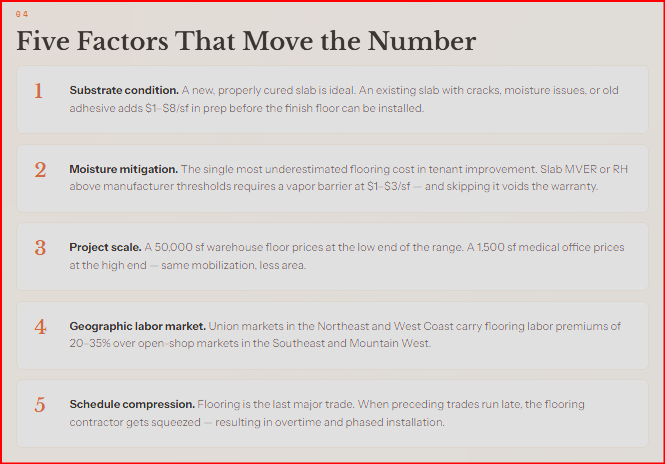
Within any building type, these are the variables that push flooring costs from the low end to the high end of the ranges above.
Substrate condition is the most common source of flooring cost surprises. A new concrete slab poured to proper specifications — flat, level, cured, and free of moisture issues — is the ideal substrate for any flooring system. An existing slab with cracks, unevenness, moisture vapor transmission above manufacturer thresholds, adhesive residue from previous flooring, or structural deficiencies requires preparation work that adds $1 to $8 per square foot before the finish floor can be installed. Moisture mitigation alone — applying a moisture vapor barrier to a slab that exceeds acceptable MVER or relative humidity limits — runs $1 to $3 per square foot and is the single most frequently underestimated flooring cost in tenant improvement projects.
Project scale drives meaningful per-square-foot savings on large installations. A 50,000-square-foot warehouse floor will price at the low end of the range due to crew efficiency, material volume pricing, and mobilization costs spread over more area. A 1,500-square-foot medical office floor will price at the high end because the same mobilization, prep, and setup time applies to far less area.
Geographic labor markets affect flooring installation costs just as they affect every other construction trade. Union markets in the Northeast and West Coast carry flooring labor premiums of 20–35% over open-shop markets in the Southeast and Mountain West. Terrapin's national project experience provides regional cost data and subcontractor relationships across all major U.S. markets.
Sequencing and schedule coordination are often the hidden cost drivers in commercial flooring. Flooring is almost always the last major trade to work in the building — after MEP rough-in, drywall, painting, and ceiling installation. If preceding trades run behind schedule, the flooring contractor gets compressed into a shorter installation window, resulting in overtime, shift premiums, or phased installation that adds cost. Construction management that actively manages the critical path prevents flooring from becoming the schedule casualty.
Lifecycle cost versus installed cost is the most strategically important flooring decision owners make. A polished concrete floor at $8 per square foot that lasts 20 years with minimal maintenance has a lower total cost of ownership than a carpet tile floor at $5 per square foot that needs replacement every 7 years. Owners who evaluate flooring on installed cost alone consistently spend more over the building's life than owners who evaluate on lifecycle cost. TCG's owner's representative services include lifecycle cost analysis as part of the finish selection process.
Need flooring budgets for a specific project? The IMP Install Estimator helps budget insulated metal panel enclosure systems for climate-controlled buildings where flooring performance is critical. For complete project budgeting including flooring, schedule a 30-minute call with TCG's preconstruction team.
How Flooring Interacts with Insulated Metal Panels and Building Envelope Performance
In climate-controlled commercial buildings — cold storage, food processing, pharmaceutical, and data center applications — the flooring system is not an independent decision. It is part of the overall building envelope thermal strategy. The floor must be thermally coordinated with the wall and roof insulated metal panel (IMP) system to create a continuous thermal boundary. Any gap or discontinuity between the floor insulation and the wall panel system creates a thermal bridge — a path for heat transfer that undermines the building's energy performance and can create condensation, frost, or ice formation at the junction.
This is particularly critical in cold storage construction, where the floor-to-wall thermal transition is one of the most failure-prone details in the entire building. IMP manufacturers including Kingspan, Metl-Span, and PermaTherm publish specific thermal detail requirements for floor-to-wall transitions, and TCG's flooring and IMP installation teams coordinate these details during preconstruction to ensure the thermal envelope is continuous from slab to roof panel. For a deeper understanding of IMP systems and their integration with commercial buildings, see TCG's IMP installation technical guide and manufacturer comparison.
The Three Flooring Mistakes That Cost Owners the Most Money
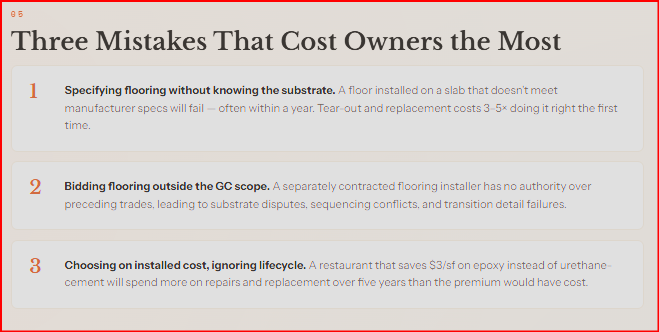
After managing commercial construction projects across the country, these are the three most expensive flooring mistakes we see owners make.
The first is specifying flooring without understanding the substrate. An architect or designer who selects a flooring material without knowing the concrete slab's moisture vapor emission rate, flatness tolerance, and curing schedule is setting up a failure. Flooring manufacturers' warranties require specific substrate conditions, and a floor installed on a slab that doesn't meet those conditions will fail — often within the first year. The cost to tear out and replace a failed floor is 3 to 5 times the cost of doing it right the first time. TCG's preconstruction process includes slab specification review as part of the flooring scope to prevent this.
The second is treating flooring as a standalone procurement rather than an integrated construction scope. Owners who separately bid and contract their flooring — outside the GC's scope — lose the coordination benefits that prevent the most common flooring installation problems: sequencing conflicts with other trades, substrate conditions not meeting flooring manufacturer requirements, and transition details between different flooring zones not being properly detailed. Bringing flooring into the general contractor's scope ensures it is managed as part of the overall project — not as an afterthought.
The third is ignoring the long-term cost of the wrong flooring system. A restaurant operator who installs standard epoxy in a commercial kitchen because it was $3 per square foot cheaper than urethane-cement will spend more on repairs and replacement over five years than the premium would have cost. A warehouse operator who skips slab densification to save $1 per square foot will spend more on dust control, joint repair, and surface maintenance over the building's life. The owner's representative function TCG provides during preconstruction helps owners evaluate these tradeoffs with data rather than guesswork.
Getting Flooring Right on Your Next Commercial Project

The commercial flooring decision should be made during preconstruction — not at the end of the design process when the budget is already committed. The right flooring system is determined by the building's use, the substrate conditions, the operational requirements, the lifecycle budget, and the integration with the building envelope. All of these factors are known (or knowable) during preconstruction, and getting the flooring specification right early prevents the cost overruns, schedule disruptions, and performance failures that result from late-stage flooring decisions.
Terrapin Construction Group provides commercial flooring installation, preconstruction services, commercial general contracting, construction management, and design-build delivery for commercial projects nationwide. Our engineering partners at 9BA MEP provide mechanical, electrical, and plumbing engineering, and our design consulting partners at 3rd Act Architecture support projects requiring architectural documentation. If you're planning a commercial project and want a frank conversation about what the right flooring system will cost, we'd welcome a call.
Schedule a conversation → calendly.com/will-terrapincg/30min
Frequently Asked Questions: Commercial Flooring Costs
How much does commercial flooring cost per square foot in 2026?
Commercial flooring costs between $2 and $50+ per square foot installed in 2026, depending on the flooring system, building type, and substrate condition. Sealed concrete for warehouse applications runs $2 to $6 per square foot. Polished concrete runs $4 to $16 per square foot. Epoxy coatings run $3 to $12 per square foot for standard commercial applications. Luxury vinyl tile runs $5 to $12 per square foot. Commercial carpet tile runs $3.50 to $7.50 per square foot. Ceramic and porcelain tile runs $7 to $25 per square foot. Specialty systems for food processing, cold storage, and data centers run $12 to $50+ per square foot. These ranges include materials and labor at national average rates. Terrapin Construction Group's flooring division provides project-specific estimates based on the actual substrate conditions, building type, and regional labor market.
What is the best flooring for a commercial warehouse?
The best flooring for a commercial warehouse is a densified and sealed concrete slab. For standard dry warehouse and distribution center applications, a concrete slab finished with a lithium silicate densifier and penetrating sealer provides a hard, dust-free, low-maintenance surface at $2 to $6 per square foot for the finish treatment. For higher-performance applications — automated fulfillment, e-commerce distribution, or facilities where light reflectivity and aesthetics matter — polished concrete at $4 to $8 per square foot delivers improved durability, easier cleaning, and energy savings through light reflection that can reduce lighting costs by up to 30%. Epoxy coatings are sometimes specified in warehouse applications requiring chemical resistance or demarcation markings but add cost and require periodic resurfacing.
How much does polished concrete cost for a commercial building?
Polished concrete costs $4 to $16 per square foot installed for commercial buildings in 2026. The price varies primarily by polish level, surface condition, and decorative treatment. A basic 200 to 400-grit matte polish for an industrial or warehouse floor runs $4 to $8 per square foot. A 800-grit semi-gloss polish for a retail or commercial space runs $8 to $12 per square foot. A 1,500+ grit high-gloss polish with decorative staining or scoring for a corporate lobby or showroom runs $10 to $16 per square foot. Each additional grinding pass adds approximately $0.35 to $0.75 per square foot. Surface preparation on slabs with cracks, coatings, or unevenness can add $1 to $3 per square foot. Polished concrete can last 20 years or more with minimal maintenance and contributes to LEED certification.
What flooring is required for a commercial kitchen?
Commercial kitchen flooring must meet health department requirements for cleanability, resist grease and chemical exposure, provide slip resistance for staff safety, and withstand thermal shock from hot equipment and cleaning procedures. Quarry tile ($8 to $15 per square foot installed) is the traditional commercial kitchen floor — it is slip-resistant, grease-resistant, and extremely durable. Urethane-cement (cementitious urethane) flooring at $12 to $25 per square foot is the premium choice for commercial kitchens and food processing facilities because it provides seamless, monolithic coverage with superior chemical resistance, thermal shock tolerance, and antimicrobial properties. Standard epoxy is not recommended for commercial kitchens because it softens under heat and can delaminate under thermal cycling. QSR restaurant construction and full-service restaurant builds require careful coordination between the flooring system, floor drains, and kitchen equipment rough-in.
How much does epoxy flooring cost for a commercial space?
Epoxy flooring costs $3 to $12 per square foot installed for standard commercial applications in 2026, with industrial-grade systems reaching $8 to $25 per square foot. Basic solid-color epoxy for light commercial or garage applications runs $3 to $7 per square foot. Decorative flake or quartz broadcast systems for showrooms, retail, or lobbies run $6 to $12 per square foot. Chemical-resistant and anti-static industrial systems for manufacturing, pharmaceutical, and laboratory applications run $10 to $25 per square foot. Epoxy floors typically last 5 to 10 years in commercial settings before requiring resurfacing, which is an important lifecycle cost consideration. Polyurea and polyaspartic coatings at $6 to $15 per square foot offer faster cure times and UV resistance as alternatives to traditional epoxy.
What is the best flooring for a medical office or healthcare facility?
The best flooring for most medical offices, optometry offices, and urgent care facilities is commercial-grade luxury vinyl tile (LVT) with welded seams. LVT provides a seamless, waterproof, chemically resistant surface that meets healthcare infection control standards while delivering a warm, professional aesthetic. Installed cost runs $6 to $12 per square foot for healthcare-grade products with antimicrobial treatments and appropriate wear layers. Sheet vinyl at $4 to $8 per square foot is specified in exam rooms and procedure areas where fully seamless, cove-based installation is required. Rubber flooring at $7 to $14 per square foot is used in high-traffic emergency department corridors for impact absorption. Hospital and acute care facilities require specialty flooring at $15 to $40+ per square foot in operating rooms and critical care areas.
How much does cold storage flooring cost?
Cold storage flooring systems cost $15 to $35 per square foot installed in 2026. This is a complete system cost — not just a surface treatment. A cold storage floor system typically includes a structural slab, under-slab heating (glycol tubes or electric resistance), a vapor barrier, rigid insulation layers, a reinforced wear slab, and a topcoat (typically urethane or epoxy). The under-slab heating system alone runs $3 to $8 per square foot and is essential in freezer applications to prevent frost heave — ice formation beneath the slab that can crack and lift the entire floor structure. TCG's flooring division coordinates cold storage floor system installation with the overall cold storage construction scope, including insulated metal panel enclosure, to ensure thermal continuity between floor and walls.
What flooring do data centers use?
Data centers primarily use raised access flooring — modular panels on adjustable pedestals that create a below-floor plenum for cable management and air distribution. Raised access floor systems run $12 to $30 per square foot installed, depending on panel type, load rating, and height. Steel panels with HPL (high-pressure laminate) or bare finish are standard for server rooms. Concrete-filled panels are specified for higher load ratings. Data center flooring must provide electrostatic discharge (ESD) protection; ESD-compliant vinyl or epoxy coatings for slab-on-grade data center designs run $8 to $18 per square foot. The flooring system must be coordinated with the cooling strategy — under-floor air distribution requires specific panel perforation patterns and plenum heights — and is managed as part of the overall construction management scope.
How does flooring affect the total cost of a commercial construction project?
Flooring typically represents 3 to 8% of total commercial construction hard costs, depending on building type and finish level. In a standard warehouse, flooring (slab treatment only) might represent 2 to 4% of total cost. In a high-end restaurant or healthcare facility, flooring can represent 6 to 10% of total hard costs. The most important way flooring affects project cost is through sequencing — flooring is the last major interior trade, and delays in preceding trades (MEP, drywall, painting) directly compress the flooring installation window. Construction management that actively protects the flooring installation window in the project schedule prevents the overtime, premium labor, and phased installation costs that result from schedule compression.
Should I include flooring in my general contractor's scope or bid it separately?
Including flooring in the general contractor's scope is strongly recommended for commercial construction projects. When flooring is managed within the GC's overall project scope, the GC controls sequencing and schedule coordination with preceding trades, manages substrate preparation and quality verification, coordinates transition details between different flooring zones, and ensures the flooring specification is compatible with the building's structural and MEP systems. Separately bid flooring introduces coordination gaps — the flooring contractor has no contractual authority over the trades that precede them, and substrate condition disputes between the GC and the flooring contractor are one of the most common sources of project delays and claims. Terrapin Construction Group includes flooring as an integrated scope in all design-build and construction management projects.
Related Reading
Pre-Engineered Metal Building Cost Per Square Foot in the USA
Average Cost to Build a Grocery-Anchored Strip Mall in the USA
Commercial Construction Challenges 2026: Tariffs, Labor, and Materials
Sources
Principia Consulting — Commercial Flooring Demand Drivers Through 2026
Fortune Business Insights — Flooring Market Size and Share, 2026–2034
Custom Market Insights — U.S. Commercial Flooring Market, 2033
Cleveland Concrete Coatings — Commercial Epoxy Flooring Cost, 2026
Epoxy Resin Factory — Epoxy Flooring Cost Budgeting Guide, 2026
Rose Restoration — Concrete Polishing Cost Per Square Foot, 2026
Builders Group Construction — 2026 Commercial Flooring Trends
