

Commercial Construction Costs in Dallas-Fort Worth, TX (2026)
Commercial Construction Costs in Dallas-Fort Worth, TX — 2026
DFW is the #1 industrial absorption market in the USA. Here's what's moving 2026 Metroplex bids — logistics demand, Texplat labor, PEMB popularity, and submarket-level pricing.
$175 to $605 per square foot. That's the full 2026 DFW commercial construction range, and the gap between those two numbers is not noise — it's the Metroplex doing what Metroplex does best, absorbing more industrial square footage than any other market in the country while simultaneously building corporate campuses, data centers, and specialty manufacturing at a pace no other city can match. You can't price a Dallas job off last year's comps. Land basis moved. Labor moved. The data center pipeline moved. And PEMB pricing — still the secret weapon of Texas industrial — moved with steel.
The Honest DFW Number in 2026
Dallas-Fort Worth commercial runs $175 to $605 per square foot in 2026. Tilt-up distribution sits at the low end, riding a corridor that's averaged over 30M SF of industrial absorption annually since 2021 (CBRE US Industrial Logistics Figures). Cold storage with IMP envelope lands $275–$495. Class A office comes in at $280–$450. Data center shell-and-core and semiconductor-adjacent industrial run $380–$605, depending on density, redundancy, and MEP spec. For a deeper benchmark across asset classes, see our commercial construction costs hub.
Construction employment across the Dallas-Fort Worth-Arlington MSA was up 3.4% year over year per BLS (Feb 2026). Open-shop structural iron, concrete, and electrical trades are running hot — loaded wages up 6–9% on the year. That's not Houston-level labor drain (see our Houston GC hub for coastal-market comparison), but it's not the DFW of 2019 either. The five forces reshaping commercial construction in 2026 are all live in this market, compounding labor, materials, and permitting pressure.
DFW commercial construction 2026: $175–$225 tilt-up shells · $275–$495 cold storage / IMP envelope · $280–$450 Class A office · $380–$605 data center shell & core and specialty industrial.
DFW Cost by Asset Class — 2026
Distribution shells 150k–1.2M SF. Concrete tilt walls, TPO cool roof, 36'–40' clear, cross-dock product for Amazon, FedEx, Walmart, and 3PL tenants across the Metroplex.
30k–100k SF pre-engineered shells. Open-shop erection advantage. IMP wall upgrades add 8–12% over bare shell. Fastest-moving product type in the market.
IMP envelope, USDA finishes, refrigeration packages. Deep sub bench on blast freeze and medium-temp applications.
Uptown, Legacy West, Las Colinas, Preston Center, Fort Worth CBD. Medical office along the Baylor / Presbyterian / Medical City corridors.
Plano, Richardson, Garland, Sherman-Denison. Hyperscale and colocation. Electrical and mechanical trade competition is intense.
DFW Metroplex Sub-Market Pricing
The Metroplex is twelve counties and more than 9,000 square miles. Pricing varies 12–18% across sub-markets depending on land basis, freight access, permit jurisdiction, and proximity to active industrial or data center campaigns. For a closer look at specific services available in the region, see our IMP installation page (our methodology applies equally to Texas work) and the broader commercial general contractor service page.
City of Dallas (Dallas County)
CBD, South Dallas, West Dallas, Mesquite. Longest permit windows in the metro. Deep trade bench but highest land basis.
Alliance / North Fort Worth
BNSF intermodal, FedEx ground, Alliance Airport. Aerospace and large-scale distribution anchor. Tight labor and steady absorption.
I-35W Corridor / Denton County
Emerging distribution and cold storage. Faster permits than Dallas proper. Strong PEMB market.
Plano / Frisco / Legacy West
Corporate HQ, data center, upscale retail, MOB. Finish level and glazing spec drive the upper bound.
Arlington / Mid-Cities
Entertainment district (AT&T Stadium, Globe Life, Six Flags). Mixed-use and hospitality density. Stable sub capacity.
South Dallas / Ellis County
Waxahachie, Midlothian, Lancaster, Hutchins. Large-scale tilt-up bulk product chasing lower land basis. Fast-moving market.
Need a DFW Number Before the Next Bid Deadline?
Send us your scope. We'll come back with a Good / Better / Best preliminary budget that reads open-shop labor, submarket land basis, and 2026 data center / semiconductor pull the way DFW owners actually need them read.
Get a Preliminary BudgetExplore TCG Service Lines
Run your scope through TCG's instant AI cost estimator → Good / Better / Best pricing in minutes, calibrated to Alliance, I-35W, South Dallas, and Legacy West realities.
Six Forces Moving DFW Pricing in 2026
1. Industrial Absorption and Land Basis Pressure
DFW has led the country in industrial absorption for four consecutive years. Vacancy has bottomed in several submarkets and land basis in prime logistics areas is up sharply. JLL Research and CBRE both track sub-5% industrial vacancy in Alliance, South Dallas, and I-35W through 2025 and into 2026. Colliers North Texas industrial reports confirm the trend. Land price compression forces owners to either build higher clear-height product or chase Ellis and Kaufman counties for basis.
2. Open-Shop Labor Advantage (vs Chicago, NY, LA)
Texas is a right-to-work state per Texas Workforce Commission. DFW commercial construction runs substantially open-shop. That translates to a 20–30% loaded-labor advantage against Chicago, and a 25–35% advantage against New York metro. It's a structural edge for Texas industrial pricing — but one that's being partially eroded in 2026 by trade shortages, not unionization.
3. Data Center Campaign Labor Pull
Hyperscale and colocation data center campaigns in Plano, Frisco, Garland, and the Sherman-Denison corridor pay premium electrical, switchgear, and mechanical wages. ENR Texas has tracked multi-billion-dollar announcements across the Metroplex, and Data Center Frontier has been tracking the DFW hyperscale pipeline in detail. Commercial projects within a 40-mile radius of active data center campaigns pay up on electrical, controls, and specialty piping trades. Our data center cost guide breaks out the trade-level impact.
4. Semiconductor and Sherman Corridor
The Texas Instruments and GlobalFoundries semiconductor expansion in the Sherman-Denison corridor and the broader North Texas semiconductor industrial base is reshaping the upper-end industrial market. Cleanroom-adjacent work, ultra-pure water trades, and specialty mechanical contractors who work semi are out of capacity through 2027 on many scopes. If your project shares trades with a Sherman megaproject, price accordingly.
5. Severe Weather and Hail Risk Pricing
North Texas sits in the most active hail corridor in the United States per NOAA Storm Prediction Center. Builder's risk premiums and roofing contractor schedules are shaped around April–July hail exposure. Roof replacement and new install work routinely absorbs 2–4 weeks of weather delay in spring. Owners pricing off a Phoenix or Atlanta comp miss the roof-specific severe-weather line. See cool roof ratings for how Texas roof specs drive premium.
6. Permit Runway Across 30+ Municipalities
DFW has more than thirty commercial-grade building departments across Dallas, Tarrant, Collin, Denton, Ellis, and Rockwall counties. Permit speed varies dramatically. The City of Dallas and City of Fort Worth run the longest cycles. Plano, Frisco, Irving, Arlington, and Allen routinely issue in under 8 weeks. On a schedule-sensitive project, submarket selection is part of the cost calculus. Our state-by-state permitting timeline guide covers the full Texas picture.
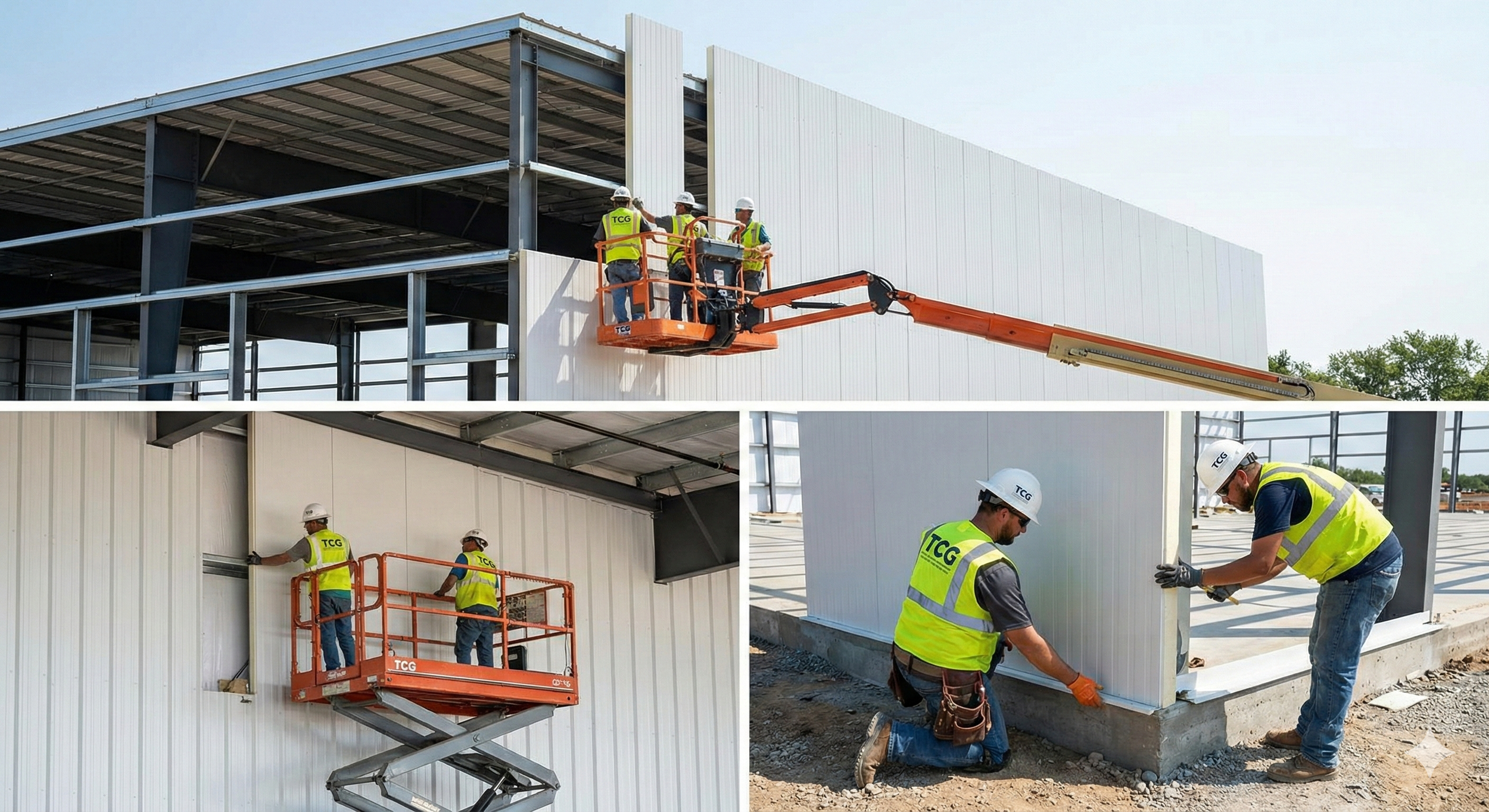
Field Note — Alliance PEMB Erection, 2024
A 72,000 SF PEMB industrial shell in the Alliance corridor, built for a regional logistics tenant. The owner's initial schedule assumed a 7-month erection-to-CO window based on historical DFW PEMB pace. The project manager walked through steel mill lead times (see our 2026 material lead times), IMP panel availability, and MEP coordination against the data center labor pull in Plano. Team landed on a 6.5-month window by locking PEMB erection crews six months out and pre-purchasing IMP panels through our equipment procurement channel with a Midwest manufacturer shipping through the Ft. Worth intermodal. Erection came in on schedule. The real advantage was lead-time discipline, not per-SF price — the project saved an estimated $380,000 in holding cost by hitting CO a month early.
Field Note — South Dallas Tilt-Up, Concrete Labor, 2025
A 480,000 SF tilt-up spec distribution shell near Lancaster. Concrete crew capacity in southern Dallas County tightened sharply in mid-2025 as two data center foundation projects absorbed subs. The GC team sequenced the slab pour across three weekends to secure a second crew at a modest premium, then used the primary crew on tilt panels during weekdays. Schedule slipped 11 days versus plan but came in 3 weeks ahead of what a single-crew sequence would have produced. Net labor cost premium: roughly $64,000 on an $11M shell. The schedule savings paid for the premium several times over. This is the kind of sequencing logic our sequencing guide covers in detail.
DFW vs. Other Major Texas and Sunbelt Metros — 2026
| Market | Tilt-Up Warehouse | Cold Storage | Class A Office | Labor Pressure |
|---|---|---|---|---|
| Dallas-Fort Worth, TX | $175–$225 | $275–$495 | $280–$450 | High |
| Houston, TX | $170–$215 | $260–$510 | $270–$440 | High |
| Austin, TX | $195–$245 | $290–$530 | $305–$475 | Very High |
| San Antonio, TX | $160–$205 | $245–$465 | $255–$410 | Moderate |
| Phoenix, AZ | $195–$245 | $280–$515 | $290–$460 | Very High |
| Atlanta, GA | $180–$220 | $280–$515 | $285–$460 | High |
| Denver, CO | $195–$240 | $290–$525 | $300–$465 | High |
"Dallas rewards owners who treat PEMB as a first option instead of a fallback. On industrial under 100,000 SF, PEMB with an IMP envelope beats tilt-up on total cost and schedule more often than not — and DFW has the deepest PEMB erector bench in the country. The real trap in 2026 is pricing a Dallas job from a national average and ignoring how much the data center and semiconductor pull has tightened electrical, mechanical, and controls trades. The labor advantage versus Chicago and New York is still real — but the gap has narrowed."
What Owners Get Wrong About DFW Bids
The first mistake is treating DFW as a single market. Dallas County, Tarrant County, Denton County, and Collin County price meaningfully differently. A number that works in South Dallas doesn't work in Legacy West. A number that works for Alliance doesn't work for Plano. Our guide on how to read a commercial GC bid walks through exactly how sub-market pricing should show up on a line-item takeoff.
The second mistake is under-budgeting data center and semiconductor labor pull. If your project sits inside 40 miles of an active hyperscale or fab campaign, your electrical and mechanical bids will carry an implicit premium you can't negotiate away. For context on how much these technology megaprojects are reshaping trade capacity, see the coverage in Construction Dive and Building Design+Construction.
The third mistake is ignoring hail. North Texas builder's risk premiums and roof installation windows are shaped by hail exposure. Owners who budget from Atlanta comps miss the spring severe-weather hit. Our commercial roofing cost guide breaks out the hail-zone premium by region.
The fourth mistake is comparing apples to oranges in the bid review. DFW has a large open-shop sub base and a wide variance in overhead allocation across GCs. A 6% price gap on paper often tells you nothing until you pull the structural takeoff and the concrete footing quantities apart.
When Design-Build Wins in Dallas
DFW's open-shop environment, speed-to-market pressure, and PEMB-friendly industrial demand make design-build especially valuable. Coordination gaps between a separate architect, structural engineer, and GC cost weeks in a market that measures competitive advantage in occupancy dates. Our design-build primer and design-build trends article both unpack how single-contract delivery protects schedule in hot Texas markets.
For projects under $3M, hard-bid design-bid-build can still win. For PEMB and tilt-up under $15M, design-build almost always wins on schedule and total cost. For data center shell-and-core and specialty industrial, design-build with early trade partner engagement is often the only delivery method that works — because the MEP trades set the critical path, not the shell. See our breakdown of Cost-Plus vs GMP delivery methods for how contract structure interacts with DFW's labor market.
For early-stage owners, the most valuable move is getting a GC to the table during schematic design. Our early GC engagement article covers the pre-con value specifically, and our preconstruction services page details the scope.
Building in Dallas-Fort Worth in 2026?
TCG has active IMP work and preconstruction capacity across Texas — including PEMB, tilt-up, cold storage, and data center scopes. Send us your program. We'll come back with a real DFW number and a real DFW calendar.
Book a 30-Minute CallFAQ — DFW Commercial Construction 2026
What does commercial construction cost in Dallas-Fort Worth in 2026?
DFW commercial construction runs $175–$605 per SF in 2026. Tilt-up distribution lands $175–$225. Cold storage with IMP envelope runs $275–$495. Class A office $280–$450. Data center shell-and-core and semiconductor-adjacent industrial trend $380–$605 depending on classification. See our commercial construction costs hub for a full asset-class benchmark.
Why is DFW commercial pricing up in 2026?
DFW is the #1 industrial absorption market in the country. Amazon, FedEx, Dr. Pepper, and Walmart logistics networks anchor the corridor. Data center demand in Plano, Frisco, and Garland plus semiconductor-adjacent industrial in Sherman/Denton is pulling trade labor. Loaded wages on electrical, concrete, and structural steel are up 6–9% year over year.
How does Dallas cost compare to Houston?
Dallas-Fort Worth and Houston price within 2–5% on generic commercial. DFW is generally slightly higher on tilt-up warehouse (stronger demand) and slightly lower on industrial-specialty work (no petrochemical campaign competition). DFW has no hurricane wind premium; Houston pays 6–11% more on envelope for coastal wind code.
Why is PEMB so popular in Dallas-Fort Worth?
Dallas is open-shop, no hurricane code, no snow load to speak of, and has strong access to rolling mill freight out of the Texas triangle. PEMB is 20–35% faster to erect than tilt-up on sub-100k SF industrial and frequently lands 5–12% cheaper on total cost for distribution, light manufacturing, and self-storage. The Metroplex has more qualified PEMB erectors than any single U.S. market.
How long do DFW commercial permits take?
City of Dallas Building Inspection runs 8–14 weeks on commercial permits over 10,000 SF. Fort Worth is typically 6–10 weeks. Suburban municipalities — Plano, Frisco, Irving, Allen, Mansfield, Arlington, Grapevine — usually issue in 4–8 weeks. Denton County unincorporated and Johnson County run faster still. See the state permitting timeline guide.
What are the hottest DFW submarkets for industrial in 2026?
Alliance / North Fort Worth for large-scale distribution and aerospace. I-35W corridor (Denton County) for logistics and cold storage. Mesquite / South Dallas for last-mile fulfillment. Garland / Richardson for data center. Waxahachie / Ellis County for large tilt-up bulk product chasing lower land basis. Our 3PL cost guide covers the specific dynamics of last-mile and fulfillment product.
Does Texas have union labor rules on commercial construction?
Texas is a right-to-work state with predominantly open-shop commercial construction. Union trades exist (IBEW, Pipefitters, Iron Workers) but don't dominate the way they do in Cook County or New York metro. Dallas commercial bids don't carry Chicago-style union loading, which is a structural 20–30% labor cost advantage.
What's a typical GC contingency in DFW commercial projects?
Design-build negotiated: 3–5%. Hard-bid commercial: 6–8%. Severe-weather exposure (hail, tornadic activity, severe thunderstorms) should carry an additional 1–2% insurance/contingency line, particularly on roofing-sensitive schedules between April and July. Our guide on managing construction risks covers how contingency should be sized by project type.
How long does a 500,000 SF DFW warehouse take to build?
13–16 months from Notice to Proceed in 2026, assuming a tilt-up shell in the Alliance or South Dallas corridor with typical 32'–40' clear heights. Mild Texas winters rarely extend foundation schedules. Severe hail events in spring can delay roof dry-in by 2–4 weeks if they strike mid-install.
Does Terrapin Construction Group work in Dallas-Fort Worth?
Yes. TCG has installed insulated metal panels on cold storage, food processing, and industrial builds across the Metroplex. IMP installation is self-performed through TCG field crews. Other trades run through a vetted subcontractor network. TCG is licensed in all 50 states. Contact us here or book a 30-minute call.
Related Reading
Sources & Further Reading
- U.S. Bureau of Labor Statistics — Dallas-Fort Worth-Arlington MSA
- AGC — Construction Inflation Alert, Q1 2026
- RSMeans City Cost Index — Dallas, TX
- CBRE — US Industrial & Logistics Figures
- JLL Research — DFW Industrial Absorption
- Colliers — North Texas Industrial Market
- Cushman & Wakefield — DFW Reports
- City of Dallas Building Inspection
- City of Fort Worth Development Services
- City of Plano Building Inspections
- ENR — Texas Regional Reporting
- Construction Dive
- Building Design+Construction
- Data Center Frontier — DFW Hyperscale Pipeline
- NOAA
- NOAA Storm Prediction Center — Hail Climatology
- Texas Workforce Commission
- AllianceTexas — Hillwood Development
- Texas Instruments Newsroom
- GlobalFoundries Newsroom
